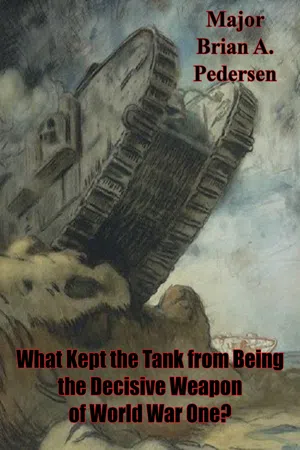
eBook - ePub
What Kept The Tank From Being The Decisive Weapon Of World War One?
- 78 pages
- English
- ePUB (mobile friendly)
- Available on iOS & Android
eBook - ePub
What Kept The Tank From Being The Decisive Weapon Of World War One?
About this book
The modern tank was invented in 1916 as a means to mechanically overcome the stalemate of trench warfare brought on by the increased lethality of fires employed during World War I. Its introduction received mixed reviews among British leaders. Some advocated its continued role supporting infantry and artillery attacks. Others envisioned it as a revolutionary weapon with the potential to effect decisive results at an operational and strategic level. Still others viewed it as a useless and unnecessary drain on already-scarce resources of men and materiel. Ultimately, the tank was an ancillary sideshow and failed to produce a decisive knock-out punch leading to Allied victory in World War I. The purpose of this paper is to examine the reasons why the tank failed to become the decisive weapon of World War I. It specifically focuses on the genesis of logistics, maintenance, training, and production infrastructure, studying the interaction of development, employment, acceptance or lack thereof, and subsequent frictions which negatively influenced the ascent of tanks as the decisive weapon of World War I. By examining the British efforts to design support systems while simultaneously producing, fielding and employing multiple iterations of the tank, this paper seeks to promote a deeper understanding of the potential challenges facing other armed forces that are rapidly upgrading or replacing combat systems in the midst of the Global War on Terror.
CHAPTER 1 — INTRODUCTION
Enter the Landship
The Great War introduced the world to the horrors of modern conflict on a scale then unimaginable. Trench warfare added a new dimension as it robbed all the pugilists of decisive offensive maneuver, forcing armies to dig expansive complexes, turning virtually every mile of defended line into strongholds. Great Britain, embroiled in the quagmire on the Western Front for nearly two years and unable to generate successes on other fronts, made the first substantive contribution to the Allies in breaking the stalemate. Having tried and failed to overcome the problem with new techniques, changing tactics and massed manpower, the British turned to technology as a solution. As early as December 1914, British ministers, soldiers, and scientists began the critical process of combining available technologies in a novel. In 1915, the British unveiled the results of their labors: a revolutionary new device bearing the innocuous moniker “tank” to confuse would-be spies.{1}
The name persevered and still commonly evokes a vision of clanking steel and thundering cannon. The tank’s initial capabilities comprised the mechanical means to defeat the static and impregnable trench defenses on the Western Front: a mobile and armored firepower platform able to defeat German machine gun nests, allowing allied forces to penetrate and engage in offensive maneuver warfare.{2}
After a rapid prototype development and testing program, the first tanks made their appearance in 1916 on the French fields of Flers. Over the next two years, tanks would see action up and down the Western Front, never providing the decisive blow for victory, but nearly always showing a glimmer of what might be possible. Eventually, the capabilities exhibited by the tank would usher in a new era of ground combat, with machine versus machine in an unmerciful clash on the battlefield, each posturing for the upper hand. However, in 1916, another clash was already underway, between conflicting ideologies of how tanks would be deployed on the battlefield, and how they fit in with the large infantry-based armies of the early 20th century. This clash became epic as well, lasting for over twenty years until the Germans resolved it, leaving little room for doubt with their lightning tank offensives at the outset of World War II.
First introduced at the Battle of Flers-Courcellette on 15 September, 1916, the tank made an inauspicious start as reliability and mobility issues plagued early tank models. Of the forty-nine tanks originally slated for the attack, seventeen suffered mechanical failure enroute to the front lines and another fifteen broke down or were abandoned before departing the launching point. The tanks that did enter the fight made a somewhat successful, although localized impact on the battle, striking fear in the enemy and allowing the Allies to advance over 2 kilometers, an impressive gain at the time.{3}
The Battle of Flers-Courcellette exposed a number of other drawbacks beyond reliability and mobility. These include survivability, visibility, speed, and ease of operation. Later tank versions produced before the end of World War I would address these technical issues.
The next major use of the tank came at the Third Battle of Ypres (Passchendaele), beginning on 31 July 1917. After unseasonably rainy weather and ten days of preparatory artillery bombardment (which subsequently destroyed area drainage control), the terrain became impossible for the tanks to cross, marginalizing their usefulness in the battle. Troubles with maintenance and mobility persisted. While the sheer number of tanks at the battle reflected an overt commitment to the development and continued use of the tank, covertly a lack of faith in its usefulness plagued many elements of the allied leadership. The results at Passchendaele merely confirmed what many already believed to be true: The tank was a secondary weapon at best, until further technological advances might enhance performance and relevance. The Germans quickly identified the tank’s shock value, but also recognized the substantial weaknesses they could readily exploit. Heavy rifles, massed indirect- and direct-fire artillery, and tank ditches all proved capable of disabling or destroying the tank. Additionally, the lack of wireless capability or external field telephone inhibited flexibility, initiative and often the most basic command, control, and coordination. Because of these perceived weaknesses, the Germans grew to despise the tank, failing to realize its worth until very late in the war, when their own mechanized development program had fallen too far behind to make an impact.
Action at Cambrai in November 1917, marked the first time where tanks were massed as a pure fighting element, not subjugated to the role of providing support to enable infantry maneuver. Later successes in battles at Le Hamel and Amiens prompted a more vigorous review of the expanded possibilities of tank and armored warfare. Foreword-thinking officers began to envision how tanks, armor, and mechanization en masse might manifest themselves in future wars. Yet, that “future” had many different meanings to each of the officers, depending upon their predispositions, country, their military education, and upbringing. Some saw it merely as a tool to break the stalemate so the infantry-centric armies could get back to the business of maneuver warfare. Others saw it as a way to operationally extend the battle space vertically, creating chaos and confusion in depth while disrupting synchronization. Still others saw it as a way to larger and decisive strategic engagements, striking deep at the heart of their enemies for a rapid and glorious victory. In those formative early years of the tank, many opportunities arose for innovation, free thinking, and adaptation. France, Great Britain, and the United States all took a turn at making the leap into modern warfare. Adaptation and improvisation occurred during the latter years of the war but their impact on the war’s outcome is highly questionable at best.
The introduction of the tank at this seminal moment was supposed to have led to a decisive victory on the battlefield, thus shortening the war. Yet it did not. In retrospect, and under the right conditions, this revolutionary weapon should have provided an insurmountable technological overmatch against the Germans. What kept the tank from being the decisive weapon of World War I?
Many factors contribute to the successful development, fielding, and employment of a new weapon. Systems or programs to provide the infrastructure, equipment, manpower, training, maintenance, and logistical needs for organizations are prerequisites for such success. Much the same in 1915 as in 2007, armies and their civilian enablers must have a common vision in order to implement change. For various military and civilian enablers, the list of potential obstacles was long: the tank was complex, expensive and revolutionary, in a time of relative simplicity, war-induced economic crisis and cultural narrow-mindedness. Where did its production fit into the overall war plan? What would be the resulting friction points regarding resources and priorities? What forethought did developers give to creating a maintenance program capable of sustaining tank use? How did they derive the factors for materials, mechanics, and repair facilities? How would the tank be integrated into the order of battle to ensure its mobility and survivability? Would it be equally accepted across the commands? What would be the methodology for commanding and controlling tanks—both within their own formations and as part of the total battle? How did training evolve to suit the unique needs of the tank corps? Who would take the lead? What would be the personnel and manning challenges, and how would they be overcome in the face of personnel demands across all the fronts? How much thought and constructive energy was placed in developing a logistics program for the tank? How would it be deconflicted with other force logistic requirements? What would tank doctrine and tactics look like on the battlefield? Would the Royal Navy, the proponent and bill payer for most of the tank program, have a significant part to play in determining the tank’s battlefield role? Finally, had planners prepared for rapid adaptation and escalation of tank production based on what would undoubtedly be learned from each successive battle?
The main purpose of this study is to provide a better understanding of how the prerequisites—training, maintenance, and logistics—were addressed by the enablers and if their development or lack thereof subsequently prevented the tank from being the decisive weapon of World War I. The study moves chronologically with each chapter exploring the tank’s evolution over a finite period. Chapter 2 covers the inception of the tank from notion to testing, production, initial doctrinal concepts, and concludes with its opening performance at the Battle of Flers.
Chapter 3 picks up immediately following the British Army’s first swing at mobile warfare. It covers the first major design revisions based on actual battle performance. Feedback from the army is reviewed to determine what if any changes were implemented to facilitate logistical support. Doctrine and tactics are tracked for significant changes in employment as well as changes in leader attitudes. The Battle of Cambrai provides a good point of summary for allied accomplishments, as innovators continue to work at making the tank decisive for overall victory.
Chapter 4 tracks progress of the tanks in light of significant German offensives in spring 1918. It reviews the lessons learned from Cambrai and how they affected all further tank developments through the end of the war.
Chapter 5 sums key points as well as providing retrospective overview and analysis of J. F. C. Fuller’s concept for a massive tank raid into Germany, Plan 1919, in relation to the condition of the prerequisites (maintenance, logistics, and training) at war’s end. Was his lightning strike into Germany feasible? Would it have presaged the successive knock-out punches that Adolf Hitler’s Panzer Divisions executed in 1939 and 1940?
Review of Major Literature
Development and use of the tank in World War I is a much debated subject in scholarly literature, specifically among those who closely study the British Army of the period. Most often debated among historians is whether individual personalities, civilian attitudes, military cultures, political realities, elitism, or some combination is the key factor determining the development and application of new technologies, doctrine, and tactics during World War I. Bookshelves are filled with analyses of the how’s, why’s and when’s of these factors, each author proclaiming their specific codification of factors most strongly influencing the military technology advances of World War I, their employment and subsequent adaptations. In The Killing Ground (1987), Tim Travers sums up the various schools of thought aptly.{4} Those who view critically the performance of allied military leadership during the War favor the internal factors of incompetence, arrogance, inflexibility, or cowardice within the senior officer ranks. The perception of cowardice is still widely circulated even in the face of evidence showing the high casualty figures for senior allied officers during the war. Military historians such as B. H. Liddell Hart ascribe to the school of flawed personalities and attitudes. Within Reputations: Ten Years Later (1928), Hart describes General Sir Douglas Haig, Commander of British Expeditionary Forces for most of the war, as being far from genius, lacking vision, unreceptive to ideas (novel or otherwise) and obstinate.{5} Historian J. P. Harris states in Men, Ideas and Tanks: British Military Thought and Armoured Forces, 1903-1939 (1995), military culture is the root cause of opposition to the tank.{6} He cites numerous high-ranking officers within General Headquarters of the British Expeditionary Forces who actively opposed through words and actions the development and expansion of mechanical warfare, either as a threat to the traditional branches’ (Infantry, Artillery and Cavalry) resources, role, or prestige.
The second school of thought, emerging primarily through the British military’s official collection of war history serves to absolve allied leaders for the carnage, citing external factors as the culprit. Inexperience among staff officers, the failure of new technology to provide its promised results, German fighting acumen and political interference are the leading reasons listed in this school of thought. British Chief official historian Brigadier General Sir James Edmonds was the key advocate of this school, and has gathered a large contemporary following. In agreement is historian David J. Childs, A Peripheral Weapon (1999).{7} He makes a compelling argument for widespread military and political support for the tank program, with the weak link being the technology itself. Most other historians fall somewhere in the middle of the two schools. Travers ascribes to a combination of personalities, social conservatism, and political culture. Robert H. Larson, The British Army and the Theory of Armored Warfare, 1918-1940 (1984) points to outdated views on strategy crippling British tank development, and alludes to causes somewhere between the two schools.{8} The truth as I see it lies as always somewhere between the seams of each major school of thought. Attitudes and culture had major effects on decisions. Poor staff training crippled situational understanding and decision making at the highest levels. Technology, or actually lack thereof with communications and mechanics in the face of advances in firepower and lethality left a dangerous void within command and control.
The introduction of the tank at this crucial moment could have led to a decisive victory on the battlefield, if not for a myriad of variables, controllable or otherwise, standing in the way. In retrospect, and under certain conditions, this revolutionary weapon might have been the modern warfare parallel to the invention of gunpowder. However, in Great Britain of the early 20th century, the vision was not quite as clear as it is today, and the millions of lives lost in the last two years of the Great War are a solemn testament to the failed vision.
CHAPTER 2 — EVOLUTION OF THE TANK THROUGH SEPTEMBER 1916
To truly understand the tank’s failure in bringing about decisive victory, one must know how and why the tank came into existence, as the process directly affected its lack of success. It not only began inauspiciously, but very nearly failed to launch. Only through the concerted efforts of determined visionaries did the tank make it from science fiction to operational fact. These visionaries had to work within the existing cultural and societal constraints of early 20th Century Great Britain with its often rigid Edwardian mind-set. Yet, the visionaries brought with them experiences from other military branches, prior wars, and civilian services which allowed them to see the problem in a slightly different light than those immersed in the daily strife of trench battles. Near-heroic efforts enabled production, but could not overcome the early training, maintenance, and supply issues. Moreover, infighting over control of the tank which, once endemic, was difficult to overcome. Likewise, tank doctrine and tactics suffered from the same infighting, leaving the tank on a dense intellectual battlefield as it rolled across the line of departure for the very first time on 15 September 1916, in Flers-Courcelette.
A working background of tank genesis is necessary in order to fully analyze the suppor...
Table of contents
- Title page
- TABLE OF CONTENTS
- ABSTRACT
- ACKNOWLEDGMENTS
- ACRONYMS
- CHAPTER 1 - INTRODUCTION
- CHAPTER 2 - EVOLUTION OF THE TANK THROUGH SEPTEMBER 1916
- CHAPTER 3 - EMERGENCE OF THE TANK: FLERS TO CAMBRAI
- CHAPTER 4 - YEAR OF DECISION
- CHAPTER 5 - CONCLUSION
- REQUEST FROM THE PUBLISHER
- BIBLIOGRAPHY
Trusted by 375,005 students
Access to over 1.5 million titles for a fair monthly price.
Study more efficiently using our study tools.
Information
Frequently asked questions
Yes, you can cancel anytime from the Subscription tab in your account settings on the Perlego website. Your subscription will stay active until the end of your current billing period. Learn how to cancel your subscription
No, books cannot be downloaded as external files, such as PDFs, for use outside of Perlego. However, you can download books within the Perlego app for offline reading on mobile or tablet. Learn how to download books offline
Perlego offers two plans: Essential and Complete
- Essential is ideal for learners and professionals who enjoy exploring a wide range of subjects. Access the Essential Library with 800,000+ trusted titles and best-sellers across business, personal growth, and the humanities. Includes unlimited reading time and Standard Read Aloud voice.
- Complete: Perfect for advanced learners and researchers needing full, unrestricted access. Unlock 1.5M+ books across hundreds of subjects, including academic and specialized titles. The Complete Plan also includes advanced features like Premium Read Aloud and Research Assistant.
We are an online textbook subscription service, where you can get access to an entire online library for less than the price of a single book per month. With over 1.5 million books across 990+ topics, we’ve got you covered! Learn about our mission
Look out for the read-aloud symbol on your next book to see if you can listen to it. The read-aloud tool reads text aloud for you, highlighting the text as it is being read. You can pause it, speed it up and slow it down. Learn more about Read Aloud
Yes! You can use the Perlego app on both iOS and Android devices to read anytime, anywhere — even offline. Perfect for commutes or when you’re on the go.
Please note we cannot support devices running on iOS 13 and Android 7 or earlier. Learn more about using the app
Please note we cannot support devices running on iOS 13 and Android 7 or earlier. Learn more about using the app
Yes, you can access What Kept The Tank From Being The Decisive Weapon Of World War One? by Major Brian A. Pedersen in PDF and/or ePUB format, as well as other popular books in History & British History. We have over 1.5 million books available in our catalogue for you to explore.