New Mexico Territory attracted outlaws and desperados as its remote locations guaranteed non-detection while providing opportunists the perfect setting in which to seize wealth. Many wicked women on the run from their pasts headed there seeking new starts before and after 1912 statehood. Colorful characters such as Bronco Sue, Sadie Orchard and Lizzie McGrath were noted mavens of mayhem, while many other women were notorious gamblers, bawdy madams or confidence tricksters. Some paid the ultimate price for crimes of passion, while others avoided punishment by slyly using their beguiling allure to influence authorities. Follow the raucous tales of these wild women in a collection that proves crime in early New Mexico wasn't only a boys' game.

- 128 pages
- English
- ePUB (mobile friendly)
- Available on iOS & Android
eBook - ePub
Wicked Women of New Mexico
About this book
Information
PART I:
LADY KILLERS
Chapter 1
Paula Angel: Hanged Twice for Love
Crimes of passion span the history of the world from biblical days to the present. A woman scorned can be dangerous and, in many cases, lethal. Such was the case with Paula Angel.
Also known as Pablita Martin, Polonia Angel or Pablita Sandoval to some, Paula Angel made a mistake that often ends badly regardless of which era a person lives: she fell in love with a married man, and he with her. The initial excitement, fear of discovery and thrill of having the complete attention of someone new was too much to ignore for the young couple. Their deep lust drew both of them into a world of deceit, lies and secrecy.
But as we know, sometimes one of the parties involved in such a relationship has a change of heart or cooling down period and tries to end the tryst. When Juan Miguel Martin, a married man with five children and a prominent businessman from a powerful family, realized the error of his ways and broke it off with Paula, the celebrated beauty of the Las Vegas, New Mexico area calmly accepted the news while giving the appearance of going about her life without much distress.
We are not certain of Paula’s exact age at the time; the accepted range is anywhere between nineteen and twenty-six. (While there are no verifiable written records, she is thought to have been born in 1834.) Either way, she was a young woman in her prime who had given everything to a man who had spurned her to return to his wife. Although a great scandal would have occurred if Juan Miguel had stayed with Paula, this did not concern her. She had been pushed aside by the man she loved, which, in her mind, was a crime.
If Paula had come from the “other side of the tracks” or, in this case, the other side of the Gallinas River, one might have expected the wrath she was to encounter. But she was from a highly respected family who happened to live near Loma Parda, a small farming community located along the Sapello River, about twelve miles north of Las Vegas, and had seen many suitors vying for their daughter’s attention, all of whom were refused.
Some stories indicate that Paula was married with children, a prostitute and/or a witch, but no records survive to substantiate these claims.
The daughter of a man who was skilled in both woodworking and adobe-making and a mother who taught her the trade of being a seamstress for the soldiers’ wives at nearby Fort Union, Paula worked hard for a living. Although many soldiers vied for her attention, she unfortunately lost her heart to a married man.
Exactly who initiated this affair is a mystery, but the issuance of promises no doubt was involved, and they were now broken. It was evident through his past actions that Mr. Martin did not take vows or promises to heart.
Several weeks after the painful breakup, Paula sent a message to her former lover requesting to see him “one last time.” Martin, not sensing anything sinister afoot, agreed to meet her in an alley so that they would not be detected by any nosey passersby.
Paula, of Spanish Conquistador heritage, was a proud beauty, and she took special care in preparing herself for their reunion. Her best dress was complemented by a dainty shawl to protect her from the cool spring evening. It was certain that Paula wanted Juan Miguel to see what he had given up and subsequently regret his foolhardy decision.
One can imagine the meeting between the two, who were unknowingly at such opposite ends of the spectrum about what to expect from the other. Paula, in her youth, surely envisioned Juan Miguel groveling at her feet and begging forgiveness. Juan Miguel, who most likely still loved Paula but was now recommitted to his large family, may have seen the meeting as a way to appease the young woman so that she would not remain angry with him.
It is not written what were the exact words exchanged between the couple, but the results spoke volumes. Be it for protection or premeditation, Paula produced a kitchen knife, which she had hidden in her wrap, when the scenario did not go to her advantage and stabbed her former lover in the back, just below the left shoulder, during the final embrace she had demanded.
Juan Miguel, stabbed in the alley behind the brothels and gambling rooms he had been frequenting, took his last breaths in the Cantina Gallina. Immediately arrested for the crime, Paula was taken into custody and secured in a local family’s home. Her arraignment was held on March 23, 1861.
Paula’s subsequent trial was to be the most attended event in the region. Scandalous court testimony generally rendered courtrooms with standing room only, and this was no exception.
Even in trials involving murder, an all-male jury usually found it difficult to impose a harsh sentence on a woman—mainly due to the scarcity of her sex in the West. In Paula’s case, however, it appeared the opposite happened. Convicted of her crime, Paula was quickly sentenced to be hanged without mercy. Many have questioned the reasons behind this obvious callousness toward the defendant. Maybe the fact that the victim came from a wealthy, influential family sealed Paula’s fate more harshly.
Paula was defended by famed attorney Spruce M. Baird, nicknamed “Colorado” due to his red beard. Baird, a Confederate sympathizer who himself would be brought up on treason charges in 1862, spoke to the jury both in English and Spanish as he passionately pleaded his client’s case. Paula’s plea of innocence fell on deaf ears despite the fact that the foreman of the jury was also from Loma Parda and testified to her good character. The men of the town and court set out to make an example of the perpetrator of this cold-blooded killing of one of their prominent sons.
Juan Miguel’s family sought the support of Colonel J.D. Sena of the New Mexico Volunteers, who was stationed in Santa Fe at the time. Sena had been seen walking around Las Vegas with a smirk on his face and gifting money to gain favors in the community. It was a not so closely kept secret that the Martin family would accept nothing less than the conviction and subsequent death of Paula Angel.
Judge Kirby Benedict, who was said to be one of the more lively characters in New Mexico’s history as a Civil War participant who would later become the chief justice to the state supreme court, passed the unthinkable sentence of death by hanging on the young Paula Angel after she was found guilty. The officers’ wives for whom Paula had sewn dresses were shocked by the severity of the sentence. While they didn’t condone the crime, they thought an easier fate should have been imposed.
Territorial judges were appointed by the U.S. president, and Benedict had been appointed by both Lincoln and Buchanan. Benedict was required to hold court in New Mexico’s original nine counties twice a year but was also known to be a carouser.
When Benedict came to Las Vegas with his entourage of lawyers, they were often seen playing poker and drinking in the Buffalo Hall of the Exchange Hotel. Upon witnessing the group, citizens sounded the alarm and reported them to the grand jury. The names of the attorneys were read in court the following morning, and each lawyer pleaded guilty and paid his fines. When Benedict’s name was read, it is said that the judge stood up and yelled out his statement: “Kirby Benedict enters a plea of guilty. The court assesses his fine at $10.00 and costs, and what is more, Kirby Benedict will pay it!”
After his brush with the local law, Judge Benedict focused on his task at hand: sentencing a young woman to die. As the case was handed to the jury, Benedict wrote out instructions that would summarily lead to Paula’s doom: “The defendant is guilty of first-degree murder, or not guilty of any crime.”
With instructions such as these, the jury of her peers, against their best wishes, was not able to save Paula. Less than thirty minutes later, Paula was found guilty of homicide in the first degree. The judge declared, “Paula Angel is to be hanged by the neck until dead on Friday, April 26, 1861, between the hours of 10 o’clock in the forenoon and 4 o’clock in the afternoon.”
Although Paula was allowed an appeal, Judge Benedict stated that it “should in no manner operate as a stay of execution.” Today, an appeal would result in an automatic stay of execution, but in 1861, Benedict acted under the Kearny Code, which stated that stays of execution were discretionary with the court.
However, Paula’s case was sent to the Territorial Supreme Court for appeal, citing jury tampering, court errors and new evidence. She had been tried under the code of laws given to New Mexico by General Stephen Watts Kearny, who had taken control of the Southwest in 1846. The military now controlled all of the courts in the territory.
Although Baird went to the commanding general, who informed him Paula’s case would be given consideration in proper time, the appeal ended there. The court consisted of three district judges, including Benedict, who was the only one who voted in opposition to the stay.
Unfortunately for Paula, communications were slow since they arrived by horse and rider, and the stay appeal was not heard due to the vastness of the New Mexico Territory. It was well known that the Martin family’s influence carried far more weight than a mere attorney.
The lack of evidence in Paula’s case has led some to speculate whether her story was merely fabricated to sell newspapers and magazines. Her case did exist in the records of the San Miguel County Territorial District Court. However, when those records were transferred to the New Mexico State Records Center and Archives along with another group of records in 1976, it was discovered that Paula’s folders were missing.
The timing of the case was unfortunate for Paula since the country was in the beginning throes of the Civil War, which garnered the attention of the majority of newspapers that would have ordinarily covered such a salacious case. Santa Fe authorities were not concerned with a mere woman in Las Vegas; they had larger events to worry about, such as the secession movement.
To add insult to injury, Paula was assessed not only the costs of her trial but also her hanging expenses. It is not known whether her family actually paid these charges once the execution commenced. The death warrant, signed by Governor Rencher, was lost for many years before finally turning up at the Huntington Library in California. It would later be returned to the New Mexico state archives.
Once remanded into custody, Paula was kept in a small room that doubled as a solitary confinement cell in the small sheriff’s office. By orders of Judge Benedict, Paula was to be “secured by whatever chains and shackles necessary.” When the family of the condemned brought food to the jail, they were allowed only three minutes of time with Paula, and this was through a small window situated high on an adobe wall.
Each day, as he walked by her cell, Sheriff Antonio Abad Herrera would take great pleasure in tormenting the condemned woman by reminding her of how many days she had left to live. The sheriff’s reasons for anger toward Paula are unknown, but his disdain was extremely evident in his actions. It is possible that he was related to the victim or that Paula had once spurned his advances. Others think he was convinced Paula was a witch and that he was rattled by this.
By the time the fateful day came to pass nearly a month later, on April 26, 1861, Paula was a mere shadow of her former self—frail with a pale pallor. She had dropped so much weight that the people who saw her before the hanging were afraid she would not survive to be executed.
A gasp of horror could be heard from the huge crowd that had gathered right after sunrise as the young woman arrived at the cottonwood stand a few miles from the town plaza. To add insult to injury, Paula was forced to ride on her own coffin in a spring wagon on the short trip to the hanging spot, which was located northwest of Las Vegas near a country road along the Gallinas River.
The festive atmosphere, created by hundreds of spectators who traveled, in some cases, many miles from the Sapello and Mora River Valleys and as far away as Santa Fe and the Pecos Valley and who had brought their families and picnic lunches to the hanging, was to be dampened by the spectacle they were about to witness.
In his eagerness to rid the world of this wretched killer, or possibly in his own nervousness in front of the crowd, Sheriff Herrera hastened to complete his task. Paula stood on the back of the wagon, facing the throngs of people, while Herrera tied her feet together. After fitting the hangman’s noose around her neck, the sheriff ran to the front of the wagon to spur on the team. No mercy was given Paula even in her manner of death—instead of a quick jerk, Herrera had plans for Paula to slowly swing and strangle.
Much to his horror, as well as to that of the crowd, when he looked back, Herrera saw a dangling Paula desperately struggling to release herself. In his haste to accomplish his duties, Herrera had forgotten to secure her hands.
As Herrera realized his mistake, he immediately jumped off the wagon and flung himself around one of Paula’s legs, pulling down as hard as he could to expedite the execution. The crowd rushed in, having witnessed the sheriff’s attempts to strangle his prisoner, to stop the atrocity as Paula kicked wildly at her executioner. When this did not work, a deputy joined in the efforts, grabbing her other leg.
One witness was not able to stomach the spectacle in front of him and, just in the nick of time, cut the rope from which all three people swung. Paula fell to the ground, her fragile frame unshielded from the impact. The noose was taken off from around her neck, and members of the crowd urged her to run. But this was impossible since, in her condition, she was unable to stand.
As Paula was again loaded into the wagon, the crowd became hostile. “You have already hanged her once. That satisfies the law!” yelled one witness.
Herrera protested, “The judge ordered her hanged until dead, and that is what I intend to do! Get out of the way and do not interfere with us!”
The men of the crowd then encircled the wagon, preventing it from being driven away. Pushed aside, Sheriff Herrera protested, “I have armed deputies among you. If you oppose due process of law, they will shoot!”
Colonel Sena, who was under orders to see to Paula’s death, no matter what, stood beside Herrera in the wagon in support and spoke to the now furious crowd: “A prominent young man has been murdered on the very threshold of a useful life, and it has been the just decision of a jury and court that the murderess must die in expiation for her crime against justice.”
Under the impression that the execution orders were in effect only until noon, a man in the crowd pointed out the time, to which Sena was quick to protest that the orders clearly stated Paula was to be hanged between the hours of ten o’clock in the morning and four o’clock in the afternoon. There was still plenty of time for Herrera to fulfill the orders.
The sheriff seized the opportunity Sena afforded him by trying to regain control of the situation. During this commotion, Sena was knocked off the wagon into an eagerly awaiting crowd, who pummeled him with punches and kicks.
The chaos gave Herrera and his deputy time to reposition Paula for a second hanging. Challenged by the crowd, Herrera would not fail this time. The wagon was violently jerked out from under the woman a second time with the use of a bullwhip, and this time her fate was secured.
Paula Angel was dead, strangled after a few painfully agonizing minutes. The horrified crowd grew silent as they realized the awful task had been accomplished. Paula Angel was the first and last woman to be legally hanged in New Mexico and probably the first executed west of the Mississippi.
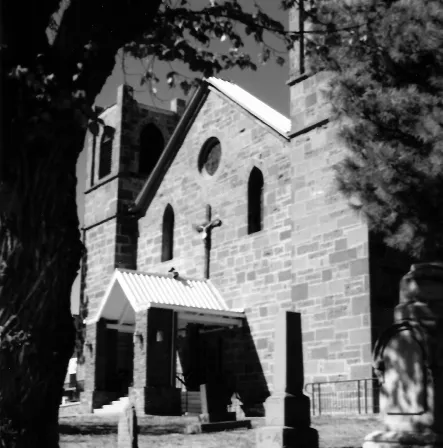
Our Lady of Sorrows Catholic Church in Las Vegas, New Mexico, is the final resting place of Paula Angel, although the exact location of her grave has been lost to history. Author’s collection.
The men would not allow Herrera to retrieve Paula’s limp body. They carefully wrapped the body in a blanket and, in a silent procession, carried her back to town on their shoulders. The exact location of her final resting place is lost to history, but it is written that she is buried in a special place in the corner of the cemetery of Our Lady of Sorrows Church in Las Vegas. Maybe it was there, in that forgotten grave, that Paula finally gained peace.
Sheriff Herrera wrote out and signed the death warrant in Spanish. When translated, it reads, “I, Anto...
Table of contents
- Front Cover
- Half Title
- Title Page
- Copyright
- Dedication
- Contents
- Acknowledgements
- Introduction
- I. Lady Killers
- II. Gambling Queens
- III. Soiled Doves
- Bibliography
- About the Author
Trusted by 375,005 students
Access to over 1.5 million titles for a fair monthly price.
Study more efficiently using our study tools.
Frequently asked questions
Yes, you can cancel anytime from the Subscription tab in your account settings on the Perlego website. Your subscription will stay active until the end of your current billing period. Learn how to cancel your subscription
No, books cannot be downloaded as external files, such as PDFs, for use outside of Perlego. However, you can download books within the Perlego app for offline reading on mobile or tablet. Learn how to download books offline
Perlego offers two plans: Essential and Complete
- Essential is ideal for learners and professionals who enjoy exploring a wide range of subjects. Access the Essential Library with 800,000+ trusted titles and best-sellers across business, personal growth, and the humanities. Includes unlimited reading time and Standard Read Aloud voice.
- Complete: Perfect for advanced learners and researchers needing full, unrestricted access. Unlock 1.5M+ books across hundreds of subjects, including academic and specialized titles. The Complete Plan also includes advanced features like Premium Read Aloud and Research Assistant.
We are an online textbook subscription service, where you can get access to an entire online library for less than the price of a single book per month. With over 1.5 million books across 990+ topics, we’ve got you covered! Learn about our mission
Look out for the read-aloud symbol on your next book to see if you can listen to it. The read-aloud tool reads text aloud for you, highlighting the text as it is being read. You can pause it, speed it up and slow it down. Learn more about Read Aloud
Yes! You can use the Perlego app on both iOS and Android devices to read anytime, anywhere — even offline. Perfect for commutes or when you’re on the go.
Please note we cannot support devices running on iOS 13 and Android 7 or earlier. Learn more about using the app
Please note we cannot support devices running on iOS 13 and Android 7 or earlier. Learn more about using the app
Yes, you can access Wicked Women of New Mexico by Donna Blake Birchell in PDF and/or ePUB format, as well as other popular books in History & North American History. We have over 1.5 million books available in our catalogue for you to explore.