- 240 pages
- English
- ePUB (mobile friendly)
- Available on iOS & Android
eBook - ePub
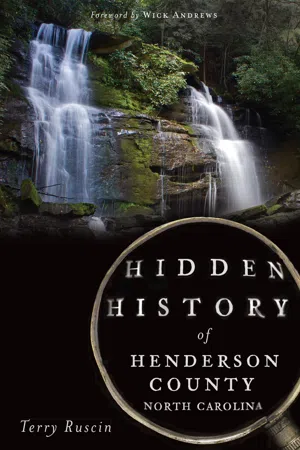
Hidden History of Henderson County, North Carolina
About this book
Join author and historian Terry Ruscin as he reveals Henderson County's forgotten yet colorful history complete with its own cast of characters and historic landmarks.
Who composed a blockbuster opera a few miles from downtown Hendersonville? Who were the record-setting McCrary twins, and why were they famous? These questions and many more are answered in this exciting volume of obscured history. From James Brown's 1950s performance on Hendersonville's Main Street to the rumors of illegal distilling in Cathead, these are the tales of surreptitious cascades, log homes and unattended cemeteries. Delve into the communities of Black Bottom, Delmont and Peacock Town. Discover what lurks within the derelict buildings of the county's backcountry roads.
Trusted by 375,005 students
Access to over 1.5 million titles for a fair monthly price.
Study more efficiently using our study tools.
Information
Part IV
THE ROAD LESS WRITTEN
Tour of Crab Creek Road
Much has been written of the “great flat rock,” the granite outcropping from which the western North Carolina village takes its name, yet little exists in print with regard to the vast lands just west and south of the storied village of Flat Rock. And few alive today recall when the artery now called Kanuga Road (County Road 1127), Kanuga Street and Crab Creek Road (County Road 1127) was called Crab Creek Road all the way from the wee villages of what is now eastern Transylvania County to downtown Hendersonville.
Under orders in 1792, Sergeant Lambert Clayton (1755–1828) and his militia built a road from the Catawba Trail, near what is now Flat Rock, through the Little River and Crab Creek settlements to the Estatoe Path—a primary Cherokee hunting and trading corridor—to the Davidson River. This conduit, known as the Crab Creek Path, coursed through the Blue Ridge Mountains to the Cherokee village of Estatoe in South Carolina—one of the first routes to navigate and open up the rugged, densely forested terrain. Clayton, born in Kent County, Delaware, relocated to Rowan County, North Carolina, before acquiring large tracts of land in what became Transylvania County. Clayton served as this area’s first postmaster and justice of the peace.
Not so long ago in this sublimely mysterious valley, sawmills buzzed and gristmills clunked, and the fragrance of freshly mown hay permeated the atmosphere. These pastoral lands that juxtapose the heritage of Henderson and Transylvania Counties still reflect a sense of what was—rolling with grain fields, dotted with iconic scenes and vacant structures that served as homes and post offices and country stores. Mundane, perhaps, yet the passage of time has conferred a special romance on these workaday buildings where farmers and others toiled at their trades, and here, in some respects, rural life proceeds as it has for generations.
Here grain fields and pastureland unfurl for miles to a horizon serrated with blue ridges—a panoply of geography: forested mountains, sprawling valleys and tributaries of one of the planet’s most ancient of rivers. A popularly held notion alleges that the French Broad River is the third oldest in the world behind the Nile and the ironically named New River, part of which flows through North Carolina. The Cherokee named the French Broad River Agiqua, meaning “long man.” Historians attribute its current name to French explorers.
Let’s take a road trip from points where Transylvania was Henderson, through population centers known as Penrose and Little River, to the Crab Creek Valley, up Kanuga Road and into Hendersonville. Along the way, we’ll pause at structures, taking a peek into state forests, camps, cemeteries and the farms, homes and stores now mostly lost to nature and time.
PENROSE
The tiny population and agricultural center known as Penrose stretches from the southern foot of Fodderstack Mountain, bounded by the French Broad flood plain. Within the midst of these rural reaches, the Calhoun Post Office was established in 1856 and the Penrose Post Office in 1889.

The W.L. Talley barn.
THOMAS GLADIOLUS FARM
Thomas’s Gladiolus Farm once counted among the thriving agricultural enterprises in this sector, where, in 1950, Alexander P. Thomas (1910–1971) began propagating gladioli in the fertile flood plain and sold and shipped corms and flowers to markets all over the country. A founding member of Sacred Heart Catholic Church in Brevard, North Carolina, Thomas raised a considerable amount of money to construct the first Sacred Heart Church by selling his flowers. He and his wife, Edith Lowe Thomas (1909–1999), also lived in Florida and owned gladioli farms there as well, in Cocoa and Fort Myers, cultivating the plants in North Carolina during the summer and in Florida during the winter.
The Thomases, who purchased the property from the Everetts of Cleveland, Ohio, sold to the Ecusta Mill (1939–2002) in 1971. Ecusta, which produced flax pulp and cigarette paper, added the Thomas land to its holdings for warehousing purposes, using part of the property for an employee shooting range. The Lenz family currently holds the property.
Distracted by traffic signals, cellphones, iPhones and offensive driving, it’s easy for commuters to miss the historic aspects surrounding them. History keeps reminding us that nothing stays the same, yet a few tangible traces of earlier life along the periphery of Henderson and Transylvania Counties remain as cues of a vast rural culture. Landmarks in this sector include an excavated granite massif known as Vulcan Penrose Quarry, the Triangle Stop (formerly the Penrose Grocery), the Transylvania County Airport and a span of railroad tracks—all within a stone’s throw of sweeping farmland. East of Highway 64, we find the Old Hendersonville Highway and branching from it a little-used section of the old Crab Creek Road, which crews realigned and paved in 1947–48. The Old Hendersonville Highway was rerouted in 1956, and the segment of Crab Creek Road known by locals as “Little River Highway” was re-looped to meet U.S. 64 at a more westerly position, with a bridge added. Horace Clayton Lyday (1895–1969) owned the land under the quarry at Penrose, just west of the moldering vestiges of Evan Talley’s farmstead.

The Thomas Gladiolus Farm sign now hangs at the home of Andrew P. and Jackie Thomas in Brevard, North Carolina.

Gladioli awaiting shipment via train cars. Photo by Lucile Stepp Ray, courtesy of Henderson County Genealogical and Historical Society, Inc.
EVAN AND CATHERINE TALLEY HOUSE AND FARM
Classic examples of demolition by neglect may be glimpsed alongside U.S. 64. The clutch of sagging farm buildings and derelict I-house belonged to Evan O. Talley (1838–1916). His wife, Ellen Catherine Talley (1843–1916), was daughter of Wilson Picklesimer (1816–1897). The Talleys’ circa 1880 weatherboarded house, swathed in white and trimmed with green, stands on native stone foundations and sports an asymmetrical façade; two cut-stone, gable-end chimneys; a hip-roofed front porch; and a painted, standing-seam metal roof. Three bays wide and one room deep, the house incorporates a hall-and-parlor plan, its rear ell at one time connecting a separate kitchen to the main house. A smokehouse and springhouse join the rear ell by a breezeway, and originally there may have been a spring trough on the back porch. The approach to the property—in the Talleys’ time encompassing approximately one hundred acres—rambled much longer before the rerouting of U.S. 64 in the 1950s, and a snapshot of the farm would have proffered a view of hayfields flanking the scene. The Talleys’ son Carl Wilson Talley (1885–1959) and his wife, Bonnie Aiken Talley (1890–1952), were next to occupy this farm.

The Evan Talley home with Fodderstack Mountain in the background.
One of the oldest standing buildings on the Talley tract would be the corncrib of mortise-and-tenon timber frame, slatted siding and gabled roof. The gable-roofed frame barn features handmade, metal-strip hinges and has been evaluated by National Register scholars to be the same era as the house. Other structures include a concrete silo built in the 1920s, a poured concrete bank house/root cellar “built like a bomb shelter” and a hog pen.
Today, a pair of Hydro stone tablets inscribed with the Ten Commandments remains planted in front of the sagging Talley house—a silent vestige of faith-based, diligent farmers.
TALLEY HO
William Luther Talley (1868–1945) and his wife, Louetta Talley (1870–1920), built Penrose Cottage, their characteristically Victorian-style home—later renamed Talley Ho—on the Old Hendersonville Highway (SR 1504). Traveling salesmen and vacationers passing through the area lodged at this boardinghouse until the late 1930s.
Reports vary on the completion date of Talley Ho, some suggesting circa 1890 and others, circa 1902. The Talleys added a wing to the dwelling in 1904. The well-preserved and maintained frame house sports a pebbledash6 exterior, a polygonal front gable ell and Victorian and stick-work details. The interior features what have been described as a notable Colonial Revival mantel with ionic colonettes, door and window surrounds with bull’s-eye corner blocks and turned newels and balusters adorning the staircase.

Talley Ho.
A white, gable-fronted stock barn with vertical plank siding and enclosed side sheds occupies a space between the old boardinghouse and Crab Creek Road, as do a milk shed and stuccoed springhouse.
Across the road from the barn, William Luther Talley kept a general store known as the Penrose Store. His son William Everett “Scad” Talley (1898–1960) took over operations after his father’s tenure. Exemplary of earlier country emporiums, this one featured a potbellied stove, wooden chairs for gossipers, a candy counter and displays of dry goods, meats, cheeses, canned goods and household products. A small loading dock out back served farmers who bought feed and seed from the Talleys. Mrs. Ina Rustin (1896–1977), William’s sister, served as postmistress in a corner of the store. When the county moved the road, channeling most traffic away from the store, William built a store of brick at the intersection of Crab Creek Road and the new Highway 64 and repurposed the old building, using it for storage until it was razed.
Clyde Nicholson (1916–1999) and Nell McCrary Nicholson (1911–1997) later owned and operated a store called Nick’s Grocery, constructed of cinderblocks and still standing on Crab Creek Road across from Everett Road. According to Lenoir Ray, this site hosted the Calhoun Post Office, established in 1856, where David Shuford (1788–1862), Jane P. Shuford (1830–1898) and Alexander Gray (1824–1895) served as postmasters.
Talley also operated the county’s only cooperative cheese factory on the family farmstead in the 1910s. Between the old and new stores, a sawmill counted among the business concerns of this now hauntingly hushed nook off Crab Creek Road.
Everett Road was named for Sylvester Thomas Everett (1838–1922), a financier, industrialist, politician and philanthropist from Cleveland, Ohio, and the man indirectly responsible for Hendersonville’s first library. Everett’s family kept a summer home at Engadine Farms in Transylvania County, North Carolina.

V. Leon Pace stands within the foundations of the former Piney Grove Methodist Church.
PEACE IN THE VALLEY
Sundry stone tablets fleck the periphery of a slope rising from the right side of Talley Road where it veers sharply northeast from Crab Creek Road. This is Piney Grove Methodist Cemetery, where, under a canopy of hoary pines and oaks, foundation stones trace the footprint of Piney Grove Methodist Church betwixt a medley of monuments bearing the names of Gray, Galloway, Allison and more.
JETER MOUNTAIN
Meandering south on Crab Creek, we come to Jeter Mountain Road, which scales a peak straddling Transylvania and Henderson Counties. Around 1800, when the geological prominence fell within Buncombe County, Revolutionary War veteran William Sentell (1756–1837) of Virginia was one of the first pioneers to settle there. Sentell and his wife, Elizabeth Stevens Sentell (1760–1847), raised their eight children on the mountainside. They were buried in the now nearly obscured family cemetery on a knoll above Big Willow Creek. The elements have mostly erased the tombstones’ inscriptions, but the more legible ones show variations in the spelling of the surname. Like spokes of a wheel, several Sentell family members lie buried around the hub of a now-dead cedar tree in this partially cleared recess sometimes referred to as “the Yankee burial ground” because its interments included Sentells who fought on the Union side during the Civil War.

Like spokes of a wheel, graves of Sentell family members radiate from the base of a now-dead cedar tree. To access this burial ground, the visitor must ford a creek, scale a steep bank and negotiate a laurel hell.
Near the apex of Jeter, Richard Fitz Randolph Sewell (1907–1987) raised white-faced Herefords on pastureland on both sides of Jeter Mountain Road—a farm he named Fairfolly. Sewell’s wife, Blanche Todd Sewell (1893–1970), worked at nearby Eagle Nest Camp. The Sewells’ barn now sags from age, as does the two-story frame house, which at one time headquartered the Tuckasegee Beagle Club. Named for the Tuckasegee River, the club moved in the 1980s from Bryson City to Jeter Mountain and has since moved to Ellenboro, South Carolina.

Reverend Robert F. Hamilton’s plot at Holly Springs Baptist Church Cemetery.
Reverend Robert F. Hamilton (1834–1923) had a mill, and he and his wife, Elizabeth “Betty” Ann Osteen Hamilton (1841–1933), farmed 640 acres on Jeter. The Hamiltons are buried at Holly Springs Baptist Church Cemetery. The Osteen/Patterson Cemetery also occupies a slope of Jeter. Today, Carl Sandburg’s granddaughter Paula Steichen Polega (1943– ) and her husband, Stanley, live on the mountain.
LITTLE RIVER VALLEY
Populated by white settlers when it was part of Buncombe County, the community of Little River, bounded by the French Broad River, belonged to Henderson County from 1838 until 1861, when the county of Transylvania was formed from segments of Jackson and Henderson Counties. At that time, one of the largest population centers in the area, Little River evolved between what are now Shuford’s Bridge (Penrose) and the Crab Creek community and maintains to this day much of its bucolic character.
Long before the arrival of Anglo-Saxon pioneers, the feet of aboriginal people and buffalo herds beat the trading path known as Estatoe from South Carolina to what is now Transylvania County. Some of the first white settlers who populated the banks of the D...
Table of contents
- Front Cover
- Title Page
- Copyright
- Dedication
- Contents
- Foreword
- Preface
- Acknowledgements
- I. Historic Log Structures
- II. What Was That?
- III. Who Was That?
- IV. The Road Less Written: Tour of Crab Creek Road
- Afterword
- Bibliography
- About the Author
Frequently asked questions
Yes, you can cancel anytime from the Subscription tab in your account settings on the Perlego website. Your subscription will stay active until the end of your current billing period. Learn how to cancel your subscription
No, books cannot be downloaded as external files, such as PDFs, for use outside of Perlego. However, you can download books within the Perlego app for offline reading on mobile or tablet. Learn how to download books offline
Perlego offers two plans: Essential and Complete
- Essential is ideal for learners and professionals who enjoy exploring a wide range of subjects. Access the Essential Library with 800,000+ trusted titles and best-sellers across business, personal growth, and the humanities. Includes unlimited reading time and Standard Read Aloud voice.
- Complete: Perfect for advanced learners and researchers needing full, unrestricted access. Unlock 1.5M+ books across hundreds of subjects, including academic and specialized titles. The Complete Plan also includes advanced features like Premium Read Aloud and Research Assistant.
We are an online textbook subscription service, where you can get access to an entire online library for less than the price of a single book per month. With over 1.5 million books across 990+ topics, we’ve got you covered! Learn about our mission
Look out for the read-aloud symbol on your next book to see if you can listen to it. The read-aloud tool reads text aloud for you, highlighting the text as it is being read. You can pause it, speed it up and slow it down. Learn more about Read Aloud
Yes! You can use the Perlego app on both iOS and Android devices to read anytime, anywhere — even offline. Perfect for commutes or when you’re on the go.
Please note we cannot support devices running on iOS 13 and Android 7 or earlier. Learn more about using the app
Please note we cannot support devices running on iOS 13 and Android 7 or earlier. Learn more about using the app
Yes, you can access Hidden History of Henderson County, North Carolina by Terry Ruscin in PDF and/or ePUB format, as well as other popular books in History & North American History. We have over 1.5 million books available in our catalogue for you to explore.