This study examines the campaign to defend southwest France waged by Marshal Nicholas Soult against the Anglo-Allied Army of Arthur Wellesley from 1 July 1813 until 14 April 1814 to garner insights that are applicable to today's officer. In the first stages of the campaign Marshal Soult conducts an operational offensive across the Pyrenees Mountains but is defeated at the Battle of Sorauren. After this battle, Soult retreats back into France and attempts to defend the French frontier by occupying three successive river lines. Wellesley attacks and defeats Soult's army at each of these lines forcing the French to ultimately retire on Toulouse where the campaign ends.
A study of this campaign illustrates that there are a number of intangible factors that effect the success of a campaign. These factors include the impact of the commander's vision on the conduct of the campaign, as demonstrated by his active involvement in the operations, the decisions he makes during the campaign, as well as his ability to translate strategic guidance into a sound operational plan. Other intangible factors identified include the effects of soldiers' morale on operations and the commander's employment of forces in the manner in which they are trained.
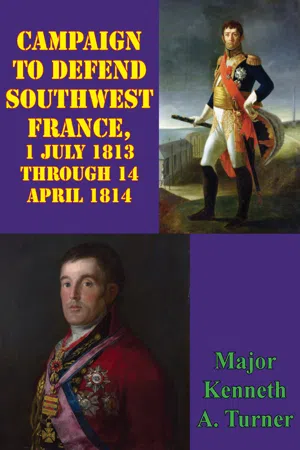
eBook - ePub
Campaign To Defend Southwest France, 1 July 1813 Through 14 April 1814
- 91 pages
- English
- ePUB (mobile friendly)
- Available on iOS & Android
eBook - ePub
Campaign To Defend Southwest France, 1 July 1813 Through 14 April 1814
About this book
CHAPTER ONE — INTRODUCTION
In the 1840s King Louis Phillipe of France organized a display at the Palace of Versailles to honor the exploits of Marshal General Nicholas Soult. At the dedication for this display, Soult observed that of all his military exploits the one that he was most proud was the defense of Toulouse in 1814. He followed by stating that it was his finest battle because he was fighting against three allied armies : the British, the Spanish and the Portuguese, led by the greatest of all allied commanders Arthur Wellesley.{1} The Battle of Toulouse was the final act in the campaign to defend Southwest France in 1814, and Soult lost the battle and the campaign. While Soult believed that Toulouse was his greatest battle, there is little utility in examining the defense of Toulouse from a historical perspective. The campaign was lost prior to the battle occurring at Toulouse. It is this campaign, leading up to Toulouse that merits consideration for the insights that can be garnered from its study.
In the closing months of 1813 Napoleon appointed Marshal Soult as commander of French forces in Spain. Marshal Soult’s mission was to defend the southwest frontier of France from the advancing allied army. The opposing forces were equal in many respects, yet in the end Marshal Soult failed in his mission. Why was he unable to defend Southwest France from the advancing Allied army? Looking at the numbers of soldiers involved and the physical characteristics of the area of operations reveals that the French should have been able to defend the frontier. The correlation of forces was relatively equal throughout the campaign and the terrain favored the defender. However, a closer examination of the campaign can identify many intangible causes for the French failure. The French Army Soult commanded was fraught with problems that affected its performance that cannot be accounted for by just assessing the numbers of soldiers involved. Other intangible factors contributed to his failure. These intangible factors included the leadership demonstrated by Soult, as illustrated by his decisions during the campaign, the methods he employed, his lack of vision, morale of the soldiers, and the force mix of his army. Many of Soult’s operational successes were later neutralized by tactical failures either on his part or the part of his subordinates. He often displayed extraordinary talent at the movement of large bodies of soldiers over vast distances, what is currently thought of as the operational level, but failed to achieve tactical victories due to a lack of initiative or will.
During this campaign, Marshal Soult demonstrated outstanding abilities in the area of administration as he organized, managed and controlled his command. However, his lack of aggressiveness and overcautious nature at the tactical level, coupled with his predictability, led to his failure. Throughout 1813-1814 he missed several opportunities to defeat the British. A demonstration of this unwillingness to take risks is illustrated by an encounter between Wellesley and Soult in the Pyrenees at the Battle of Sorauren. As the French were pursuing the British after the Battle of the Roncsevalles Pass, Wellesley rode ahead with an aide to reconnoiter the French positions. Upon arriving along the front, among his cheering soldiers, he spied Soult across the valley. During this encounter an aide heard Wellesley mumble as to himself “Yonder is a great commander, but he is a cautious one, and will delay his attack to understand the cause of these cheers; that will give time for the Sixth Division to arrive, and I shall beat him.”{2} Wellesley was right. He beat Soult in the ensuing battle and the campaign. Soult’s cautious nature prevented him from taking advantage of numerous opportunities to defeat the Anglo-Allies during the campaign. This theme runs throughout the campaign and as such this campaign serves as a model of how tactical failures can neutralize operational successes.
Another factor that prevented Soult from achieving success was the method of warfare he attempted to employ during the campaign. The campaign to defend southwest France is an anomaly of traditional Napoleonic warfare. Soult failed to conduct the campaign in what was considered Napoleonic fashion. Warfare, as conducted by Napoleon, was characterized by bold, aggressive, offensive operations. These operations capitalized on speed and outmarching the enemy with the intent of destroying the enemy’s will to fight. This was accomplished through the destruction of their field army in the climactic battle. This was the essence of Napoleonic warfare. With the enemy’s ability to resist destroyed, Napoleon could then dictate whatever political terms he desired. It was in this way that Napoleon integrated the political policy with the military strategy to attain that policy.{3} The principal element of Napoleon’s method of war can be found in his own words. “There are in Europe many good generals, but they see too many things at once; I see only one thing, namely the enemy’s main body. I try to crush it, confident that secondary matters will then settle themselves.”{4} Soult failed to do this and pursued geographic objectives as opposed to the destruction of the enemy’s forces.
Soult also conducted a primarily defensive campaign. After the failure of the initial counterattack, which culminated at The Second Battle of Sorauren, Soult went on the operational defensive. This abdicated the initiative to Wellesley and played to one of Wellesley’s strengths, positional warfare. Conversely, the French method of warfare was not conducive to defensive operations. “Make war offensively; it is the sole means to become a great captain and to fathom the secrets of the art.”{5} This was what Napoleon envisioned as the most effective way to wage war. He went on to say “That the soldier who sits in his position and waits for his adversary to attack is more than half-beaten before the first shots are exchanged....”{6} This is the critical mistake Soult commits in the campaign as he occupies successive defensive lines along the French frontier. Wellesley then takes advantage of the situation, maneuvering Soult out of each position until Soult becomes trapped in Toulouse.
Another intangible that adversely influenced Soult’s leadership effectiveness was his lack of vision. One of the most critical characteristics of a successful commander is the ability to interpret and translate strategic guidance into operational and tactical objectives. This is particularly important in the case of a modern Commander-in-Chief (CINC) who has to translate sometimes vague political guidance into achievable military objectives to meet the political goals. Only when commanders establish the conditions they want to achieve in advance, can they communicate their intent to their subordinates. To be successful, commanders must possess a “vision” of what they expect to accomplish in the pursuit of a particular campaign or operation. Clausewitz termed this the “inner light” to understand what must be done and when it must be accomplished.
“If the mind is to emerge unscathed from this relentless struggle with the unforeseen, two qualities are indispensable: first an intellect that, even in the darkest hour, retains some glimmerings of the inner light which leads to truth; and second, the courage to follow this faint light wherever it may lead. The first of these qualities is described by the French term, coup d’œil, the second is determination.{7}”
During the campaign in southwest France, Napoleon provided Soult with strategic directive that was constrained by political considerations. Napoleon’s strategic directive concentrated on the retention of geographic locations because of the political ramifications of losing territory or cities. Soult failed to translate this guidance into a successful plan. Soult should have understood that Napoleon’s strategic directive was affected by political considerations and might be inappropriate to the situation and modified his operational plan to accomplish the overall strategic objective. Soult failed to apply a vision to the directive that would have allowed him to employ Napoleonic methods of warfare to achieve the strategic goals.
The Army’s morale also hindered its performance. Its will to fight was seriously affected by the subsequent losses it incurred beginning at Sorauren and continuing until the loss of Toulouse. Soult’s Army’s effectiveness was also hindered by the quality of its soldiers. From the very beginning of the campaign, the army lost quality veteran soldiers to support Napoleon’s efforts in eastern France. The replacements for these soldiers were normally conscripts whose quality was suspect. The effectiveness of the Army was also hampered by the lack of cavalry which was removed at an ever increasing rate by Napoleon as the campaign continued. This lack of cavalry adversely affected Soult’s ability to conduct reconnaissance throughout his area of operations.
In essence, Soult failed to failed to apply the art of generalship and it is because of this that he failed. The success of an army in war is dependent on the generalship of its commander. While generalship is not the only determining factor for success it is the preeminent. As Napoleon said:
“The personality of the general is indispensable, he is the head, he is the all, of an army. The Gauls were not conquered by the Roman legions, but by Caesar. It was not before the Carthaginian soldiers that Rome was made to tremble, but before Hannibal. It was not the Macedonian phalanx which penetrated to India, but Alexander. it was not the French Army which reached Weser and the Inn, it was Turenne. Prussia was not defended for seven years against the three most formidable European Powers by the Prussian soldiers, but by Frederick the Great.{8}”
And as such it was not the French soldier or the terrain that lost the campaign for the French, but Marshal Soult. Wellesley defeated Soult because he exhibited generalship. Wellesley displayed untiring energy, coupled with the ability to be at the critical place of combat at the critical time, the ability to inspire the soldiers to greater efforts, outstanding physical courage and creative intelligence. Soult, on the other hand, failed in many of these areas.
It is not the intent to examine this campaign in order to provide a checklist of principles or a template for success. It is, however, important to study a variety of examples to attempt to “educate the judgment of the commander” as Michael Howard has said.{9} This campaign provides an example that should be examined to educate military leaders and obtain some manner of seasoning from the experiences of others. Napoleon said that it is through the study of great captains, their battles, and through experience that a knowledge of the higher- level of war is acquired. While Marshal Soult is not of the stature of the men he had in mind, i.e., Alexander, Hannibal, Gustavus, Turrene and Frederick, he was one of the premier commanders of what was once the dominant Army of the age. However, his last campaign ended in failure and often more can be learned from examining a failure then can be learned from success. Because of this, there is value in exploring his final campaign during the Napoleonic Wars to glean insights that might provide an informed perspective on solving contemporary issues for military leaders.
The examination of this campaign includes the time immediately after the Battle of Vittoria until the end of the Battle of the Nive River around Bayonne in early December 1814. While this is occurring in the west of France, Napoleon is engaged in a struggle for his Empire in the East against the Sixth Coalition. The Campaign in the west lasted from July 1813 until 14 April 1814. When Soult initially arrived, his army is demoralized and unorganized. He immediately instilled confidence in his soldiers and took the offensive against the Anglo- Allied Army headed by Arthur Wellesley. During this initial offensive Soult surprised Wellesley and forced the passes of the Pyrenees Mountains. Despite the initial surprise and subsequent success, Soult lost the initiative and suffered a defeat at the Battle of Sorauren. As a result of this defeat, Soult was forced back into France where he occupied successive defensive positions only to be outmaneuvered and eventually defeated by Wellesley the ensuing battles. Even though this campaign was an integral part of the effort to defend France in the final, years of the Napoleonic Empire, it is less studied than the efforts in the east, which were under the direct influence of Napoleon.
To analyze the campaign it is first necessary to describe the overall strategic situation of the French and the Allies leading into 1813. This will include a description of Napoleon’s strategy after 1812 and the Allies overall strategy to defeat France. It will also describe where in the strategic situation the campaign fits to provide a context of its importance.
After discussing the strategic situation, the thesis will continue with a description of the theater of operations detailing the physical characteristics of the French southwest frontier. This will provide an understanding of the operational environment of the campaign.
The operational situation will include a brief summary of the commanders involved, the forces they commanded, and a brief discussion of the differences in the way the French and British waged war during the Napoleonic wars. The thesis will conclude with an analysis of a description of the major events of the campaign from 1 July 1813 until the Battle of Nive where Wellesley defeats Soult and begins his final drive on Toulouse.
CHAPTER TWO — THE STRATEGIC SITUATION
Historians often cite Napoleon’s efforts to defend his empire in 1813-1814 as an example of Napoleon at his best. Many writers and historians frequently study the campaign to determine what insights can be gleaned for the activities of the Emperor without regard for the operations to defend the Empire in other theaters. An integral aspect, but less studied part of this campaign, is the defense of the southwest of France waged by Marshal Soult. Before the actual events in the south are recounted, it is necessary to describe the strategic setting in the west. This will provide the context to where Soult’s efforts fit in with the final months of the Napoleonic Empire.
The campaign to defend France in 1813-1814 truly begins with the crossing of the Berezina River by the remnants of Napoleon’s Grand Armée between November 26-28, 1812.{10} This event marked the end of the invasion of Russia and was the final episode in the destruction of the Grand Armée. On December 5, 1812, Napoleon left what remained of the army in the hands of Marshal Murat, and returned to Paris. He arrived in Paris on 18 December to begin the seemingly insurmountable task of preparing for the coming invasion.{11} The raising of the new army ...
Table of contents
- Title page
- TABLE OF CONTENTS
- ABSTRACT
- CHAPTER ONE - INTRODUCTION
- CHAPTER TWO - THE STRATEGIC SITUATION
- CHAPTER THREE - THE OPERATIONAL SITUATION
- CHAPTER FOUR - THE CAMPAIGN: ACTIONS IN THE PYRENEES
- CHAPTER FIVE - THE ACCOUNTING
- ILLUSTRATIONS
- BIBLIOGRAPHY
Trusted by 375,005 students
Access to over 1.5 million titles for a fair monthly price.
Study more efficiently using our study tools.
Information
Frequently asked questions
Yes, you can cancel anytime from the Subscription tab in your account settings on the Perlego website. Your subscription will stay active until the end of your current billing period. Learn how to cancel your subscription
No, books cannot be downloaded as external files, such as PDFs, for use outside of Perlego. However, you can download books within the Perlego app for offline reading on mobile or tablet. Learn how to download books offline
Perlego offers two plans: Essential and Complete
- Essential is ideal for learners and professionals who enjoy exploring a wide range of subjects. Access the Essential Library with 800,000+ trusted titles and best-sellers across business, personal growth, and the humanities. Includes unlimited reading time and Standard Read Aloud voice.
- Complete: Perfect for advanced learners and researchers needing full, unrestricted access. Unlock 1.5M+ books across hundreds of subjects, including academic and specialized titles. The Complete Plan also includes advanced features like Premium Read Aloud and Research Assistant.
We are an online textbook subscription service, where you can get access to an entire online library for less than the price of a single book per month. With over 1.5 million books across 990+ topics, we’ve got you covered! Learn about our mission
Look out for the read-aloud symbol on your next book to see if you can listen to it. The read-aloud tool reads text aloud for you, highlighting the text as it is being read. You can pause it, speed it up and slow it down. Learn more about Read Aloud
Yes! You can use the Perlego app on both iOS and Android devices to read anytime, anywhere — even offline. Perfect for commutes or when you’re on the go.
Please note we cannot support devices running on iOS 13 and Android 7 or earlier. Learn more about using the app
Please note we cannot support devices running on iOS 13 and Android 7 or earlier. Learn more about using the app
Yes, you can access Campaign To Defend Southwest France, 1 July 1813 Through 14 April 1814 by Major Kenneth A. Turner in PDF and/or ePUB format, as well as other popular books in History & British History. We have over 1.5 million books available in our catalogue for you to explore.