Originally from Riga, Latvia, Yoga practitioner, author and teacher Indra Devi (born Eugenie Peterson) lived to 102 years! She became fascinated with India at age 15 and set out to India in 1927 to become a disciple of Sri Tirumalai Krishnamacharya, after which time she moved to different parts of the world and taught Yoga. She comes from the renowned tradition of Mysore.
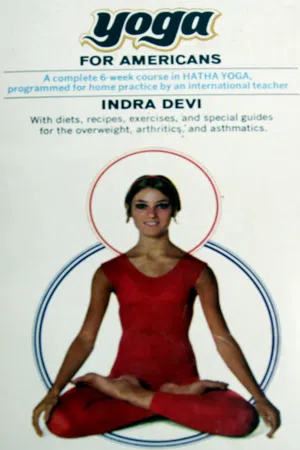
For thousands of years the culture of Yoga has existed in India, bringing to its practitioners remarkable health and spiritual well-being. In YOGA FOR AMERICANS Indra Devi has brought this ancient art to those who need it most: Americans, victims of a driving, competitive, tension-ridden society which suffers from its own superabundance. Here, in the richest country in the world, an alarming number of people still die from malnutrition and allied diseases; obesity, underactivity, and psychosomatic illness are commonplace; tension-inspired heart attacks are the worst killers of all.
Here is an invaluable book, packed with sound, proven advice, including many extras such as an introductory question-and-answer session, lavish illustrations, special diets, and constructive advice for those suffering from arthritis, asthma, and overweight.
- 176 pages
- English
- ePUB (mobile friendly)
- Available on iOS & Android
eBook - ePub
Yoga For Americans
About this book
Information
Subtopic
Indian & South Asian HistoryIndex
HistoryLESSON ONE—FIRST WEEK
“Only a few men die from sudden lack of air, but multitudes perish because for years they have not been breathing enough.”—RASMUS ALSAKER, M.D., Master Key Is Health
WHAT THE COURSE IS—AND HOW TO USE IT
As the title of my book implies, the course of exercises out-lined here for home practice is designed to teach the rudiments of Yoga so that they can be incorporated into the daily routine of the average man or woman living in our Western world. I have taken into account not only the pace to which life in the United States is geared, but also the fact that most of you have not had a chance to keep your muscles limber and your joints supple. At first glance, as you look through the illustrations in the book, some of the Yoga poses may seem impossibly difficult to you—you may feel you cannot even attempt them. But please do not be frightened away. If you follow instructions, with a little patience and method you will be able to learn a great deal more than you think possible—in less time than you imagine.
The course is divided into six lessons. Each lesson consists of a number of breathing exercises and Yoga postures—probably more than you will normally have time for. You will find yourself liking some better than others, and you may as well let personal preference guide you when it comes to choosing those you want to incorporate into your own personal routine. Once having decided, repeat your chosen routine every day for a week, in order to give yourself a chance to assimilate it before going on to the next week’s set of instructions. As you practice the same postures day by day, you will find your muscles stretching, your body growing more responsive and better controlled, until what seemed unattainable on Monday has become routine on Saturday. Then you will be ready to go on to the next week’s lesson.
I also want to make clear that throughout the book I have tried, in outlining each day’s schedule, to approximate the normal waking and sleeping hours of the average person. Those who keep odd bed and meal hours will need to adjust this schedule, making whatever changes are necessary in order to suit their particular time requirements. The best time is, of course, in the morning before breakfast, but it does not matter too much at what time of day the exercises are done, just so long as they are done on an empty stomach. Allow three to four hours after a big meal, one and one-half to two hours after a light meal, and about half an hour after a glass of juice. It is also inadvisable to do the exercises directly before eating. But the most important thing is to do them regularly, without skipping. If you happen not to have time for all of them, do just a few, perhaps even only one when you are in a great hurry—but never omit them entirely. Once you begin to skip, you are likely to do so more and more often until you stop exercising altogether.
THE WAKING-UP ROUTINE
We shall begin our first lesson with the routine you should adopt the moment you have opened your eyes in the morning and are ready to get up.
First of all, learn to wake up properly. Do some stretching. Stretch your arms, yawn several times, stretch your legs, stretch your whole body. While you are still in bed, do the following stretching exercise:
Keeping your feet together, toe to toe, start to push out the right leg, without raising if off the mattress, as if wanting to lengthen it. The pull will be felt from the hip down and the leg will be momentarily lengthened by an inch or more. Hold your leg in this position while you count to sixty, then relax, allowing the right foot to become even again with the left one. Repeat with the left leg.
This exercise stretches the spinal column and tones up the sympathetic nerves. It has a rejuvenating effect on the entire body. As this is a very potent nerve exercise, you must be careful not to overdo it. Sixty seconds for each leg is the maximum. You may, however, repeat the exercise again in the evening, if you wish. If your mattress is too soft, don’t do this in bed, but wait until you are ready to do the other exercises on the floor and simply begin with this one.
Incidentally, if you want to avoid those “morning backaches” or a tired feeling in your back, don’t ever sleep on a soft mattress. Get a hard one or put a board under the soft one. Just try it out for a week or so and you will notice the difference in the way you feel. I myself, when traveling or staying in hotels, often pull the mattress down to the floor, unless it is too heavy. If I find I cannot handle the mattress, I slip the glass top from a dressing table under it.
Another important thing to bear in mind is never to jump out of bed, even if you are in a hurry, as this gives the whole nervous system a shock. Give yourself a little time to return to this world from the threshold of another. Make this transition slowly and gradually and give your body time to “shift gears.” Animals offer a good example of natural behavior. Watch a dog or a cat, for instance. Except when in danger or emergency, they never jump up, but keep yawning and stretching for quite a while after coming awake; then they slowly get up on their feet. Imitate them. When you finally get out of bed, drink a glass of water, but water that is at room temperature, not iced. Drink it after brushing your teeth and cleaning your tongue with a special tongue scraper or with a wash cloth. The tongue, as you probably know, is a barometer that shows the condition of your intestinal tract. A bright red tongue indicates a clean intestinal tract, whereas a coated tongue indicates the opposite. If the latter is the case, you had better plan to go on a cleansing diet or fast for a few days to get rid of the impurities accumulated in your body. We shall discuss this at length later on.
Now let us return to the exercises. As has already been said, they should be done with an empty stomach, empty bladder and also, if possible, empty bowels. When you are ready to start, put on a minimum of clothing and make sure that whatever you are wearing is comfortable and not tight. Do not wear a girdle, bra, tight belt or the like while exercising. You may wear a pair of socks if your feet feel too cold.
DEEP BREATHING
Yoga emphasizes our relationship to the universe and therefore teaches a breathing different from the usual breathing, a breathing that reflects our inner attitude while we are performing it. This attitude is one of devotion toward the communion with the All, and should be maintained all the time one is doing deep breathing.
Conscious Breathing
I shall begin with an explanation of Yoga breathing, as it is most important for you first of all to understand how this deep breathing is done and how it differs from ordinary breathing.
Usually we are not conscious of our breathing. Breath passes through our bodies like dream waves. In Yoga, this process is lifted to the level of consciousness. It is you, yourself, who take over the direction and control of the air-flow.
In normal respiration the air is taken in through the nostrils without any special effort, sound or exaggerated movement of the nose or chest. In short, it is done unconsciously. We are not even aware of air traveling through our nostrils, down the nasal and oral parts of the pharynx, of its reaching the larynx and then the trachea and the lungs. More than that, not only are we unaware of the breathing process, but most of us don’t know anything about it. You can easily prove this for yourself by asking several friends to answer this simple question: “What happens to the air after it enters the nostrils?” They will probably tell you that it goes to the lungs, although everybody realizes in a general way that the nose does not reach that far in and that there is quite a distance between it and the lungs.
Taking into consideration the limited knowledge we possess about the function of our organism, I will try to make the anatomical explanations as simple as possible. It is very easy to demonstrate the deep-breathing technique, but not nearly so easy to put it in words. We shall therefore go into it in some detail so that you may be able to grasp the idea correctly.
The Anatomy of Breathing
Let us begin by analyzing the way the so-called Yoga deep-breathing exercise is usually done and see in what way it differs from ordinary deep breathing.
Take a deep breath. Just put down the book for a moment and do it the way you have always been doing it. Most people vigorously sniff air in through the nostrils, simultaneously raising the chest and popping out the eyes. Yoga deep breathing is not done this way at all. Let us examine what happens when you take the usual kind of deep breath. First of all you interrupt your normal—or unconscious—breathing and make a conscious, deliberate effort to inhale. In doing this, you use considerable force. You also produce a loud sniffing sound by automatically contracting the nostrils. In Yoga deep breathing the process is so entirely different that it is better to completely forget the way you have been doing it and learn anew. To begin with, you do not consciously use the nostrils at all; they remain completely inactive during inhalation and exhalation. Instead, you draw in the air by using the area situated at the back wall of your mouth, called the pharyngeal area. This connects the mouth with the nose, and is the continuation of the nasal openings which end behind the soft palate leading from the mouth into the throat.
You will understand this still better if you will take a hand mirror and look into it, opening your mouth wide. (I suggest that you once again interrupt your reading and pick up a mirror right now, otherwise you may forget about it.) What you see, especially if you press down the tongue, is a wall in the form of a dome. The air passage is located directly under this dome. This is the pharyngeal area. And it is this area instead of the nostrils which you must learn to use in Yoga deep breathing. This, then, is the main technical difference between ordinary deep breathing and Yoga deep breathing. Have you ever before been aware of the possibility of drawing in a breath through an area other than the nostrils? Probably not. However, people suffering from a post-nasal drip are made very conscious of this other area.
If you sniff in water, especially salt water, through the nostrils and eject it through the mouth, you will instantly become aware of the pharyngeal area, which connects the mouth with the nose. It is this connection that makes it possible to draw the air in through the pharyngeal area, while keeping the nostrils completely inactive during deep breathing. The action is felt only at the back of the throat during the exhalation and the impression is that of a hydraulic suction pump or press operating in the back of the mouth. In fact, the entire action i...
Table of contents
- Title page
- TABLE OF CONTENTS
- INTRODUCTION
- DEDICATION
- FOREWORD
- AUTHOR’S PREFACE-HOW YOGA CAN BE OF HELP TO YOU
- ACKNOWLEDGMENTS
- INTRODUCTION-WHAT YOU SHOULD KNOW ABOUT YOGA
- LESSON ONE-FIRST WEEK
- LESSON TWO-SECOND WEEK
- LESSON THREE-THIRD WEEK
- LESSON FOUR-FOURTH WEEK
- LESSON FIVE-FIFTH WEEK
- LESSON SIX-SIXTH WEEK
- APPENDIX I-DISCUSSION OF DIET AND RECIPES
- APPENDIX II-LETTERS TO THE AUTHOR
Trusted by 375,005 students
Access to over 1.5 million titles for a fair monthly price.
Study more efficiently using our study tools.
Frequently asked questions
Yes, you can cancel anytime from the Subscription tab in your account settings on the Perlego website. Your subscription will stay active until the end of your current billing period. Learn how to cancel your subscription
No, books cannot be downloaded as external files, such as PDFs, for use outside of Perlego. However, you can download books within the Perlego app for offline reading on mobile or tablet. Learn how to download books offline
Perlego offers two plans: Essential and Complete
- Essential is ideal for learners and professionals who enjoy exploring a wide range of subjects. Access the Essential Library with 800,000+ trusted titles and best-sellers across business, personal growth, and the humanities. Includes unlimited reading time and Standard Read Aloud voice.
- Complete: Perfect for advanced learners and researchers needing full, unrestricted access. Unlock 1.5M+ books across hundreds of subjects, including academic and specialized titles. The Complete Plan also includes advanced features like Premium Read Aloud and Research Assistant.
We are an online textbook subscription service, where you can get access to an entire online library for less than the price of a single book per month. With over 1.5 million books across 990+ topics, we’ve got you covered! Learn about our mission
Look out for the read-aloud symbol on your next book to see if you can listen to it. The read-aloud tool reads text aloud for you, highlighting the text as it is being read. You can pause it, speed it up and slow it down. Learn more about Read Aloud
Yes! You can use the Perlego app on both iOS and Android devices to read anytime, anywhere — even offline. Perfect for commutes or when you’re on the go.
Please note we cannot support devices running on iOS 13 and Android 7 or earlier. Learn more about using the app
Please note we cannot support devices running on iOS 13 and Android 7 or earlier. Learn more about using the app
Yes, you can access Yoga For Americans by Indra Devi in PDF and/or ePUB format, as well as other popular books in History & Indian & South Asian History. We have over 1.5 million books available in our catalogue for you to explore.