This is a book about excellence, more particularly about the conditions under which excellence is possible in our kind of society; but it is also—inevitably—a book about equality, about the kinds of equality that can and must be honored, and the kinds that cannot be forced.
Such a book must raise some questions which Americans have shown little inclination to discuss rationally.
What are the characteristic difficulties a democracy encounters in pursuing excellence? Is there a way out of these difficulties?
How equal do we want to be? How equal can we be?
What do we mean when we say, "Let the best man win"? Can an equalitarian society tolerate winners?
Are we overproducing highly educated people? How much talent can the society absorb? Does society owe a living to talent? Does talent invariably have a chance to exhibit itself in our society?
Does every young American have a "right" to a college education?
Are we headed toward domination by an intellectual elite?
Is it possible for a people to achieve excellence if they don't believe in anything? Have the American people lost their sense of purpose and the drive which would make it possible for them to achieve excellence?
- 134 pages
- English
- ePUB (mobile friendly)
- Available on iOS & Android
eBook - ePub
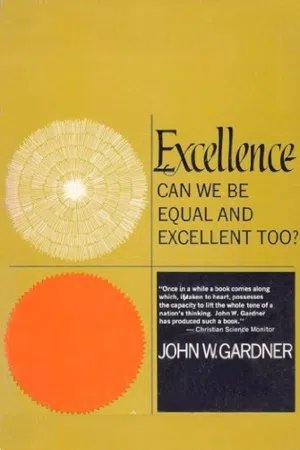
Excellence: Can We Be Equal And Excellent Too?
About this book
Information
Subtopic
History & Theory in PsychologyIndex
PsychologyPART ONE—EQUAL AND UNEQUAL
CHAPTER I—THE DECLINE OF HEREDITARY PRIVILEGE
You Can Keep a Good Man Down
If we accept the common usage of words, nothing can be more readily disproved than the old saw, “You can’t keep a good man down.” Most human societies have been beautifully organized to keep good men down Of course there are irrepressible spirits who burst all barriers; but on the whole, human societies have severely and successfully limited the realization of individual promise. They did not set out consciously to achieve that goal. It is just that full realization of individual promise is not possible on a wide scale in societies of hereditary privilege—and most human societies have had precisely that characteristic. They have been systems in which the individual’s status was determined not by his gifts or capacities but by his membership in a family, a caste or a class. Such membership determined his rights, privileges, prestige, power and status in the society. His ability was hardly relevant.
The faithful family servant of a thousand Victorian novels described one aspect of such a society by saying, “I know my place.” And Molly Malone—who was part of such an order—sang, “My father and mother were fishmongers too.” Birth determined occupation and status. It determined whom you bowed to, who bowed to you, the weight of your voice in the community and the kinds of suitors who sought your daughter’s hand.
Such societies were doomed by the Industrial Revolution, It was essential to the new modes of economic organization that the individual be free to bargain (and be bargained for) in the open market on the basis of his capacity to perform, without regard to other criteria of status. But the Industrial Revolution was not the only factor in bringing a new measure of autonomy to the individual. The seventeenth and eighteenth centuries had seen the emergence of religious ideas which laid great stress on individual responsibility. Tawney remarked of the Puritan that he was a natural republican, “for there is none on earth that he can own as master.”{1}{2} And eighteenth-century ideas of democracy demanded that the individual be allowed to function politically regardless of hereditary status. Thomas Jefferson, borrowing a vivid phrase from an English revolutionary, said, “...the mass of mankind has not been born with saddles on their backs, nor a favored few booted and spurred, ready to ride them legitimately, by the grace of God.”{3}
But although religious and political forces were powerful allies in loosening the web of hereditary privilege, it was the Industrial Revolution that forced the issue. Once its full impact was felt, societies of hereditary status could never again be quite the same. The only question was what would come next. We shall concern ourselves here with only one aspect of what came next, namely, the ways in which the new societies dealt with differences in individual ability and performance.
It is one of the ironies of history that reformers so often misjudge the consequences of their reforms. Most of those who fought to abolish social hierarchies saw the stratified society as a device for maintaining artificial differences between men, and they imagined that the removal of that artificiality would greatly diminish such differences. It was clear to Rousseau and his followers, for example, that it was simply a matter of dissolving the false relationships into which society had forced men and restoring them to their natural state. But the truth is that when men are released from the fetters on performance characteristic of a stratified society, great individual differences in performance will emerge, and may lead to peaks and valleys of status as dramatic as those produced by hereditary stratification. Many a feudal lord would have given his drawbridge to enjoy the power and glory of the industrial barons who pushed him into the history books.
When a society gives up hereditary stratification, there are two ways in which it may deal with the dramatic individual differences in ability and performance that emerge. One way is to limit or work against such individual differences, protecting the slow runners and curbing the swift. This is the path of equalitarianism. The other way is simply to “let the best man win.” As we shall see, in their moderate forms each of these points of view—equalitarianism and competitive performance—is a necessary ingredient of a healthy society (as we conceive health in a society). We shall also note that each point of view can be carried to harmful extremes.
Each position, in its more moderate form, represents a facet of the American ideal. “Zwei Seelen wohnen, ach! In meiner Brust,” Faust said. The “two souls” in the breast of every American are the average American that all men should be equal, he will say, “Of course!” And if you then say that we should “let the best man win,” he will applaud this as a noble thought.
The idea that the two views might often conflict doesn’t occur to him. His sentiments are those of the Irishman who cried, “I’m as good as you are, and a great deal better too!”
In their extreme forms the two positions are mutually exclusive. But very few societies have encouraged anything approaching extreme equalitarianism (certainly the Soviet Union has not); and very few have come close to an unbridled emphasis upon competitive performance.
It is easy for us as Americans to see positive virtue in both equalitarianism and emphasis upon competitive performance. But it is not easy for us to see the disadvantages of either. The drama which still grips our national imagination is the escape from a society of hereditary privilege. And our aversion to such a society is so great as to cast any alternatives in a positive light. As a result, any bright schoolboy can write an essay on the disadvantages of hereditary stratification. Hardly any could write an essay on the disadvantages of extreme equalitarianism or of extreme emphasis upon individual performance. But such essays must be written.
The Stubborn Vitality of Nephewism
First, however, we must look more closely at the principle of hereditary privilege. Because Americans dislike the principle, we tend not to talk about it. To the extent that it characterizes our social arrangements, we try to ignore it.
But ignoring it does not make it go away. Only the nation’s most profoundly affected by the Industrial Revolution discarded the strict patterns of hereditary stratification. The majority of societies in the world, even today, have not truly assimilated the Industrial Revolution, and thus have not experienced those volcanic forces which shattered traditional patterns in the more modern countries. Most so-called “underdeveloped” societies show a high degree of stratification. In Africa today one may observe hereditary tribal leadership existing alongside newer forms of representative government in the same community. It is correct to say that the consequences are confusing.
But even in those countries which received the full impact of the Industrial Revolution, the old way of organizing society held on with surprising stubbornness. Anyone familiar with contemporary Western Europe knows that the older forms show remarkable strength even today.
Hereditary privilege has been relatively weak in the United States, which acquired its distinctive character at precisely the time in history when the old ways were under most vigorous attack and the new ways gaining their first foothold. The colonists left the old patterns behind them, and found in America a tabula rasa on which to sketch the character of a new society. Much the same may be said of Australia, New Zealand and Canada, which also developed after the old forms of social organization had lost their grip.
Yet even in the United States one finds unmistakable vestiges of a stratified society. The “old families” of Boston, Philadelphia, Baltimore and Charleston may have grown a bit moldy, but they have survived. Vestiges of an earlier way of thinking about social class may be observed in the society columns of the newspapers, in the fashionable prep schools, in the exclusive clubs, and even in the casual conversation of many Americans.
The truth is that the characteristics of human interaction and social organization that produced societies of hereditary privilege in the first place have not changed. Indeed, the tendency toward hereditary stratification is so deeply rooted in human interaction that if one could miraculously eliminate every trace of it today, it would begin to creep back tomorrow. Every father is a potential dynast. (Ask any college admissions officer.)
This is not to say that the newer forms of social organization are ephemeral, nor that we should anticipate the return of aristocracies in the old pattern. It does mean that the older forms of social organization grew out of something enduring in the process of human interaction and that, given appropriate circumstances, this “something enduring” could easily re-create patterns we thought we had put behind us.
The newer principles—equalitarianism on the one hand and competitive performance on the other—are not easy to live with in the day-to-day round of existence. There are many individuals who can never be entirely happy in a world which judges each man on the basis of what he can do, or deals with all in a framework of unrelieved equality. Literally no one is likely to find unqualified pleasure in such arrangements.
There are many times in the life of each individual when he is delighted to accept some good thing which comes to him not because he earned it, and not because it was his equal share of something everyone else got too, but simply because he stood in a family relationship to the donor, or occupied a certain position in the community, or was a member of the same club as the donor. Similarly, almost every man who makes decisions with respect to others—recruitment, promotions, job assignments and the like—has occasionally based those decisions not strictly on performance or character or an equal sharing of favors, but on the fact that the man involved was a relative, a friend or a parishioner of the same church. This is a far cry from a society of hereditary status. But it is the seed from which such societies grow. Any favoritism which judges the individual on the basis of his relationships rather than on ability and character is a seed which, properly nourished, can eventually produce a full-blown society of hereditary status.
This is true of nepotism—literally nephewism—wherever it occurs: in business, in government or in any other organization. When the grand old man who founded a corporation forty years ago moves up to the board chairmanship and places his son in the president’s office, he is doing his bit to move society back toward a system of hereditary status. The mayor of a Western city was recently under political attack for having placed no less than fourteen relatives in city jobs. The fraternity which gives special consideration to “legacies” (i.e., relatives of present members), the college which gives special consideration to sons of alumni, the clubs which weigh family background in selecting new members, the mother who doesn’t want her son to marry “below his station”—all are examples of the continuing vigor of the forces leading back toward hereditary stratification.
The most spectacular examples of stratified societies that we know anything about are ones in which social class lines have formed and crystallized over centuries. As a result we tend to think of such stratification as a slow growth. In its fully elaborated form, no doubt it is; but its more rudimentary forms may emerge very rapidly. There is probably no town in this country so young that it does not have its local aristocracy.
But no local aristocracy—old or new—has much of a future. And since aristocracies based on “social position,” in the society-page sense of that phrase, are always primarily local, this suggests that their days are numbered. In our transient society, with its constant movement of population, it is difficult for such aristocracies to maintain their authority and to keep intact the fiction of their superior quality.
Observers who are curious about such matters might be far wiser to keep a sharp eve on aristocracies of profession. These have rather impressive survival value in our present social structure. One is bound to note and reflect on the number of academic children of academic parents, military children of military parents, and so forth. Even in the second generation, of such families one gains a remarkably strong impression of entrenched attitudes, of a sense of membership in a special world and of a developing separation from the world-at-large.
At a reception following the commencement ceremony at one of our leading universities, a biologist whom I had known for years introduced me to his prospective son-in-law, and confided later that he was disappointed in his daughter’s choice. I asked about his objections to the lad (who had impressed me very well). Was he stupid? No. Lazy? No. Ill-tempered? No. Finally my friend grinned wryly and said, “He works in a bank. He even wants to be president of it eventually.”
“Is that bad?” I asked.
“Well, no...but I had hoped she’d pick a scientist—or at least an academic man. I don’t even know how to talk to a banker!”
CHAPTER II—EQUALITY AND COMPETITIVE PERFORMANCE
All Shall Equal Be
During the California gold rush, Mrs. Clappe, a physician’s wife living in one of the mining camps on the north fork of the Feather River, made the following entry in her journal:
Sept. 4, 1852
“Last night one of our neighbors had a dinner par...
Table of contents
- Title page
- TABLE OF CONTENTS
- DEDICATION
- ACKNOWLEDGMENTS
- INTRODUCTION
- PART ONE-EQUAL AND UNEQUAL
- PART TWO-TALENT
- PART THREE-INDIVIDUAL DIFFERENCES
- PART FOUR-THE INGREDIENTS OF A SOLUTION
- ABOUT THE AUTHOR
Trusted by 375,005 students
Access to over 1.5 million titles for a fair monthly price.
Study more efficiently using our study tools.
Frequently asked questions
Yes, you can cancel anytime from the Subscription tab in your account settings on the Perlego website. Your subscription will stay active until the end of your current billing period. Learn how to cancel your subscription
No, books cannot be downloaded as external files, such as PDFs, for use outside of Perlego. However, you can download books within the Perlego app for offline reading on mobile or tablet. Learn how to download books offline
Perlego offers two plans: Essential and Complete
- Essential is ideal for learners and professionals who enjoy exploring a wide range of subjects. Access the Essential Library with 800,000+ trusted titles and best-sellers across business, personal growth, and the humanities. Includes unlimited reading time and Standard Read Aloud voice.
- Complete: Perfect for advanced learners and researchers needing full, unrestricted access. Unlock 1.5M+ books across hundreds of subjects, including academic and specialized titles. The Complete Plan also includes advanced features like Premium Read Aloud and Research Assistant.
We are an online textbook subscription service, where you can get access to an entire online library for less than the price of a single book per month. With over 1.5 million books across 990+ topics, we’ve got you covered! Learn about our mission
Look out for the read-aloud symbol on your next book to see if you can listen to it. The read-aloud tool reads text aloud for you, highlighting the text as it is being read. You can pause it, speed it up and slow it down. Learn more about Read Aloud
Yes! You can use the Perlego app on both iOS and Android devices to read anytime, anywhere — even offline. Perfect for commutes or when you’re on the go.
Please note we cannot support devices running on iOS 13 and Android 7 or earlier. Learn more about using the app
Please note we cannot support devices running on iOS 13 and Android 7 or earlier. Learn more about using the app
Yes, you can access Excellence: Can We Be Equal And Excellent Too? by Dr. John W. Gardner in PDF and/or ePUB format, as well as other popular books in Psychology & History & Theory in Psychology. We have over 1.5 million books available in our catalogue for you to explore.