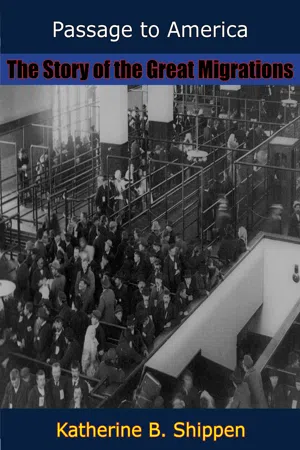
Originally published in 1950, this is a comprehensive account of the peaks and troughs of migrations to America, beginning with its original formation of the nation through to the influx of Displaced Persons.
Relating the American migrations to great movements in world history on the one hand, and to the national ideal of freedom on the other, the author discusses national and cultural migrations specifically—the French, Dutch, Norwegians, Swedes, Germans, Irish, Chinese, Italians, Russians, Russian Jews, and the refugees and survivors of World War II.
"Stimulating reading for all young Americans, at home or in the classroom."—Kirkus Review
"Passage to America was not written as propaganda, yet its very nature makes it a weapon fitted to any hand that is raised in the fight for freedom….It is good in these days to find a book that in strong but not bitter style denounces tyranny and, without any frantic flag-waving, upholds the democratic way of Life."—Sunday Review of Literature
"A living story of the meaning of democracy. The narrative moves easily and smoothly, and the book should arouse the interest of anyone over twelve or thirteen who looks at it."—The Horn Book
- 119 pages
- English
- ePUB (mobile friendly)
- Available on iOS & Android
eBook - ePub
About this book
Information
Subtopic
American Civil War HistoryIndex
HistoryVIII. From the Potato Famines of Ireland
THE thing people remembered about Ireland after they had left it was its green color as it lay there in the sea. There was a little gray toward the west where the rocks stuck through the sod, and there was a brown bog toward the north, but for the most part it was green—greener than any other place, with the sea washing up all around it, and the mists blowing over, and the rains.
The sound of the names of Ireland were hard for her people to forget after they had come to the New World. It was a pleasure to say over the names of the counties—County Galway, County Wicklow, County Offaly, County Kerry, and all the others. Down in the south was County Cork.
Dublin, the ancient capital of Ireland that sits at the edge of Dublin Bay, has changed its name now. It is called by the Gaelic name that slips from the tongue, Baile Atha Chath—but in the first part of the nineteenth century it was Dublin. There were only a few other cities, like Cork and Cobh and Belfast. They did not amount to much—a few old eighteenth-century houses half gone to ruin, and slums the like of which most people in the world have never seen, and a marketplace.
For the Irish people were country people, almost all of them. They lived in whitewashed cottages with thatched roofs, and the peat for their fires was piled up beside their doors. In the spring there was the smell of hawthorn blossoms on the hedges along the lanes.
It was always a friendly country. There every man knew every other man’s business and could do him a favor if he was so inclined. Nobody needed to be lonely there. It was a country full of warm fellowship, and there you could always hear good conversation over a mug of stout. In the west of Ireland, in places like Connemara and Kerry, the talk turned, artlessly, to poetry.
The priests of course looked after everyone’s soul in those days of the early nineteenth century. They advised about their bodies too, more often than not. And if the fairies bothered a man, putting burrs into his mare’s mane or turning the milk sour, why the priests knew how to exorcise the fairies. Fairies were after all only the spirits of those who had died without the last rites of the Church.
A friendly country, it had always been, if rather a poor one. Why then did so many leave it, to sail across the ocean to America? Be sure they did not leave their beloved island until they had to—until they could think of no other way to turn.
But in the 1840’s bad times came to Ireland. Some would say that it was the fault of England that all the trouble came. But you might have thought that Nature was to blame. Or maybe it was the Irish themselves. It would be pretty hard to say, definitely.
Certainly, in the early 1800’s, when factories were beginning in many places and changing the ways that people lived, England wanted to keep the machines to herself. Her colonies could send her the raw materials, she said; she would manufacture the raw stuff into useful goods and send them abroad to sell. The Irish people must produce food and send it to England so that the English people could spend their time not in farming but in the factories, People must eat if they were to run machines.
So now the English encouraged the Irish land owners to plant their fields with grain so that the English factory workers could have plenty to eat. The work of planting and harvesting was to be done by those who owned no land, the Irish tenantry. And since the tenants had no money with which to pay their rent, they paid in days’ work. Some have estimated that they paid half of the working days of the year to the landlord. If they were in arrears the government police helped to evict them from their cottages. It was easy to find new tenants.
The tenants depended on potatoes for their food. With an acre or an acre and a half, they could support a family on potatoes. The haulm or stalk of the potatoes could be used to thatch the roof, and the peelings could be fed to the pig. Most people tried to keep a pig, not that they would enjoy the bacon and ham themselves, but that they might sell the pig when it was fattened and so have something to buy clothes and shoes.
There was one special kind of potato called a “lumper.” It would grow on almost any kind of land whether it was fertilized or not. The people planted lots of those. Out of about nine million people who were living in Ireland in 1845, four million, it is said, depended entirely on potatoes. Who knows how many “lumpers” they planted?
“Och, we had everything we wanted in the potato, God bless it,” one Irishman said. “We had only to throw a few of them in the hot ashes and then turn them, and we had our supper.”
Plenty of potatoes and chickens and a pig—and taking the chickens and the pig to market to get a little money and buy clothes and food for a family—that was the way a man lived in the old days. But gradually as rents grew higher pigs and chickens were given up. People could not get enough to feed them with. It was potatoes altogether then.
Potatoes are a bad food to depend on. Eating potatoes and nothing else did not give a man much strength. And even if you left the potatoes in the ground till they were ready to be dug up and eaten, it was very hard to keep them from one harvest to the next. During the months of May, June, July, and August the old crop was exhausted and the new one not yet ready to eat. Those months were called the “meal months.” In the “meal months” people who could afford it bought meal and had stirabout to eat. But those who had nothing to buy grain with planted their potatoes for the next spring and took to the roads and begged. Some men had enough to get passage on steam packets to England in the “meal months.” They took their sickles with them and worked on the English farms until the new potato crop was ready. When they came back they sometimes had as much as three pounds in their pockets for the summer’s work. There were not many who could do that.
Because the laborers were so poorly nourished and could not work very hard, the Irish landlords got the idea that they were not producing enough. It would be better to turn the land into cattle ranges; there was a good market for roast beef in England. Then in many places the tenants were evicted. The government agents knocked the mud houses down with crowbars so that the tenants would not try to come back to them. Still, most of the Irish managed to get on somehow, that is, until 1845.
In 1845 a blight shriveled the potato plants all over Europe. The green plants grew black and rotted on the stems. In countries like Germany where potatoes were an important part of the peasants’ fare, it was a serious matter. In Ireland it was a tragedy.
It was September, 1845, that the blight was first seen on the potato plants. That year half the potato crop was ruined. In 1846 the blight had spread all over the island; no potatoes at all were saved. It was the same in 1847, and in 1848, and in 1849. At first the people faced the situation calmly enough, not realizing that tragedy had come. Panic came after that, and then despair. Finally, when they realized what the potato famine meant, some families went into their cottages to wait for death, but others took to the roads and wandered aimlessly from one parish to another.
Then the people were dying in multitudes. In parts of the west many lay unburied or were slid unceremoniously into hastily dug graves. Masses and prayers of the priests seemed to avail nothing. The great patriot Daniel O’Connell set out for Rome to seek the intercession of the Pope. But he died before he reached the Holy City, and the potato blight continued.
Soon “famine fever” was raging as well as starvation. People were dying by the thousands now. Mary Hayden and George A. Moonan in their Short History of the Irish People, write:
By the roadside the people lay down and died. Neighbors entering a cabin, found within the corpses of all those who had lived there. Starving crowds made their way to the newly built workhouses...where in the overcrowded buildings, the famine fever raged, and every morning a cartload of corpses was conveyed to the great pit dug in the churchyard to receive them.
In some places the people ate seaweed. In some they ate dead donkeys. There were rumors of cannibalism.
What could the British government do in such a crisis? They did nothing until it was too late. They tried then to send grain to Ireland from England, but under the Navigation Acts this could be carried only in British vessels, and none were available when they were needed. It might have been possible to carry cargoes of grain in battleships, but this was considered an interference with trade. They tried to give the Irish employment by public works, but it was thought that building a railroad, for example, would interfere with private enterprise. Such money as was spent on public works in Ireland was mostly wasted.
When news of the famine spread to America, the Quakers were quick to send what aid they could, and the United States Government sent two battleships to Ireland, loaded down with American grain. But these things amounted to nothing in the face of the need. If help was to come, the Irish people must give the help themselves. Then many decided that their only hope lay in escape: they made up their minds to leave Ireland. And now the great Irish migration to America started—a movement that was to last for fifty years. Down all the Irish roads at that time the people were moving. Some had their shabby belongings in carts; some could easily carry all they owned on their shoulders. At the seaports they paused and camped, waiting for the departure of the steamer that would take them to America. One writer said that “only the old and helpless stayed in Ireland, keening for the dead.”
There was a good deal of shipping between Ireland and America in those days, and the booking agents, seeing the flood of passengers, raised the passage charge from three pounds to five pounds, and then to eight pounds. Somehow or other the stricken people managed to pay it. “Poor Ireland’s done,” they said to one another. “We must get away.”
How did they manage to get the money to pay the passage? It is not clearly known. Perhaps some had a few tools or a bit of furniture they could sell; some may have had a pound or two tucked away under the thatch of the roof—their life’s savings; perhaps some had not paid the year’s rent and gave it to the shipping agent instead of the landlord. As time went on, those who were already in America sent back money to bring wives and sisters and brothers across; somehow they managed. Some of them remembered afterward how their friends on the shore lighted great bonfires when they were leaving. The leaping flames and the tall pillar of smoke were the last things they could see as the green shores of Ireland dropped away from their sight and they were rolling in the Atlantic swell.
They landed in all the port cities, but most of them came to New York. You might suppose they would have had difficulty supporting themselves in the New World: most of them were unskilled. They knew no handicrafts and did not even know how to farm in the way it was done in America. Most of them had very little education and no money. But they had a buoyant spirit and were glad to have the ocean between them and their old lives. They took whatever jobs they could get, and there were plenty of jobs in America then, for America was building.
So the Irishmen were hodcarriers for the buildi...
Table of contents
- Title page
- TABLE OF CONTENTS
- DEDICATION
- Acknowledgments
- I. People Moving
- II. A New Nation Is Born
- III. Émigrés and Bonapartists
- IV. The Dutch-Congregations Leave Home
- V. The Norwegians Read the “America Book”
- VI. The Swedes Arrive
- VII. Farmers and Revolutionists Leave Germany
- VIII. From the Potato Famines of Ireland
- IX. The Chinese Coolies Hear of the New World
- X. From Italy to Mulberry Street
- XI. The Escape from Russia
- XII. American Slavery and American Freedom
- XIII. The Newest Group Comes Home
- REQUEST FROM THE PUBLISHER
Trusted by 375,005 students
Access to over 1.5 million titles for a fair monthly price.
Study more efficiently using our study tools.
Frequently asked questions
Yes, you can cancel anytime from the Subscription tab in your account settings on the Perlego website. Your subscription will stay active until the end of your current billing period. Learn how to cancel your subscription
No, books cannot be downloaded as external files, such as PDFs, for use outside of Perlego. However, you can download books within the Perlego app for offline reading on mobile or tablet. Learn how to download books offline
Perlego offers two plans: Essential and Complete
- Essential is ideal for learners and professionals who enjoy exploring a wide range of subjects. Access the Essential Library with 800,000+ trusted titles and best-sellers across business, personal growth, and the humanities. Includes unlimited reading time and Standard Read Aloud voice.
- Complete: Perfect for advanced learners and researchers needing full, unrestricted access. Unlock 1.5M+ books across hundreds of subjects, including academic and specialized titles. The Complete Plan also includes advanced features like Premium Read Aloud and Research Assistant.
We are an online textbook subscription service, where you can get access to an entire online library for less than the price of a single book per month. With over 1.5 million books across 990+ topics, we’ve got you covered! Learn about our mission
Look out for the read-aloud symbol on your next book to see if you can listen to it. The read-aloud tool reads text aloud for you, highlighting the text as it is being read. You can pause it, speed it up and slow it down. Learn more about Read Aloud
Yes! You can use the Perlego app on both iOS and Android devices to read anytime, anywhere — even offline. Perfect for commutes or when you’re on the go.
Please note we cannot support devices running on iOS 13 and Android 7 or earlier. Learn more about using the app
Please note we cannot support devices running on iOS 13 and Android 7 or earlier. Learn more about using the app
Yes, you can access Passage to America by Katherine B. Shippen in PDF and/or ePUB format, as well as other popular books in History & American Civil War History. We have over 1.5 million books available in our catalogue for you to explore.