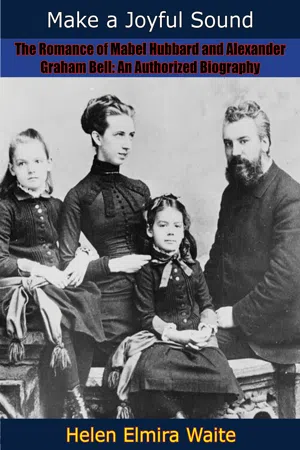
The personal factors behind the great inventions and discoveries that change the world are often overlooked, to history's loss, and nowhere has this been more true than in the case of Alexander Graham Bell, inventor, experimenter in genetics and aerodynamics, great-hearted friend and teacher of the handicapped. Without his wife's part in it, his story is only half told.
At first the couple seemed a rather unlikely match. Grown to a charming, self-assured maturity after a childhood illness that had robbed her of her hearing, lively Mabel Gardiner Hubbard of Brattle Street, Boston, was not initially impressed with the gangling, dark-haired Scotsman who taught her "Visible Speech." For Alexander Graham Bell, born of an elocutionist father and extraordinarily gifted with musical ability, falling in love with this petal-checked student of fifteen who was totally deaf was a strange emotional climax to a life devoted to the study, production and enjoyment of sound. But the sheltered girl who could not share with him the pleasure of hearing was not only a delightful, socially talented person, but alert in business matters; and the poor young teacher with a mind unadapted to everyday affairs was destined to become, with her help and encouragement, a brilliant inventor whose best-known product would soon encompass the world almost as effectively as did his own warm and generous heart….
Helen Elmira Waite's intimate study of the lovable, many-sided genius, his family life, his imaginative work and the remarkable woman who stood beside him is based upon official records (some of which are reproduced here), upon the reminiscences of the Bell children and friends, and upon family correspondence never before made available to a biographer.
Illustrated with rare photographs.
eBook - ePub
Make a Joyful Sound
The Romance of Mabel Hubbard and Alexander Graham Bell: An Authorized Biography
- 265 pages
- English
- ePUB (mobile friendly)
- Available on iOS & Android
eBook - ePub
Make a Joyful Sound
The Romance of Mabel Hubbard and Alexander Graham Bell: An Authorized Biography
About this book
Information
Subtopic
American Civil War HistoryIndex
History1—And Goodness and Mercy Shall Follow Me
SOMEHOW THE VERY AIR IN THE ROOM SEEMED TO HAVE GROWN colder and more oppressive after the sound of Mr. Stone’s uncompromising words had died away. Gardiner Greene Hubbard had heard the same verdict so often in the past months that it echoed in his ears wherever he went, or whatever he was doing. In Boston—Philadelphia—New York—always the same! All the authorities had shaken their heads glumly, but they would add, “Perhaps if you see Mr. Stone of the Hartford Asylum...We have heard they have been doing experiments with articulation there.”
But here were the Reverend Collins Stone and Mr. Turner, both regarding him with kindly, understanding eyes, and their verdict had been even more devastating than the others. Gardiner Hubbard thought he had been prepared to hear it, but suddenly he heard the desperate note in his own voice as he expostulated. “But Mabel can speak! We notice she is using more words each day——”
Mr. Turner closed his lips grimly, and Mr. Stone, Principal of the American Asylum, shook his head decisively. “You cannot retain her speech, Mr. Hubbard. She will be dumb in three months because she cannot hear. And if by some chance she did learn to produce words, her voice would be so unpleasant it would be painful to hear it—it would be worse than the screech of a steam locomotive! How old did you say the child is now? Five? When she is ten you can place her in a deaf-and-dumb asylum and she’ll be educated by the sign language.”
Gardiner Hubbard thought of his winsome little daughter just beginning to emerge from the lassitude into which she’d been plunged by the virulent attack of scarlet fever that had destroyed her hearing; how for months she had lain in such a state of complete weakness and bewilderment that the doctors had feared her brain had suffered as well as her hearing; and how wonderful it had been when at last she had begun to recognize those around her and to respond to their love and attention, and even to say a few words. Now Mr. Stone was telling him that in five more years he could consign his little girl to an “asylum”—he winced at the word—where she would be taught the language of signs!
He remembered the children he had seen here, and in the other asylums he had visited—shy, strange, unresponsive, weirdly silent, making strange and baffling gestures in the air to one another. Out of sheer desperation he asked a final question: “But—surely I recall being told that Hartford had been making experiments in teaching deaf children to speak?”
Mr. Turner was looking more dour than before, and the principal threw out his hands and gave an expressive shrug. “Yes! We did indeed! After Dr. Howe’s and Mr. Horace Mann’s unfortunately overenthusiastic and undoubtedly exaggerated report of what they had seen in Germany—deaf children speaking and understanding the lips of others—we made every effort. You tell him the results, Mr. Turner.”
Was Mr. Turner taking an actual pleasure in the tragic verdict he was giving, Mr. Hubbard wondered, or was it simply the man’s naturally dry and brittle tones that made his words ring like hail stones in his visitor’s ears?
“We experimented with teaching speech here for eight years, Mr. Hubbard,” the former principal was saying, “A fruitless effort. We can give the deaf a measure of speech, to be sure, but we cannot make them understand the use of vocal language. It has never been done; it never will be done. Speech isn’t a part of the Hartford system now, and I hope it never will be!”
Mr. Stone was smiling benignly now. “But when your little girl is old enough to be taught, I predict she’ll be very happy with the beautiful language of signs!”
Suddenly Gardiner Hubbard was swept by the feeling that he had never wanted anything so much as he wanted to get away from the American Asylum, its officers and the atmosphere of stuffy satisfaction that seemed to hover over the whole place. He reached for his hat and was on his feet in one quick movement.
“Thank you both for your patience and advice, gentlemen”—he was extending his hand to each of them in turn—“but I’m afraid I don’t think much of your ‘beautiful language of signs’! Speech is good enough for me!”
This certainly was not the way interviews with the Reverend Collins Stone and Mr. Turner usually ended. The officials of the famous American Asylum were not accustomed to having their counsel flatly rejected. Despite the many times they had used the word “impossible” there was a look of confidence in the eyes of the gentleman from Cambridge that hadn’t been there at the start of the interview.
Mr. Turner looked dourly incredulous; Mr. Stone was frowning, and his annoyance was clear in the sudden coldness of his voice. “Your stubborn wilfulness will certainly do your daughter no good, Mr. Hubbard! I urge you to resign yourself to the fact that she was destined to be deaf and dumb! I had hoped we might help you see your right course.”
Mr. Hubbard gave him a fleeting smile. “I think you have, sir. I think you did it by mentioning Dr. Howe’s name! Good day, gentlemen!” He bowed himself out of the room and hurried down the long corridor, but it wasn’t until he had shut the great door of the Asylum behind him that he seemed able to draw a deep, free breath.
All through the late afternoon, as he watched the Connecticut hills slip past his train window, Gardiner Hubbard almost fought against the spark of new hope that Mr. Stone had so unwittingly kindled. He had followed so many false paths in the past few months that he involuntarily recoiled from the thought of another disappointment, but for Mabel...
Mr. Hubbard gripped the arm of his seat, thinking of his small daughter, bewildered and helpless in the silent world in which she was finding herself. He remembered the long, terrible weeks when she had lain frighteningly quiet, or moved on unsteady feet without seeming to notice anyone or anything about her, apparently confirming the doctors’ dire beliefs that her brain had been affected. Even now Mabel’s father drew a hard breath at the thought. But her young mother had refused to believe it. She had persisted in talking to the child, speaking to her eyes now instead of her ears, trying to win her attention by showing her familiar and once-loved things—and finally there had come a glorious day when she knew she had broken through and reached May’s consciousness.
Shortly before her illness May had been taken to Barnum’s Exhibition and had seen the famous General Tom Thumb and Mrs. Thumb. She had been so delighted with the tiny lady that her mother had purchased a photograph of the famous midget, and May would kiss it over and over, saying, “Little lady! Little lady!”
On the day that would always be vivid in the Hubbards’ memory, Mrs. Hubbard had a sudden inspiration. Lifting the little photograph from the bureau, she held it before May. “Little lady, May,” she said very distinctly. “Little lady!”
For the first time since her illness a slow smile dawned in the child’s face. A little hand reached out to take the picture. “Little lady,” the long stilled voice was repeating. “Little lady.” And then, with the familiar gesture, she had kissed the pictured face. The Hubbards were exultant that day!
Under her mother’s coaxing the little girl identified more and more objects, and even volunteered a few words. It tore at their hearts when she asked, “Why don’t the birdies sing? Why don’t you talk to me?” But the great and wonderful thing remained: Mabel herself could speak!
Realizing that she would need special education and training, Gardiner Hubbard had promptly begun a search in schools for the deaf for a person who would be able to teach the child, help her regain and keep her speech and understand those about her. And then the bitterest blow of all descended upon the Hubbards. Mr. Hubbard was a member of the Massachusetts State Board of Education, but he was appalled and disgusted to discover that in the enlightened year of 1863 there was no teacher who could—or would—teach speech to a little deaf girl. They all seemed united in saying she never would understand the words of others. Indeed, there were no real schools; the only places for the deaf were asylums. And both Gardiner and Gertrude Hubbard recoiled at that word.
Mr. Stone and Mr. Turner, considered foremost in their field, had merely confirmed the general verdict. But Mr. Stone’s remark about Horace Mann and Dr. Howe and the deaf children in Germany who could speak and understand others had set him thinking. “Unfortunately overenthusiastic and exaggerated”? Mr. Hubbard knew Horace Mann’s work with the Massachusetts school system and Dr. Howe’s reputation as head of the Perkins Institution for the Blind, and he couldn’t imagine either the precise Horace Mann or the dynamic Dr. Howe exaggerating. If they said they had seen deaf children achieving these things it had to be true.
Horace Mann was dead, but Samuel Howe was still very much alive, and almost a neighbor of the Cambridge Hubbards, in South Boston. Had help for Mabel been so close to them while her father was combing distant cities for it?
Staring out into the gathering darkness, Mr. Hubbard told himself not to hope. Why should a director of a school for the blind hold the answer for a deaf child when experts working with the deaf had said bluntly there was no answer—not the kind he wanted at any rate? And yet—tomorrow he would go to South Boston. The rumbling wheels took up the rhythm of his thoughts: “Don’t hope—see Dr. Howe—don’t hope—see Dr. Howe—don’t hope——”
What Mr. Hubbard had seen of institutions made him dread visiting another, but nothing in his rounds of institutions had prepared him for Perkins, with its wide and cheerful entrance hall, the glimpses of spacious rooms, the beauty of the marble floor and stairs—so different from the drabness he usually found. What amazed him most was the alert, fearless bearing of the pupils who passed him, and the eager brightness in most of the sightless faces. He marveled when the boy who had been directed to take him to Dr. Howe led the way up the broad flight of stairs as swiftly and confidently as Mr. Hubbard was mounting himself. The boy knocked at the door at the head of the stairs, and then opened it and stood aside to let the visitor enter, without being either pitiful or groping in any of his actions, as he announced, “A gentleman to see you, sir.”
“Oh, yes, Mr. Hubbard!” Dr. Howe had glanced at the card in his hand. “Come in! Thank you, Tom.” He was the first director of an institution whose smile and handshake gave Mr. Hubbard a conviction that here was a source of understanding and help.
“I know of your work on the Massachusetts State Board of Education, Mr. Hubbard, and I’m glad to see you here. You said in your note on your card you wanted my advice on something urgent. If I can help——”
Gardiner Hubbard swallowed and opened his dry lips, and suddenly the story of Mabel’s illness and all her parents’ fears and very small hopes was rushing out. As he talked, Mr. Hubbard thought he had never realized before how hopeless the situation really was. The very telling of his quest to save Mabel from a life of silence and isolation made him realize how helpless he was. And then he had a sort of shock—for the man opposite him was not shaking his head glumly and making negative sounds; he was listening with widening eyes and a face alight with excitement.
Someone once said that when Samuel Gridley Howe met a great challenge “he kindled like a torch.” Gardiner Hubbard saw him kindle now, and before the story was completely finished he was interrupting. “Of course you can save your daughter’s speech—and add to it until she has a normal vocabulary! And she will not sound like a steam locomotive! I know! Oh, I know all the arguments you’ve heard! Especially from our friends in Hartford!” He made a grimace. “But I myself have seen children who were born deaf being taught to speak and understand conversation. I have seen it and proved it to my own satisfaction.”
“Mr. Turner said something about German schools——”
Dr. Howe’s voice was a little grim now. “I’ll warrant he didn’t remark very favorably on that report! Twenty years ago Horace Mann and I took our wives on wedding trips to Europe. While there we visited schools for both normal and afflicted children. And in Germany we saw schools where even the children born deaf used speech clearly and fluently and followed conversations from the Ups of others—lip reading, it’s called. And it’s no fraud. I tested the pupils myself. When we came home Mr. Mann published his report on what we’d seen.”
Again Dr. Howe made an expressive face. “You should have heard the outcry! And the names we were called! So I found two deaf children and taught them to speak and lip-read myself. I assure you it can be done very successfully, Mr. Hubbard, and you can accomplish it with your little girl. Mr. Mann and I had hoped to see oral schools set up for the deaf in America, but in some ways we are disgracefully backward. We like our institutions rather than schools.”
It flashed upon Mr. Hubbard that this was the difference between the other places he’d seen and Perkins. They had been institutions—asylums. Perkins was a true school. But even with hope soaring within him, he was still questioning.
“But—if all this was published and proved twenty years ago why does everyone tell me ‘Impossible’ now? And Mr. Turner assured me that at Hartford they had experimented eight years——”
What they did was to throw in a few half-hearted speech lessons with their precious sign language!” Dr. Howe’s growl was impatient. “‘An oral department,’ they said. Of course it didn’t work! Mixing speech and signs never will! I was grieved to have the matter end so, but Mr. Mann had his hands too full of public school matters, and I too much to do here to press it. Opposition rose all around us——”
“Even in the face of your proof?” It seemed cruel and unbelievable, but Mr. Hubbard knew it was true.
“Yes,” Dr. Howe’s face saddened, “chiefly from Mr. Thomas Gallaudet of the American Asylum. He set his face against us, and the other institutions and the public followed his lead.” And then the wonderful smile broke out again. “But perhaps we are beginning again with your little girl! And now let’s think about the little Mabel.” He leaned forward, suddenly intent and sober. “Go on just as you say your wife has been doing. Talk-talk-talk to her, just as you do to your other children. Make sure she is watching your lips. And teach her by vibration. Have her feel your throat—the cat’s purr—the piano. And make her talk. Whenever she wants anything, make her speak for it. Don’t let anyone use signs to her, and if she uses them, pretend not to understand. It will be heartbreaking at first, but it will pay off. And she really has one great advantage—she has heard and used her voice for the first five years of her life. In a year or so you can probably locate a teacher for her, but just now the important thing is to establish her speaking and lip-reading ability, and I think her parents can do more for her there than any teacher. Let me know how she gets on.”
Mr. Hubbard knew later that he must have managed to stand up, and he hoped he had been able to murmur some kind of thanks. He knew that he had gripped the director’s hand, and that Dr. Howe had nodded his understanding, his own voice suspiciously husky, as he repeated, “Let me hear!”
Somehow Mr. Hubbard had sped down the stairs; by some miracle he had boarded the right street car for Cambridge; but it was as if Dr. Howe had suddenly opened a...
Table of contents
- Title page
- TABLE OF CONTENTS
- DEDICATION
- AUTHOR’S NOTE
- ACKNOWLEDGMENTS
- FOREWORD
- 1-And Goodness and Mercy Shall Follow Me
- 2-Steppingstones for Mabel
- 3-Star Witness
- 4-Professor of Visible Speech
- 5-Boy with a Speaking Machine
- 6-The Turning Road
- 7-The Talking Glove
- 8-“I Can Telegraph Speech”
- 9-“Get It!”
- 10-Tempestuous Summer
- 11-“Mr. Watson, I Want You!”
- 12-Reluctant Journey
- 13-Adventurer in Sound
- 14-Bride in England
- 15-“A Prophet Is Not Without Honor”
- 16-Washington Circle
- 17-Little Ship Without a Compass
- 18-Transplanted Bit of Scotland
- 19-Lady of Baddeck
- 20-Mabel of Beinn Bhreagh
- 21-The Kites Fly High
- 22-A Man in the Air
- 23-Footprints on the Steps
- 24-Beautiful Mountain
- POSTSCRIPT
- APPENDIX
- BIBLIOGRAPHY
- ABOUT THE AUTHOR
- REQUEST FROM THE PUBLISHER
Trusted by 375,005 students
Access to over 1.5 million titles for a fair monthly price.
Study more efficiently using our study tools.
Frequently asked questions
Yes, you can cancel anytime from the Subscription tab in your account settings on the Perlego website. Your subscription will stay active until the end of your current billing period. Learn how to cancel your subscription
No, books cannot be downloaded as external files, such as PDFs, for use outside of Perlego. However, you can download books within the Perlego app for offline reading on mobile or tablet. Learn how to download books offline
Perlego offers two plans: Essential and Complete
- Essential is ideal for learners and professionals who enjoy exploring a wide range of subjects. Access the Essential Library with 800,000+ trusted titles and best-sellers across business, personal growth, and the humanities. Includes unlimited reading time and Standard Read Aloud voice.
- Complete: Perfect for advanced learners and researchers needing full, unrestricted access. Unlock 1.5M+ books across hundreds of subjects, including academic and specialized titles. The Complete Plan also includes advanced features like Premium Read Aloud and Research Assistant.
We are an online textbook subscription service, where you can get access to an entire online library for less than the price of a single book per month. With over 1.5 million books across 990+ topics, we’ve got you covered! Learn about our mission
Look out for the read-aloud symbol on your next book to see if you can listen to it. The read-aloud tool reads text aloud for you, highlighting the text as it is being read. You can pause it, speed it up and slow it down. Learn more about Read Aloud
Yes! You can use the Perlego app on both iOS and Android devices to read anytime, anywhere — even offline. Perfect for commutes or when you’re on the go.
Please note we cannot support devices running on iOS 13 and Android 7 or earlier. Learn more about using the app
Please note we cannot support devices running on iOS 13 and Android 7 or earlier. Learn more about using the app
Yes, you can access Make a Joyful Sound by Helen Elmira Waite in PDF and/or ePUB format, as well as other popular books in History & American Civil War History. We have over 1.5 million books available in our catalogue for you to explore.