Like Gallipoli, the coastal fortress of Tobruk in northern Africa has a special place in Australian's war annals. For eight month in 1941 the Australian Imperial Force helped hold the besieged town against German forces that had hitherto suffered no check.
With the distinctive mix of vigour and intelligence that made him a celebrated correspondent during and after the Second World War, Chester Wilmot here tells the story of the fighting in and around Tobruk from January to December 1941. His compelling book, based on personal observation, official documents and eyewitness accounts, is given even greater impact by the use of enemy sources including extracts from the diaries of German officers.
As well as commemorating the achievement of the besieged Allied troops against the superior strength of the Germans, Tobruk gives an exceptionally readable insight into the critical North African campaign.
"Tobruk set an example of courage in the face of superior strength, of firm spirit in spite of hardship, of cheerful defiance and offensive defence."—CHESTER WILMOT
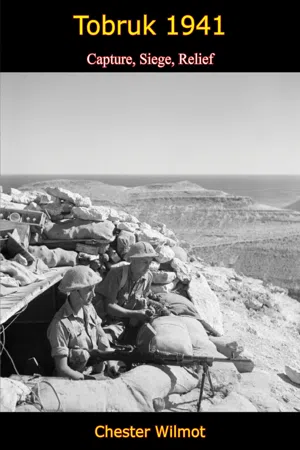
- 335 pages
- English
- ePUB (mobile friendly)
- Available on iOS & Android
eBook - ePub
About this book
Trusted by 375,005 students
Access to over 1.5 million titles for a fair monthly price.
Study more efficiently using our study tools.
Information
Subtopic
European HistoryIndex
HistoryCHAPTER I—Before Zero
“ASK, and it shall be given unto you; seek, and ye shall find; knock, and it shall be opened unto you.”
These words, first quoted by Saint Matthew, were quoted again by Winston Churchill in his Christmas signal to General Sir Archibald Wavell in December 1940. With his genius for weighing the political significance of military events, Churchill knew that the Army of the Nile, then pausing on the frontier of Libya after its victory at Sidi Barrani, must go on.
It was only six months since Dunkirk. That dark night might have been long drawn-out if the R.A.F. fighter pilots in the Battle for Britain had not scattered the then-unbroken clouds of defeat and let in the dawn. Yet it was a grey dawn of foreboding storm-clouds, from which the Axis lightning might strike any time—at Britain, at Suez.
The first shaft of light came in through the back door. Hunted from the Eastern Mediterranean by Admiral Sir Andrew Cunningham’s fleet, the Italian Navy took shelter behind Taranto Harbour’s guns. But on the night of November 11th, 1940 the Fleet Air Arm reached out to the Italian lair, sank a battleship and two cruisers, and left two battleships beached. For twenty-four hours Cunningham trailed his coat on Mussolini’s doorstep, but the Italian Navy stayed inside. With Cunningham commanding the sea, Wavell could attack on land with greater hope of victory.
Before Christmas the Middle East sun was beginning to show above the horizon. Two-thirds of Mussolini’s Tenth Army, which had been poised to strike for Suez, had been captured at Sidi Barrani or shut up in Bardia. For the time being the threat to Egypt was scotched. With Bardia taken, Wavell’s immediate military objective would be gained. Mussolini could not strike again with the small Italian forces still at large in Cyrenaica, and Cunningham’s ships would see to it that he was not swiftly reinforced. Wavell had little to gain for the defence of Suez in going beyond Bardia and thus adding to the strain on his over-taxed resources of men and material, already in action on three continents from Malta to Aden, from the Sudan to Albania.
Taking a world view, however, Churchill knew that the Army of the Nile could not stop. The Italians, reeling under the blow of Sidi Barrani, must be driven to the ropes. Part of Mussolini’s Empire must be conquered under his very nose; the destruction of his Army must go on till his humiliation was complete. With the Greeks pursuing the Italians into Albania, the British could not afford to call a halt on the Libyan border.
Nor were the British people in a mood for halting. After the defeats and sufferings of the past year it was not enough to beat off the enemy attack on Suez. They wanted to see their own troops sweep through Axis territory, as the Germans had swept through Europe. If the British people were to go on “taking it” through 1941, as they had during the latter part of 1940, they needed the stimulus of a striking victory. Men and women working in the bombed factories of Britain looked for a sign that the arms they had endured so much to fashion really were the tools of victory. America, still torn by dissension, must be shown that the cause she was asked to support was far from being lost.
More important, a strong threat must be established to the Axis in North Africa before spring brought back “invasion weather” to the English Channel. Before then German attention must be turned to the Mediterranean and away from Britain. Knowing all this, Churchill might well say to his Middle East Commander-in-Chief—as he did—“Knock, and it shall be opened unto you.”
At noon on January 5th, 1941, Italian resistance at Bardia ended. By dawn next morning Wavell’s vanguard was knocking at the door of Tobruk. But whether or not Mussolini’s Libyan Empire would be opened to him depended on what happened at that doorway.
Wavell’s desert commander was Lieutenant-General Richard O’Connor—a wisp of a man, with a bold spirit and a shrewd brain. O’Connor knew—as Rommel found out later—that no force which bypassed Tobruk could advance far beyond it. The “Imperial Army of the Nile”, which was really little more than O’Connor’s 13th Corps, had not enough motor transport to maintain its two divisions further than a hundred miles from the nearest port or railhead. Using the Sollum harbour and Bardia’s water supply O’Connor’s forces could attack Tobruk, but they could not advance the next stage to Derna until they had access to the water and harbour of Tobruk. There was certainly not the transport to supply one force containing Tobruk and another continuing westward.
Mussolini’s Libyan Commander-in-Chief, Marshal Rodolfo Graziani, still had enough troops to give serious opposition to O’Connor’s advance. At Tobruk and Derna he had two infantry divisions and an armoured force with 120 new medium tanks. He had more medium tanks than O’Connor. He had twice as many guns. In his 13th Corps O’Connor had only the 7th British Armoured Division, the 6th Australian Infantry Division, and a small reserve of British infantry, artillery, machine-guns and heavy “I” tanks.{1} He had fewer men, but these had a clear advantage in training, skill and spirit, and in addition the British had command of the sea and superiority in the air.
Nevertheless, O’Connor could not risk the inevitably heavy losses of an immediate assault on Tobruk, for the Italians had prepared it as their main fortress for the defence of Cyrenaica. After Bardia it took a fortnight to gather the necessary forces and supplies for the next attack. Preparations, however, were delayed more by the weather than by the Italians.
Every few days during this fortnight sandstorms clogged the British supply lines. Swirling dust blotted out everything and brought work and traffic almost to a standstill. I was caught in one of these storms on January 15th on the Sidi Barrani-Tobruk road. It was thicker than the worst London fog. You could not see a man ten yards in front of you, and even the sun was browned out.
In Sollum harbour that day, troops unloading supply ships could barely see to work. On the road up the cliff behind them, a captured 10-ton truck missed a sharp turn and plunged into space. Over the beds of the hospital in Bardia, the storm spread an extra blanket. Along the road between Bardia and Tobruk one of the few vehicles which tried to move, got off the tarmac and blew up on a thermos bomb. Around Gambut drome thirty-eight miles east of Tobruk, reconnaissance aircraft, which should have been taking photographs or spotting for the artillery, were grounded. In the wadis near Gambut, ordnance engineers had to lash tarpaulins over the precious “I” tanks they had been overhauling, and stop work. On the bare plateau outside Tobruk, Australian and British troops huddled in trucks with anti-gas goggles over their eyes, handkerchiefs across their noses and mouths, or lay in slit-trenches with blankets over their heads while the scourging sand steadily silted in. Preparations for the attack came almost to a halt.
The sandstorm died at dusk. Next morning was bright and clear and the road was packed with traffic making up for lost time. On the shell-torn road between Sollum and Bardia we overtook a long convoy of Italian Diesels driven by dusty, unshaven Diggers. The trucks still bore their Italian markings, but the Australians had given them new numbers—“Wop 69”, “Wop 73”; and new names—“Dago Dragon”, “Spaghetti Sue”, “Benito’s Bus”. Without the hundreds of vehicles captured at Sidi Barrani and Bardia, the speed of the advance through Cyrenaica could never have been maintained.
Inside the Bardia defences, a “Mobile Bath and Decontamination Unit” had set up showers at an Italian water-point beside the road. A convoy had stopped to let some grimy gunners have their last shower until Tobruk fell. At the water-point two huge captured water-trucks were filling up. Near by a military policeman was questioning westbound drivers—“Got any water? Fill your tins or take two from here. Up there the boys are on half a gallon a day for everything.”
A mile out of Bardia a blue enamel sign said TOBRUCH 119 km. Underneath it was a warning—KEEP TO THE ROAD: BEWARE THERMOS BOMBS.{2} Four or five trucks had been blown up already by these bombs, which Italian aircraft had scattered alongside the road.
For the first fifteen miles the road was either pock-marked by shelling or broken by enemy demolition. From there onwards it was a smooth, black highway, stretching like a liquorice strap across the desert. A motley collection of British and captured vehicles streamed westward. Ten-ton Italian Diesels ground laboriously on under 12-and 15-ton loads; staff cars, light trucks and empty ambulances sped past; dust-laden dispatch riders on Italian motor-bikes wove their way in and out among the traffic fast and slow, overtaking everything. Along a desert track, clear of thermos bombs, a few Matildas and some reconditioned Italian tanks rolled slowly towards Tobruk, husbanding their tracks and engines. The road was an ideal strafing target, but the R.A.F. ruled the skies. From time to time Hurricanes on road patrol roared past just above the telegraph poles.
Nothing checked the westbound traffic until it came to a barricade across the road and a sign—
If you lika da spaghetti-KEEP GOING. Next stop TOBRUK-27 Kms.
Fifteen miles to the town, but only four to the fortified perimeter. From this road block, however, you could see nothing of the defences. Even a couple of miles closer all that could be picked up was the outline of barbed wire etched against the skyline. On every side the flat and featureless desert swept away to the horizon. Every yard of the level plateau was covered by Italian machine-guns, firing from concrete posts, flush with the ground and invisible even from a few hundred yards. They were hard to get at and hard to see, but nothing restricted their fire, nothing blocked their view except darkness or duststorm. For the attacker there was no cover. He could be seen a mile or more from the defences and could be covered by fire all the way in.
That was Tobruk’s strength. It was not a natural fortress. Its defences had been hewn from the uncompromising desert at tremendous cost. The Italians had fortified this piece of wasteland because here there is a harbour and a few springs of moderately pure water—the only good harbour between Benghazi and Alexandria; the only good water supply between Derna and Mersa Matruh.
The harbour is the heart of the Fortress. The defences built to protect it run in a rough semicircle across the desert from the coast eight miles east of the harbour to the coast again nine miles west of it. This fortified semicircle makes a perimeter thirty miles long, enclosing an area roughly the size of Adelaide and its suburbs. The harbour is not large—only two and a quarter miles long and a mile wide-but it is safe and fairly deep. Its northern shore is protected by a high tongue-shaped promontory, on the slopes of which the Italians built the garrison town of Tobruk—a cluster of little white houses, big concrete barracks and other naval and military installations covering an area about half a mile by a mile.
Between the high coastal cliffs and the perimeter the desert plateau rises in three steps—each step leading to a flat shelf a mile or two wide before the next escarpment carries the plateau another fifty to a hundred feet higher. The edge of these escarpments is broken by a series of rough wadis, useful for concealing artillery and headquarters.
The coastal cliffs are also broken by wadis and several of these, with their reliable wells and occasional clump of thirsty palms, might almost pass for oases. These are the least unpleasant places in the Fortress, for in addition they open on to sheltered beaches of white sand. Elsewhere there is a wasteland of rock and bare, brown earth bound together by stubby, thorny camel-bush. It is a hard, cruel and parched land and even the ten inches of rain, which reputedly fall each year, often leave the desert two or three miles inland bone dry. There nothing lays the dust or gives shade from the fierce summer sun or shelter from the winter’s bitter wind.
Around the 30-mile perimeter the Italians by January 1941 had drilled and blasted a fairly strong defensive system. First there was a double wire fence—five feet high. Outside this they had begun to dig an anti-tank ditch. Where it was finished, it was twenty feet wide and twelve feet deep and in most places it had been cut out of solid rock. In the southern sector, however, for four miles east of the El Adem road the d...
Table of contents
- Title page
- TABLE OF CONTENTS
- DEDICATION
- LIST OF MAPS
- PREFACE
- CHAPTER I-Before Zero
- CHAPTER II-Breakthrough
- CHAPTER III-The Thrust to the Town
- CHAPTER IV-The Round-up
- CHAPTER V-The Town We Took
- CHAPTER VI-Tobruk Derby
- CHAPTER VII-The Fortress and its Garrison
- CHAPTER VIII-The Easter Battle
- CHAPTER IX-Tobruk Commander
- CHAPTER X-Offensive Defence
- CHAPTER XI-Battle of the Salient
- CHAPTER XII-Rommel Changes his Tune
- CHAPTER XIII-Wouldn’t It?
- CHAPTER XIV-Holding the Salient
- CHAPTER XV-Salient Scenes
- CHAPTER XVI-The Battle for No-Man’s Land
- CHAPTER XVII-“We Never Say ‘No’”
- CHAPTER XVIII-Smashing the Stuka Parade
- CHAPTER XIX-Keeping the Harbour Open
- CHAPTER XX-So Long Tobruk
- CHAPTER XXI-What a Relief
- EPILOGUE
- APPENDIX I-TOBRUK GARRISON
- APPENDIX II-HONOURS AND AWARDS
- APPENDIX III-THE MAIN EVENTS OF 1941
- REQUEST FROM THE PUBLISHER
Frequently asked questions
Yes, you can cancel anytime from the Subscription tab in your account settings on the Perlego website. Your subscription will stay active until the end of your current billing period. Learn how to cancel your subscription
No, books cannot be downloaded as external files, such as PDFs, for use outside of Perlego. However, you can download books within the Perlego app for offline reading on mobile or tablet. Learn how to download books offline
Perlego offers two plans: Essential and Complete
- Essential is ideal for learners and professionals who enjoy exploring a wide range of subjects. Access the Essential Library with 800,000+ trusted titles and best-sellers across business, personal growth, and the humanities. Includes unlimited reading time and Standard Read Aloud voice.
- Complete: Perfect for advanced learners and researchers needing full, unrestricted access. Unlock 1.5M+ books across hundreds of subjects, including academic and specialized titles. The Complete Plan also includes advanced features like Premium Read Aloud and Research Assistant.
We are an online textbook subscription service, where you can get access to an entire online library for less than the price of a single book per month. With over 1.5 million books across 990+ topics, we’ve got you covered! Learn about our mission
Look out for the read-aloud symbol on your next book to see if you can listen to it. The read-aloud tool reads text aloud for you, highlighting the text as it is being read. You can pause it, speed it up and slow it down. Learn more about Read Aloud
Yes! You can use the Perlego app on both iOS and Android devices to read anytime, anywhere — even offline. Perfect for commutes or when you’re on the go.
Please note we cannot support devices running on iOS 13 and Android 7 or earlier. Learn more about using the app
Please note we cannot support devices running on iOS 13 and Android 7 or earlier. Learn more about using the app
Yes, you can access Tobruk 1941 by Chester Wilmot in PDF and/or ePUB format, as well as other popular books in History & European History. We have over 1.5 million books available in our catalogue for you to explore.