First published in 1947, Pearl Harbor: The Story of the Secret War is widely regarded as the first Revisionist book about the attack on Pearl Harbor on December 7, 1941, and the complex history which preceded and followed it.
Although it drew both criticism and praise on its initial release, this book covers many aspects of that war, its antecedents and its consequences, and ranks among the best of the numerous volumes published on the subject.
"Those who object to historical skepticism may complain that my book is no contribution to the political canonization of its central figure. That is no concern of mine. As to the purpose my book is intended to serve, some observations from the minority report of the Joint Congressional Committee which investigated the Pearl Harbor attack are pertinent: 'In the future the people and their Congress must know how close American diplomacy is moving to war so that they may check in advance if imprudent and support its position if sound ... How to avoid war and how to turn war -- if it finally comes -- to serve the cause of human progress is the challenge to diplomacy today as yesterday.'"—George Morgenstern
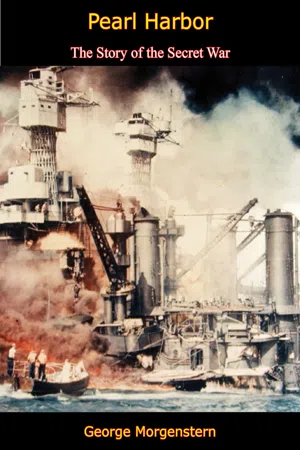
- 437 pages
- English
- ePUB (mobile friendly)
- Available on iOS & Android
eBook - ePub
About this book
Information
Subtopic
European HistoryIndex
HistoryChapter One—WAR
AT 7:58 A.M. on Sunday, December 7, 1941, a radio warning was broadcast to all ships in Pearl Harbor. “Air raid, Pearl Harbor!” the radio screeched. “This is no drill! This is no drill!” Three minutes before, Japanese warplanes had come in over the great naval base at Oahu, launching their first torpedoes and dropping their first bombs.
Almost at once a second warning was broadcast by the commander-in-chief of the Pacific fleet: “From Cincpac to all ships Hawaii area: Air raid on Pearl Harbor. This is no drill.” The Navy radio station at Mare Island Navy Yard, San Francisco, intercepted this message. The country soon knew that it was at war.
For a year and a half a debate had raged the length and breadth of America over going to war or staying out. It was bitterly fought in Congress, in the newspapers, over the radio, in public forums, in private homes, by propagandists, by politicians, and by the plain people—and all the words, if people had but known it, were futile. Long before December 7 the United States was in fact at war. That decision had come at the policy-making level of the government and of the Army and Navy high command, and it had been put into execution without anybody asking a vote from Congress or bothering to let the people in on the secret.
For more than two years there had been war in Europe, and for more than four years war in the Orient, but, so far as the people knew, the United States was not a party to either war. In Europe, Germany and Italy, with their satellites, were at war with Russia, Britain, and the nations of the British Commonwealth, supported by a group of paper allies, the governments in exile of Poland, Norway, Belgium, Yugoslavia, Greece, Ethiopia, Holland, and the De Gaullists of France. In the Far East Japan and China had been fighting since July 7, 1937, but neither chose to call it a war. To the Japanese it was “the China Incident.” The Chinese didn’t have a name for it until two days after the attack on Pearl Harbor, when they finally declared war.
The debate over American intervention was emotional and none too well informed. The totalitarian governments of Germany and Italy, with their scurvy and cutthroat leadership, had nothing to commend them, while the brutal efficiency of the German army terrified the timid. The saber-rattlers of Tokyo were no more ingratiating. The Japanese military, in the course of a long harassment of the inoffensive mass of the Chinese people, had earned the condemnation of civilized men, and, in such outbreaks of mass insanity and violence as accompanied the fall of Nanking, had aroused horror and revulsion.
On the other hand, the forces in opposition were hardly able to pin the sanctions of high-minded morality or abstract justice to their banners. Even the Chinese, who had suffered long and had a legitimate claim upon the sympathy of the outside world, were afflicted with a corrupt, devious, and scheming central administration under the domination of a leader whose methods had frequently been discreditable, exercising his will ineffectively through the one-party Kuomintang government. China was disorganized, shot through with internal dissension, and more an anarchy than an organized state.
The faults of Britain and France were of another order. The French and British Munich-men had been guilty of the betrayal of national self-interest—the cardinal sin in the conduct of statesmen—and were now appealing to America to bail them out. They had sacrificed whatever hope there might have been in collective security by their selfish and cynical policy, accepting the extinction in turn of Austria, Ethiopia, Czechoslovakia, Albania, and the legal Spanish government, and calling these sell-outs “appeasement” and “peace for our time.”{14} The judgment of Winston Churchill after Munich was prophetic: “France and Britain had to choose between war and dishonor. They chose dishonor. They will have war.”
The Nazi and Fascist slave states were abhorrent to decent people, but it was not easy to forget that the British Empire rested upon the exploitation of hundreds of millions of natives, sweating out their lives in the steaming mines of the Rand at 7 cents a day or in the jungles of New Guinea at less than 5½ cents a day, or subsisting, as 400 million of them did in India, with famine always half a step from the threshold.
Shocking as were Hitler’s concentration camps, his calculated campaign against the Jews, and his dictum that the conquered were “subhuman,” fit only for slavery or the charnel house, the barbaric government by terror, purge, and enslavement conducted by Stalin over his fellow-Russians was no more exemplary. The two tyrants had had no scruples in striking a bargain on August 23, 1939, when the ten-year “nonaggression” pact signed by them turned the German army loose eight days later upon Poland and Western Europe, and permitted Stalin to roll up eastern Poland. Moral distinctions were difficult to perceive between this pair.
For its part, Britain, in guaranteeing to defend the corrupt Polish government of colonels and feudal gentry, had committed itself to a decision which was on a par with all of the other stupidities achieved in London. At any time up to the dismemberment of Czechoslovakia on October 1, 1938, the British and French, if they had been so minded, could have stopped Hitler.{15} When they finally chose Poland as the issue over which to fight a war, they assumed a task which was militarily impossible. They had waited too long and Hitler had grown too strong. Moreover, their commitment was neither complete nor candid.
Britain’s guaranty to Poland was first announced in the House of Commons March 31, 1939, by Prime Minister Neville Chamberlain. The Prime Minister stated that consultations were in progress between the two governments, but in the meantime, before their conclusion, “I now have to inform the House that during that period, in the event of action which clearly threatens Polish independence, and which the Polish government accordingly considered it vital to resist with their national forces, his Majesty’s government would feel themselves bound at once to lend the Polish government all support in their power.” Chamberlain added that the French government had adopted a parallel policy.
On April 6 a communiqué released by Chamberlain stated that “the two countries were prepared to enter into an agreement of a permanent and reciprocal character to replace the present temporary and unilateral assurance given by his Majesty’s government to the Polish government.”
“Like the temporary assurance,” the communiqué stated, “the permanent agreement would not be directed against any other country but would be designed to assure Great Britain and Poland of mutual assistance in the event of any threat, direct or indirect, to the independence of either.”
On August 25, six days before Germany invaded Poland, the tentative Anglo-Polish arrangement was converted into a formal agreement of mutual assistance, pledging each party to give the other “all the support and assistance in its power” in the event of either “becoming engaged in hostilities with a European power in consequence of aggression by the latter against that contracting party.” Eight articles of the treaty were made public. The first seemed to be an unequivocal pledge to fight any aggression. Such was not the fact.
Despite Chamberlain’s statement in Parliament and the clear commitment in the published articles that Britain would come to Poland’s defense in the event of aggression by any European power, it would later be discovered that strings were attached to the British guaranty, and that Britain had escaped from any commitment to defend Poland against aggression by Russia or to rectify any grabs Russia might subsequently make. It was finally disclosed on April 5, 1945, that the first article of a secret protocol to the Anglo-Polish treaty of mutual assistance provided, “By the expression ‘a European power’ employed in the agreement is to be understood Germany.”{16} This escape clause paved the way for the Yalta and Potsdam deals handing over eastern Poland to Russia, thereby permitting Stalin the fruits of aggression under his deal with Hitler in August, 1939.
As the capstone to this edifice of bad faith, Hitler and Stalin, through the uneasy twenty-two-month existence of their “nonaggression” treaty, dickered for a full military alliance and a four-way partnership dividing up three continents among themselves, the Italians, and the Japanese. All that prevented the consummation of this deal was the cupidity of the tyrants in Berlin and Moscow, whose greed and distrust confirmed the validity of the definition that an alliance is “the union of two thieves who have their hands so deeply inserted in each other’s pockets that they cannot separately plunder a third.”{17}
The memoirs of Prince Konoye, who committed suicide on December 16, 1945, provide evidence that Russia late in 1940 agreed “in principle” to broaden the tripartite alliance of September 27, 1940, among Germany, Italy, and Japan into a four-power entente. Konoye said that Iran and India were to be Russia’s “future sphere of influence” under a secret agreement accompanying the proposed entente. Japan was to receive the South Seas area, Germany would have taken central Africa, and Italy northern Africa.
Konoye stated that Von Ribbentrop, Nazi foreign minister, advanced the plan for a four-power agreement, providing:
Firstly, the Soviet Union will declare that it agrees with the principle of the tripartite pact in the sense of preventing war and swiftly recovering peace.
Secondly, the Soviet will recognize the leading position of Germany, Italy, and Japan, respectively, in the new order in Europe and Asia, and the three nations will pledge respect of Soviet territory.
Thirdly, the three nations and the Soviet Union pledge not to assist any nation being the enemy of the other, nor to join such a group of nations.
The Japanese government promptly approved the plan, which was handed to Foreign Commissar Molotov of Russia during his Berlin visit in November, 1940. Then Tokyo heard nothing further until March, 1941, when the Japanese foreign minister, Yosuke Matsuoka, visited Berlin. Matsuoka was told that Molotov had agreed in principle, but proposed “exchange conditions of over 30 articles which Germany could in no way recognize.” By then, Matsuoka told Konoye, German officials were openly talking about the inevitability of a Nazi-Soviet war.{18}
Additional light on this cynical deal was supplied through captured German documents, now in the possession of the American government, tracing Molotov’s conversations with Ribbentrop. These documents disclosed that Russia’s appetite for more and yet more of the earth’s surface was all that prevented the formation of a Berlin-Moscow-Tokyo-Rome plunderbund.{19}
These intrigues are sufficient to demonstrate that there was not a major power involved in the mess in Europe or Asia that could come to the United States with clean hands, or represent itself as either a democracy or an exemplar of justice. The knowledge of all of this chicanery was, of course, withheld from the American people until after the war, and the debate on the question of intervention versus non-intervention was thus not illuminated by any perceptible degree of understanding or truth.
The American people, who thought that the issue of whether it was to be peace or whether it had to be war was still subject to democratic debate, did not know in the closing months of 1941 that the decision had long since passed them by. They did not know that already a state of war existed by executive action. Not for four years would they hear the admission from President Roosevelt’s chief of naval operations that by October, 1941, the American Navy was “in effect, at war” in the Atlantic,{20} and that this shooting war against Germany and Italy constituted a direct invitation to Japan to attack the United States under the tripartite pact.{21}
On December 7, 1941, the policy-makers and war-makers in Washington were confidently awaiting the hour when their undeclared war would be regularized by the logic of events. On that same December 7, the people were still hoping that the peace which had already been lost could be preserved.
The previous day Pope Pius had said that the world needed faith more than great statesmen. In one American city there was a Christmas expression of such faith: a great “star of peace” emblazoned in lights 132 feet wide and 150 feet high on the side of a skyscraper office building. Even Lord Halifax, the British ambassador, had a kind word for peace as he busied himself talking up war. Lasting peace, he said, was foreshadowed “explicitly and implicitly” in the Atlantic Charter;{22} but he implied that to catch up with the shadow Americans would first have to fight; otherwise the professed objectives of the charter could not be realized.
The war, so far, had made little impact upon civilian life in America. The national debt, after eight and one-half years of the New Deal, stood at 55 billion dollars. There were fifteen shopping days until Christmas and the display advertisements told of peace-time abundance. No one yet had imposed rationing, although some of the more vocal proponents of war in and out of the administration were impatient that consumer’s goods were still available, when, so these gentlemen thought, the nation’s entire production should be devoted to rearmament and lend-lease for Britain and Russia. Secretary of Commerce Wallace was later to pay his peculiar tribute to American industry and management, which outproduced all other belligerents combined, friends and foes alike, by saying that plant managers were “sheer Fascists” and that it had been necessary “to take industry by the scruff of the neck” to get it into war.
If war crept int...
Table of contents
- Title page
- TABLE OF CONTENTS
- FOREWORD
- ACKNOWLEDGMENTS
- Chapter One-WAR
- Chapter Two-MOUNT NIITAKA
- Chapter Three-THE RISING SUN
- Chapter Four-THE SCAPEGOATS
- Chapter Five-THE BASING OF THE FLEET
- Chapter Six-BLUEPRINT FOR DEFEAT
- Chapter Seven-BACK DOOR TO WAR
- Chapter Eight-A, B, C, D’s
- Chapter Nine-MEETING AT SEA
- Chapter Ten-THE LAST OF THE JAPANESE MODERATES
- Chapter Eleven-DIPLOMACY FOR D-DAY
- Chapter Twelve-MAGIC
- Chapter Thirteen-THE WRITING ON THE WALL
- Chapter Fourteen-EAST WIND RAIN
- Chapter Fifteen-“IMPRISON’D IN THE VIEWLESS WINDS”
- Chapter Sixteen-“DO-DON’T” WARNINGS
- Chapter Seventeen-“KNOWN IMPENDING WAR”
- Chapter Eighteen-THE LIGHT THAT FAILED
- Chapter Nineteen-JAPAN SOLVES THE DILEMMA
- Chapter Twenty-WHO WAS GUILTY?
- APPENDIX
- REQUEST FROM THE PUBLISHER
Trusted by 375,005 students
Access to over 1.5 million titles for a fair monthly price.
Study more efficiently using our study tools.
Frequently asked questions
Yes, you can cancel anytime from the Subscription tab in your account settings on the Perlego website. Your subscription will stay active until the end of your current billing period. Learn how to cancel your subscription
No, books cannot be downloaded as external files, such as PDFs, for use outside of Perlego. However, you can download books within the Perlego app for offline reading on mobile or tablet. Learn how to download books offline
We are an online textbook subscription service, where you can get access to an entire online library for less than the price of a single book per month. With over 1.5 million books across 990+ topics, we’ve got you covered! Learn about our mission
Look out for the read-aloud symbol on your next book to see if you can listen to it. The read-aloud tool reads text aloud for you, highlighting the text as it is being read. You can pause it, speed it up and slow it down. Learn more about Read Aloud
Yes! You can use the Perlego app on both iOS and Android devices to read anytime, anywhere — even offline. Perfect for commutes or when you’re on the go.
Please note we cannot support devices running on iOS 13 and Android 7 or earlier. Learn more about using the app
Please note we cannot support devices running on iOS 13 and Android 7 or earlier. Learn more about using the app
Yes, you can access Pearl Harbor by George Morgenstern in PDF and/or ePUB format, as well as other popular books in History & European History. We have over 1.5 million books available in our catalogue for you to explore.