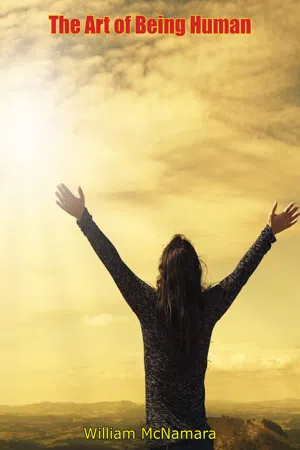
In THE ART OF BEING HUMAN, Father McNamara has taken a new, vital approach to effective socially oriented Christian living in tune with the needs and demands of our times. He takes for his theme the basic traditional truth: grace builds upon rather than destroys human nature, and develops this theme with extraordinary understanding and eloquence.
The first chapter—"Becoming Human"—sets the tone of the book. For Father McNamara the sanctifying process is the humanizing process and the way by which one can cultivate "the art of being human" within oneself. He then probes into the very roots of the conditioning processes which daily shape our lives, and poses for the reader some incisive questions which demand reflection and inner search. Discussions on faith, hope, love, religion, mental prayer, and spiritual growth follow. The final chapters on leisure and leadership are especially provocative since they direct the reader's attention to where the responsibility for the self-accomplishment of this "art" truly lies.
Father McNamara has the knack of putting his finger directly on the problems of today's living. THE ART OF BEING HUMAN does not pretend to have all the answers but it goes a long way toward taking the reader in the right direction.
"Here is a book to read, to ponder and to act as its message challenges us to do."—Magnificat
- 140 pages
- English
- ePUB (mobile friendly)
- Available on iOS & Android
eBook - ePub
The Art of Being Human
About this book
Information
Topic
Theology & ReligionSubtopic
ReligionTHE ART OF BEING HUMAN
1. BECOMING HUMAN
Since this book is about becoming human, I could hardly begin with a more appropriate question than: What is the purpose of human life?
It is a common question; so common it is barely noticed; hardly ever answered; almost never faced squarely and seriously. The fact is that most people have the wrong idea of the purpose of life. You ask ten men this basic question and nine of them will say: “The purpose of life is to save my soul.” And they’ll back it up with dozens of catechisms.
But it’s wrong. I don’t say it’s heretical. It is certainly not, strictly speaking, a theological error. It has, in fact, some good but very limited, partial theological sense. However, it is the psychological ramifications of such an answer in the actual life of a real human being that are distressing.
Just imagine what would happen, for instance, if you really believed that the first and foremost purpose of life was to save your own soul, and you set out seriously to do it. All your thoughts, desires, and actions, even your service to your neighbor, even your lovemaking, would be, primarily, for your own sake. You see what is happening? You are becoming an egotistic horror; and in the name of religion. You are losing your capacity to judge things objectively, to respond to value other than your own, to act selflessly, to love. You come to the aid of your hungry, needy neighbor not because he is good, a living witness of Christ, an image of God; but rather for what you get out of this service, namely, merit, growth in grace, assurance of your own salvation.
There are many pious people who stifle their love and spoil their lives by an inordinate desire to save their own souls. You’ve got to save your soul. This is vastly important: “What doth it profit a man to gain the whole world if he loses his own soul!” But the point is: you save your soul best, without any unwholesome, un-Christian psychological effects, by setting out, first of all, to fulfill the purpose of life.
What is it, then, if not the salvation of one’s soul? Well, you can’t improve on the Word of God. And if you read the Gospel you will notice that whenever our Lord speaks of the purpose of life it is never in terms of “getting” anything: moral improvement, perfection, or salvation. It is always in terms of “giving”—giving honor and glory to God. That is the purpose of life. The by-product of zest and zeal for God’s glory is perfection, holiness, and, certainly, salvation.
That is what our Lord meant when He said that we must seek first His kingdom, and everything else would unfold inevitably, graciously. And when He said that we must lose our lives in order to save them, He was talking about the same thing.
In other words, we must be so concerned about God and His kingdom, His glory, His will, that we come very close to forgetting about ourselves. We must be so taken up with our Fathers business, that we would never think of setting up a pokey little business of our own. And so our petty little problems get swallowed up in the unrelenting, consuming pursuit of God’s honor and glory.
Giving honor and glory to God is the purpose of all life—vegetable and animal as well as human. Trees give glory to God by being good, decent trees. Dogs give glory to God by being as doggy as possible. Humans give glory to God by being human—by being as human as possible.
On that day that we become as perfectly human as we can in this world, then we shall be saints. Live saints, not dead saints; human saints, not odd, sour-faced, or inhuman saints. If, here and now, we are not saints, it is only because we are not human enough. I think the best definition of a saint is: a whole man—holy. That is why it is true to say that if a man does not become a saint he is a failure.
Now, what is it that distinguishes us from every other animal in the world and really makes us human? It is the spiritual powers of knowing and loving. When these powers are fully exercised and satisfied, then we are completely humanized. But God is the only object that can fully exercise and satisfy the human capacity for knowledge and love. Therefore, it is loving knowledge of God and His creation that makes a saint; not flight from the world, multiplication of devotions, or even moral rectitude.
The sanctifying process is a humanizing process. It is the progressive enlightenment of the mind and enlargement of the heart. It is to know God so well that you fall in love with Him—and once you know Him you’ve got to love Him: He is so infinitely lovable—and it is this positive, outgoing, unselfish love that drives you to avoid evil and practice virtue, and do penance. But above all, it makes you human—kind, joyous, enthusiastic, adventurous, uproariously happy, relentlessly apostolic.
To emphasize the human element in the process of sanctification is not to ignore the divine; to save the value of the creature is not to lose the infinitely greater value of the Creator: as though the other from Him were apart from Him, as though He had to compete with other forces and therefore demand that we love nothing but Him. It’s that false “either-or” principle that keeps cropping up in spiritual writings. To hold creatures cheap, St. Thomas remarks, is to slight divine power. We must frown on nothing except our sins.
Charity is not just the soul’s response to the breath of the Spirit. It is rather the response of the whole man to the touch of the triune personal love of God (grace). We are called into lasting friendship with God, and to make us purely instruments ruling us out as lovers, St. Thomas boldly says, does not enhance but diminishes the dignity of charity. You will not find in St. Thomas any kinship with those who say that grace works best when everything congenial to us has been pumped out. Nature abhors a vacuum, and so does supernature. Grace does not dwell, like a lonely, lofty light, in the attic of the personality. It is not limited even to what is technically spiritual. It suffuses and permeates the whole person, transfigures the whole man. St Thomas, for instance, does not regard the infused virtues of fortitude and temperance as qualities of our higher selves or habits of willpower, but rather as transfigurations of emotion: fortitude is a temper restrained or fired according to circumstances; temperance is passion and pleasure controlled but unmitigated.
Man is at heart created and conserved by divine power, and his activity is motored and energized by that same power which wells up in him like a living, superabundant fountain of life divinizing him at every level, and expanding through every part of his organic personality.
It is this merging of the natural and the supernatural that brings us to the affirmation of the second big point of this first chapter, and the point is: you cannot become perfectly human until you are partly divine.
In other words, the humanizing process is from beginning to end a divinizing process—a suffering of divine things, a transformation into Christ, a life dominated by the indwelling Spirit. This is the mystical life. The whole man must, then, be a mystic.
A mystic is one who knows God by experience. All of the Apostles were mystics. John, the beloved disciple, opens up his first epistle with a clear, outspoken admission of this fundamental fact.
We proclaim what was from the beginning, what we have heard, what we have seen with our own eyes, what we have gazed upon, and what we have embraced with our own hands. I refer to the Word who is and who imparts life. Indeed, this Life has manifested himself. We ourselves have seen and testify and proclaim that Eternal Life which was with the Father and has manifested himself. To you we proclaim what we have seen and heard, that you may share our treasure with us. That treasure is union with the Father and his Son, Jesus Christ. I write this to you that we may have joy in the fullest measure (1 Jn 1:1–4).
John, the beloved disciple, has given his witness. What he once touched and tasted and handled, that he has declared unto us. It was the shining, the epiphany of God the Father which he and the Twelve had discovered tabernacled close at their side in the body of Christ. “We saw his Glory, the glory as of God himself.”
The Disciple’s first encounter was the day he saw Jesus coming toward him and a wonderful word broke from the Baptist: “Behold, the Lamb of God.” The words fascinated, haunted him, and when, on the following day, John uttered them again, three of them at least could not rest; their hearts burned to know more.
So two of them, and John the beloved who tells the story, followed Him. Now that He, the stranger, found them following, He turned and spoke. For the first time, then, He looked upon them with that look which again and again had the power to draw a soul, by one glance, out of the night of sin into the life of eternal light. And so they heard His voice—that voice which by its cry could raise the dead. “Whom seek ye?” That was all. And they hardly knew what to say—only they must see Him, must go with Him; and they stammered: “Rabbi, where dwellest thou?” And He said: “Come and see.”
They went and saw. So intense is the Apostle’s memory of that personal encounter that he can never forget the very hour of the day. It was just ten o’clock when he got to the house. They stayed with Him long enough to know, by experience, who He was.
This religious experience of the Apostles is a basic, simple form of what we call mysticism. The typical mystic is the person who has a certain firsthand experience and knowledge of God through love. This is quite different from knowledge by hearsay or cold, detached study. It is what breathes eternal life into the latter forms of abstract knowledge. “And this is eternal life that you may know God, and Jesus Christ whom he has sent.”
We are prone in our thinking to limit the modes of God’s action in people to forms familiar to us; hence we tend to restrict unduly the number of contemplatives. There is a different form not only for each great saint, but for each person, even the most ordinary.
This experience of God may come in many ways and under many symbolic disguises. It may be steady or fleeting, dim or intense. But insofar as it is direct and intuitive it is always a mystical experience.
Experience is a difficult term to tie down with the threads of definition or description. The word which seems to get closest to the heart of things is awareness: the subjective reaction to some objective reality which is perceived in some way by the subject. This awareness can be conscious and unconscious; and that is what makes the difference between a saint who is a mystic and one who isn’t; but the awareness of God possessed in common by both is in each case genuinely, essentially mystical.
This awareness is not simply an intellectual recognition of some object of thought but an awareness in which the whole man is engaged (involving and causing, normally, some sensation). It is a body-soul reaction to a mystical reality, namely, the divine encounter with man. It has nothing to do with emotional feelings except insofar as the spiritual reaction of mind and will has some subsequent effect on the emotions.
The point is made succinctly by Jacques Maritain:
The phrase mystical experience I take...not in the more or less vague sense (applicable to all kinds of facts more or less mysterious or preternatural or even to simple religiosity) but in the sense of an experimental knowledge of the depths of God, or of the suffering of divine things, leading the soul, by a series of states and transformations to the point of realizing in the depths of self the touch of the deity.{1}
Sacred History is the history of religious experiences: God intervening in human affairs, revealing Himself, inviting and readying man to reach the pinnacle of all human experiences—the personal encounter with the living God. The cosmic and Mosaic revelation represents nothing more than a stage in mankind’s advance in the knowledge of the true God. It is only in Jesus Christ that the hidden God is truly revealed: “No man has seen God at any time: the only-begotten Son who is in the bosom of the Father, he has declared him.” God has expressed His fullness in the Word.
The Incarnation is the high point of religious experience: the divine-human encounter. And the Church is the prolongation of the Incarnation. The code and cult of the Church are meaningless apart from religious experience. They are either conceptual interpretations of religious experience (doctrine) or the external, physical, cultural embodiments of religious experience (liturgy). Whatever is unrelated to this spiritual center is ecclesiastical materialism. In the light of this it seems that what is defective about our religious revival today is that most of us are spending all of our time and energy running around the circumference, and taking for granted the center which is religious experience.
We have shied away from the term “religious experience” ever since the Protestant revolution with its false and disastrous forms of “experiencing.” Shall we discard religious experience because we have read or heard about neuropathic perversions or concomitants of religious experience? Do we condemn sex because we know of morbidities, hysteria, and perversions which abound in the sexual sphere? We think it is unreasonable to reject religious experience as subjective illusion, when in power, satisfaction, and delight, and in its value, intellectual and spiritual, it incalculably exceeds any other form of human experience.
What, then, is mystical theology? It is the theology of the fullness of the Christian life lived in union with Christ and the total Christ, the Church, and lived in such a way that it is experienced as well as understood. Mystical theology is bound up with what has been called by the Apostles and early Fathers “the mystery”—the living mystery of Christ on earth being born, living, redeeming the times, and dying day by day and rising again in the life of Christians. “No longer I but Christ lives in me.”
Any deep spiritual life is a mystical life. If we define mystical life as that in which the direct action of God through the gifts of the Holy Spirit is predominant, we cannot conceive the possibility of living the spiritual life in any other way.
Extraordinary favors and thrilling experiences are not part of the mystical life. The life of St. Thomas, and even the lives of Mary and Joseph, is the living illustration and affirmation that the highest mystical life may be (and often is) without any appearance of mystical phenomena.
Mysticism is the passionate longing of the soul for God, the Unseen Reality,...
Table of contents
- Title page
- TABLE OF CONTENTS
- THE ART OF BEING HUMAN
- DEDICATION
- ACKNOWLEDGMENTS
- INTRODUCTION
- 1. BECOMING HUMAN
- 2. A FULL LIFE
- 3. A MEDIATOR
- 4. A REAL CHRIST
- 5. FAITH
- 6. HOPE
- 7. LOVE
- 8. RELIGION
- 9. MENTAL PRAYER
- 10. SPIRITUAL GROWTH
- 11. THE NEED FOR ROOTS
- 12. LEISURE
- 13. LEADERSHIP
- REQUEST FROM THE PUBLISHER
Trusted by 375,005 students
Access to over 1.5 million titles for a fair monthly price.
Study more efficiently using our study tools.
Frequently asked questions
Yes, you can cancel anytime from the Subscription tab in your account settings on the Perlego website. Your subscription will stay active until the end of your current billing period. Learn how to cancel your subscription
No, books cannot be downloaded as external files, such as PDFs, for use outside of Perlego. However, you can download books within the Perlego app for offline reading on mobile or tablet. Learn how to download books offline
Perlego offers two plans: Essential and Complete
- Essential is ideal for learners and professionals who enjoy exploring a wide range of subjects. Access the Essential Library with 800,000+ trusted titles and best-sellers across business, personal growth, and the humanities. Includes unlimited reading time and Standard Read Aloud voice.
- Complete: Perfect for advanced learners and researchers needing full, unrestricted access. Unlock 1.5M+ books across hundreds of subjects, including academic and specialized titles. The Complete Plan also includes advanced features like Premium Read Aloud and Research Assistant.
We are an online textbook subscription service, where you can get access to an entire online library for less than the price of a single book per month. With over 1.5 million books across 990+ topics, we’ve got you covered! Learn about our mission
Look out for the read-aloud symbol on your next book to see if you can listen to it. The read-aloud tool reads text aloud for you, highlighting the text as it is being read. You can pause it, speed it up and slow it down. Learn more about Read Aloud
Yes! You can use the Perlego app on both iOS and Android devices to read anytime, anywhere — even offline. Perfect for commutes or when you’re on the go.
Please note we cannot support devices running on iOS 13 and Android 7 or earlier. Learn more about using the app
Please note we cannot support devices running on iOS 13 and Android 7 or earlier. Learn more about using the app
Yes, you can access The Art of Being Human by William McNamara in PDF and/or ePUB format, as well as other popular books in Theology & Religion & Religion. We have over 1.5 million books available in our catalogue for you to explore.