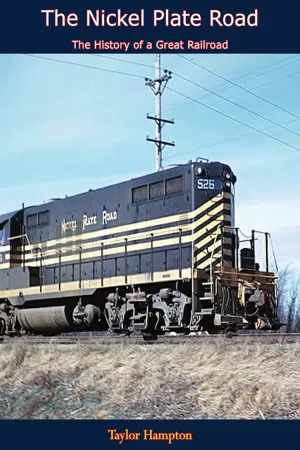
A richly illustrated history of the New York, Chicago and St. Louis railway.
"The New York, Chicago & St. Louis Railway (termed the Nickel Plate in a day when anything of superior quality was "nickel-plated") was incorporated in 1881. The line between Buffalo and Chicago was completed in the autumn of the following year, and hardly was the last section of rail in place when the road was sold by the Seney Syndicate (the incorporators) to the Vanderbilt interests. For thirty-four years it continued under what Mrs. Hampton terms the "suppressing domination" of the New York Central before it was taken over by the Van Sweringens in 1916. During the Van Sweringen regime the Nickel Plate acquired two additional divisions—the Toledo, St. Louis & Western and the Lake Erie & Western. These acquisitions virtually rounded out the present system. In 1937, with the collapse of the Van Sweringen empire, Robert R. Young acquired control of the Nickel Plate. Each of the periods of the road's history is dealt with by Mrs. Hampton, who devotes about half the pages of her narrative to the Seney Syndicate and divides the other half among the three succeeding regimes, with least emphasis upon the Young era."-Journal of Economic History
- 320 pages
- English
- ePUB (mobile friendly)
- Available on iOS & Android
eBook - ePub
About this book
Trusted by 375,005 students
Access to over 1.5 million titles for a fair monthly price.
Study more efficiently using our study tools.
Information
Subtopic
American Civil War HistoryIndex
HistoryPART ONE—The Seney Syndicate
1—Setting the Stage
IN THE early eighties all eyes were turned toward the Middle West and the West. The Civil War had been fought, the panic of 1873 had been survived, and business had recuperated. It was a period of great development and fantastic speculation. Railroads were planned and even built everywhere and anywhere. Many never passed the “on paper” stage and, in some cases, much worthless paper was all the eager investors had to show for the dollars they had contributed to the glowing schemes. Surveying parties moved in all directions, running lines and driving stakes. Their appearance in any locality was the signal for great excitement and unfounded gossip concerning a new line. It was said of some counties that they had more railroad surveyors’ stakes driven in them than a porcupine’s back had quills.
There was no national regulation or restraint exercised, and the field for legitimate enterprise was as wide as the limitations on illegitimate schemes would permit. The names of Vanderbilt, Gould, Jewett, Garrett, Seney, and Roberts were prominent in the transportation field as in many others. Fortunes were fabulous and those who had them, for the most part, were willing to risk them with the hope of further gain. In all it was a colorful era filled with great hope. And yet although wild, and in some ways seemingly chaotic according to present standards, it built the rock foundation upon which rests our modern transportation network. The Nickel Plate Road was no unsound, highly speculative scheme conceived by inexperienced promoters in a moment of flighty desire. It was a sound, legitimate enterprise organized by men of position, influence, and means, who had successfully built and operated other railroads.
During the early eighties there were conflicting views as to the extent of the need for additional roads. Some people contended fewer were wanted, others felt more were needed.
Those who made the first contention argued that too much of the available capital of the country was being diverted from other industries and enterprises into this channel; that the rail-road development was greatly in excess of the growth in population or the material improvement of the country in other ways. They further feared that the desire for roads would reach the stage of mania, where all sense of balance and sound economics would be lost. To substantiate their contentions they cited the fact that in 1871 the capital and funded debt of all railroads amounted to $2,664,627,645. At the beginning of 1881 it aggregated over five billion dollars, an increase of about two and one-half billion dollars in ten years, including three years of business paralysis incident to the great panic of 1873.
In 1830, when the first railroad was put in operation, there were 23 miles of road; in 1860, when railroads became an important factor in national progress, there were 30,635 miles; and by 1880 there were 92,700 miles. The decade between 1870 and 1880 showed by far the greatest increase, with 39,786 miles of new road.{1} In 1881 there was underway the construction of, or companies organizing for the building of, nearly 10,000 miles of new road, at an aggregate cost of considerably over three hundred million dollars.
Cautious analysts of the total effect of this speculative tendency dwelled on the danger of the reaction likely to follow the vast outlay of capital for railroads. All the iron-rail mills, the mines, the car shops, and other manufactories were operating at maximum capacity to meet orders; labor was being diverted from other channels to the work of construction. They felt that when the expected reverse came a number of roads might be pronounced bankrupt and passed over to receivers, which would cause a panic and the withdrawal of capital. That, in turn, would mean a suspension of work and the stopping of the factories that were currently working night and day to fill orders. Their pessimistic prediction was that much capital would be lost in useless investments, manufacturers ruined, and thousands of men thrown out of work. However, in spite of all these claims and the denouncements of expansion, most critics of railroad expansion admitted the need for two or three more great trunk lines to the Eastern seaboard, their main objections being to the multiple side roads which were the fruits of the speculative tendency incident to the new era of prosperity.{2}
The more aggressive, optimistic group of financiers and rail-road men pointed to the great activity in all fields incident to railroad construction and made glowing predictions of the future and specific statements concerning immediate demands. A manager of one of the largest freight lines in the country stated, “You can hardly conceive the extent of this enormous freight business; and it is increasing to an extent you could not be made to believe unless you were really in the business.” No trunk line, they contended, under the most favorable circumstances could move its freight as fast as it was needed.
The enormous increase in traffic during 1880 was of such proportions as to seem fabulous; nowhere in the social, business, or political economy of the country was the progressive, prosperous condition of the people illustrated better than in this enormous body of interchanging products. In spite of new road building, the double-tracking of old ones, and an almost endless chain of new rolling stock, the motive power and terminal facilities were totally inadequate.{3} These were the claims of those who were less inclined to view depression as the ultimate end of a complete cycle of prosperity.
By January 1, 1881, the states later served by the New York, Chicago and St. Louis Railway already had extensive railroad mileage and many competing lines. Poor’s statistics of that date show: New York, 132 roads with 6,018.69 miles; Pennsylvania, 145 lines with 6,242.87 miles; Ohio, 70 lines with 5,912.07 miles; Indiana, 37 lines with 4,454.33 miles; and Illinois, 58 lines with 7,954.98 miles.{4} Many of these roads were later consolidated into larger systems or under new names. The Baltimore and Ohio Road was well established; the Erie Railroad was known as the New York, Lake Erie and Western Company; the Pennsylvania was operating to Pittsburgh as the Pennsylvania Railroad, and the Pennsylvania Company managed in the interest of the Pennsylvania Railroad the lines leased and controlled by it west of Pittsburgh. While Vanderbilt controlled three roads which were the backbone of the New York Central system, they were operated as separate lines: the New York Central and Hudson River Railroad, east of Buffalo; the Lake Shore and Michigan Southern Railway, between Buffalo and Chicago; and the Cleveland, Columbus, Cincinnati and Indianapolis Railway. William H. Vanderbilt was president of the first two roads and due to his association with J. H. Devereux, who was president of the third line, it is assumed Vanderbilt controlled the latter. While there were many other roads upon which comment could be made, the status of these four systems is particularly noteworthy. The Vanderbilt-Gould feud was raging and Gould was seeking a new road between Toledo and Buffalo to connect respectively with his Wabash and the Erie. A constant threat to Vanderbilt was a paralleling Gould line to his Lake Shore and Michigan Southern.
Such was the era, such was the stage, which was set for the entrance of the New York, Chicago and St. Louis Railway.
2—Entrance
THE New York, Chicago and St. Louis Syndicate was formed by the promoters of two hitherto separate railroad enterprises—the Lake Erie and Western project and the Clark, Post, and Martin plans.
By 1880, George I. Seney and his associates, who were in control of the Lake Erie and Western Railroad Company, had formed a syndicate to construct a railroad from a point on that company’s line between Tipton and Frankfort, Indiana, to St. Louis, to be called the Lake Erie and St. Louis Railway, and ultimately to be consolidated with the Lake Erie and Western Railway Company. At this time the Lake Erie and Western had a road of 353 miles between Fremont, Ohio, and Bloomington, Illinois, with a 9.2 mile branch from St. Marys to Minster, Ohio. Several million dollars were subscribed to the new project and the promoters began making surveys, obtaining right of way, and securing local aid. However, during the fall of 1880 conditions developed within the L.E. and W. which in the judgment of the Syndicate made it impractical to develop the St. Louis line. During November or December in 1880 the Syndicate then proposed to construct instead a line from the same location between Tipton and Frankfort on the Lake Erie and Western, to Cleveland via Fort Wayne, Indiana, and to add a “branch” from Fort Wayne to Chicago. The pool, or subscription, was enlarged accordingly and the necessary changes made in the contract which had been entered into with Brown, Howard, and Company (a partnership consisting of Walston H. Brown of New York, and William B. Howard and Columbus R. Cummings of Chicago) for the construction of the line as first projected.{5}
Meanwhile, on October 7, 1880, articles of association for a Buffalo, Cleveland and Chicago Railway Company of New York were filed in the office of the secretary of state of New York.{6} And on October 18, 1880, railroad circles, particularly in Ohio, were startled to learn of the incorporation at Columbus, Ohio, of the Buffalo, Cleveland and Chicago Railroad Company with a capital of six and one-half million dollars. It was pointed out that the New York Company and the Ohio Company would be consolidated.{7} Furthermore, on November 19, 1880, a charter was issued at Harrisburg, Pennsylvania, to the Buffalo, Cleveland and Chicago Railway Company of Pennsylvania.{8}
So, it can be seen that for some months prior to 1881, Clark, Post, and Martin of 34 Pine Street, New York City, and their associates had been preparing to build a railroad from Buffalo to Cleveland to be known as the Buffalo, Cleveland and Chicago Railway. Surveys had been made, beginning at least as early as the winter of 1879-80, by engineers—including Major Wallace McGrath of Columbus, Ohio, and Oliver W. Barnes, a civil engineer of New York City—who had practically completed the location of the line from Buffalo to the Pennsylvania-Ohio state line and had done some surveying in Ohio.{9}
Fortunately or unfortunately, most of the preliminary survey work was popularly believed to have been done for Jay Gould and a proposed new line which he intended to construct from Buffalo to Toledo in competition with Vanderbilt’s Lake Shore and Michigan Southern, and which would give him control of the direct route from New York to the Pacific Coast and Southwest.
In the first part of January, 1881, McGrath explained the routes he was surveying. “We have made Ashtabula the starting point from which we shall survey both ...
Table of contents
- Title page
- TABLE OF CONTENTS
- MAP
- DEDICATION
- Introduction
- List of Illustrations
- PART ONE-The Seney Syndicate
- PART TWO-The New York Central Regime
- PART THREE-The Van Sweringen Period
- PART FOUR-The Young Era
- Condensed Financial Statement-Appendices-Bibliography
Frequently asked questions
Yes, you can cancel anytime from the Subscription tab in your account settings on the Perlego website. Your subscription will stay active until the end of your current billing period. Learn how to cancel your subscription
No, books cannot be downloaded as external files, such as PDFs, for use outside of Perlego. However, you can download books within the Perlego app for offline reading on mobile or tablet. Learn how to download books offline
Perlego offers two plans: Essential and Complete
- Essential is ideal for learners and professionals who enjoy exploring a wide range of subjects. Access the Essential Library with 800,000+ trusted titles and best-sellers across business, personal growth, and the humanities. Includes unlimited reading time and Standard Read Aloud voice.
- Complete: Perfect for advanced learners and researchers needing full, unrestricted access. Unlock 1.5M+ books across hundreds of subjects, including academic and specialized titles. The Complete Plan also includes advanced features like Premium Read Aloud and Research Assistant.
We are an online textbook subscription service, where you can get access to an entire online library for less than the price of a single book per month. With over 1.5 million books across 990+ topics, we’ve got you covered! Learn about our mission
Look out for the read-aloud symbol on your next book to see if you can listen to it. The read-aloud tool reads text aloud for you, highlighting the text as it is being read. You can pause it, speed it up and slow it down. Learn more about Read Aloud
Yes! You can use the Perlego app on both iOS and Android devices to read anytime, anywhere — even offline. Perfect for commutes or when you’re on the go.
Please note we cannot support devices running on iOS 13 and Android 7 or earlier. Learn more about using the app
Please note we cannot support devices running on iOS 13 and Android 7 or earlier. Learn more about using the app
Yes, you can access The Nickel Plate Road by Taylor Hampton in PDF and/or ePUB format, as well as other popular books in History & American Civil War History. We have over 1.5 million books available in our catalogue for you to explore.