A classic account of the Reformation, revealing the issues and preoccupations which seemed central to the age and portraying its leading figures with vigour and realism.
The book is an analysis of the religious, economic, cultural and political history of Europe during the period of the Reformation. Author G. R. Elton examines the history of the period through the interrelationships between different forces in Europe at the time, such as the Holy Roman Emperor Charles V, the Papacy, reformers such as Martin Luther, John Calvin, Martin Bucer and Zwingli, and explores the resultant Counter-Reformation and the beginnings of European colonisation of other parts of the world such as South America. Its central focus is upon the conflict between Luther and Charles V.
"A masterly survey by a fine historian. He has gone to great pains to understand and do justice to the theological side, and if political history is still his strength there is no doubt that this paperback in scholarship, perspective and information far outweighs in value and importance most of the hard-bound studies of the 16th century in the last fifty years."—E. GORDON RUPP
"It is extremely pleasant to welcome a new History of Europe series in which the inaugural volume is of such high merit. Dr. Elton sets himself a difficult task; the result is a book written with the bold, subtle, assured pen of an accomplished scholar."—JOEL HURSTFIELD
"Not since Ranke has any historian described the religious and political history of Central Europe during the Reformation with as much insight and authority."—H. G. KOENIGSBERGER, History (London)
"Dr. Elton has put all students in his debt by providing an up-to-date and highly readable account of the ecclesiastical, political, and social history of Europe during the vital years 1517 to 1559...This book can be unreservedly commended."—C. W. DUGMORE, The Journal of Ecclesiastical History
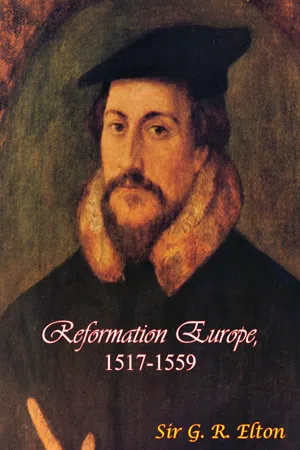
- 288 pages
- English
- ePUB (mobile friendly)
- Available on iOS & Android
eBook - ePub
Reformation Europe, 1517-1559
About this book
Information
Topic
GeschichteSubtopic
Britische GeschichteCHAPTER I—LUTHER
I
On 31 October 1517, Dr. Martin Luther, professor of theology in the recently founded Saxon University of Wittenberg, nailed a paper of Ninety-Five Theses to the door of the Castle Church in that town. There was nothing unusual about this. Any scholar who wished to defend any propositions of law or doctrine could invite learned debate by putting forth such theses, and church doors were the customary place for medieval publicity. Luther’s Ninety-Five attacked the practice of selling indulgences—documents offering commutation of penance for money payments. Certainly Luther had no thought of starting a schism in the Church. These were not the first theses he had offered for public disputation, nor did they embody necessarily revolutionary doctrines. Nevertheless, the day continues to be celebrated in Lutheran countries as the anniversary of the Reformation, and justly so. The controversy over indulgences brought together the man and the occasion: it signalled the end of the medieval Church.
Martin Luther (1483-1546) was the son of a miner of Eisleben in Saxony. Since he early showed intellectual promise, his father intended him for the canon law, a profession of honour and profit; he was extremely angry when the boy instead found that his studies at the University of Erfurt inclined him to theology and contemplation. In 1505, Luther entered the order of the Austin Friars at Erfurt; in 1508, he was appointed a professor at Wittenberg. For nearly ten years he read and thought, wrestling with his humanity in his desperate search for salvation. This young friar and academic, obscure enough in all conscience, hid behind the heavy peasant’s face a mind exceptional in its passion, intensity, stubbornness and subtlety, a mind which could not rest at ease with the prospect of pastoral and professional success for which in other ways he seemed so well fitted. He was a solid scholar, trained and for a time sunk in the late-medieval scholasticism of Occamist nominalism, as transmitted by the pietist Gabriel Biel who taught that despite the Fall man had power to seek salvation of his own free will. These teachings soon ceased to satisfy Luther who was to revolutionise theology because in fact he found himself in a state of despair before God. He wanted the assurance of being acceptable to God, but could discover in himself only the certainty of sin and in God only an inexorable justice which condemned to futility all his efforts at repentance and his search for the divine mercy. In vain he tried to solve his difficulties by all the mortifications and other means advised by his Church and Order. When he found the answer, it grew directly out of his total sense of helplessness in the face of God (coram Deo), and out of his reading of St. Paul with the assistance of St. Augustine. He went back to the Fathers and finally to the Gospel, till he understood that “the righteousness of God” (iustitia Dei) meant not God’s anger at sin but His willingness to make the sinner just (free of sin) by the power of His love bestowed freely on the true believer. Luther held that man was justified (saved) by faith alone: the words sola fide came to be the watchword and touchstone of the Reformation. Man could do nothing by his own works—whether works of edification like prayer, fasting, mortification, or works of charity—to compel justification. But if he believed, God of His grace would give him the gifts of the Holy Spirit—salvation and eternal life. The means of grace were in Jesus Christ; faith was created by abandoning oneself to the message of the gospel, to what Luther called the Word.
Of course, this doctrine was not new; it hardly could be in a religion which for 1500 years had explored every possibility within itself. Luther did not think it new: to him it was the truth of the gospel. The study of his lectures in the years before he became a public figure has shown the development of his theology and illuminated its close links with late-medieval teaching and mysticism, with views, that is, on the relationship of God and man which laid the stress not on institutional and sacramental expedients but on the search of the individual soul. Nevertheless, Luther’s views proved revolutionary because they concentrated with such incisive singlemindedness on the total inability of man to help himself to his own salvation. He took seriously the accepted doctrine of God’s omnipotence and therefore (as it were) sole monopoly of free will. In consequence, as the event was to show, Luther had rendered superfluous the whole apparatus of the Church, designed to mediate between man and God. If man’s justification depended solely on God’s infusion of grace into the believing soul, there was no need for a priesthood alone capable of performing the sacramental acts through which (as the Church taught) the way was opened for grace to enter man. Beside the doctrine of justification by faith alone there soon stood its companion, that of the priesthood of all believers. At first, Luther had no quarrel with the pope, the hierarchy or the Church, and he never lost his conservative sense of an order embodied in institutions. He proved in many ways a most reluctant revolutionary who never wished to abandon tradition, unless his reading of scripture compelled him to it. Thus, when a more radical disciple protested against the elevation of the host in the mass, asking, “Where does Christ command it,” Luther replied: “Where does He forbid it?” But he shared the widespread dissatisfaction with the standards of the clergy and in particular had been shocked by what he saw of the papal Curia when he visited Rome in 1510. He had his share of German nationalism and bigotry, with their violent dislike of all those subtle Italian devices which, prejudice alleged, were milking honest Germans and sending them to perdition. His own experiences had turned him against the futility of monkish asceticism as well as the indecency of its hypocrisy. Thus he was ready enough to give voice to the prevalent anticlericalism of the day.
Throughout, however, there was more than politics, prejudice or envy in the attack on the traditional Church which Luther developed under pressure of controversy, until he left little of it standing. If all men were “priests”, able to seek salvation without intercession, the priesthood were not only unnecessary but a hindrance, blurring or destroying the truth behind a magic mumbo-jumbo of ritual in order to preserve a privileged position. Luther therefore denounced the whole concept of a special priesthood, blamed it for keeping God’s message from the Christian people, and assigned to the clergy only the function of informing man of his way to God by preaching the Word. As it turned out, the spirit had visited a man unusually capable of making himself heard, so much so that the sceptic may wonder whether the word that broke the old Church was God’s or Luther’s. For thirty years the powerful mind and large heart of Martin Luther poured forth in an unbelievable output of books, pamphlets, sermons and letters; it has been calculated that he published at the rate of a piece a fortnight. And if the vigour was often coarse, the undeniable humour foulmouthed, the controversial method ruthless and the strong conviction at times only pernicious prejudice, this, needless to say, did not lessen the impact or repel the many who were willing to hear. The Reformation was no more the work of one man than any such upheaval can ever be; but without Luther there would still have been no Reformation.
Nothing of all this could be suspected when Luther attacked indulgences. But it is important to realise that even at that early date the essentials of Luther’s theology were worked out. To a man so overwhelmingly aware of the problem of salvation, indulgences touched the essence of things. Indulgences were remissions of the penance imposed on confessed and absolved sinners. The danger of leaving such power in lesser hands had led earlier popes to reserve the granting of them to themselves; the fiscal possibilities were soon seen; and by the later middle ages a reasonable practice had grown into an abuse. Though official doctrine was always careful to stress the need for genuine penitence and the impossibility of obtaining valid remission of sins by merely buying an indulgence, the manner in which the business was represented to, and taken by, the simple people was much cruder. In practice it came to be thought that by the act of buying a papal indulgence men could at least shorten their own time in purgatory, and by the fifteenth century it was commonly held that the souls of the dead in purgatory could also be helped by indulgences bought on their behalf. Though indulgences were always proclaimed for an ostensibly religious purpose—a crusade, or the building of a cathedral—they came in fact to be no more than an important source of papal revenue. In 1517 Pope Leo X permitted the new archbishop of Mainz, Albert of Hohenzollern, to recoup by their sale the heavy outlay incurred on entering his dignity. This sale was very efficiently advertised; despite perfunctory safeguards, the stress lay on the chance offered to people to buy themselves and their relatives out of so much time in the fires of purgatory by a money payment which would enable them to participate in the merits of the saints without going through the tiresome process of contrition, absolution and penance. Moreover, the business was put in the hands of crude salesmen like the Dominican John Tetzel who operated near Wittenberg. Electoral Saxony, where Luther lived, was closed to Tetzel because the Elector Frederick the Wise wanted all money available for pious uses to be spent on his own unique collection of supposed holy relics. But Luther’s souls were crossing the river and bringing back bits of paper to prove their freedom from sin. They found their pastor mountingly indignant and distressed.
Thus Luther attacked indulgences, not as just another abuse but as something close to the central truth of religion. Even so, his theses need not have led to more than an obscure academic dispute. They did question certain papal powers, but in a moderate manner and by way of opening up debate. Luther had published them in Latin, but they were at once translated into German and spread abroad by the printing press. Interest in them was general, sudden and unexpected. Unfortunately for itself, the Church tried to silence the critic. Indulgences were too precious to be given up; Tetzel’s Order jumped to his defence against a mere Augustinian; John Eck, professor at Ingolstadt in Bavaria and a professional disputant, decided to take a hand by publicly accusing Luther of heresy. The case was referred to Rome: a fateful step. Attacked by Eck, Luther demonstrated his readiness with the pen, and his views grew less circumspect. Called by his own Order to answer for himself at a provincial chapter at Heidelberg in April 1518, he only made converts. While Germany began to stir in support of this monk who dared call abuses by their name, Rome was reluctantly drawn into drastic action, both by the influence there exercised by Luther’s enemies and by his own developing language. In August 1518, Luther, summoned to Rome, appealed for protection to his elector. Frederick secured him a hearing at Augsburg before Cardinal Cajetan, general of the Dominican Order and an outstanding theologian of his day. Cajetan seems to have had a better understanding of Luther’s essential lack of revolutionary fervour than did his foes who persuaded the papacy to treat him, before trial, as a notorious heretic. The talks with the cardinal—Luther expected death at the stake—were quite peaceable but fruitless; Luther proved stubborn in his convictions and went so far as to assert that a pope could err. Greatly relieved, he got bade safely to Wittenberg; the controversy continued.
By now he was famous, and many looked to him for leadership. In June-July 1519 he engaged in public disputation with Eck at Leipzig. He had not originally been concerned in this affair: Eck had called out Andrew Carlstadt, a colleague of Luther’s at Wittenberg and a passionate if woolly follower of the new teaching. But Luther thought himself attacked and decided to face Eck in person. The more experienced conservative soon drove him out of equivocation into the uncompromising assertion that not only popes but even General Councils of the Church could err. Scripture was the only authority. He had now taken his stand on doctrines condemned as heretical a hundred years earlier, in the trial of the Bohemian John Hus; Duke George of Saxony, a sound conservative, who attended the disputation, threw up his hands at this point and exclaimed at the heretic. Indeed, Luther, who had before this rejected Hus, as any orthodoxly trained theologian and patriotic German was bound to do, had by this time come to think that there was point in those earlier onslaughts on the papal rule in the Church. Leipzig proved how far he had gone from his purely theological beginnings: too far to retreat.
The battle continued, in the study and in the press; the Church was in turmoil. In 1520 Luther decisively burned his boats in the three great treatises which remained the foundation of his beliefs, his teaching, and his historic importance. In the Address to the Christian Nobility of the German Nation he analysed and destroyed the “paper walls” put up by the “Romanists” in defence of their usurped powers, and called upon the Germans to reform the Church by summoning a General Council. The Babylonish Captivity of the Church is a theological treatise in which he attacked the papacy for depriving Christendom of the true religion, described the basis of the new theology, and declared that only three sacraments (baptism, penance and the eucharist) were scriptural. This removed the other four recognised by the Church (confirmation, extreme unction, orders and marriage) and altered the whole concept of a sacrament from a means to salvation created by the officiating priest to the occasion on which the believer can receive grace. In due course the reformers were to dispense with penance, too. Lastly, The Liberty of a Christian Man, in a last attempt to establish contact with the adversary, rehearsed in conciliatory terms the doctrines of justification by faith and the priesthood of all believers. However, in general these works, selling in great numbers and to a wide public (only the Babylonish Captivity, addressed to scholars, was written in Latin), served to define Luther’s now schismatic position and to rally support. Leo X, taking fright rather too late and now rather too drastically, excommunicated Luther in the Bull Exsurge Domine (June 1520), made operative in January 1521 by another, Decet{1}.
Luther’s reaction was both characteristic and symbolic. The three years’ struggle had greatly increased his self-confidence: a self-confidence of humility, for he saw in the support given to him the working of God’s will and assurance of his rightness. They had also persuaded his eschatological mind that the pope was the Antichrist of the Apocalypse; both his own pronouncements on the point and the busy propaganda literature of the day, with its proliferation of telling, if often crude, woodcuts, grew more recklessly violent and abusive. In 1519 Luther had genuinely believed that the pope was misinformed and needed only enlightenment; in 1520 he knew that this great beast must be destroyed. The chasm was unbridgeable. Now he took his spade and dug it deeper still. In December 1520, he publicly and ceremoniously burned Exsurge domine at Wittenberg, together with a number of his opponents’ books and the volumes of the “popish” canon law. For him, and for his followers, the cause of Luther was the cause of the gospel, and the cause of the gospel involved cleansing the Church of all the means of power and government which the papacy had created in the previous 500 years.
Within three years of coming obscurely into the open with his attack on Tetzel, Luther had thus become the spiritual—and to many the political—leader of a movement convulsing most of Germany, drawing large numbers of the influential into his following, and attracting both notoriety and some support well beyond the borders of his own country. It is no wonder that to Luther this marvellous growth was a sign of God’s approval; the historian, however, may ask whether there were not conditions present which enabled this one friar’s protest to swell so rapidly into a movement threatening the unity of the Church and the supremacy of the pope.
II
In the early sixteenth century, the complex of principalities and territories known as Germany was at a height of prosperity and population. In particular, there had been a growth of towns, of trade and crafts. The collapse of the thirteenth-century agrarian boom in the population crisis produced by plague after about 1350 had only promoted the wealth of the trading towns—in the north, where the Hanseatic League dominated the Baltic and the North Sea, and in the south where the Danube and Rhine towns controlled the profitable trade routes over the Alps into Italy and from France and Burgundy in the west to flourishing industries and markets in the east. Germany was at this time the centre of the European economic system, left in possession after the decline of France in the wars of the previous two centuries and of Italy in the Franco-Spanish wars of the previous thirty years. Wealth and population growth resulted in the growth of industries organised in craft gilds, while the countryside also profited from the increasing market; by 1500 the old “ kernel “ lands of the south and south-west harboured a reasonably well-to-do peasant agriculture, while east of the Elbe beginnings were made to open up the great plains for the commercial production of grain. Natural resources were exploited as never before: Germany was the centre of mining and therefore of metal and armament manufactures. Commerce and wealth produced a vigorous money market and such finance houses as the Fuggers who, secured on the Tyrol mines leased from the Habsburg dukes of Austria, were able as capitalists to rival the age-old monopoly of Italian firms in international finance. The Fuggers, and their rivals the Welsers, both of Augsburg, had interests extending from the edge of Hungary to the Spanish colonies in America; they and their like had contact with every government of the day. Wealth was also reflected in the proliferation of civic culture. This was not only the age of the Fuggers but also of Lucas Cranach and Albrecht Dürer, artists fit to stand by the side of the great Italians; of such printers as Froben at Basel, Erasmus publisher; of the rapid spread of lay education in the towns, the founding of universities, the rise of men trained in the linguistic disciplines of humanism and the practical arts of the Roman law. Luther’s Germany was in many ways the most alive, the most flourishing part of Europe.
However, this prosperity and vigour could not hide some serious problems and strains. Above all, Germany was not a political unit; it would not be excessive to call it a political mess. Nominally identical with the Holy Roman Empire, it really lacked all central authority. Not only had outlying parts of the Empire (the Swiss Confederacy, most of the Netherlands, Bohemia, Milan) severed all significant connection with it; in Germany itself the authority of the emperor had nearly ceased to have any meaning. The imperial crown, in theory elective, had come to be almost hereditary in the House of Habsburg which possessed extensive lands round the upper Rhine and in the Austrian provinces. The Emperor Maximilian I (1493-1519) greatly enlarged Habsburg power when he married the heiress to the Burgundian domains, built up in the fifteenth century till they included not only the Free County of Burgundy round Besançon (the duchy proper had been surrendered to France in 1477) but the great commercial and manufacturing centres of the Netherlands (Brabant, Flanders, Artois, Luxembourg, etc.). The increase in his family’s power could not, however, be turned to profit in the organisation of Germany; attempts around 1500 to create central institutions—a national government, national law courts, national taxation—languished almost as soon as they were made. Maximilian, a charming, reckless, irresponsible and unreliable adventurer (and very popular with it), pursued no policy except dynastic aggrandisement with sufficient consistency to promote success.
In the absence of imperial authority, and in turn assuring its continued weakness, the splintering of Germany devolved the task of government and the possibilities of ambition upon the rulers of the separate territories. In particular, the princes showed signs of being able to read the times aright. From the greatest—the seven electors who composed the college qualified to choose the emperor{2}—to the last count or lord with territorial claims, they were in the fifteenth and sixteenth centuries engaged upon the twofold task of consolidating their power internally and protecting it against encroachment from outside; though in many lands active representative bodies existed, these in general assisted princely leadership against even further fragmentation. For the time, at least, the so-called imperial cities, who recognised no authority except the emperor’s, were able to hold their own; some eighty-five in number, they jealously guarded their independence and maintained their defences, some—like Nuremberg—acquiring in the process quite extensive landed possessions, but most of them relying on their privileges, wealth and town walls. Inside the towns oligarchic pressure was steadily increasing, but except in Nuremberg, which was firmly in the hands of the pa...
Table of contents
- Title page
- TABLE OF CONTENTS
- PREFACE
- CHAPTER I-LUTHER
- CHAPTER II-CHARLES V
- CHAPTER III-YEARS OF TRIUMPH
- CHAPTER IV-THE RADICALS
- CHAPTER V-OUTSIDE GERMANY
- CHAPTER VI-THE FORMATION OF PARTIES
- CHAPTER VII-THE REVIVAL OF ROME
- CHAPTER VIII-CALVIN
- CHAPTER IX-WAR AND PEACE
- CHAPTER X-THE AGE
- FURTHER READING
- REQUEST FROM THE PUBLISHER
Trusted by 375,005 students
Access to over 1.5 million titles for a fair monthly price.
Study more efficiently using our study tools.
Frequently asked questions
Yes, you can cancel anytime from the Subscription tab in your account settings on the Perlego website. Your subscription will stay active until the end of your current billing period. Learn how to cancel your subscription
No, books cannot be downloaded as external files, such as PDFs, for use outside of Perlego. However, you can download books within the Perlego app for offline reading on mobile or tablet. Learn how to download books offline
Perlego offers two plans: Essential and Complete
- Essential is ideal for learners and professionals who enjoy exploring a wide range of subjects. Access the Essential Library with 800,000+ trusted titles and best-sellers across business, personal growth, and the humanities. Includes unlimited reading time and Standard Read Aloud voice.
- Complete: Perfect for advanced learners and researchers needing full, unrestricted access. Unlock 1.5M+ books across hundreds of subjects, including academic and specialized titles. The Complete Plan also includes advanced features like Premium Read Aloud and Research Assistant.
We are an online textbook subscription service, where you can get access to an entire online library for less than the price of a single book per month. With over 1.5 million books across 990+ topics, we’ve got you covered! Learn about our mission
Look out for the read-aloud symbol on your next book to see if you can listen to it. The read-aloud tool reads text aloud for you, highlighting the text as it is being read. You can pause it, speed it up and slow it down. Learn more about Read Aloud
Yes! You can use the Perlego app on both iOS and Android devices to read anytime, anywhere — even offline. Perfect for commutes or when you’re on the go.
Please note we cannot support devices running on iOS 13 and Android 7 or earlier. Learn more about using the app
Please note we cannot support devices running on iOS 13 and Android 7 or earlier. Learn more about using the app
Yes, you can access Reformation Europe, 1517-1559 by Sir G. R. Elton in PDF and/or ePUB format, as well as other popular books in Geschichte & Britische Geschichte. We have over 1.5 million books available in our catalogue for you to explore.