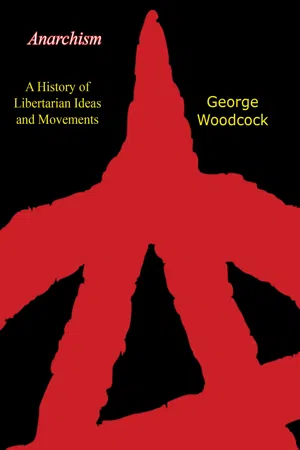
"'Whoever denies authority and fights against it is an anarchist,' said Sebastien Faure. The definition is tempting in its simplicity, but simplicity is the first thing to guard against in writing a history of anarchism. Few doctrines or movements have been so confusedly understood in the public mind, and few have presented in their own variety of approach and action so much excuse for confusion." These are the opening sentences of this book, which brilliantly effaces confusion by providing a critical history of anarchist thought and practice.
Mr. Woodcock traces the development of anarchism from its earliest appearances, and the rise and fall of anarchism as a movement aiming at practical social changes during the nineteenth and twentieth centuries. He discusses the ideas of the principal anarchist thinkers—Godwin, Proudhon, Bakunin, Kropotkin, Tolstoy, among others—and explains the various forms—anarchist individualism, anarchist communism, anarcho-syndicalism—that anarchist proposals for change have taken. The development of anarchist organizations, the various forms (peaceful and violent) of anarchist political action in Europe and America, the reasons for the appeal of anarchism at certain periods and to certain people—all these are given full treatment in Mr. Woodcock's comprehensive work, which closes with a discussion of the causes of anarchism's failure as a movement and with a consideration of whether there are any elements in anarchist thought that—despite the failure of anarchism as a political panacea—may still be worth preserving in the modern world.
"The essential introduction to the classical anarchist thinkers."—Mark Leier, Director, Centre for Labour Studies, Simon Fraser University
- 388 pages
- English
- ePUB (mobile friendly)
- Available on iOS & Android
eBook - ePub
About this book
Information
Topic
HistoireSubtopic
Histoire de la Grande-BretagneII — THE MOVEMENT
9. International Endeavors
Humanity is one, subjected to the same condition, and all men are equal. But all men are different, and in his inner heart every man is in fact an island. Anarchists have been especially conscious of this duality of universal man and particular man, and much of their thought has been devoted to seeking a balance between the claims of general human solidarity and those of the free individual. In particular they have sought to reconcile internationalist ideals—the idea of a world without frontiers or barriers of race—with a stubborn insistence on local autonomy and personal spontaneity. And even among themselves they have not often been able to achieve this reconciliation. For almost a century they have tried to create an effective world organization of anarchists; their efforts have been frustrated by an intolerance of any form of centralism and a tendency to retreat into the local group, which are both encouraged by the nature of anarchist activity. Since the anarchists do not seek electoral victories, there is no need to create elaborate organizations similar to those of political parties, nor is there any need to frame general programs of action; most anarchist groups have in fact been dedicated to individually motivated propaganda—either of the word or the deed—and in activity of this kind the lightest of contacts between towns and regions and countries is usually sufficient. Significantly, only in the marginal field of anarcho-syndicalism, which is based on mass trade-union formations rather than on small propaganda groups, have local and individual interests been sufficiently subordinated to allow the creation of a durable and relatively efficient form of libertarian international organization.
Since this largely unsuccessful search for an effective international organization raises so clearly the central libertarian problem of a reconciliation of human solidarity with personal freedom, it seems appropriate to consider anarchism as an international movement before discussing its record in individual countries. The approach is further justified by the fact that the anarchist movement made its earliest appearance within the First International and the cosmopolitan brotherhoods founded by Bakunin, and only later separated into national movements which each took a special character from the circumstances in which it was developed.
The history of anarchist internationalism falls into five periods. From the participation of the Proudhonian mutualists in the discussions that led to the foundation of the First International, down to the break with the Marxists after the Hague Congress of 1872, the anarchists-whether they followed Proudhon or Bakunin—were seeking to fulfill their internationalist aspirations in collaboration with socialists of other kinds. From 1872 to the famous “Black International” Congress of 1881, they tried to create a purely anarchist International, and this urge continued weakly through a series of abortive congresses during the 1880’s and the early 1890’s. In the third period, from 1889 to 1896, the anarchists concentrated on an attempt to gain a footing in the Socialist Second International. Their final ejection from the London Socialist Congress of 1896 initiated a further period, reaching its climax at the Amsterdam Congress of 1907, during which an organization restricted to convinced anarchists was once again sought; this period came to an end with the outbreak of the First World War in 1914. The last period, from 1919 to 1939, was dominated by the relative success of the anarcho-syndicalists who, after several false starts, finally created at Berlin in 1923 their own organization of libertarian trade unions, the International Workingmen’s Association, which still survives in Stockholm almost forty years after its foundation.
During the 1840’s, as I have shown, Proudhon was already speculating on the prospects of an international association of producers, and it is thus appropriate that his followers should have played a decisive part in the negotiations that led to the foundation of the First International. These negotiations began when Napoleon III, as part of his policy of courting the French workers, encouraged a delegation of artisans to visit the London International Exhibition of 1862. Among them were several of the mutualists who later signed the Manifesto of the Sixty, and who on this occasion started conversations with English trade unionists and with the German expatriates clustered around Karl Marx. In the following year, 1863, three of the same group—Tolain, Limousin, and Perrachon—went again to England at the invitation of the London Trades Council. Their ostensible purpose was to take part in a meeting in support of Polish freedom, held at St. James’s Hall on July 22, but once again there were conversations on the possibilities of international organization. Finally, in September 1864, a delegation of French socialists arrived in London with the aim of co-operating in the actual foundation of an association. All the delegates were Parisian artisans. Three of them, Tolain, Limousin, and Fribourg, were more or less orthodox Proudhonians; the fourth, Eugène Varlin, was a near-anarchist of another kind, who, while rejecting authoritarian socialism, held collectivist views similar to those of Bakunin. The French delegates attended the great meeting held at St. Martin’s Hall on September 28, and it was they who put forward the resolution proposing the foundation of the International Workingmen’s Association.
Tolain, Limousin, and Fribourg were chosen as French correspondents for the International, and the bureau they set up in Paris was the real center of anarchist organization in that country; in this sense it will be discussed more fully when I deal with the movement in France. So far as the International as a whole was concerned, the task of implementing the St. Martin’s Hall resolution was left to a Central Committee of twenty-one members, entrusted with the task of drawing up rules and a constitution, and, since London seemed the safest place for such a body to operate, the control fell into the hands of English trade unionists and foreign refugees, including Marx and his German followers, a few French Blanquists, and the Mazzinian Major Wolff. This situation, which continued after the Central Committee was replaced by the General Council at the Geneva Congress of 1866, meant that the anarchists, whether of Proudhonian or Bakuninist persuasion, never had any foothold in the executive center of the International, and were restricted to deploying their strength at the various congresses, so that they could only influence comparatively general fields of policy.
The consequences of this division of control did not become immediately evident. The Geneva Congress-the first plenary gathering of the International—was preceded by an interim conference in London, at which reports of the working-class movements in various countries were exchanged, and a few general resolutions on such uncontroversial subjects as the Polish question and the lamentable influence of the Russian autocracy on European affairs were passed. The general atmosphere of this gathering was cordial, though Marx went out of his way to slander Proudhon privately to Tolain and Fribourg in the hope of leading these two influential delegates into his own camp. He was unsuccessful; the French remained determinedly anti-authoritarian, as did the only Belgian delegate, Caesar de Paepe.
At the Geneva Congress the line of division between libertarians and authoritarians within the International was already beginning to show sharply. The French delegates, who constituted almost a third of the Congress, were mostly Proudhonians, though collectivists like Benoît Malon and Eugène Varlin were present, as also were Albert Richard of Marseilles—soon to become a devoted Bakuninist—and, among the Swiss representatives, James Guillaume and Adhemar Schwitzguébel, the later leaders of anarchism in the Jura. But Bakunin was not yet a member of the International, and it was the mutualists who at this point maintained the struggle against the authoritarians in favor of a strictly working-class program based on association and mutual credit, in the spirit of Proudhon’s suggestions in De la Capacité Politique des Classes Ouvrières.
In accordance with this attitude, the mutualists sought to restrict the membership of the International to actual manual workers; they were defeated as a result of strong opposition from the British trade unionists. They were also defeated when they opposed a Marxist resolution which, under the guise of approving legislation to protect labor, subtly introduced the concept of the “workers’ state,” since it claimed that “by compelling the adoption of such laws, the working class will not consolidate the ruling powers, but, on the contrary, will be turning that power which is at present used against it into its own instrument.” On the other hand, they gained one minor victory by persuading the Congress to pass a resolution for the establishment of a mutual credit bank, as well as securing approval for the promotion of producers’ co-operative societies as a vital part of the general struggle for workers’ freedom.
A pronounced shift soon became apparent in the balance of power within the International. At Lausanne in 1867 the mutualists were perceptibly weaker, largely because of the spread of the collectivist viewpoint in France. This resulted in Tolain and his followers compromising over resolutions calling for state intervention in education and—more important—for the public ownership of the means of transport and exchange. The deliberately ambiguous wording of the latter resolution made it acceptable both to those who wished for state ownership and to those who preferred control by associations of workers. Yet the mutualists once again won a small success by obtaining the postponement of the question of public ownership of the land, to which they preferred peasant possession, until the next congress.
The mutualists were still a force to be reckoned with at the Brussels Congress of September 1868, yet this gathering in the end marked a clear shift toward a policy of economic collectivism. The Proudhonian opposition to socialization of the land was now unavailing, since the Belgian collectivists, led by Caesar de Paepe, controlled more than half the votes, and a resolution calling for public ownership of mines, transport, and land was passed by a large majority. On the other hand, the mutualists gained a last triumph when Belgian support enabled them once again to pass a resolution approving the foundation of mutual credit banks.
The Brussels Congress established a socialized economy as the future aim of the European working-class movement. It did not determine the vital question whether that socialization should be carried out by authoritarian or libertarian means, but it seems clear that the spirit of the gathering tended in the latter direction, and the stage was now set for the second wave of Proudhon’s followers, those who accepted collectivism but retained all the Master’s hatred of authority, to appear on the scene. They presented themselves at the Basel Congress of 1869 under the leadership of Bakunin. Bakunin, like Proudhon, had long dreamed of an international organization for the emancipation of the working class, and I have traced the attempts he made during the period before he entered the International, theoretically as an individual member but really as the leader of movements in Italy, Spain, the Jura, and southern France, all of which were formed largely under his influence.
It is unnecessary to repeat the accounts of the Geneva and Hague Congresses of the International in which the issues between Marx and Bakunin were fought out and the organization itself split apart into the dying Marxist rump centered around the New York General Council and the anti-authoritarian majority centered around the Bakuninist Jura Federation. But it is desirable to consider some of the factors underlying the final emergence of a predominantly anarchist International in 1872.
The conflict between Bakunin and Marx was the dramatic encounter of two historically important individuals, and for this reason one is tempted to interpret events in the epic terms of personal combat. But such an interpretation cannot explain entirely either the considerable following which Bakunin gathered during his struggle with Marx or the fact that such a substantial proportion of the International—certainly representing the greater part of its actual membership—finally entered the Bakuninist camp.
In fact, the schism was not merely between convinced Marxists and convinced Bakuninists. When the delegates of the Jura Federation and a few Geneva expatriates met at Sonvillier in November 1871, at the conference that marks the real beginning of the attempt to form an anarchist International, the circular they issued received the support of the Bakuninist federations of Spain and Italy but also of the Belgian followers of Caesar de Paepe, who stood halfway between anarchism and social democracy, while it aroused interest in Holland and England. The appeal it made was not due to the anarchist viewpoint of those who framed it, but to the fact that it echoed a growing discontent, even among Marx’s former followers, with the way in which he sought to bring the centralized authority of the General Council under his own control. Whether the threat was regarded as one of personal dictatorship or of organizational rigidity, it was repugnant not only to the anarchists but also to men reared in the democratic traditions of labor movements in Britain and in the Low Countries. This was why they responded favorably to the key paragraph of the Sonvillier Circular, which stated with a moderation rare in nineteenth-century socialist polemics the libertarian ideal of a decentralized working-class organization.
We do not wish to charge the General Council with bad intentions. The persons who compose it are the victims of a fatal necessity. They wanted, in all good faith, and in order that their particular doctrines might triumph, to introduce the authoritarian spirit into the International; circumstances have seemed to favor such a tendency, and we regard it as perfectly natural that this school, whose ideal is the conquest of political power by the working class, should believe that the International, after the recent course of events, must change its erstwhile organization and be transformed into a hierarchical organization guided and governed by an executive. But though we may recognize that such tendencies and facts exist, we must nevertheless fight against them in the name of the social revolution for which we are working, and whose program is expressed in the words, “Emancipation of the workers by the workers themselves,” independently of all guiding authority, even though such authority should have been consented to and appointed by the workers themselves. We demand that the principle of the autonomy of the sections should be upheld in the International, just as it has been heretofore recognized as the basis of our Association; we demand that the General Council, whose functions have been tempered by the administrative resolutions of the Basel Congress, should return to its normal function, which is to act as a correspondence and statistical bureau....The International, that germ of the human society of the future, must be...a faithful representation of our principles of freedom and of federation; it must reject any principle which may tend towards authoritarianism and dictatorship.
The men of Sonvillier considered that they were maintaining the original aims of the International, and it was in this spirit that, after the great schism of The Hague, the Saint-Imier Congress came together in 1872. There were delegates from Spain, Italy, and the Jura; they included many of the great names of anarchist history—Bakunin, Cafiero, Malatesta, Costa, Fanelli, Guillaume, Schwitzguébel. Two Communard refugees, Camet and Pindy, represented France, and another, Gustave Lefrançais, represented two sections in the United States. The Saint-Imier Congress was concerned mostly with the establishment of the new International, or rather, as its members contended, with the reformation of the old. For the Bakuninists always regarded their International as the true heir of the organization set up in 1864, and counted their congresses from the First (Geneva) Congress of 1866.
There was some justification for this point of view, since it soon became clear that the Marxist rump, with its headquarters in New York, had retained hardly any support among the rank-and-file membership of the International. Its one attempt at a Congress, at Geneva in 1873, was, as the Bolshevik historian Stekloff admitted, “a pitiful affair,” attended almost entirely by Swiss and German exiles in Switzerland. “The game was up,” as Marx exclaimed when he heard of it.
The Saint-Imier International, on the other hand, gathered at its 1873 Congress (also in Geneva) a fair number of delegates, not only from Spain, Italy, and the Jura, but also from France, Holland, Belgium, and Britain, including—the most surprising catch of all—Marx’s former lieutenant Eccarius. How many actual adherents of the International these delegates represented is as hard to suggest as it is to estimate the numerical support of the International at any period of its existence. Stekloff quotes estimates that place the adherents of the united organization in 1870 as high as five or even seven million, but he rightly dismisses these figures as “pure invention”; fairly reliable estimates of the membership of the Spanish Federation, one of the largest, place it at 60,000 in 1872, and on this basis one can assume that the total membership of the International before the Hague Congress was probably less than a million, and that even at its height in 1873 the Saint-Imier International had considerably fewer adherents, many of whom must have been no more than inactive card-carriers. Nevertheless, one can safely assume that from 1872 to 1877 the Bakuninists commanded a following far greater than the Marxists.
The diminished International did not immediately begin to take on a specifically anarchist character. The Congress at Saint-Imier was concerned mostly with questions of organization, and its decisions were acceptable to a range of anti-Marxists as far apart as conservative English trade unionists and extreme anarchist insurrectionists. It proclaimed the autonomy of sections and federations, and denied the legislative competence of congresses, which should confine themselves to expressing “the aspirations, the needs and the ideas of the proletariat in various localities or countries, so that they may be harmonized or unified.” It set up “a friendly pact for solidarity and mutual defense” directed against the threat of centralism.
Only one resolution at Saint-Imier was specifically anarchist, and that repudiated the emphasis laid on political action at preceding congresses since the Lausanne gathering of 1867. “The aspirations of the proletariat,” it maintained in characteristically Bakuninist tones, ...
Table of contents
- Title page
- TABLE OF CONTENTS
- I - THE IDEA
- II - THE MOVEMENT
- SELECTED BIBLIOGRAPHY
- REQUEST FROM THE PUBLISHER
Trusted by 375,005 students
Access to over 1.5 million titles for a fair monthly price.
Study more efficiently using our study tools.
Frequently asked questions
Yes, you can cancel anytime from the Subscription tab in your account settings on the Perlego website. Your subscription will stay active until the end of your current billing period. Learn how to cancel your subscription
No, books cannot be downloaded as external files, such as PDFs, for use outside of Perlego. However, you can download books within the Perlego app for offline reading on mobile or tablet. Learn how to download books offline
Perlego offers two plans: Essential and Complete
- Essential is ideal for learners and professionals who enjoy exploring a wide range of subjects. Access the Essential Library with 800,000+ trusted titles and best-sellers across business, personal growth, and the humanities. Includes unlimited reading time and Standard Read Aloud voice.
- Complete: Perfect for advanced learners and researchers needing full, unrestricted access. Unlock 1.5M+ books across hundreds of subjects, including academic and specialized titles. The Complete Plan also includes advanced features like Premium Read Aloud and Research Assistant.
We are an online textbook subscription service, where you can get access to an entire online library for less than the price of a single book per month. With over 1.5 million books across 990+ topics, we’ve got you covered! Learn about our mission
Look out for the read-aloud symbol on your next book to see if you can listen to it. The read-aloud tool reads text aloud for you, highlighting the text as it is being read. You can pause it, speed it up and slow it down. Learn more about Read Aloud
Yes! You can use the Perlego app on both iOS and Android devices to read anytime, anywhere — even offline. Perfect for commutes or when you’re on the go.
Please note we cannot support devices running on iOS 13 and Android 7 or earlier. Learn more about using the app
Please note we cannot support devices running on iOS 13 and Android 7 or earlier. Learn more about using the app
Yes, you can access Anarchism by George Woodcock in PDF and/or ePUB format, as well as other popular books in Histoire & Histoire de la Grande-Bretagne. We have over 1.5 million books available in our catalogue for you to explore.