![]()
1
NELLIE NEAL LAWING, 1873–1956
Lawing, Alaska
Born a Missourian who endured hardships in the gold mining towns of Colorado as a young adult, she staked out a new life in Alaska as a roadhouse contractor for the new Seward-to-Fairbanks railroad. She arrived in Alaska alone, middle-aged, but full of fire. Her operation of way stations enabled greater access to fish and game for Alaskans and visiting sportspersons.
The allure of Alaska tugs at the heartstrings of all those with a spirit of adventure. Some don’t tarry for even a day in moving to The Last Frontier to fish, hunt, trap, prospect, escape the law, or just create a new reality. Most never make the move at all; others do it much later in life. The latter category fits the curious case of Nellie Trosper Neal Lawing.
Because of multiple marriages that changed her last name, I’ll refer to her simply as Nellie.
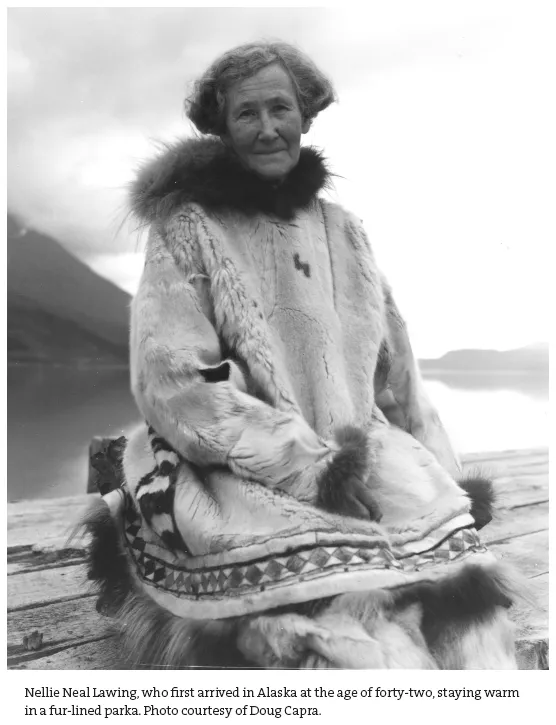
Nellie would not set foot in Alaska until 1915 at the age of forty-two, well past what most consider their prime. But when she did arrive, she commenced tackling the Alaska wilderness with a rare grit and perseverance for someone reaching middle age, much less a wispy five-foot divorcee. But before delving into the portion of Nellie’s life that would make her an iconic figure in Alaska’s history, let’s review her life before she stepped off the boat in Seward.
She came into this world in 1873 as Nellie Trosper in Saint Joseph, Missouri. Her father, Robert N. Trosper, was a Civil War veteran who married Jennie Jane Gibson. Named Nellie after Ulysses S. Grant’s daughter, she was the eldest of twelve children, two of whom died when quite young.
The hardships and disarray of the Civil War still hung in the air as Robert and Jennie soon left Saint Joseph and moved to Platte County near the town of Weston, Missouri. There they bought a timber-bordered farm with a five-room log cabin. Even on a farm, it was undoubtedly a formidable task for such a large family to keep food on the table and everyone clothed. As Nellie toiled with household and farm chores and helped raise her siblings, she heard tidbits about Alaska—quite likely from an occasional traveler who happened through town or perhaps from newspaper accounts.
However the news about such a magical land came into her psyche, it resonated. She longed for a less-mundane life, and Alaska became the dream that promised exactly that. For the next half of her life, that idyllic dream grew stronger. In her autobiography, Alaska Nellie, published in 1940, she described this vision of Alaska at an early age:
“My father and mother asked me what vocation I would choose when the time came for me to make my own way through life. When I told them of my desire to go to Alaska, to live in a log cabin, hunt big game, run a trap line and catch beautiful furs, they thought that I, like most all young people with freakish dreams, would outgrow them.”
She and her brother Harry ran a trapline along Bee Creek for raccoons, skunks, weasels, possums, and other small game. Nellie also enjoyed hunting, fishing, and riding horses with her coonhound, Hot Foot, frequently tagging along.
When her mother died in 1898 and her father remarried two years later, Nellie took on the role of being both a sister and a mother to her younger siblings. Despite her father’s misgivings in general about Nellie’s leaving the family homestead and specifically her goal of living in Alaska, she nonetheless closed the door behind her for good on May 30, 1901. She boarded a train for Green River, Wyoming, where she’d already lined up a job running a lunchroom for the Union Pacific Railroad. That job didn’t last long as soon afterward she accepted a better-paying position at Glenwood Springs, Colorado, for the Denver & Rio Grande Railroad. From there she bounced to Denver, where, on October 20, 1903, an employment agency directed her to an opening at a boarding house near Pike’s Peak in Cripple Creek, Colorado.
She arrived the next day at one of the world’s largest gold-mining camps. But as she would later write in her book, “Could I have seen through the coming years I would not have taken this trip, as it led up to one of the greatest struggles of my life.”
Cripple Creek was in constant turmoil due to conflicts between angry unionized miners and intransigent mine owners. Nellie remained neutral, but the strife propelled her to quickly ditch the boarding house in favor of opening her own place six miles away in Victor. However, the violence shifted practically to her front door, and Nellie—not one fond of flying bullets and bomb explosions—sold her place in Victor and bought a thirty-room hotel called the Courthouse Club back in Cripple Creek.
By then she’d met Wesley Neal, a former Missourian doing a thriving business as a gold assayer. They went from friends to lovers, and they married on February 26, 1906. Doug Capra, a historian of Alaska and an author from Seward who’s writing a biography about Nellie, discovered an interesting bit of information that suggests she had been previously married. “Her marriage certificate in Cripple Creek lists her name as Nellie Bates and not as her maiden name of Nellie Trosper,” Capra wrote in an email to me. “That suggests she was married when living in Saint Joseph, Missouri, but I can find no record of that at all.”
Nellie’s hotel operation flourished, but the incessant lawlessness of Cripple Creek made for a stressful and sometimes traumatic existence. On one occasion she nearly lost her life when a thief tried to kill her in the hotel, and on another she had to shoot it out with a would-be robber in Wesley’s assay office.
If the constant threat of violence wasn’t enough, her marriage also deteriorated. Wesley had too strong an affinity for rum, which led to his mental and physical abuse of Nellie. And so on November 12, 1912, she packed up her belongings and went back to Denver to the same employment agency that had previously helped her. This time it set her up for a job with the Oregon Short Line in Huntington, Oregon.
After nearly two years in Oregon, Nellie grew restless. On a visit to Seattle in 1914, she heard about the U.S. government’s plans to build a railroad from Seward to Fairbanks, a project that would be unveiled in the coming spring at the Panama-Pacific International Exposition in San Francisco. Excited at the prospect of finally getting to Alaska, Nellie took a temporary position with the Southern Pacific Railroad in Carlin, Nevada. In early spring of 1915 she set out for San Francisco; in late June she bought a ticket on the Admiral Evans, a steamship bound for Seattle, where she transferred to the steamship Alameda for the seven-day trip to Seward.
It had been fourteen long years since she’d left home, and now she’d be going to Alaska. The journey north was like a blood transfusion as Nellie stood on deck while the Alameda passed Vancouver and cruised the Inside Passage on the way to Seward. The sweep of the snow-tipped mountains and the sight of gliding eagles and breeching whales framed by glaciers could only have entranced her. Nellie must have relished the cool, fresh air washing over her face, thrilled that a lifelong dream was about to be realized.
Nellie stepped onto the pier at Seward, Alaska, on the evening of July 3, 1915, filled with exhilaration and hope. Immediately, she secured employment as a housekeeper with a local family and sometime later hired on as cook for Jim Hayden, the operator of a gold mine and mill. Hayden owned a beautiful log home, named Oasis, located twenty-six miles from Seward and five miles west of the railroad in the mountains.
En route to Oasis on the Alaska Central Railroad, Nellie disembarked to stretch her legs at the tiny village of Roosevelt at Mile 23. Along the route, she had noted that the marker numbers represented the miles north of Seward. Nellie felt an immediate, almost-spiritual heart tug while admiring Roosevelt’s beautiful vistas and the inviting log house standing on the edge of shimmering Lake Kenai.
Nellie worked hard at the Oasis, starting at fifty dollars a month and soon advanced to a hundred—a healthy income for that era in a remote portion of Alaska. When summer passed and ice shut off the flow of river water to the mill, everyone left Oasis for Seward. Not Nellie. She’d previously stumbled upon an abandoned cabin while hunting ptarmigan, and in December 1915 she moved into it. Living alone thirty miles deep in the mountainous wilderness, she savored the white silence of winter and the calming solitude for the next three months.
That spring, the U.S. government bought the bankrupt Alaska Central Railroad. It became the Alaska Northern Railway, the precursor of a Seward-to-Fairbanks railway project. Nellie sought a contract to operate a roadhouse—a combination hotel and diner—and suggested Mile 45 as a central location for the 114-mile Seward-to-Anchorage division. She hoped to be the region’s Fred Harvey, the famous entrepreneur who, in 1875, started America’s first restaurant chain by opening cafes along the western railways that cooked good meals served by young, attractive waitresses.
Nellie secured the contract, taking over a four-story roadhouse where she prepared meals and offered lodging. Rather than accepting the designation Mile 45, she decided to name the spot Grandview, an appropriate placename due to the great natural beauty of the surroundings. Nellie was tasked with obtaining all needed supplies in Seward and oversaw the cooking and innkeeping. Besides a dining room, thirteen bunks provided sleeping arrangements for men, and Nellie lived in a small room over the kitchen. Two trains each week stopped in Grandview, where travelers could join miners in relishing Nellie’s excellent cooking.
Time went by, and after sixteen months in Alaska, Nellie had found her niche and discovered her soul. In her book she puts it this way: “I could never express how deeply attached I had become to this great frontier country. It had truly exceeded all my expectations. The brilliant night of my imagination was now made doubly bright by personal contact.”
Nellie quickly acquired the skills to be a successful innkeeper and cook, and those qualities put her in good stead. But another reason for her rising reputation became founded on a willingness to help others even at her own peril. One night when snow had stalled a train two miles to the north, fifty railroad men worked eighteen hours straight to clear it. Nellie prepared ham-and-egg sandwiches, donuts, and coffee, packed the food on a dog sled, and headed out into the night—even though it was twelve below zero. Much to their collective delight, Nellie reached the men, and the nourishment provided a jolt of energy that helped them to finish digging out the rails.
Although weather conditions were often daunting, that didn’t deter Nellie. She’d barge into the wilderness to deliver meals to spike camps or even spend all day trudging with snowshoes to Seward to fetch someone’s medical supplies. When such stories reached the locals as well as visitors, they earned Nellie respect. And guests knew they’d be taken care of at Grandview. It was a clean and dependable place to sleep and the delicious preparations of fish and game made her place a regional favorite. She also entertained guests with tales of her heroics, even if some were embellished for the sake of a good story.
The more that Nellie experienced the challenges of the Alaska wilderness, the farther her skills advanced. After only a few years in the territory, she could already fish, hunt, trap, and mush with the best of them. And from her decade in Cripple Creek, she had the ability to relate well with the many gold prospectors coming through the area.
Of the many stories Nellie wrote in Alaska Nellie, two of the more-often quoted ones involve the rescue of a mail carrier and her entrustment with a fortune in gold. The first occurred in January of 1920 when Henry Collman’s dog sled was late in delivering to the train several sacks of correspondence that included documents vital to Seward. Nellie took off with her dog team into the teeth of a massive blizzard and somehow found Collman nearly frozen to death along the railway. She could waste no time collecting his mail sacks and pouches, or he would die before getting him to Grandview.
She did just that. Her book describes just how critical was Collman’s condition: “He was thawing out too rapidly. After filling a washtub with snow, I packed his feet with snow, then applied snow packs to his face and hands, keeping him warm at the same time so the snow would melt fast. He took hot drinks and I applied kerosene, which has a healing effect on frozen parts.”
But that’s half the story. Knowing the importance of mail to everyone in the territory, at 3 A.M. she left Grandview and traversed huge snowdrifts to go back and get the sacks and pouches. Nellie stopped at the roadhouse and, after finding Collman still asleep, she went on to the next train flag stop, where she arrived just in time at 7 A.M. The mail delivery was made, much to the relief of Collman, the railroad, the postal service, and everyone in Seward. Later that year, just before her third Christmas in Alaska, Nellie received a package. The town of Seward recognized her extraordinary heroism with a gift of a pendant of solid-gold nuggets centered with a diamond—a personalized treasure she wore for the rest of her life.
The events in the second story occurred on a cold December day when U.S. marshals named Cavanaugh and Irwin and two other men came to Grandview after a long trip. Badly in need of a night’s rest before continuing on their journey, the exhausted travelers found just enough energy to remove heavy wooden boxes from their sleds and bring them inside the roadhouse. Nellie learned that the boxes contained $750,000 in gold bullion fresh from the Iditarod mining district.
The men asked Nellie where it could be hidden for the night, and she said to slide it under the dining room table. As all four men quickly dozed off, Nellie sat up all night in a rocking chair beside the fireplace because all the beds were taken. She knew all too well from her days in Cripple Creek what evil effect gold had on the integrity of men, and she wasn’t about to let anyone touch this bullion. It’s doubtful the marshals would have entrusted such a mega-fortune to anyone else than Nellie. All that gold remained safely secured until the next morning, when the men loaded it back onto their sleds and mushed on to Seward.
Everyone who visits the wilds of Alaska ends up with bear stories, and Nellie had her share. Once when hunting, she stumbled on two black bear cubs up in a tree, and she knew the mother would be ready to kill any creature in the vicinity. Sure enough, a large female emerged, rose onto its hind legs, and would have surely charged her had Nellie not killed it with one shot to the chest. She retrieved the motherless cubs—left on their own, they would have died—and turned them into pets, which for many years offered great amusement and fascination to many visitors. Nellie would likewise later discover another pair of black bear cubs – this time without a momma bear around. They became her pets too.
In her most horrific and dangerous bear incident, a brown bear came onto her property and killed Mike, her only remaining black bear cub at the time. Nellie had discovered Mike’s collar and bloodstains where the cub had been chained, and followed bear tracks down a trail until running into a massive brown bear. Wishing she’d brought her rifle along, Nellie ducked behind a half-fallen tree as the beast charged, barely missing her. She took off for the horse barn at the camp and made it inside just before the beast closed the distance to kill her. She broke three fingers in the jam and bruised her knee as the bear slammed into the door. The intensity of the bear’s attack and ferocious growling and snarling terrified Nellie, as it would anybody.
When the bear gave up and Nellie heard it leave, she bolted to her cabin to recover. Gathering her strength and fed by the anger of Mike’s death, Nellie grabbed her .30-40 Winchester rifle, went to a ridge above the barn and confronted the bear. It reared up to fight—a big mistake, given Nellie’s shooting proficiency. She pulled the trigger, but it took six slugs, the last spiraling through the heart, before it ended the battle. The huge brown bear measured nine feet, six inches tall, nearly twice the size of Nellie. When she gutted him, her cub Mike and a porcupine were in its stomach and she found remnants of other bullets from some poor hunter who probably didn’t survive the ordeal.
“Ammunition with shocking power is of vital importance for shooting this dangerous game,” she wrote in her book. “Sometimes a bear riddled with bullets, any of which would cause death, keeps coming toward one—perhaps for the same reason that a chicken flops around after it has been beheaded.”
Nellie took these challenges in stride as a trade-off for the privilege of living in Alaska. “After terrific encounters with huge beasts that tried to do me to death, I was always ready to apply the old remedy of courage and fearlessness and go on to the next encounter undaunted,” as she put it. Indeed, deep reservoirs of icy cool seemed to course naturally through Nellie’s veins
But sometimes two-legged beasts will wreak havoc too. Case in point: After noting how hard Nellie worked to keep Grandview operating at a high level, a well-heeled lodge guest with an alcohol addiction offered to partner with Nellie—he also suggested marriage on top of that. Nellie turned him down on both accounts. She eschewed partnerships with anyone in the roadhouse business, and there was no way she was going to get hitched to another drunk. The jilted man opened an opposing place of business nearby....