eBook - ePub
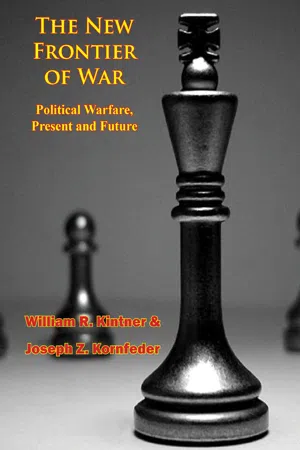
The New Frontier of War
Political Warfare, Present and Future
- 383 pages
- English
- ePUB (mobile friendly)
- Available on iOS & Android
eBook - ePub
About this book
This exploration of Soviet communist political maneuvering was written in 1962 at the height of the Cold War by the then professor of Political Science at the University of Pennsylvania and the former leader of the American Communist Party. With examples from recent history the authors show how the inner workings of the Soviet machine differ from the popular idea of how communists proceed. The book also details how the Western World could formulate counter-strategies to the Communist political attacks, assaults and infiltrations.
Trusted by 375,005 students
Access to over 1.5 million titles for a fair monthly price.
Study more efficiently using our study tools.
Information
Subtopic
Russian HistoryPART ONE—THE COMMUNIST MACHINE
THE CONFLICT MANAGEMENT OF COMMUNIST POLITICAL WARFARE long ago established certain ground rules: (1) there must be an overall theory for orientation, setting goals and establishing guide lines; (2) there must be an organization, both adequate and capable, to work for the realization of these goals; and (3) there must be operational methods suited to the purpose.
In the context of political warfare, a nation is not a monolithic abstraction represented only by its governmental heads. It is a myriad of social, economic and political subgroupings, each with its own part in the conflict of the epoch and each influencing, and being influenced by, the great socio-political trends and decisions. Today’s struggle is taking place in all corners of the earth. It involves use of the instruments of power available to a state—diplomacy, psychological warfare, and economic warfare—to influence directly or indirectly the components of the adversary’s politico-social fabric and through them to influence the policies and debilitate the power of the adversary nation. Political warfare also shapes the hostile nation’s “intelligence,” its picture of the meaning of events, and hence brackets the decision-making process.
The “cold war,” which is really pure political warfare, results from the expansionist techniques which the U.S.S.R. initiated and with which the United States has been more and more compelled to cope.
Communists achieve successes through organizational skills welded to a practical concept of power accumulation. The Communist will join in any fight, support any cause which gives him the chance of getting at the levers of power. Khrushchev told us in his revealing January, 1961, speech that “Communists are revolutionaries” and that it would be a bad thing if they failed to spot newly arising opportunities or to find new ways and means leading most surely to the realization of their set goal.{9}
This helpful information was preceded by advice drawn from Lenin and incorporated in the statement of the eighty-one Marxist-Leninist parties, which called “for the maximum utilization of the revolutionary possibilities of the various classes and social strata and for drawing all allies, no matter if inconsistent, shaky and unstable, into the struggle against imperialism.”{10}
With such marching orders the Communist may find himself shoulder to shoulder with pacifists, race minorities, nationalists, peasants or proletarians, right-wing socialists or left-wing socialists, just as, at the national level, he can tolerate an alliance with bourgeois democracies or with rightist dictators. Thus does he seek to win, step by step, not just opinions and popular support, but the control of organizations beyond his own party, its front groups, and captive organizations.
The communist machine did not spring full born from the mind of Lenin in a single night. But its genesis influences directly the operational pattern of communist political warfare. The first three chapters of Part One trace this evolution: The initial party structure has been modified by successive communist dictators, and the recruiting base has been opportunistically broadened so that all but the most hard-bitten capitalists can be enticed into the movement. Stalin’s reign transformed the movement from an initially idealistic conspiracy into a monolithic party, easily copied by the Fascists and Nazis, in which members are motivated primarily by the urge to power. Success attracts success. Communist party leaders throughout the Free World seek constantly to master the many roads that lead the true believer to power.
Part One examines the sociological character of communist political warfare demands and the contrast between propaganda and agitation; the nature of the ideological attack on non-communist symbols and the range of social targets considered to be accessible to communist penetration.
Finally, Part One surveys the role of the Communist state, as contrasted to the worldwide network of parties, in political warfare operations, with emphasis on the Soviet Union. The principal kinds of Soviet operations are analyzed, the role of military power and its companion—disarmament—is then set forth preliminary to describing post-Stalin organizational innovations in what the Communists call “the conflict of systems.”
CHAPTER I—THE COMMUNIST PARTY STRUCTURE AND RECRUITING BASE
COMMUNIST POLITICAL WARFARE IS HIGHLY DEPENDENT UPON the party system of organization. The recruiting base of the Party is in turn sensitive to shifts in communist strategic doctrine.
The special role of the Party as a functioning mechanism is not well understood in the West. The Party, whatever it is, is not a “party” in the sense outlined by Paul Ostrogorski about 1900 in his classic La Démocratie et l’Organization de la Partie Politique. The Communists organize a party to destroy all other parties, not a fraction to contend with other fractions within the limits of a genuine democracy. In this sense, the Hitlerites were more brutal and more honest than the Communists in their nomenclature when they insisted that their Partei was not really a Partei but a Bewegung—a “movement” which would sweep all other movements before it. Neither the economic ideas attached to the theory of communism nor the statist realities applied by communist governments in power matter as much as the dynamism of their self-styled “party.” The communist organization and operation of the “party” is the most revolutionary innovation which political technology has seen since Machiavelli. It is the “party” which has transformed communism from an occult parlor game of intellectuals into a chain of empires bigger and fiercer than anything ever erected by Genghis Khan.
The communist “party” develops in two distinctive stages. It changes like those insects which metamorphose as they leave the larval stage. Before gaining power, the Party is a power-seeking mechanism of considerable versatility and strength. The moment it obtains power, it becomes a policing mechanism without parallel in the modern world. There is an organic connection between communist party structure and methods prior to and after seizure of power.
We turn now to the Communist Party of the U.S.S.R., which still plays the commanding role in the world movement.
Mao Tse-tung stated in late 1957: “Our Socialist camp should have a leader, and this is the Soviet Union. The enemy also has a leader, and this is America. If there is no leader, the strength will be weakened.”{11} Khrushchev made the same point more obliquely:
It should be noted that the delegation of the Communist Party of the Soviet Union stated at the meeting [November, 1960 meeting in Moscow of eighty-one Marxist-Leninist parties] its point of view that the Soviet Union stands at the head of the Socialist camp and the C.P.S.U. at the head of the Communist movement....There has always been complete equality and solidarity of all the Communist and Workers’ Parties....The Communist party of the Soviet Union does not lead other parties. There are no “superior” and “subordinate” parties in the Communist Movement.{12}
After this tribute to equality, Khrushchev continued: “The Communist Party of the Soviet Union has always been the universally recognized vanguard of the world Communist movement.”{13} In order that all parties can keep in step with the vanguard:
We need to set our watches, so that our mighty army should keep in step and march confidently towards Communism. Putting it figuratively, Marxism-Leninism, the jointly prepared documents of international Communist meetings, are our time-piece.
Now that all the Communist and Workers’ Parties have adopted unanimous decisions at the Meeting, each Party will strictly and undeviatingly abide by these decisions in everything it does....
The unity of every Communist Party, the unity of all the Communist Parties is what makes up the integral world Communist movement, which is aimed at achieving our common goal—victory of Communism throughout the world.{14}
It is noteworthy that the United States Supreme Court, in an epochal 5 to 4 decision on June 5, 1961, likewise concluded that the Communist Party, U.S.A., was part of “the integral World Communist Movement” and noted, accordingly, that it would have to register as an agent of a foreign power.
The Communist Party represents a complete departure from the political organizations developed in democracies. It comprises a new system, a political elite which aims at total power over society. It seeks not to compete with other parties but to do away with them. The Communist Party’s organizational structure, weapons system, and operational methods are constructed to serve that purpose. The communist one-party state formed after the seizure of power is foreshadowed in the organization, structure, and methods of any communist party seeking power.{15}
Transformations in the structure and strategy of the vanguard Communist Party of the Soviet Union inevitably influence the conduct of communist political warfare, both inside and outside the communist orbit. Analysis of communist political warfare must therefore begin with the present party machine.
Toward the second half of the nineteenth century, the communist-type political party began to emerge. Its essential principles were embodied in the Communist Manifesto, authored by Karl Marx and Friedrich Engels. The Manifesto advocated the abolition of the existing free democratic society in favor of one in which all property would be owned by the state. The state would become a “dictatorship of the working class,” pending transformation into a new form of society. In view of the cultural backwardness of the working class, an elite party would be needed to lead them toward that goal.
It is significant that the architects of the totalitarian-type organization, of which the Communist Party is now pre-eminent, were all former Socialists.{16} Most noteworthy were Nicolai Lenin and his associates, former Socialist Benito Mussolini of Italy, and, later, Hitler and others who, although not Socialists, used or imitated the pattern set by Lenin.
Lenin’s concept of a party first appeared in 1902 in a pamphlet entitled What Is to Be Done? Subsequently he called for a party of “professional revolutionaries” who were to devote their lives to the conquest of power: a party centrally directed and highly disciplined; a party of “democratic centralism.” In time, the democracy faded and only the centralism remained.
Lenin incorporated into his party program some of the anarcho-syndicalist concepts of the use of labor unions for revolutionary purposes. Lenin conceived the idea, not envisaged by Marx, of an alliance with the small-property element, the peasants, without which seizure of power in Russia would have been impossible. Outside these modifications in organization and strategy, Lenin adhered in the main to Marx’s socialist concepts of a party based on the working class. Out of the womb of Marx’s socialist movement was born a new party which departed more and more from the earlier democratic tendencies of the Western European socialist movement.
The seed of totalitarianism was present in Marx’s theories of a class dictatorship and a class party, but until Lenin, two paths of development were still possible: one toward limited democracy and the other toward the one-party state, or totalitarianism. Lenin took the latter path.
Lenin’s party resembled the conventional democratic parties in only one respect: it put up candidates during parliamentary-election campaigns. But even that was done largely for the purpose of propaganda and agitation, and if any of its candidates were elected and took the oath of office, they were to sabotage the parliamentary system, not serve it. In every other respect, Lenin’s party—and later Stalin’s—was as different from democratic parties as fire is from water.
Lenin’s party came into power as a result of the collapse of the Czarist monarchy in World War I. Lenin had had little to do with the actual overthrow of the Czars, but, with the aid of Imperial Germany, he helped to destroy the democratic government which succeeded it. Among the first acts of Lenin’s Bolshevik Party was the forcible dissolution of the newly elected Constituent Assembly, the only freely elected parliament in the entire history of Russia.
According to Trotsky and others, Lenin’s supposed goal was the birth of a superior democracy, a birth at which his party’s dictatorship was to serve as midwife. In reality, the Russians had real democracy stolen from under their noses by talk of an allegedly superior new democracy—an ingenious ideological hoax. This ideological confidence game was repeated years later in Czechoslovakia, China, and Cuba with the same totalitarian results. It appears, therefore, that just as individual rights lead to democracy, so party dictatorship, which is a denial of those rights, leads to totalitarianism.
A century of “Marxist” propaganda has created the impression that communist doctrine—and hence strategy—is, and was, always the same. It is quite true that Marx’s principal writings still provide the basic philosophy of dialectical materialism. Karl Marx, however, conceived of the socialist revolution only in highly industrialized countries where the working class was in a majority. Lenin, on the other hand, conceived of the possibility of a “socialist-led” revolution in a country like Russia, where the factory working class was a small minority compared to the peasants. He did this by devising a theory which he called the “Bourgeois Democratic Revolution carried out by the Proletariat,” a theory which required a strategy entirely different from that envisioned by Marx, although the ultimate goal was the same: political power. Lenin’s theory about the metamorphosis of the bourgeois revolution into a proletarian revolution is dealt with in his thesis on “Two Tactics,” in which he forges the bourgeois democratic revolution and the socialist revolution as two links in one chain. In Lenin’s words:
The course of the revolution has confirmed our view. First of all, the proletariat marched with the peasantry as a whole; against the monarchy, against the landlords, against the vestiges of medievalism (and up to this point the revolution was still bourgeois, was still bourgeois democratic). Then the proletariat marched with the poorer peasants, with the semiproletarians, with the exploited; against Capitalism, and against its embodiment in the countryside, the Kulaks, the speculators so that now the revolution became a socialist revolution.{17}
This theory made possible the communist alliance of the worker with the peasants. Marx saw the peasants only as property owners to be expropriated. Lenin offered them land to induce them to back his ride to power, only to take it away from them, in stages, later on.
Lenin thus saw two types of revoluti...
Table of contents
- Title page
- TABLE OF CONTENTS
- PREFACE
- INTRODUCTION
- PART ONE-THE COMMUNIST MACHINE
- PART TWO-THE BATTLEGROUND
- PART THREE-COUNTERATTACK
- BIBLIOGRAPHY
Frequently asked questions
Yes, you can cancel anytime from the Subscription tab in your account settings on the Perlego website. Your subscription will stay active until the end of your current billing period. Learn how to cancel your subscription
No, books cannot be downloaded as external files, such as PDFs, for use outside of Perlego. However, you can download books within the Perlego app for offline reading on mobile or tablet. Learn how to download books offline
Perlego offers two plans: Essential and Complete
- Essential is ideal for learners and professionals who enjoy exploring a wide range of subjects. Access the Essential Library with 800,000+ trusted titles and best-sellers across business, personal growth, and the humanities. Includes unlimited reading time and Standard Read Aloud voice.
- Complete: Perfect for advanced learners and researchers needing full, unrestricted access. Unlock 1.5M+ books across hundreds of subjects, including academic and specialized titles. The Complete Plan also includes advanced features like Premium Read Aloud and Research Assistant.
We are an online textbook subscription service, where you can get access to an entire online library for less than the price of a single book per month. With over 1.5 million books across 990+ topics, we’ve got you covered! Learn about our mission
Look out for the read-aloud symbol on your next book to see if you can listen to it. The read-aloud tool reads text aloud for you, highlighting the text as it is being read. You can pause it, speed it up and slow it down. Learn more about Read Aloud
Yes! You can use the Perlego app on both iOS and Android devices to read anytime, anywhere — even offline. Perfect for commutes or when you’re on the go.
Please note we cannot support devices running on iOS 13 and Android 7 or earlier. Learn more about using the app
Please note we cannot support devices running on iOS 13 and Android 7 or earlier. Learn more about using the app
Yes, you can access The New Frontier of War by William R. Kintner,Joseph Z. Kornfeder in PDF and/or ePUB format, as well as other popular books in Politics & International Relations & Russian History. We have over 1.5 million books available in our catalogue for you to explore.