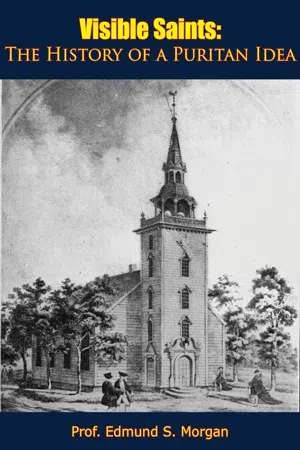
While Morgan's literary portfolio shows remarkable diversity, it is studded with works on Puritanism. "Visible Saints" further solidifies his reputation as a leading authority on this subject.
An expanded version of his Anson G. Phelps Lectures of 1962 (presented at New York University), this slender volume, first published in 1963, focuses on the central issue of church membership. Morgan posits and develops a revisionary main thesis: the practice of basing membership upon a declaration of experiencing saving grace, or "conversion," was first put into effect not in England, Holland, or Plymouth, as is commonly related, but in Massachusetts Bay Colony by non-separating Puritans. Characterized by stylistic grace and exegetic finesse, "Visible Saints" is another scholarly milestone in the "Millerian Age" of Puritan historiography.
"Although he does not pretend to deal 'exhaustively' with the subject, Professor Morgan leaves few aspects untouched. Throughout, we are presented with thoughtful, original scholarship and with a skillful reinterpretation of a Puritan idea."?New England Quarterly
- 123 pages
- English
- ePUB (mobile friendly)
- Available on iOS & Android
eBook - ePub
About this book
Information
Subtopic
American Civil War HistoryIndex
HistoryVISIBLE SAINTS — The History of a Puritan Idea
1 — The Ideal of a Pure Church
CHRISTIANITY teaches that God is good and man is bad, that God is in fact so good and man so bad that man deserves eternal damnation. Christians accordingly strive to overcome the imperfections that invite damnation. They seek to share the righteousness of Christ, and they join with other men in institutions designed to control and alleviate the effects of human corruption. In particular they join with other Christians in the institution which God Himself has prescribed for those who wish to approach Him, the church.
In managing their churches, Christians have inevitably been troubled by the very human badness they seek to overcome. “Corruption—too much corruption in these matters” is the perennial cry of church reformers, appalled at the impurities that men have introduced into God’s temple.{3} Practices and beliefs, accumulating over the years, appear on fresh examination to be contrary to God’s commands. And sometimes the church seems to be corrupted in its very matter: it seems to have admitted the wrong people to membership. In every age some reformers have attacked not only corrupt forms of worship and organization but corrupt membership: they have sought to exclude wicked men and women from the church.
To exclude the wicked from the earliest Christian churches seemed at first an easy task. The wicked readily identified and excluded themselves from an organization that brought suffering and persecution to its members. By the very desire to join the early church, a man demonstrated a palpable devotion to the true faith. But St. Paul found the church at Corinth filled with unworthy members, and more and more, as Christianity won acceptance, men and women of unsaintly temper knocked at the doors of the church, and those who stood at the entrance had to decide whether or not to admit them. Since Christianity taught that all men are sinful in some measure, it was not easy to draw the line between good and bad, and the guardians of the church, recognizing that none was perfect, swept all but the most hardened sinners inside.
In reaction against this comprehensive policy, the first reformers seceded and set up churches of their own, from which, blind to the sin of their own complacency, they excluded anyone whom they considered less than perfect in his dedication to Christ. Although there were many different groups with as many different definitions of perfection—Montanists, Novatianists, Cathari—the group known as Donatists won the greatest notoriety and became for after ages the symbol of those who thought that the church of Christ could achieve in this world a holiness “without spot and wrinkle.”{4}
In answer to the Donatists St. Augustine developed the theory of the church which was to guide orthodox Christian thought on the subject. There were, according to Augustine, two churches. One was pure but invisible; it included every person living, dead, or yet to be born, whom God had predestined for salvation. The other was visible but not entirely pure; it included only living persons who professed to believe in Christianity. Not every member of the visible church was destined for salvation, for not every man who professed belief would actually possess the true belief, the saving faith necessary for redemption. The visible church, operating in the world of time and of human corruption, must inevitably contain sinful men. It was holy, but not completely so, not without many spots and wrinkles.{5}
Although the visible church must thus remain impure, Augustine acknowledged that it should strive for purity by excluding obvious and gross sinners, at least until they visibly repented. Subsequent generations, while disclaiming the Donatist ideal of perfection in this world, did make an effort to restrict church membership according to Augustine’s formula. They tried also by means of instruction, admonition, and expulsion and by imposing penance for sins, to maintain the purity of those already admitted to the church. But reformers often found the efforts insufficient, and finally in the Reformation of the sixteenth century a host of zealous men left the established church to build new ones of their own. They left for different reasons, some because they disliked the ceremonies or the doctrines or the officers of the church, some because they thought its membership too indiscriminate. And as they differed in their discontents, so also in their methods of reconstruction: some sought the help of kings and princes to reorganize the church on a national scale; others disclaimed assistance from any quarter and sought the kingdom of God in free associations of believers. These volunteers, whatever their doctrines, were usually dismissed by the others as Anabaptists, because some of them rebaptized themselves, maintaining that their baptism in the Catholic church had been false or that only adult believers should be baptized.
The Anabaptists held stricter views of church membership than most other reformers, so strict that the others charged them with Donatism, that is, with seeking a church of perfect purity in this world. This charge was also leveled against the most ardent reformers in England, the Puritans. Actually, the English Puritans were neither Anabaptists nor Donatists: they believed neither in rebaptism nor in perfect purity. But some of them did develop a unique conception of church membership, designed to make the visible church a closer approximation of the invisible than St. Augustine probably had in mind. How this conception originated and developed in England, Holland, and New England is the subject of this book.
The Reformation in England, though it may have had popular roots in the Lollard movement of the fifteenth century, did not begin officially until the 1530’s when Henry VIII repudiated the pope. Henry’s object in freeing England from Rome was to free himself from Catharine of Aragon and to strengthen his own authority. Since he had few aspirations toward purity, either personal or ecclesiastical, he did his best to keep his popeless church otherwise unchanged and un-Protestant. But the ideas of the great continental reformers spread rapidly in a country that had formally rejected Rome. Moreover, Henry allowed the translation of the Bible into English, and the Bible became in England, as on the continent, a measure by which to judge the departure of the church from God’s prescriptions. English reformers multiplied, and at the accession of Henry’s ten-year-old son, Edward VI, in 1547, they gained a controlling influence at court. Under Edward, “that blessed ympe,” as a later reformer called him, the English church was stripped of many Roman ceremonies.{6} Edward’s sister Mary the reformers considered a different kind of imp. When she ascended the throne in 1553 and handed England back to Rome, the most outspoken Protestants who escaped execution fled to the continent. There they learned more reforms from Calvin and from the Rhineland disciples of Zwingli and Bucer.{7} And there they gained experience in the founding and management of churches of their own.
Upon Mary’s death and the accession of Elizabeth in 1558, the English exiles returned to their own country to resume the work they had started under Edward. But Elizabeth was no child. She felt competent to run England and the English church without direction either from ardent papists or ardent Protestants. After making bishops of the most moderate reformers she could find, she allowed a return to most of the practices of Edward’s day and had them established formally in the Thirty-nine Articles of 1563. But she stubbornly and skillfully resisted further reforms and the dissatisfied extremists, who wanted to eliminate every relic of Romanism, were derided as Puritans, a term designed to suggest that they were Donatists. In spite of Elizabeth’s political skill, the Puritans increased their numbers steadily and continued to demand further reforms. But by the close of Elizabeth’s reign they had made little headway. In the year 1600 a Puritan listed ninety-one things still wrong with the Church of England.{8} Among other offenses, he objected to the use of the Apocrypha, to liturgies and set forms of prayers, to prohibitions of marriage and of eating meat at certain times, to the rituals used in baptism, in the Lord’s Supper, in marriages and burials; he objected to confirmation, to popish vestments, to the neglect of preaching, to tithes, canon law, bishop’s courts, and to the very existence of archbishops, lord bishops, and some thirty-odd other offices recognized by the church.
In every Puritan catalogue of corruptions, unscriptural ceremonies and offices occupied the largest place; but Puritans also found corruption in the membership of the church: in the men and women who belonged to it and received its sacraments, and in the men who occupied its offices. In attacking the membership of the church, the earliest Puritans assailed the clergy more often than they did the laity. Many of the English clergy had held positions in the Roman church under Mary and had made no public repentance of their sins for so doing. Though the Puritans did not maintain that a reversion to popery was unpardonable, they did think that unrepentant Catholic priests were unfit to be Protestant ministers. Moreover, for lack of other pliable candidates, Elizabeth’s new bishops had filled vacant benefices with incompetent and disreputable men, unqualified to preach the gospel while able but intransigent Puritan preachers were rejected and silenced.
Puritans set much store by preaching, which they considered the principal means ordained by God for instructing people in the great truths revealed by the Scriptures. A thorough understanding of those truths was necessary to salvation, and Puritans therefore resented the appointment of ministers who were unable or unfit to instruct their congregations by preaching. In petitions, admonitions, and supplications to Parliament, Puritans complained of the “Dumme Doggs, Unskilful sacrificing priestes, Destroyeing Drones, or rather Caterpillars of the Word,” who occupied the pulpits of England.{9} Puritans thought that a minister must be learned in the Scriptures in order to bring understanding to others. In England, they said, too many ministers substituted an affected eloquence for sound knowledge and indulged themselves “in fonde fables to make their hearers laughe, or in ostentation of learning of their Latin, their Greke, their Hebrue tongue, and of their great reading of antiquities.”{10}
Worse than these dilettante preachers were the ignorant and evil ministers, incapable of preaching at all, “some having bene Shoemakers, Barbers, Tailers, even water bearers, shepheards, and horse keepers.”{11} And lest the Parliament think these accusations rash, Puritans compiled lists of the unpreaching and unworthy ministers in various counties, with names of witnesses to support the unflattering descriptions of them. Among those in Essex County, for example, in 1586, were the following:
Mr. Levit, parson of Leden Roding, a notorious swearer, a dicer, a carder, a hawker and hunter, a verie careles person, he had a childe by a maid since he was instituted and inducted....
Mr. Vawx, vicar of High Ester, a verie negligent man, and one that spendeth much time at the bowles, cards, and tables, and one verie careles for his familie, for his wife and children want at home while he spendeth abroad.
James Allen, vicar of Shopland, some time a serving man, unable to preach, for he cannot render an accompt of his faith, neither in Latine nor English, yet made a minister within these 3 or 4 yeeres.
Mr. Phippe, vicar of Barling, Sometime a sadler by occupation, convicted of whoredome, who kept a whore long time in his house, a man far unable to preach.
Mr. Atkins, curate of Romford, thrice presented for a drunkard.
Mr. Palmer, parson of Widford, heretofore a servingman or a souldier, a gamster and pot companion, he received into his house a strumpet, who was brought to bed there, which was done to save her from punishment, himself was called before the spirituall court for the same; he allso usuallie marieth unknowne persons without anie banes.
Mr. Hailes, vicar of Witham, n[o] p[reacher], one that gave a summe of money to two men to conceile his pretensed whoredoome at Islington, and so there promised that he would never inveigh against adulterie while he lived, which vow he hath hitherto kept.
Mr. Ampleforth, vicar of Much Badow hadde a childe by his owne sister, and it doth appeare to be true by his diverse examinations, and deposition taken as well before Justices of Peace as in the spirituall court before the high commissioners, as allso by keeping of the child in sundrie places at Unworthy his charges; he is also suspected of poperie, sometime a popish priest, and he is one that doth falsifie the Scriptures.
Mr. Goldrioge, parson of Laingdon Hills, he was convicted of fornication, a drunkard.
Mr. Cuckson, vicar of linsell, unable to preach, hee hath bene a pilferer, of scandalous life.
Mr. Mason, parson of Rawrey, had a childe by his maide, and is vehementlie suspected to have lived incontinentlie with others, and was brought for the same before a Justice of peace.{12}
With such men for ministers the Puritans foresaw that the membership of the Church of England could never be anything but ignorant, degraded, and corrupt. Without good teachers to instruct them, how could Englis...
Table of contents
- Title page
- TABLE OF CONTENTS
- DEDICATION
- PREFACE
- 1 - The Ideal of a Pure Church
- 2 - The Separatist Contribution
- 3 - The New England System
- 4 - The Halfway Covenant
- 5 - Full Circle
- REQUEST FROM THE PUBLISHER
Trusted by 375,005 students
Access to over 1.5 million titles for a fair monthly price.
Study more efficiently using our study tools.
Frequently asked questions
Yes, you can cancel anytime from the Subscription tab in your account settings on the Perlego website. Your subscription will stay active until the end of your current billing period. Learn how to cancel your subscription
No, books cannot be downloaded as external files, such as PDFs, for use outside of Perlego. However, you can download books within the Perlego app for offline reading on mobile or tablet. Learn how to download books offline
Perlego offers two plans: Essential and Complete
- Essential is ideal for learners and professionals who enjoy exploring a wide range of subjects. Access the Essential Library with 800,000+ trusted titles and best-sellers across business, personal growth, and the humanities. Includes unlimited reading time and Standard Read Aloud voice.
- Complete: Perfect for advanced learners and researchers needing full, unrestricted access. Unlock 1.5M+ books across hundreds of subjects, including academic and specialized titles. The Complete Plan also includes advanced features like Premium Read Aloud and Research Assistant.
We are an online textbook subscription service, where you can get access to an entire online library for less than the price of a single book per month. With over 1.5 million books across 990+ topics, we’ve got you covered! Learn about our mission
Look out for the read-aloud symbol on your next book to see if you can listen to it. The read-aloud tool reads text aloud for you, highlighting the text as it is being read. You can pause it, speed it up and slow it down. Learn more about Read Aloud
Yes! You can use the Perlego app on both iOS and Android devices to read anytime, anywhere — even offline. Perfect for commutes or when you’re on the go.
Please note we cannot support devices running on iOS 13 and Android 7 or earlier. Learn more about using the app
Please note we cannot support devices running on iOS 13 and Android 7 or earlier. Learn more about using the app
Yes, you can access Visible Saints by Prof. Edmund S. Morgan in PDF and/or ePUB format, as well as other popular books in History & American Civil War History. We have over 1.5 million books available in our catalogue for you to explore.