In the history books, the Italo-Ethiopian War will doubtless be entered as one of the strangest wars ever waged. History will record the spectacle of a primitive people—haphazardly armed and lacking in modern military technique—seeking to resist Mussolini's modern war machine by tribal cunning on the battlefield and up-to-date intrigue in the diplomatic councils of Europe.
But what the history books will not record, W.W. ("Bill") Chaplin tells in this fascinating volume. It is behind the scenes of politics and bloodshed in this curious conflict that Mr. Chaplin takes the reader in a vivid diary of his day-by-day experiences and observations at the Italo-Ethiopian War front.
Written with the dramatic simplicity of a newspaperman trained in the art of brevity, Mr. Chaplin's account of the thousand and one quixotic incidents in a war correspondent's life in Ethiopia sparkles with interest and amusement. From the beginning when he describes his departure on an Italian troop-ship at Naples to the very end when he returns to the same port as the approaching rainy season slows down the pace of the war, Mr. Chaplin records an odyssey as strange as the war itself.
The reader is led through picturesque by-ways into the heart of the Ethiopian war zone and shown not only what war has wrought on the battlefield but what it has wrought in the hearts of fighting men. This and much more that is of human texture, Mr. Chaplin tells in a diary that reflects undiluted curiosity and a subtle sense of the dramatic.
- 104 pages
- English
- ePUB (mobile friendly)
- Available on iOS & Android
eBook - ePub
About this book
Information
Topic
Personal DevelopmentSubtopic
European HistoryBLOOD AND INK
OCTOBER 11, 1935
NAPLES.... The Conte Biancamano, sturdy veteran of the Atlantic passenger trade, sailed tonight on a “Luxury Cruise” to one of the most unluxurious spots in the world—Massawa, which those who know describe as being very close to the heart of Hell.
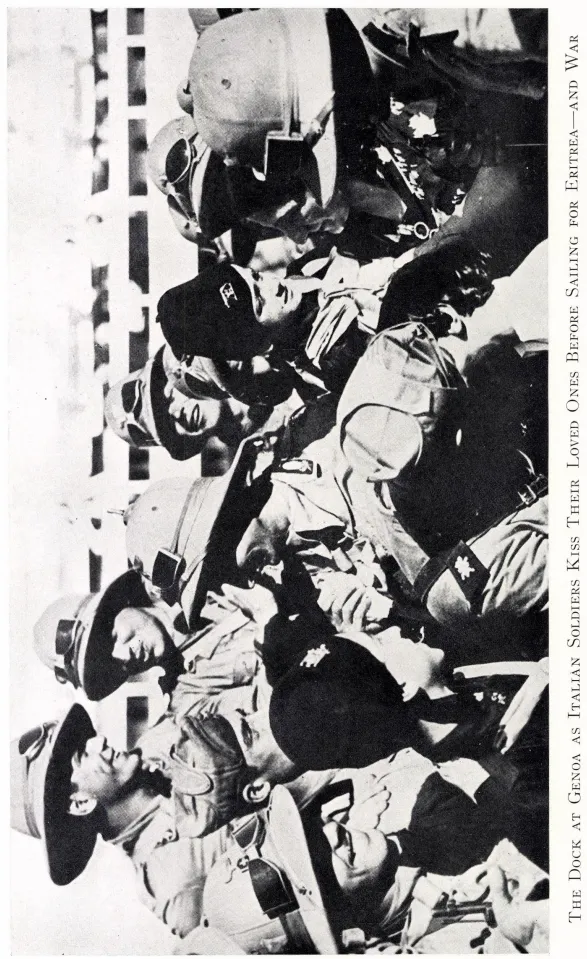
There are about 4000 Black Shirts and Regular Army soldiers aboard and there was a noisy send-off at the dock. Perhaps 2000 relatives and friends, several bands playing several tunes simultaneously, some weeping and a great deal of shouting.
And off across the city Vesuvius reached a white arm of smoke to the rim of a full moon just above.
The gang plank is lowered. The whistle reverberates across the silver bay. The last flower is thrown. The last farewell comes bell-like across the widening water. And so the forging has begun of another link in the chain with which Mussolini intends to bind the empire of Ethiopia to the wheels of his Roman chariot.
The steward assigns me and John Whitaker, another American correspondent, to a large outside cabin on the promenade deck. Two real beds and an adjoining private bath room. Plenty of water, hot or cold, salt or fresh. We look at each other and grin. Can this be war?
We do a little nosing around to find out who some of our fellow passengers may be. There are five other newspaper men, two Italian, two French and one English. The latter is Major-General J. F. C. Fuller, retired, a veteran of the Indian service. More important in the military scheme of things than the reporters, however, are several of Mussolini’s big shots, “big pieces,” the Italians call them.
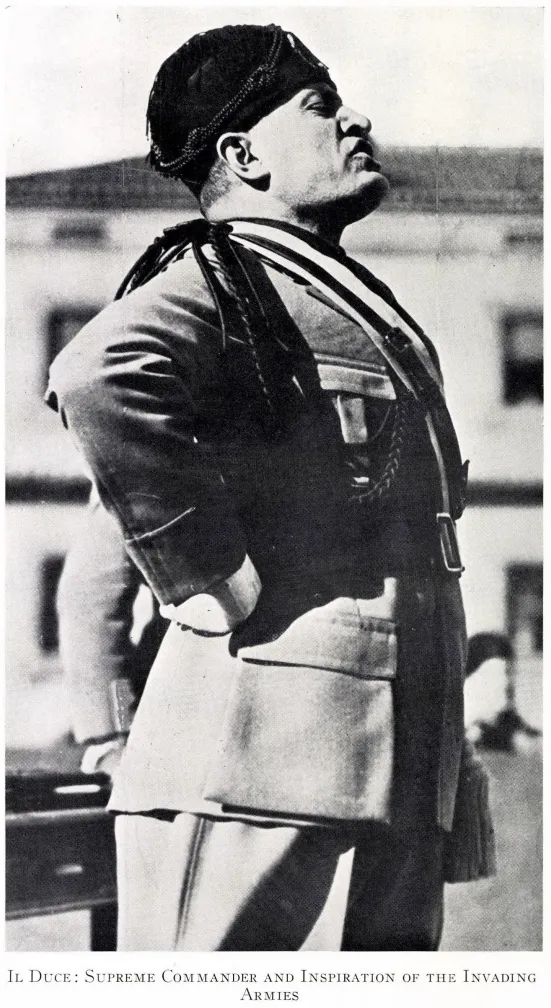
The biggest of these big pieces is no less a personage than Marshal Badoglio, big boss under the Duce of all Italy’s armed forces. He’s going down to see how lesser pieces like De Bono and Graziani are getting along.
Another passenger of rank is Dr. Aldo Castellani, Inspector General of the Italian Armies as well as being a part time professor both in London and at the Louisiana State University, the institution which was so close to the heart of the late Huey Long. Still another is Under-Secretary for Colonies Lessona, off to watch the boys string Ethiopia like a bead on the chain of Italy’s African colonies.
As we go comfortably to bed the Biancamano steams steadily through the Bay of Naples, which is so calm it seems to be holding its breath as though in expectation. Of what? Perhaps we may find that answer east of Suez.
***
OCTOBER 12, 1935
MESSINA.... We are entering this Sicilian port when we descend for breakfast and learn that the seven correspondents have been assigned to a room off the main dining salon where the officers eat, which used to be the children’s dining room before war turned the Conte Biancamano from a deluxe passenger liner to an only slightly less de luxe troop ship.
The food is excellent—fruit, eggs, bread and butter, coffee. We are served by a steward and a helper. The steward tells us he worked for two years in a speakeasy on Houston Street in New York City. Those were the good old days, he sighs.
French proves to be the linguistic least common denominator and so table conversation proceeds in that tongue, with occasional lapses for asides in English or Italian between the various compatriots.
There is shouting ashore and we go on deck to see long brown lines of soldiers under heavy pack arriving to swell our military complement. They sing as they march, these dark Sicilians, and in their tropical helmets they wear jaunty Italian flags and colored religious cards. Many of the officers carry bright bouquets of flowers, last minute gifts of wives or sweethearts.
While the embarkation goes on we chat with Marshal Badoglio and Dr. Castellani. Both men of unusual charm. Both famous, each in his own field, but both as easy to talk to as old friends. We ask how long they are to be in Africa.
The Marshal says he doesn’t know, but later he has us informed that this is purely an inspection trip. He doesn’t want the story to get around that he is going to Africa to shake up the high command or perhaps take personal command himself. Castellani, who is responsible for the present good health of the armies in Africa, seems less certain about his own plans. He says:
“How long do you suppose this will last? I’ve just got to get back to New Orleans in December to begin my lectures on tropical medicine at the Louisiana State University.”
Just as dark falls we get under way again. And Messina puts on an unforgettable show for us. Two cruisers are lying alongside and suddenly they burst into light, searchlights raking the sky and bands playing. Rails, turrets, guns, all are covered with white-clad sailors standing at salute. Sirens shriek from every craft in the harbor. One thinks inevitably of Pinafore.
An urchin who had smuggled himself aboard with some notion of going to glory under the African sun leans too far over the rail and falls with a splash. A searchlight picks him out, a life preserver thuds close to him, and we see him hauled into a bumboat as we turn majestically into the Messina Straits and head southward where history is being written in blood with an iron pen.
OCTOBER 13, 1935
ABOARD THE CONTE BIANCAMANO....Dr. Castellani rounds up the few of us who left too hurriedly to receive necessary injections against diseases which flourish in the Italian war area toward which we are steadily steaming.
He jabs us with a mixture he himself concocted which innoculates against typhoid, paratyphoid of two types, and cholera. He grins and says:
“Doesn’t hurt a bit, does it? Well, just wait till tonight and you’ll be sending me to a hotter place than Africa.”
The food continues excellent. A typical meal: soup, hors d’oeuvres or spaghetti, meat and potatoes or a green, salad,, red and white wine, fruit, cheese, and coffee. At lunch today we even had octopus as a special delicacy. One of the French journalists, who is from Marseilles, ate his.
The enlisted men don’t fare so badly either. They are served on deck in metal mess kits much like those the doughboys had in the World War. They get meat, potatoes, greens, cheese, wine, and Some sort of sweet.
They seem a completely contented lot. They lie about the decks most of the time. Many of them go barefoot by preference and for the moment they dress as they like, which is not very much. The morale is evidently excellent, as evidenced by their boisterous games and songs. The deck outside our cabin is one of their playgrounds and as my cabin-mate remarked when awakened by their hubbub shortly after five in the morning:
“There may be better armies but there aren’t any noisier ones.”
Early tomorrow morning we reach Port Said and then it’s through the Suez Canal and into the Red Sea. It’s a long way to go for a war. A long way to send hundreds of thousands of men, and an expensive way. Who’s going to pay that bill in the final reckoning? That’s right, little reader. Head of the class for you.
Dr. Castellani is not only the most famous doctor of tropical diseases in the world. He is also an ace predicter. The needle doesn’t hurt but what it puts into you is nothing you could describe to a lady.
We passed the Lombardia today, coming back empty for another load of Mussolini’s men to hurl across the high plateau of Eritrea and into the Devil’s sand box which is Somaliland.
Shuttle in. Shuttle out. While the old men ponder in Geneva Italian youth is rushing to action, asking no questions, feeling no doubts. The Duce has commanded and the Duce must be served. Peace is a whisper from the Alps. War is a blast of siren sound which drowns that whisper out.
***
OCTOBER 14, 1935
SUEZ CANAL....At dawn we arrived at Port Said, city of a wicked past.
At present it is dominated by great electric signs advertising cocoa, beef tea and malted milk.
Natives swarmed out in small boats to sell fountain pens, whips, bedroom slippers and other articles equally well-fitted for men off to the wars.
These natives are all dressed in fezes and burnooses. Imagine grandpop’s embarrassment if he had ever known his nightshirt was a burnoose. At least he sent his to the wash every week.
After a couple of hours wait we move into the Canal and the east is no longer merely a direction. It is a part of the world, and a very strange part at that.
Sand as far as the eye can see. Camels...
Table of contents
- Title page
- TABLE OF CONTENTS
- INTRODUCTION
- PREFACE
- FOREWORD
- LIST OF ILLUSTRATIONS
- BLOOD AND INK
- EPILOGUE
- REQUEST FROM THE PUBLISHER
Trusted by 375,005 students
Access to over 1.5 million titles for a fair monthly price.
Study more efficiently using our study tools.
Frequently asked questions
Yes, you can cancel anytime from the Subscription tab in your account settings on the Perlego website. Your subscription will stay active until the end of your current billing period. Learn how to cancel your subscription
No, books cannot be downloaded as external files, such as PDFs, for use outside of Perlego. However, you can download books within the Perlego app for offline reading on mobile or tablet. Learn how to download books offline
Perlego offers two plans: Essential and Complete
- Essential is ideal for learners and professionals who enjoy exploring a wide range of subjects. Access the Essential Library with 800,000+ trusted titles and best-sellers across business, personal growth, and the humanities. Includes unlimited reading time and Standard Read Aloud voice.
- Complete: Perfect for advanced learners and researchers needing full, unrestricted access. Unlock 1.5M+ books across hundreds of subjects, including academic and specialized titles. The Complete Plan also includes advanced features like Premium Read Aloud and Research Assistant.
We are an online textbook subscription service, where you can get access to an entire online library for less than the price of a single book per month. With over 1.5 million books across 990+ topics, we’ve got you covered! Learn about our mission
Look out for the read-aloud symbol on your next book to see if you can listen to it. The read-aloud tool reads text aloud for you, highlighting the text as it is being read. You can pause it, speed it up and slow it down. Learn more about Read Aloud
Yes! You can use the Perlego app on both iOS and Android devices to read anytime, anywhere — even offline. Perfect for commutes or when you’re on the go.
Please note we cannot support devices running on iOS 13 and Android 7 or earlier. Learn more about using the app
Please note we cannot support devices running on iOS 13 and Android 7 or earlier. Learn more about using the app
Yes, you can access Blood and Ink by W. W. Chaplin in PDF and/or ePUB format, as well as other popular books in Personal Development & European History. We have over 1.5 million books available in our catalogue for you to explore.