- 253 pages
- English
- ePUB (mobile friendly)
- Available on iOS & Android
eBook - ePub
About this book
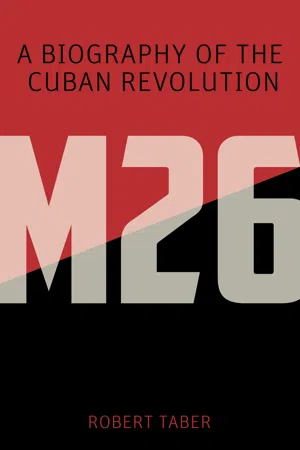
M-26: A Biography of the Cuban Revolution, first published in 1961, is a reporter's account of the overthrow of the Batista regime and Fidel Castro's successful rise to power. Author Robert Taber, a correspondent for CBS, details the political and economic situation which helped foster the revolution, plus chronicles events of the revolution and his experiences while living with the guerrilla fighters in Cuba's mountainous interior.
M26 (the name is from an earlier unsuccessful uprising—
Movimiento Revolucionario—led by Castro in July, 1953) is a valuable resource for anyone seeking a well-written account of this critical period in Cuba's history.
Trusted by 375,005 students
Access to over 1.5 million titles for a fair monthly price.
Study more efficiently using our study tools.
Information
Topic
StoriaChapter One
THE NAME of Fidel Castro is known to newspaper readers in Cairo and Khartoum, it is a headline in Pravda; school teachers in Outer Mongolia mention it when they speak of the struggle against “American imperialism,” and a million Muscovites turn out to shout the Russian equivalent of “Cuba sí, Yanquis no!” and “Viva Fidel Castro!” But in the United States, the questions persist, and are evidence of the obfuscation that clouds all aspects of the gathering American Revolution.
There is no novelty in this. The entire history of Cuba is, in American school books, a complicated lie. One must reach the graduate school level to get a glimmering of the truth. Few Americans knew, until well into 1959, that in 1952 a general named Batista seized power in Cuba at pistol point and was recognized by Washington as the legitimate ruler. Even fewer were aware that in 1953 a young attorney named Castro led an assault on a military barracks in Santiago de Cuba and was condemned to serve fifteen years in prison.
The Cuban insurrection of 1956-1958 was popularly regarded in the United States, until its successful conclusion and even for some while afterwards, as an adventure on the operatic scale, a peculiarly Latin-American compound of histrionics, headline hunting, and romantic idealism, sustained not so much by its own virtue as by the blunders of what began to emerge as a brutally stupid and corrupt ruling clique. This was the newspaper view.
Fidel Castro himself was an enigma, a figure of saintly and slightly sinister presence (Is he a Communist? Will he become a dictator?) passionate, eccentric, capable of exerting great personal magnetism and of attracting a fanatical following but not so surely, in the opinion of “responsible” political analysts, a leader who might direct the destinies of even a small nation—or of a lucrative U.S. economic colony.
The skeptics who chose to view the entire Cuban struggle throughout as a prolonged political skirmish, a noisy tug of war between “in” and “out” parties, judged that he might serve well enough as a cat’s-paw for weightier men behind the scenes. Apparently it did not occur to them that there was, in reality, no one behind the scenes.
The only significant struggle, amazing in its simplicity, was the drama being enacted under the open sky, plainly visible to anyone who cared to investigate it.
What was in progress that the newspaper accounts and diplomatic reports of the time contrived to conceal? The insurrection that began in early 1957 in the Sierra Maestra mountains of Oriente Province was, however Lilliputian and improbable, the opening campaign of a Cuban civil war and the initial phase of a revolution that is in process, not merely in Cuba, but throughout the western hemisphere.
The fact is that neither Fidel Castro nor the Revolution conform to any stereotype. Both are fresh, new, radical; each has an existence complementary to the other. Fidel{1} is as much the product of the Cuban Revolution as he is its librettist, stage director, and principal actor.
“We have struck the spark of the Cuban Revolution,” he declared in a television interview atop Cuba’s highest mountain in April of 1957,{2} just a few months after his invasion of Oriente Province.
At the time he was a hunted fugitive with a price on his head and fewer than one hundred men under his command. Yet he could make his declaration with supreme confidence, knowing that the tinder had already been laid long since, and required only to be kindled by the spark of imagination which he himself was applying.
This is, of course, to reject superficial political interpretations of the Cuban Revolution. “Our movement,” says Fidel Castro, “has no relationship with the political past of Cuba.”
Who is Fidel Castro? One may anticipate conclusions by declaring at once that he is neither a Communist nor a “tool” of anyone. He describes his political philosophy as “humanism,” and might equally well define it as humanitarianism. Whatever else he may be, he is a radical thinker, a pragmatist, supremely a revolutionary: in many ways the prototype of the revolutionaries who even now begin to appear everywhere on the American scene.
He is, and they will be, anti-Yankee and nationalistic to the precise measure that the United States has played, or has seemed to play, the role of exploiter, friend of dictators, employer of gunboat diplomacy, and of what is aptly called, in the modern political slang, “dollar diplomacy.”
If the slogans of the Communists are heard in Cuba, and elsewhere in the Americas, increasingly, it is in the absence of better slogans. And if the economic formulae of the Cuban Revolution resemble those of the Russians and the Chinese, that, too, may be a measure of the failure of the theories that support what we like to call “the American way of life,” which is not truly American, but is only the privileged way of life of a relatively few millions of modern Romans in the United States and in U.S. enclaves abroad.
Who are the Cuban rebels? Fidel Castro Ruz was a young attorney, the third son of a Spanish immigrant who had achieved a modest fortune as a timber merchant and small sugar-cane planter (colono is the Cuban term) in the rural municipality of Mayarí, in Oriente Province. Marcelo Fernández was a Cárdenas grocer’s son. Abel Santamaría was an accountant. Armando Hart’s father was a judge. Frank País was a young schoolmaster in Santiago de Cuba. Camilo Cienfuegos played minor league baseball in Texas. So it goes.
Revolution. An instance of great change in affairs, or in some particular thing.{3}
We use the word in its full historical sense, to signify the whole of a radical process, the product of long-drawn social, political, and economic developments brought to maturation in a powerful mass movement, expressing the deepest aspirations and most urgent needs of a people, charged with the momentum of their collective experience, articulating their desires, channeling their energies in a common cause, and, once set in motion, irresistible.
Here is the Cuban Revolution. Admittedly it was in this sense not apparent as more than a faint possibility on December 2, 1956, when Fidel, leading an expedition from Mexico, landed at Playa de las Coloradas on the remote southern shore of Oriente with eighty-one reckless followers. Nor had it been apparent when, with the same mad confidence, he led a platoon of clerks and students against a fortress at Santiago, July 24, 1953, in the abortive uprising that gave his Movimiento Revolucionario 26 de Julio—MR-26-7—its name. Yet he persisted. And events sustained him.
No doubt the surface phenomena were misleading. On the surface, at least, there was little to distinguish the Castro filibuster of December, 1956, from the hopeless insurrection of July, 1953; nor either of these from scores of other Latin-American political adventures.
Cuban history, the incredible corruption of Cuban politics, the great wealth at stake, and certain psychological factors—the morbid preoccupation with death, the yearning for eternal glory which are part of the Spanish heritage—all combined to create an atmosphere of conspiracy, adventurism, and make-believe that obscured the deeper struggle. Equally obfuscating were the intricate maneuvers, the endless face-saving devices and graceless compromises of the “out-party” politicos. Post-insurrectionary developments have further complicated the picture.
The Latin-Americans have their idiosyncrasies, like any other people. Their political calendars resemble religious calendars; they are studded with saints’ days, the holy days of the martyrs, and this is but part of the simbolismo without which no orator expects to hold an audience, no leader to attract followers, no movement to capture the popular imagination.
The founder of a movement invariably establishes a new red-letter day on the calendar, the letter etched in blood, commemorating the day of the heroic martyrdom of Pepe So-and-So, the day of the glorious assault on the citadel of Such-a-Place. Every village in Cuba has its roster of patriotic martyrs; for the most part they were heroic schoolboys, whose obsession seems to have been not so much to live gloriously as to die gloriously.
Jesús Montand, a studious accountant, relating how he had been on the point of being castrated after the July 26 uprising, remarks: “For us, to die for la patria is a satisfaction.” And then he adds, as if in afterthought: “Luckily, an officer intervened at that moment.”
At an age when schoolboys in the United States are collecting picture cards of baseball players, Cuban boys collect pictures of revolutionary heroes, hurling themselves glory-bound at one or another of the gun-bristling yellow fortresses which were among the principal architectural features of every large and small town on the island.
Cuban youth is brought up on strong doses of history and heroics; the language itself is rhetorical and inflammatory; the universities are political forums in which the boasts and the rhetoric inevitably demand proofs.
Given a history of oppression, such traditions are inevitable. They may even serve some purpose. Yet none of this should be given too much weight in the present context. Countless martyrs have hurled themselves against citadels of tyranny to no effect; countless conspiracies have come to nothing. If the conspiracies and heroics of the Cuban struggle of 1956-1958 came to something, it is because there existed a firm social base and an historic necessity.
That Fidel was fully conscious of the social basis upon which his revolutionary career was predicated is beyond question.
His invasion of Oriente Province from Mexico at the end of 1956 was, as previously indicated, not his first assault on the dictatorship, but his second.
The first attempt, in 1953, was a military failure, but it produced certain collateral gains. Fidel, then not yet twenty-seven years old, made an effort to call the country to arms by leading an attack on the second most important military establishment on the island, the Moncada Barracks in Santiago.
During his trial in Santiago in the autumn of 1953, Fidel attributed his failure to accidental factors rather than to lack of popular support. He may have been wrong. Yet the revolutionary manifesto which was the real substance of his nominal defense spelled out clearly his conception of the nature of his support and the basis of his program.
“We had,” he declared, “the certainty of being able to count on the people.”
The word “people” was carefully defined before the judges in a declamation that had no other intention than to sound a renewed call to rebellion:
By “people” we understand, when we speak of struggle, the great unredeemed mass, those to whom all make promises, and whom all betray; those who long for a country better, more worthy, more just; those who are moved by ancestral desires for justice, having suffered injustice and scorn generation after generation; those who long for great and wise transformations in the entire order of things, and who are ready to give in order to achieve when they believe in something or someone, ready to give to the last drop of blood when, above all, they believe sufficiently in themselves.
This is surely clear enough. The key phrase is “transformations in the entire order of things.” But there was more. The rallying cry was specific. It was addressed to:
Seven hundred thousand Cubans without work, who desire to earn their daily bread honestly without having to emigrate in search of livelihood.
Five hundred thousand farm laborers inhabiting miserable shacks, who work four months of the year and starve for the rest of the year, sharing their misery with their children, who have not an inch of land to cultivate, and whose existence inspires compassion in any heart not made of stone.
Four hundred thousand industrial laborers and stevedores whose retirement funds have been embezzled, whose benefits are being taken away, whose homes are wretched quarters, whose salaries pass from the hands of the boss to those of the usurer, whose future is a pay reduction and dismissal, whose life is eternal work and whose only rest is in the tomb.
One hundred thousand small farmers who live and die working on land that is not theirs, looking at it with sadness as Moses did the promised land, to die without possessing it; who, like feudal serfs, have to pay for the use of their parcel of land by giving up a portion of their products; who cannot love it, improve it, beautify it or plant a lemon or an orange tree on it, because they never know when a sheriff will come with the rural guard to evict them from it.
Add to these Cuba’s thirty thousand teachers and professors, “so badly treated and poorly paid,” twenty thousand small merchants “overwhelmed by debt...driven to the auction block by a plague of thieving and venal petty officials”; ten thousand young professionals; doctors, engin...
Table of contents
- Title page
- TABLE OF CONTENTS
- Chapter One
- Chapter Two
- Chapter Three
- Chapter Four
- Chapter Five
- Chapter Six
- Chapter Seven
- Chapter Eight
- Chapter Nine
- Chapter Ten
- Chapter Eleven
- Chapter Twelve
- Chapter Thirteen
Frequently asked questions
Yes, you can cancel anytime from the Subscription tab in your account settings on the Perlego website. Your subscription will stay active until the end of your current billing period. Learn how to cancel your subscription
No, books cannot be downloaded as external files, such as PDFs, for use outside of Perlego. However, you can download books within the Perlego app for offline reading on mobile or tablet. Learn how to download books offline
Perlego offers two plans: Essential and Complete
- Essential is ideal for learners and professionals who enjoy exploring a wide range of subjects. Access the Essential Library with 800,000+ trusted titles and best-sellers across business, personal growth, and the humanities. Includes unlimited reading time and Standard Read Aloud voice.
- Complete: Perfect for advanced learners and researchers needing full, unrestricted access. Unlock 1.5M+ books across hundreds of subjects, including academic and specialized titles. The Complete Plan also includes advanced features like Premium Read Aloud and Research Assistant.
We are an online textbook subscription service, where you can get access to an entire online library for less than the price of a single book per month. With over 1.5 million books across 990+ topics, we’ve got you covered! Learn about our mission
Look out for the read-aloud symbol on your next book to see if you can listen to it. The read-aloud tool reads text aloud for you, highlighting the text as it is being read. You can pause it, speed it up and slow it down. Learn more about Read Aloud
Yes! You can use the Perlego app on both iOS and Android devices to read anytime, anywhere — even offline. Perfect for commutes or when you’re on the go.
Please note we cannot support devices running on iOS 13 and Android 7 or earlier. Learn more about using the app
Please note we cannot support devices running on iOS 13 and Android 7 or earlier. Learn more about using the app
Yes, you can access M-26 by Robert Taber in PDF and/or ePUB format, as well as other popular books in Storia & Storia della guerra civile americana. We have over 1.5 million books available in our catalogue for you to explore.