- 172 pages
- English
- ePUB (mobile friendly)
- Available on iOS & Android
eBook - ePub
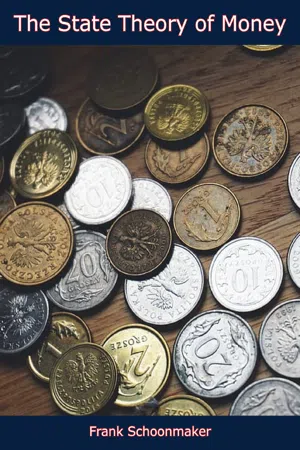
The State Theory of Money
About this book
Georg Friedrich Knapp (1842-1926) was a German economist who in 1895 published "The State Theory of Money," which founded the chartalist school of monetary theory, which takes the statist stance that money must have no intrinsic value and strictly be used as governmentally-issued token, i.e., fiat money. Published originally in 1905, it created a stir among academics and policy makers, with proponents and critics both arguing forcefully about it. It was written at a time when monetary matters were in a great flux. Throughout the world, countries debated the optimal metallic standard for their monetary systems. Should it be silver, gold, both in a fixed relation (bimetallism), a combination of the two (symmetalism), or should the selection of the standard be left to the market? Knapp put the debate on new ground by suggesting that there need not be a metallic standard at all. Ideas about the desirability of paper money not backed by gold or other metals had been presented before but were never able to command academic respectability.-Print ed.
Trusted by 375,005 students
Access to over 1.5 million titles for a fair monthly price.
Study more efficiently using our study tools.
Information
Subtopic
Investments & SecuritiesIndex
EconomicsCHAPTER I—PAYMENT, MONEY AND METAL
§1. Autometallism; Nominality of the Unit of Value
MONEY is a creature of law. A theory of money must therefore deal with legal history.
The favourite form of money is specie. As this implies coins, most writers have concluded that currency can be deduced from numismatics. This is a great mistake. The numismatist usually knows nothing of currency, for he has only to deal with its dead body; he has no ready way to the understanding of paper money pure and simple. It may be a dubious and even dangerous sort of money, but even the worst sort must be included in the theory. Money it must be, in order to be bad money.
Nothing is further from our wishes than to seem to recommend paper money pure and simple in such a form, for instance, as the Austrian State Notes of 1866. It is well for any State to wish to keep to specie money and to have the power to do so. And I know no reason why under normal circumstances we should depart from the gold standard. I say this at once to reassure the public man. Still, in this book the silver standard too is carefully studied, and we have paid more attention to paper money than has been its lot hitherto. For on close consideration it appears that in this dubious form of “degenerate” money lies the clue to the nature of money, paradoxical as this may at first sound. The soul of currency is not in the material of the pieces, but in the legal ordinances which regulate their use.
All money, whether of metal or of paper, is only a special case of the means of payment in general. In legal history the concept of the means of payment is gradually evolved, beginning from simple forms and proceeding to the more complex. There are means of payment which are not yet money; then those which are money; later still those which have ceased to be money.
What then is a means of payment? Is there a wider concept under which means of payment can be subsumed?
Usually, “means of payment” are explained by recourse to the concept “exchange-commodity,” which presupposes the concepts “commodity” and “exchange.”
In defining one must start from some fixed point. We will venture to regard “commodity” and “exchange” as sufficiently elementary ideas.
If we assert, “Every means of payment is an exchange commodity,” we are altogether wrong, for in the course of history we meet with means of payment which are not in any way commodities of exchange in the proper sense of the term. “Exchange-commodity” is therefore not the wider concept we are seeking.
If, however, we say conversely, “Every exchange-commodity is a means of payment,” we have not got what we wanted. There are exchange-commodities which are not means of payment.
If one man exchanges corn for another’s silver, the silver is an exchange-commodity for the one, corn an exchange-commodity for the other, within this one transaction.
In this wide sense the concept “Exchange-commodity” does not yet serve our purpose; it remains uncertain whether the exchange-commodity is a means of payment. And this cannot be asserted either of silver or of corn, so long as we look only to one transaction.
When, however, in any society, for example, a State, it is a custom gradually recognised by law that all goods should be exchanged against definite quantities of a given commodity, e. g. silver, then in this instance silver has become an exchange-commodity in a narrower sense. It is called, therefore, within the range of its use, a general exchange-commodity. The general exchange-commodity is, accordingly, an institution of social intercourse; it is a commodity which has obtained a special use in society, first by custom, then by law.
Such a “socially” recognised exchange-commodity is, of course, always a means of payment, and therefore is included in the concept “means of payment.” On the other hand, it is untrue that every means of payment is a socially recognised exchange-commodity. It is indeed always socially recognised and also is always used for exchange; but it is questionable whether it is always a commodity. In order to be a commodity it must, in addition to its use in the manner provided by law, also be capable of a use in the world of art and industry, and this is not the case with all means of payment. The sheets of paper, which are all the eye of the craftsman sees in paper money, are an example of an object which has no other industrial use. They are therefore not an exchange-commodity, though they are a means of exchange.
The result of our considerations, cautiously stated as theory demands, is as follows. In the socially recognised exchange-commodity we have an instance of a means of payment, and therefore not its definition; it is only a special case of a means of payment, and that the simplest that can be imagined. Let us assume that this exchange-commodity consists of a metal—which is not absolutely necessary, but occurs in the most important case—we can then give a name to this simplest form of the means of payment; it is “autometallistic.”
Autometallism views metal only as material and gives no juristic consideration to the form of the pieces. The quantity of the material is measured in a merely physical manner; in the case of a metal, by weighing. The exchange-commodity is always weighed out to the creditor.
There is no difficulty in conceiving autometallism; the only difficulty is with those means of payment which are no longer autometallistic (e. g. money). We shall therefore use autometallism in order to show what is the distinguishing characteristic of the concept “means of payment.” Let us put ourselves in the place of the creditor. A man receiving a pound of silver (or copper or gold) in exchange for commodities, which are not means of payment, can use it in two ways. Either he can use the silver in some craft to make vessels such as goblets or plates, or perhaps even rings and chains for ornament, or else he can use it as a means of exchange, and obtain with it other commodities as he needs them. The holder can make use of his property in one of these two ways, but not in both at once. He can either use it in some craft, thus obtaining “real” satisfaction, or else obtain other commodities with it, when his satisfaction is derived from its value in exchange.
The possibility of “real” satisfaction is undoubtedly a necessary condition for any commodity becoming a socially recognised exchange-commodity. If metals had not been indispensable in handicrafts, autometallism would never have arisen. But there is “real” satisfaction in every commodity which is taken in exchange. A man who barters a sheep for wooden dishes, takes the dishes only because they give real satisfaction, i. e. because he can use them. But the dishes do not thereby become socially recognised exchange-commodities. The possibility of “real” use is therefore essential if a commodity (e. g. a metal) is to be chosen as a socially recognised exchange-commodity; but this property is insufficient to make it a means of payment.
With the satisfaction derived from exchange{5} the position is quite different. It is a necessary and sufficient property of every means of payment, and of the autometallistic in particular. A man who can employ the exchange-commodity he has received for some craft, but cannot pass it on in circulation, owns a commodity, but not a means of payment. For example, the owner of a pound of copper would be in this position if in his country silver was the autometallistic means of payment.
It is of the greatest importance that this should be borne in mind. Even in autometallism (the simplest form of a means of payment) it is first the possibility of employing it in exchange that gives it the property of becoming a means of payment. The possibility of “real” use does not produce this property, otherwise all goods would be already potentially means of payment, for they all have a technical use.
The use in exchange is a legal phenomenon. Even autometallism is therefore a legal form of the means of payment.
Let us not forget, however, that autometallism is only one instance of means of payment.
Whenever a material, measured in some physical manner, is used as a recognised exchange-commodity, we will call this form authylic (hyle meaning matter). Autometallism is only the most important example of authylism; and authylism itself is only one instance of a means of payment, an instance, namely, where the holder can choose between “real” satisfaction and “circulatory.”
What then is a means of payment? A movable object which can in any case be used for circulation. This, however, is a mere general hint, and you will please note that “real” use should not come into the definition. It would be equally wrong either to demand or to exclude it.
It is difficult to give a correct definition of a means of payment, just as in mathematics we cannot say what a line or a number is, or in zoology define an animal. Often the simplest case (straight line, positive integer) is taken, and one can then proceed to widen the concept, at first recognised in a given example.
Suppose we said, “A means of payment is a movable thing which has the legal property of being the bearer of units of value,” this would be exactly what we mean. But let us not give this as a definition, for it would assume “unit of value” as a self-evident notion, which it is far from being.
Let us say no more than is absolutely necessary for our purpose. First, the unit of value is nothing but the unit in which the amount of the payment is expressed. Every traveller entering a new country asks the name of this unit—whether accounts are in marks, francs, crowns or sterling. When this question is answered, the traveller asks what the usual means of payment look like and what they are worth in the unit of that country. He is then in a position to make payments himself. We see that the unit of value has everywhere a name which in some countries has remained unaltered for centuries (pound sterling), while in others (e. g. Austria) it has been deliberately changed (to krone since 1892). In any case there is a name, and the question is now what it means.
Can it be defined according to its technical use (that is, use in a craft)? For example, a mark is the 1/1395th part of a pound of gold. The metallists would so define it.
Or is it absolutely impossible to define by technical use? If so, in what other way are we to define? This is the task of the nominalists.
The metallists tell us we can only speak of the value of a commodity by comparison with another commodity. A man purchasing a commodity says how much of another commodity he is prepared to spend on it. A man selling a commodity says how much of another commodity he will take for it. Each time the equivalent is mentioned for comparison, so that the idea of the value may have only one meaning. It is equally clear here that the value is a fact which cannot be determined by observation, but rests on an agreement. A third person can, of course, observe what an object is worth, but only by observing the agreement of the buyers and sellers. If the commodity used for comparison is not expressly named, the value of an object then means the lytric value, that is, the value that results from a comparison with the universally recognised means of exchange. From this, again, it follows that we cannot in this sense speak of the value of the means of exchange itself. Only those commodities have lytric value which are not themselves means of exchange.
The metallist always conceives a means of exchange to be an exchange-commodity.
All these propositions are indubitably correct. It follows that the concept of lytric value can only arise from a comparison with a generally recognised exchange-commodity, which, as we have seen, is always the simplest form of the means of payment.
But there are means of payment which extend beyond this simple form, namely, those which are not commodities except in so far as law makes them so. The most important case is real genuine paper money. The name of the unit of value (e. g. gulden, in Austria) continues to exist, but it is no longer possible to give it a technical definition such as “a gulden is the 1/45th part of a pound of silver,” for it is plain to anyone that this is indeed a definition of a gulden of sorts, not of that gulden in which payments are made, but of a kind of gulden in which no one pays. What we must define is the unit of the customary means of payment, and this is impossible for the metallist in the case before us.
We have now reached the point where opinions differ. As long as autometallism prevails, the technical definition of the unit of value can be quietly accepted, at any rate as long as th...
Table of contents
- Title page
- TABLE OF CONTENTS
- AUTHOR’S PREFACE TO THE ENGLISH EDITION
- AUTHOR’S PREFACE TO THE FIRST GERMAN EDITION (1905)
- NOTE BY TRANSLATORS
- CHAPTER I-PAYMENT, MONEY AND METAL
- CHAPTER II-CURRENCY WITHIN THE HOME COUNTRY
- CHAPTER III-MONETARY RELATIONS WITH FOREIGN COUNTRIES
Frequently asked questions
Yes, you can cancel anytime from the Subscription tab in your account settings on the Perlego website. Your subscription will stay active until the end of your current billing period. Learn how to cancel your subscription
No, books cannot be downloaded as external files, such as PDFs, for use outside of Perlego. However, you can download books within the Perlego app for offline reading on mobile or tablet. Learn how to download books offline
Perlego offers two plans: Essential and Complete
- Essential is ideal for learners and professionals who enjoy exploring a wide range of subjects. Access the Essential Library with 800,000+ trusted titles and best-sellers across business, personal growth, and the humanities. Includes unlimited reading time and Standard Read Aloud voice.
- Complete: Perfect for advanced learners and researchers needing full, unrestricted access. Unlock 1.5M+ books across hundreds of subjects, including academic and specialized titles. The Complete Plan also includes advanced features like Premium Read Aloud and Research Assistant.
We are an online textbook subscription service, where you can get access to an entire online library for less than the price of a single book per month. With over 1.5 million books across 990+ topics, we’ve got you covered! Learn about our mission
Look out for the read-aloud symbol on your next book to see if you can listen to it. The read-aloud tool reads text aloud for you, highlighting the text as it is being read. You can pause it, speed it up and slow it down. Learn more about Read Aloud
Yes! You can use the Perlego app on both iOS and Android devices to read anytime, anywhere — even offline. Perfect for commutes or when you’re on the go.
Please note we cannot support devices running on iOS 13 and Android 7 or earlier. Learn more about using the app
Please note we cannot support devices running on iOS 13 and Android 7 or earlier. Learn more about using the app
Yes, you can access The State Theory of Money by Georg Friedrich Knapp in PDF and/or ePUB format, as well as other popular books in Economics & Investments & Securities. We have over 1.5 million books available in our catalogue for you to explore.