eBook - ePub
The Spartacist Uprising of 1919
and the Crisis of the German Socialist Movement
- 216 pages
- English
- ePUB (mobile friendly)
- Available on iOS & Android
eBook - ePub
About this book
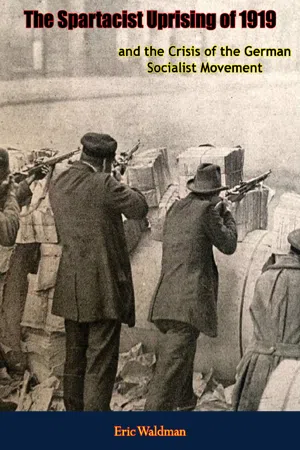
This study aims at exploring the crisis of the German socialist movement which grew in intensity from the time of the open split of the Social Democratic Party during the war until its climax in the bloody fighting between the radical left and moderate socialists during the so-called Spartacist Uprising of January 1919. In the course of this primary pursuit, two subsidiary aims are served: an analysis of the relationship existing between the theory and practice of the German Communists during their period of political infancy; and an examination of the impact of the Communists on the course of the German Revolution.
Trusted by 375,005 students
Access to over 1.5 million titles for a fair monthly price.
Study more efficiently using our study tools.
Information
Subtopic
19th Century HistoryIndex
HistoryPart 1—The Emergence of the Spartacists
Chapter 1—The Left Wing Within the German Social Democratic Party Prior to World War I
1. The Growth of the German Socialist Movement
Many of the ideological concepts and organizational characteristics of the Spartacists, the forerunners of the German Communists, have their origin in the period which followed the unification of the Lassallean workers’ organization with the Marxian socialists in 1875. The end product of this fusion was the Social Democratic Party of Germany (SPD).{1} In the decades following the union, the SPD developed into a strong mass party and along with its allied trade unions became a powerful factor in German political life.
During this period, a number of political factions emerged within the SPD. These were an outgrowth of basic disagreements in major political and tactical issues, resulting partly from different interpretations of Marxian doctrines and partly from the conflicting objectives of an organization which regarded itself as a proletarian party in a bourgeois state. The perpetuation of these factions in a period of crisis caused by the outbreak of World War I led eventually to a division of the German labor movement into hostile camps, a situation which persists to the present time.
The purpose of this chapter is to analyze the factors and conditions contributing to the growth of the political thought and revolutionary tactical concepts of the radical left wing of the SPD. This complex later became known, organizationally, as the Spartacist League and eventually, on December 31, 1918, as the Communist Party of Germany (KPD).{2} An attempt has also been made to analyze a selected number of concepts characteristic of the radical left wing of the German socialists.
Socialist ideas were abroad in Germany before 1848, but it was not until that year that a genuine working-class movement came into existence in the form of a number of workers’ associations. The growth of organized labor was not impressive, however, until the 1860’s, when Ferdinand Lassalle brought life and action into the movement. A group of professed Marxists with a relatively small following was also active among the German proletariat, but it did not succeed in increasing its strength substantially until after the death of Lassalle.{3}
In 1875 the two movements among the German workers combined to form the united SPD, thus providing a more powerful organization to fight for the interests of the increasing number of German workers.{4} Thus, from its very inception the SPD carried within its organization two basically different creeds. Those who held the romantic nationalism and democratic concepts of the Lassallean group had complete confidence in the possibility of improving the workers’ lot by reforms within the framework of the existing state. The other group accepted the Marxian concepts regarding the historic mission of the proletariat and the ultimate socialist revolution as the final stage of the inevitable class struggle within the capitalist society. It was the second group which gained dominance in the SPD and caused at least a temporary subordination of Lassalleanism.{5}
After the unification of Germany was achieved by Chancellor Bismarck and the subsequent rapid industrialization, the SPD considerably widened its influence among the growing number of German workers, Bismarck’s concern with the rapid spread of socialism among the workers prompted his anti-socialist law of 1878 which was intended to stop the growth of the movement. But persecution only resulted in making the SPD stronger, and Bismarck soon realized the futility of the provisions of the antisocialist law. While keeping the law on the books, in the 1880’s he changed his policy toward the workers, in an attempt to give them a definite interest in the perpetuation of the existing state by promulgating progressive social legislation. Marx’s famous phrase in the Communist Manifesto that the proletariat has nothing to lose but its chains lost part of its significance for the German workers as a result of the social policies of Bismarck.
After the fall of Bismarck in 1890—the year which also saw the end of the anti-socialist law—William II sponsored an ambitious program of factory legislation. But even this did not stop the steadily mounting strength of the socialist movement.{6} In the face of this development one could have expected that the German government would follow one of two alternatives. One was the brutal suppression of the socialists. However after 1890—the year in which the SPD obtained almost one and a half million votes and entered the Reichstag with thirty-five deputies—apparently none of the leading German politicians were inclined to use the methods Bismarck had tried with so little success, The other alternative was to pursue a policy based on a compromise with the political aspirations of the middle class and the workers and gradually to transform Germany into a democratic constitutional monarchy. William II and his chancellors (Caprivi, Hohenlohe, and Buelow) followed neither of these courses, but allowed the socialist movement to take its own course.{7}
A few figures will illustrate the rapid strengthening of the SPD and the trade unions during the pre-war period. The only figures available for the SPD prior to 1906 are the election results. In 1871 less than three per cent of all votes cast went to the SPD. In 1879 the number had risen to almost nine per cent. During the anti-socialist law period there was a temporary setback and the figure dropped to six per cent in the 1881 election. In 1890 the SPD received almost twenty per cent of all votes cast and in the last election before the war the figure reached 34.8 per cent.{8} In actual votes the number grew from roughly 1,000,000 to 4,250,329 and the number of representatives in the Reichstag increased to 110. In the elections for the Reichstag on January 12, 1912, every third man over 25 years of age voted for the SPD.{9}
Membership figures for the SPD run as follows: in 1906, 384,327 members; in 1910, 720,038; and in 1913, 982,850. Even more impressive are the trade union figures. Here the information goes back to 1891, the year after the anti-socialist law was discarded. Membership in the trade unions increased from 277,659 in 1891 to 2,548,763 in 1913, and the financial assets of the unions in the same period increased from 425,845 marks to 88,069,295 marks.{10}
These figures tell only one part of the story. The SPD had a highly disciplined organization—the first modern mass organization in history—based on a large, thoroughly-trained party bureaucracy, which gave the workers confidence in the strength of their organization. They believed that their party was a bulwark of peace and would make wars completely impossible.
Indeed the SPD had developed into a nationwide party with an organization managed by about 4,100 professional party officials and approximately 11,000 salaried employees. The election results of 1912 had made the SPD a parliamentary power of the first order, and its 94 newspapers assured the party of continuous influence in large segments of the population. By 1914 the SPD had an investment of 20,000,000 Marks and thereby had given evidence of the confidence the party had in the stability of the state and economy.{11}
It has also been asserted that in spite of the great expansion of the party organization and its increased membership, the SPD had lost none of its efficiency.{12} Organizational efficiency is not, however, the only yardstick for measuring the effectiveness of a political party. The tremendous growth of the SPD and the trade unions plus their widespread vested interests were of utmost consequence for many of the changes within the party and for the emergence of a revolutionary opposition faction fighting from within against the increasingly pronounced middle class attitude of the party aristocracy.
2. The Emergence of Different Factions Within the SPD
The anti-socialist legislation of 1878 caused considerable difficulties for the SPD. Party leaders were arrested and numerous limitations and restrictions were placed upon party newspapers and other activities. However, the strong-arm methods used by the German government to suppress the socialists demonstrated to the workers better than any socialist propaganda could to what extent Bismarck’s state served the ruling classes and perpetuated the status quo. Thus, one of the major factors which transformed the SPD into a genuine revolutionary Marxist party was this period of suppression of the socialists.
After the lapse of the anti-socialist law in 1890, the SPD felt a necessity of restating its objectives as well as of clarifying the methods to be used in the Party’s coming struggle. At the Party Congress held in Erfurt in 1891, the SPD developed a program which incorporated many more basic Marxist dogmas than had the Gotha Program of 1875, which at one time had been heavily attacked by Marx himself. A materialistic interpretation of history supplied the basis for many parts of the program, which asserted that the class-character of the state determined the political actions of the proletariat. The workers, it was emphasized, must seize political control of the state in order to transform the capitalist economy into a socialist one. The seizure of political power as a prerequisite for the expropriation of the means of production and redistribution of wealth was adopted as a tenet by the Congress.{13}
The formulation of the revolutionary Erfurt Program did not go unchallenged. For example, the Bavarian party leader Georg von Vollmar strongly opposed the revolutionary policies approved by the Congress. He and his followers advocated without much success a program directed at gradual reforms of the existing social, political, and economic institutions. From the fact that the SPD had again become a legal political party within the existing state they concluded that it should fight for reforms in alliance with some of the political parties of the middle classes. Von Vollmar’s approach was rejected by the Erfurt Congress; thus defeating this early attempt to revert to some of the reformistic Lassallean concepts—“revisionism” as this school of thought was later called.{14}
Just before the turn of the century another attack was made by the reformists against the adherents of the revolutionary tactical principles inherent in the Marxist theories officially incorporated in the party’s program. This time the attack against Marxist dogmas was better organized and more systematized. At least three factors contributed to the success which revisionism was able to achieve as a result. First, there was the substantial attempt by Eduard Bernstein and a number of other socialist leaders to bring Marx’s teaching up to date and into harmony with the experiences gained by the SPD. After...
Table of contents
- Title page
- TABLE OF CONTENTS
- Acknowledgment
- Introduction
- Part 1-The Emergence of the Spartacists
- Part 2-The November Revolution and the Spartacists
- Part 3-The Spartacists and the January Uprising
- Conclusions
- Summary
- Bibliography
Frequently asked questions
Yes, you can cancel anytime from the Subscription tab in your account settings on the Perlego website. Your subscription will stay active until the end of your current billing period. Learn how to cancel your subscription
No, books cannot be downloaded as external files, such as PDFs, for use outside of Perlego. However, you can download books within the Perlego app for offline reading on mobile or tablet. Learn how to download books offline
Perlego offers two plans: Essential and Complete
- Essential is ideal for learners and professionals who enjoy exploring a wide range of subjects. Access the Essential Library with 800,000+ trusted titles and best-sellers across business, personal growth, and the humanities. Includes unlimited reading time and Standard Read Aloud voice.
- Complete: Perfect for advanced learners and researchers needing full, unrestricted access. Unlock 1.5M+ books across hundreds of subjects, including academic and specialized titles. The Complete Plan also includes advanced features like Premium Read Aloud and Research Assistant.
We are an online textbook subscription service, where you can get access to an entire online library for less than the price of a single book per month. With over 1.5 million books across 990+ topics, we’ve got you covered! Learn about our mission
Look out for the read-aloud symbol on your next book to see if you can listen to it. The read-aloud tool reads text aloud for you, highlighting the text as it is being read. You can pause it, speed it up and slow it down. Learn more about Read Aloud
Yes! You can use the Perlego app on both iOS and Android devices to read anytime, anywhere — even offline. Perfect for commutes or when you’re on the go.
Please note we cannot support devices running on iOS 13 and Android 7 or earlier. Learn more about using the app
Please note we cannot support devices running on iOS 13 and Android 7 or earlier. Learn more about using the app
Yes, you can access The Spartacist Uprising of 1919 by Eric Waldman in PDF and/or ePUB format, as well as other popular books in History & 19th Century History. We have over 1.5 million books available in our catalogue for you to explore.