- 170 pages
- English
- ePUB (mobile friendly)
- Available on iOS & Android
eBook - ePub
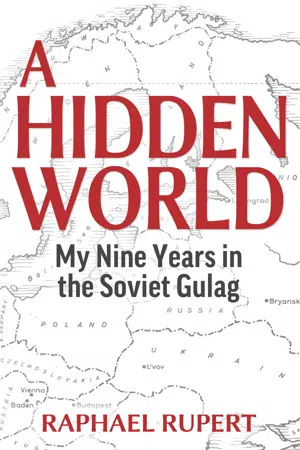
A Hidden World
About this book
A Hidden World, first published in 1963, recounts the nine years spent by Hungarian Raphael Rupert in the prison camps of Soviet Russia—the Gulag. At the time of his arrest in 1947, Rupert was working from the British Embassy in Budapest. His trial, based on a presumed confession of acting as a spy, ended in his sentence to Camp 10 for 25 years of 'forced labor.' A Hidden World describes the daily life and endless brutalities endured in the camps...the numbing winter cold, the mindless drudgery in the factories, the harsh treatment by guards and prison gangs, the lack of food and medical care. Finally, after nine years, Rupert was released and able to emigrate to Great Britain, eventually settling in Ireland.
Information
Subtopic
Russian HistoryII. RUSSIA — 1949-1954
4. Quarantine — MARCH 1949
We looked out through the grilles, and saw a maze of wooden palisades, hutments, watch-towers, miles of barbed wire, and groups of prisoners in torn, quilted clothes accompanied by guards and dogs. As the train moved slowly on, we passed at least ten of these camps. We were in a new environment, a kind of national park, a human zoo.
The perimeter of Camp 10 consisted of a palisade about twenty feet high surrounded by barbed wire, which projected inwards and outwards. There was a second barbed-wire fence outside this, in which were a number of watch-towers, about a hundred yards apart. On each of these hung a five foot iron rail, which the guards would hit from time to time to inform the neighboring towers that they were on the alert. The corner towers were equipped with machine-guns and searchlights.
At the gates I saw for the first time another curious gadget of camp life with which I was to become familiar, a piece of birch wood shaped like a slate. The guards used this when counting prisoners at roll calls. They scratched a figure on it, which they would erase later with a piece of broken glass—an interesting comment on the shortage of paper in the Soviet Union. The only writing materials in the camp were bits of birch and sharp instruments, pieces of flint or glass which served as pencils.
The inmates of the camp, mostly old and crippled prisoners, were loitering about staring at us, but they were sharply ordered back into their huts. Some of us had become so weak during the journey that they had to be carried on stretchers by their friends. We were taken into a large barracks which had been divided off from the rest of the camp by a barbed-wire fence, the quarantine barracks for new prisoners.
While waiting, some of my companions went up to the barbed-wire fence to look round, but the guards in the watch-towers waved them away. One prisoner did not move quickly enough, and the guards shot in the air behind him. I was to discover that the guards in this camp were very quick on the trigger; if they disliked a prisoner they would shoot near him. When the administrative arrangements had been completed, the checking of names, numbers, ages, etc., we were divided into groups and taken to the baths.
The temperature outside was thirty degrees below centigrade zero, and even in the bathroom it was below freezing point. We had to strip completely and were then admitted to the bath, a big wooden tub nine feet high, twelve feet in diameter, where we were given two pails of water and a small piece of brown soap. Meanwhile, our clothes were taken away by elderly prisoners for schmom (searching of pockets), and disinfecting.
It was so cold that we all washed quickly, only to find that we had to wait naked and shivering for half an hour until the clothes were brought back. While we were dressing, one of the elderly prisoners who had been in charge of the clothes, seemed anxious to talk to me. He spoke German, and said how sorry he was to see a young man like myself in such a place. “Do you know what kind of camp this is?” he asked.
I said I imagined it was like any other Russian concentration camp. I supposed they were all much the same.
“No,” he said. “You are in the camp for the worst political offenders. Old Tsarist officers like myself, dangerous spies, high Communist officials who have fallen into disgrace, Leninists, Trotskyists, scientists who have offended authority. That is why this camp is nearer Moscow than the others. Not in Siberia. They want to keep an eye on you.” He looked at me intently, and then said, ‘No one has ever left this camp alive.”
He told me he was an ex-staff officer, who had fought the Reds during the revolution. He was captured and imprisoned, but released in the twenties. Later, in Stalin’s time, he was imprisoned again, and sent to this camp. All his relations were dead, so he had no wish to leave it. He doubted if he could ever find his place again in the modern world. No one would now understand him; he was only waiting for God to relieve him of his sufferings.
“All the same,” he said, “I can’t bear to see young chaps like you in this camp. You still have something to live for. We are all suffering for a better, Christian way of life. All we can do is to accept the suffering God imposes. You, my boy, must regard your fate as a good Christian should. Suffer it with dignity and patience.” He was so touched by his own words that he started to cry.
I told him it was not enough to accept suffering passively; I agreed that we must keep our faith in God, and said that I knew He would not allow such injustice to go on indefinitely. “I know,” I said, “that we shall live to see better days. In a free and happier world. We shall enjoy life again.”
This conversation made a deep impression on me. Although it depressed me, it was a help in the first hours of my life in the camps, to meet such a man. His religious conviction strengthened the determination, which I had developed since my arrest, that the only way in which I could stand suffering would be by putting myself into the hands of God.
All new prisoners had to pass through the quarantine period, partly to undergo a medical inspection which would allot us to our work; partly, I believe, to prevent our talking with the other prisoners, and spreading optimistic stories about the West. After a month or six weeks, any information the newcomer brings is out of date, and (this was psychologically most ingenious) our enthusiasm and desire to spread news had diminished.
As the period of quarantine passed in idleness, and we had no more personal stories to tell one another, a mood of general depression replaced the first optimism. Some of us were more cold than hungry; others more hungry than cold. The food was execrable—thin cabbage soup, mush from half hulled grain, and a pound of bread, a heavy black dough, containing fifty per cent water. Our ration was small because this was an invalid camp, for the weaker prisoners in the low working categories. This resulted in continuous bartering. Those who had managed to bring a scarf, a vest, or piece of warm clothing, would exchange it for a few pieces of dry bread. I exchanged some of my clothes for bread in this way, but I regretted it. For a few hours’ relief from hunger, I lost a warm pullover.
There was no heating, but one advantage of being overcrowded (we slept almost on top of one another) was that we generated warmth on our own. Bloodstains from previous battles with bed-bugs were visible on all the bunks, and we were soon fighting the losing battle with this vermin.
We used snow for bath water. For tooth-brushes, we used our fingers, and soap for paste.
A guard had been placed at the entrance of the quarantine block to prevent us talking with other prisoners. He was not armed—a safety precaution I learned, because prisoners in the past had often attacked guards and stolen their weapons. But sometimes, if he was not looking, we could approach the wire fence in the quarantine barracks, and exchange a few words with the old men who were clearing away the snow. It was often so high around the palisades that even the top of the fence was covered. This made escape easier in the winter, and explained why the older men, incapable of anything else, were regularly sent out to clear it as it fell. Most of them had Mongolian or Chinese faces (some were Turkmen or Kazakstakian) and I had great difficulty in telling the difference between the various eastern faces I saw across the palisades.
After two weeks the snow fell so heavily that even the quarantine prisoners were used to clear it near the railway lines. We still wore our tattered old Russian uniforms, which were poor protection in this climate, and I had a greatcoat which was tied together with bits of string. Our clothes were often fastened in this way because, when we were searched, which was fairly often, the schmom was conducted in such a brusque manner that the buttons were torn off. Later, we were given caps, padded with cotton wool, and old military boots.
As the days of waiting in quarantine passed, some of the more daring prisoners who had been years in the camp, sneaked into our barracks to talk and find out all about us. One of these was a Hungarian cobbler, a Communist, who had fled to Russia in a fit of idealism. I liked him, but my friends warned me that he might be an informer who had been sent in to find out what we talked about.
My greatest surprise (and delight) was to meet Miklos Csomos, who had worked in the same underground movement in the war. I have mentioned that, during my interrogation in Baden, the Russians had threatened me with the “same fate as Csomos’s.” Sure enough, here we were in the same camp! But when we met we did not at first recognize one another. He had been a huge bear-like fellow, and I remembered him radiating good health and energy. The man who approached me now had hollow cheeks; the great frame seemed shrunken and emaciated. The ghost of the man I had known came towards me. Only his irrepressible good humor and love of life remained. He roared with laughter when he recognized me, and slapped me on the back.
“Raphael!” he cried. “You look as if you had gone through a mangle. What have they done to you?”
“What have they done to you?” I said. “You must have lost five stone.”
“Yes,” he said philosophically. “The food here is not exactly nourishing. Not like those meals we used to eat together on the Margaret Island. But it’s marvelous to see you again, you old rogue! What did they get you for?”
I told him my story, and talked about our work for the western allies and the political views he had shared with me and my father. “Yes, yes,” he said. “The mad son of a mad father! We all stood up to the Germans. Now we are standing up to the Russians. And here we are! This is what Liberal politics have done to us!”
He had been sentenced to death in Hungary by the Communists, and had remained forty days in the death cell. For forty days and nights he never knew if, when the cell door opened, he was to be taken out into the yard and, like many whose cries he had heard, hanged. His sentence had finally been commuted, and here he was serving a term of twenty-five years’ hard labor.
He had arrived some years before me, and the camp administration had soon discovered his dental qualifications. They now used him as their family doctor. He had a privileged position, working in the hospital block, which enabled him to obtain drugs for the weaker prisoners from the special police stock, and permits for the sick, exempting them from work. In the days to come Miklos did everything he could to help us. When the end of the quarantine period was approaching, a Russian general, Sergienko, visited our barracks and made a short speech, asking if we had any complaints. Two Lithuanian boys came forward, claiming that they should not be punished as the adults; they asked to be transferred to a youth camp. They said they had been too young to know what they were doing, and they courageously expressed their dislike of Communism. The older prisoners who understood this (the Lithuanians spoke Russian, because Lithuania had been under Soviet rule for some years, and they had learnt Russian in school) held their breath, fearing that the Russian general would lose his temper, and punishments would follow for everyone. But the general showed no emotion.
“You are old enough to know you committed a crime,” he said. “You are, in fact, doubly guilty, because you received a good education in Lithuania. This should have taught you that it is a crime to engage in partisan activities against the Soviet Union. Being properly educated, you are regarded as adults. That is why you have been punished as adults.”
He then warned us that we had all come here to be punished, and that work was about to begin. He assured us that the administration knew how to run the camp, that they had means of finding out our most secret thoughts and plans.
5. The World of Prison Camps — APRIL 1949
The Dubrov area in which we were, formed only one of the many concentration camp centers in the Soviet Union. These were spread out across the entire country, as far north as the Kolyma Camps in North-Eastern Siberia, where gold was mined in the tundra. There was the Vorkuta region, also in the north, concentrating largely on anthracite mining; the Petchora region, in the north-east, with ordinary coal mines; the virgin forest area near Taiga above Lake Baikal, producing timber and asbestos; the Altai Mountains near Kazakhstan where quicksilver, copper and lead were mined. Farther south, was the Karaganda concentration camp area. There were further groupings, I believe, in Turkmenia and in the northern Caucasus.
All these other areas had a relatively healthy climate; whereas the Dubrov area was in the marshes, invaded by mosquitoes in summer and damp cold in winter. It had been chosen, as the ex-Tsarist officer had said, for the “political” prisoners, many of whom were often older men, incapable of the hard manual work required in the other, mining, areas. The work here was concerned largely with maintenance—bridges, roads, snow-clearing, or the unloading of railway wagons. The wagons arrived from the surrounding forests with timber for the other working camps in the Dubrov area, some of which specialized in woodwork shops and furniture factories. While in quarantine, the work capacity of each of us was assessed by the nariarchiks, or inner camp administrators, and we were now allotted our place in working brigades.
These nariarchiks were the confidence men of the regime, selected from among the prisoners, usually Russians or men from the Soviet Union’s other territories, who had been sentenced for some minor offense. They were exempted from outside work, and carried out administrative duties in the camp. They supplied the authorities with regular reports about the morale of the prisoners and other confidential matters. They were responsible for staffing the working brigades, to whom they forwarded orders received from the central officer. They were all loyal to the camp administration, and were always prepared to carry out any task, hoping for an amnesty, or at least for an improvement in their position, in reward for faithful service. This was a little naive of them, because they should have known by now how the Soviet system worked, how little it cared about anyone who had lost its favor. But they obstinately clung to their hope of redemption.
One morning, a nariarchik came to our block with his adjutants, and allotted us to various working brigades, according to our fitness. The secret police made a final search of our barracks and then, after a month of quarantine, we came out into the working and, if one may so call it, the social world of the Soviet Concentration Camp 10.
We reported to our brigadier who had received a list of names, and he gave us our tasks. [The distinction between nariarchik and brigadier is, I hope, clear, as these terms will be frequently used. Both were prisoners in semi-official positions, the former administrative, the latter executive.] Some of these brigadiers were extremely unpleasant men; but ours, who was half Finnish, was helpful, even well disposed, to the Hungarians. He pointed out that our two nations, the Finns and Hungarians, were related, and he said he was glad I was working under him.
The day’s work started with reveille at five in the morning when it w...
Table of contents
- Title page
- Table of Contents
- About the Author
- Introduction
- Acknowledgments
- I. EASTWARD - 1947-1949
- II. RUSSIA - 1949-1954
- III. WESTWARD - 1954-1956
- APPENDIX - The Death Sentence in Russia
Trusted by 375,005 students
Access to over 1.5 million titles for a fair monthly price.
Study more efficiently using our study tools.
Frequently asked questions
Yes, you can cancel anytime from the Subscription tab in your account settings on the Perlego website. Your subscription will stay active until the end of your current billing period. Learn how to cancel your subscription
No, books cannot be downloaded as external files, such as PDFs, for use outside of Perlego. However, you can download books within the Perlego app for offline reading on mobile or tablet. Learn how to download books offline
Perlego offers two plans: Essential and Complete
- Essential is ideal for learners and professionals who enjoy exploring a wide range of subjects. Access the Essential Library with 800,000+ trusted titles and best-sellers across business, personal growth, and the humanities. Includes unlimited reading time and Standard Read Aloud voice.
- Complete: Perfect for advanced learners and researchers needing full, unrestricted access. Unlock 1.5M+ books across hundreds of subjects, including academic and specialized titles. The Complete Plan also includes advanced features like Premium Read Aloud and Research Assistant.
We are an online textbook subscription service, where you can get access to an entire online library for less than the price of a single book per month. With over 1.5 million books across 990+ topics, we’ve got you covered! Learn about our mission
Look out for the read-aloud symbol on your next book to see if you can listen to it. The read-aloud tool reads text aloud for you, highlighting the text as it is being read. You can pause it, speed it up and slow it down. Learn more about Read Aloud
Yes! You can use the Perlego app on both iOS and Android devices to read anytime, anywhere — even offline. Perfect for commutes or when you’re on the go.
Please note we cannot support devices running on iOS 13 and Android 7 or earlier. Learn more about using the app
Please note we cannot support devices running on iOS 13 and Android 7 or earlier. Learn more about using the app
Yes, you can access A Hidden World by Raphael Rupert, Anthony Rhodes in PDF and/or ePUB format, as well as other popular books in Politics & International Relations & Russian History. We have over 1.5 million books available in our catalogue for you to explore.