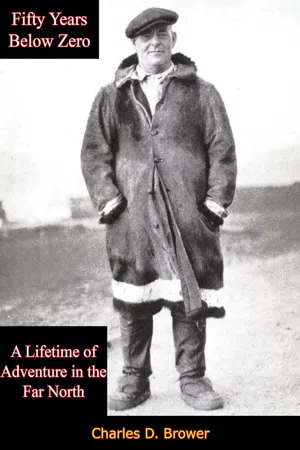
Brower had left San Francisco with the intention of making a short dash north on a whaling ship bound for the mythic Arctic Circle. Adventure had a way of following Charlie Brower. His initial landing turned into a fifty-year long ice-bound lifestyle. Once he stepped off the whaler and back onto dry, albeit frozen land, Brower took a job as master of the whaling station. But, though commerce brought him north, it was the people that helped keep him there for Charlie soon became fast friends with the native Inuit people. They taught him how to hunt seals on the ice, caribou on the tundra, and whales out on the sea. He learned their secrets, lived in their igloos, navigated in their kayaks and avoided being murdered in their feuds. Plus the young adventurer observed the great dramas of the Far North play out. He saw the last of the sailing ships disappear over the horizon, and watched the first airplane fly in. For fifty-seven years, through ice storms and northern lights, Charlie Brower maintained both this lonely outpost and his claim as "Uncle Sam's most northerly citizen."
A book to remember, "Fifty Years Below Zero" is richly illustrated throughout with photos by the author.
- 336 pages
- English
- ePUB (mobile friendly)
- Available on iOS & Android
eBook - ePub
About this book
Information
Subtopic
American Civil War HistoryIndex
HistoryCHAPTER I
To A boy not yet twenty-one but already fed up with the solitude of seven years at sea, the bustling San Francisco of 1883 looked like the Promised Land.
“No more lonesome places for me!”
That was my one thought while elbowing through the crowds in search of a job. I turned down the first one offered because it came, ironically enough, from the City Fire Department and I’d had enough fire for a lifetime.
It was some months later while working for a newspaper that the old lure of wide horizons and far places began to stir. Africa, for example. I’d always wanted to see what Africa was like inside.
Gradually the conviction took hold that somehow Fate would set me in Africa yet—little dreaming that ladies’ corsets even then were shaping my course in exactly the opposite direction.
Ladies’ corsets! For without them there would have been no demand for whalebone, hence no great whaling fleets of sturdy wooden vessels, sail and steam, manned by men the like of whom the world had never known.
The importance of whaling in those days can be understood when you remember that whalebone was worth around five dollars a pound and that a self-respecting whale was likely to be carrying anywhere from five to ten thousand dollars’ worth of corset stays “in the rough.” Result: A far-flung Arctic industry with hardship, disaster and violent death on one side of the ledger, balanced by fabulous profits on the other.
Profits were never so large, however, that an alert outfit like the Pacific Steam Whaling Company didn’t try to cut operating costs in every way. And since one aggravating source of expense was the high cost of shipping coal to the far north for use of its fleet, reports of certain coal veins near Cape Lisburne, Alaska, on the Arctic Ocean, called for immediate investigation.
Which was Fate’s way of turning me into what some of my more romantic friends call “the most northernly citizen of the Western Hemisphere.”
Quite unexpectedly, the Pacific Steam Whaling Company had offered me a chance to accompany a small party to Arctic Alaska on this coal mining proposition. They were also to trade with the Eskimos, for furs, whalebone and ivory. I was mulling it over, my thoughts still leaning towards Africa, when my old shipmate, George Leavitt, hove into view. I blurted everything out.
“Going to take it, Charlie?” he asked.
“Would you?” I countered.
Somewhat to my amazement, George not only would but did. And so did I.
In the Company’s office shortly afterwards we were introduced to a Captain Ned Herendeen who was getting ready to leave for Point Barrow to start a new whaling station for the same outfit. It seemed he had just spent two years up there with Lieutenant Ray of the United States Army Survey, and had convinced the Company that Point Barrow would be a fine place to whale when the ice broke up in spring.
Our little coal prospecting party consisted of four in all. J. J. Haverside was in charge. The others were George Leavitt, a man named Henry Woolfe and myself. Knowing nothing of the Arctic, George and I were busy boys those last days before sailing, trying to round up what we considered essentially such a venture. We made plenty of silly mistakes. But among my few sound hunches was a trip to San Leandro for an Eskimo dog that somebody wanted to give away. Mark proved a fine, big fellow and I kept him in the north as long as he lived.
We put out of San Francisco early in June on a little schooner, the “Beda,” under command of Captain Gage who had never sailed the Arctic before; our main cargo, coal and other supplies for the fleet.
Heading across the North Pacific, we made Atka, one of the Aleutian Islands, two weeks later. Then, after landing four copper prospectors on Solonois Island, a pin-point of land so tiny that I’ve never found it on any map, the “Beda” turned northward up Bering Sea for the Pribilof Islands. This was the run that gave me my first taste of Arctic fog and storm.
In those days mail went to Alaska by any craft headed in that general direction, and since we had a load of it for precipitous, windswept St. Paul, one of the Pribilofs, we tried hard to land it somewhere near the settlement. With the wind wrong, there wasn’t a chance. The lee of the island was bad enough because of high surf.
I was used to surf landing, however, and promptly volunteered to try it with the small boat and one other man.
As we neared the beach, we regretted our rashness. Only the eager looks of the waiting populace kept us on until it was too late to quit, anyhow. There was nothing to do but wait for an enormous roller, then start in, rowing desperately.
As soon as we hurtled, ker-blam, on to the beach, men rushed shoulder-high into the water, grabbed the boat on both sides and landed us in the midst of as extraordinary a setting as I ever saw before or since.
It wasn’t the Aleuts themselves that astonished me, deliriously happy though they were to get long-delayed mail from “outside.” What made my eyes pop was the sight of seals—seals—seals. Millions of them, it seemed, in every direction!
We had been too busy trying to keep right-side-up to realize that we were heading straight into the center of where these numberless females had their pups, one to a mother. Only here and there was an old bull who had hauled out early in the season, gradually gathering his harem around him as they arrived later.
No matter where we went, there was nothing either way but these breeding rookeries. I never could have imagined such a sight.
It was curious to see how the young males kept together in a section they had set apart for themselves. I noticed, too, that a good many of the pups seemed alone, and asked if they were orphans.
The man laughed. “Their mothers are off fishing, that’s all. Sometimes leaves ‘em alone for two days at a time. But you take the old bulls, now, they’re different. No, sir, you don’t catch an old bull quitting the island till the breeding season is over.”
Pondering over the private life of the seal, we finally remembered the “Beda” lying offshore and came to with guilty consciences. Friendly hands helped launch the little boat through the breakers and presently we climbed aboard our schooner thoroughly soaked, to be welcomed by Captain Gage with choice remarks about “three hours to put a mail sack ashore.” But it was worth it.
After breaking anchor, we headed north again, our destination distant Point Hope where we were to meet the whaling fleet and give them their coal.
Raising St. Lawrence Island days later, we finally entered shallow Bering Strait and, leaving the Diomede Islands to port, skirted Cape Prince of Wales where Cape Mountain marks the westernmost tip of the continent. At this point the Strait is only fifty-six miles wide, and it gave me a strange, exhilarated feeling to see North America on one side of me and the dim outlines of Siberian hills on the other.
Creeping northward into the Arctic Ocean, we encountered our first scattered ice, a new and disconcerting discovery for good Captain Gage. So disconcerting that, instead of heading direct for Point Hope, he went over to the east along the edge of the ice. The result of his unnecessary caution was that on July 1, 1884 we anchored under the lee, not of Point Hope but of Cape Krusenstern, miles south. It took another two days to work our way north to the fifteen-mile finger of sand which forms Point Hope.
There was plenty of ice offshore the whole distance, but long before reaching our rendezvous the sight of some seventy whaling ships of all kinds encouraged Captain Gage to hold his course.
Presently, two of our Company’s vessels steamed up and piloted us through small strips of ice until we anchored on the south side of Point Hope in a good lee.
The direct water route from San Francisco was about thirty-five hundred miles. The actual distance we had sailed was anybody’s guess. I only know that Captain Gage wasn’t the only one to heave a sigh of relief as we set about distributing mail to all the ships’ boats which promptly surrounded us.
As fast as they got it, away they went, leaving the captains of our own ships aboard to settle in what order they would get their coal. Captain Everett Smith of the steam whaler “Bowhead” drew first chance, so that same night—it was light all the time now—we warped the “Beda” alongside the “Bowhead” and gave him his fuel.
Captain Smith was a fine man and an old-timer at the whaling game, and it happened that he and his crew were feeling extra good over getting eight large whales. Just the same, I thought it a rare kindness for him to insist on steaming all the way back to Port Clarence for an Eskimo and his wife who were to cook for our coal prospecting party.
Third in line for her fuel was the “Orca,” under command of Captain Colson. It had been arranged that the “Orca” was to take us the rest of the way to those coal veins north of Cape Lisburne, and we lost no time transferring all our supplies and equipment to Captain Colson’s vessel. Considering the complete “knocked-down” house we had brought along from San Francisco, this proved quite a job. But we heaved and tugged and got the last piece stowed just in time, so we thought,—only to find ourselves camped there for three more long days and nights while the deck swarmed with Eskimos trading whalebone. The guttural hubbub never stopped.
What impressed me was the air of prosperous independence of these natives. But whalebone was selling at the time for more than four and a half dollars a pound. So why shouldn’t they feel cocky —at least compared to a handful of white adventurers in search of some half-mythical coal supply?
The crew, meantime, were entertaining us with tales intended to be helpful to greenhorns. For years, it seemed, whenever a ship was wrecked in the Arctic the Eskimos had always been allowed to do with it as they pleased, even to ordering the crew off. Hence, their present reputation for being a bad lot. What they might do to a small party of white men wintering among them was a question. Some advised us to give up the idea entirely.
“At any rate,” they warned, “if you ever see a bunch of ‘em heading your way without their women and children, lock yourselves in and be damned sure your guns are loaded.”
We promised.
In spite of their ominous predictions, we were glad to be on our way at last, and relieved when the “Orca” managed to steam up the coast as far as Cape Lisburne without meeting serious ice. When I mentioned our luck to Captain Colson, his square, grizzled face cracked into a grin and he pointed ahead.
Just around the Cape, we now made out what looked like a compact mass of ice.
George and I had been at sea together for several years but ice navigation was new to both of us. We watched the “Orca” tackle the job with something more than casual interest.
A deep bight made in north of Cape Lisburne, it was twenty-four miles to where we were to erect our house, and the first twenty-two were packed by broken ice through which we twisted and turned to every point of the compass.
It was early evening when we entered the bight. By midnight all headway stopped. The captain now climbed into the crow’s nest for a personal survey. His report: A strip of solid ice two miles wide separated us from clear water.
“That ends it for tonight,” I said to George, secretly relieved. “I’m going below for a little rest.”
Hardly had I pulled off my clothes when the engine-room bell rang for “astern.” Then came “full speed ahead.” Too tired to pay attention, I was about to crawl peacefully into my bunk when suddenly the “Orca” hit the Rock of Gibraltar and I landed in a heap against the forward partition.
Clawing on my clothes again, I rushed on deck, prepared for a scene of utter confusion. But nobody seemed disturbed or even excited as the “Orca” backed off preparatory to ramming the ice again.
This battering-ram procedure went on methodically the rest of the night. Sometimes the ship would slide up ten or fifteen feet on the ice and lie there, rolling a little from side to side as though catching her breath before plopping back into deep water. Occasionally her sheer weight would break the ice. More often it required repeated ramming. But always we made some progress, anyhow, and several hours later we crashed through the last of the floe. Then, nothing lay ahead bu...
Table of contents
- Title page
- TABLE OF CONTENTS
- DEDICATION
- INTRODUCTION
- ILLUSTRATIONS
- PROLOG
- CHAPTER I
- CHAPTER II
- CHAPTER III
- CHAPTER IV
- CHAPTER V
- CHAPTER VI
- CHAPTER VII
- CHAPTER VIII
- CHAPTER IX
- CHAPTER X
- CHAPTER XI
- CHAPTER XII
- CHAPTER XIII
- CHAPTER XIV
- CHAPTER XV
- CHAPTER XVI
- CHAPTER XVII
- CHAPTER XVIII
- CHAPTER XIX
- CHAPTER XX
- CHAPTER XXI
- CHAPTER XXII
- CHAPTER XXIII
- CHAPTER XXIV
- CHAPTER XXV
- CHAPTER XXVI
- CHAPTER XXVII
- CHAPTER XXVIII
- CHAPTER XXIX
- CHAPTER XXX
- CHAPTER XXXI
- CHAPTER XXXII
- CHAPTER XXXIII
- CHAPTER XXXIV
- CHAPTER XXXV
- CHAPTER XXXVI
- CHAPTER XXXVII
- CHAPTER XXXVIII
- CHAPTER XXXIX
- CHAPTER XL
- CHAPTER XLI
- CHAPTER XLII
- CHAPTER XLIII
- CHAPTER XLIV
- CHAPTER XLV
- CHAPTER XLVI
- CHAPTER XLVII
- CHAPTER XLVIII
- CHAPTER XLIX
- CHAPTER L
- CHAPTER LI
- CHAPTER LII
- CHAPTER LIII
- CHAPTER LIV
- CHAPTER LV
- EPILOG?
- REQUEST FROM THE PUBLISHER
Trusted by 375,005 students
Access to over 1.5 million titles for a fair monthly price.
Study more efficiently using our study tools.
Frequently asked questions
Yes, you can cancel anytime from the Subscription tab in your account settings on the Perlego website. Your subscription will stay active until the end of your current billing period. Learn how to cancel your subscription
No, books cannot be downloaded as external files, such as PDFs, for use outside of Perlego. However, you can download books within the Perlego app for offline reading on mobile or tablet. Learn how to download books offline
Perlego offers two plans: Essential and Complete
- Essential is ideal for learners and professionals who enjoy exploring a wide range of subjects. Access the Essential Library with 800,000+ trusted titles and best-sellers across business, personal growth, and the humanities. Includes unlimited reading time and Standard Read Aloud voice.
- Complete: Perfect for advanced learners and researchers needing full, unrestricted access. Unlock 1.5M+ books across hundreds of subjects, including academic and specialized titles. The Complete Plan also includes advanced features like Premium Read Aloud and Research Assistant.
We are an online textbook subscription service, where you can get access to an entire online library for less than the price of a single book per month. With over 1.5 million books across 990+ topics, we’ve got you covered! Learn about our mission
Look out for the read-aloud symbol on your next book to see if you can listen to it. The read-aloud tool reads text aloud for you, highlighting the text as it is being read. You can pause it, speed it up and slow it down. Learn more about Read Aloud
Yes! You can use the Perlego app on both iOS and Android devices to read anytime, anywhere — even offline. Perfect for commutes or when you’re on the go.
Please note we cannot support devices running on iOS 13 and Android 7 or earlier. Learn more about using the app
Please note we cannot support devices running on iOS 13 and Android 7 or earlier. Learn more about using the app
Yes, you can access Fifty Years Below Zero by Charles D. Brower in PDF and/or ePUB format, as well as other popular books in History & American Civil War History. We have over 1.5 million books available in our catalogue for you to explore.