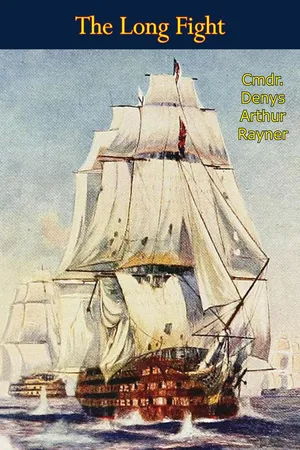
A LONG, DESPERATELY FOUGHT BATTLE BETWEEN THE BRITISH FRIGATE "SAN FIORENZO" AND THE FRENCH FRIGATE "PIEMONTAISE" IN THE INDIAN OCEAN IN 1808…
In the path of the three India merchantmen setting out on their long voyage home lurked the French raider based on Mauritius, then known—the year in 1808—as the Ile de France. The frigate San Fiorenzo was despatched to escort them past the danger point. The enemy frigate, Piemontaise, sighted the convoy first, but was in turn sighted by the San Fiorenzo before she could close with and board her prizes. Then ensued a three-day running fight of truly epic quality. The San Fiorenzo, an elderly vessel captured from the French in the Mediterranean a generation earlier, was out-gunned and out-manned; many of her crew had had to be put ashore owing to sickness, and she had just weathered a furious storm. On the other hand she had only recently emerged from dry-dock and could outsail the Frenchman, who had been too long at sea. But more important even than speed and armament were the minds of the opposing captains…
- 163 pages
- English
- ePUB (mobile friendly)
- Available on iOS & Android
eBook - ePub
The Long Fight
About this book
Information
Topic
HistoireSubtopic
Histoire de la Grande-BretagneBook One—On Guard
Chapter 1
The wind, soon after it struck, had shifted to the north and blown with an unyielding and steadily increasing frenzy. With her bow pointed north-west to make good the leeway, His Britannic Majesty’s Frigate San Fiorenzo moved slowly to the west under her three close-reefed topsails. In the afternoon she had rolled with abandon and to either side, but now that the real wind had come, she rolled with determination, and only to port—away from the wind. Mountains of water, laced with a netting of phosphorescent foam, swept remorselessly upon her, burst into spray against her wooden side, and flung water that was almost a solid sheet across her.
Captain George Nicholas Hardinge, First Lieutenant William Dawson, and the Sailing Master, Mr. Dunnovan, stood together by the mizzen rigging. Spindrift rattled like shot against their bulky, wide-collared tarpaulin coats, and the pale gleam from the waves glinted on the wet curved crowns of their heavily varnished straw hats. The Captain was distinguished by his slight carriage, and that only by comparison with the squat bulk of his two companions, who waited with patient strength on their captain’s commands.
So much spume was being blown across the ship that, although Hardinge knew rain had been falling when darkness closed in, he did not know whether the water which washed from side to side across the deck or blew about in little whirlwinds was still mixed with rain. From time to time Hardinge had seen minute beads of phosphorescence in the shallow ripples. Fresh water, he knew, soon killed the power of the tiny marine creatures to emit their ghostly light. He guessed the rain had stopped—and that suggested even more wind.
The others on deck were crouched beneath the weather rail between the guns. From that position, the inclined lengths of the masts was clearly visible; and because they were out of the wind, the angle of the masts was more unnerving for them than for the few standing upright against the wind’s fury.
“— log,” Hardinge heard Dunnovan shout. He nodded without turning around.
Five minutes later he was aware of the pressure of a body against his. “Well?” he shouted as, still keeping his eyes on the waves, he bent his head to make shelter for them both with the brim of his hat.
“Three and a quarter through the water, sir,” Dunnovan shouted. “Not much more than two, on course.”
A heavier than usual sheet of water spread itself over the ship. The larger wave had a larger trough. She fell over further than ever before—until her men caught their breath and wondered when she would come back. In rolling so she raised her weather side, and for a moment the rail stopped the wind from tearing across the quarterdeck. Suddenly there was easement, almost quiet.
And in that moment of foreboding peace, the Captain heard the bell struck eight times—Monday’s midnight, and Ceylon two hundred miles ahead.
Chapter 2
Dawn, creeping after night, confirmed the Captain’s impression that the seas were higher now than when darkness had fallen. The waves were larger, less steep, and there had been an increase in the power of their heavy crests. Turning over in hoary curls, they roared down the flanks of the waves. When they struck the ship they thundered against the channel plates, which stood out four feet from the ship’s side and carried the dead-eyes to which the lower ends of the shrouds were fastened. The blows shook her from end to end, and the men felt as if each thrust were directed against their own bodies.
The overcast sky was underhung with a scurrying cloud rack of darker gray. The lack of any rain was paradoxically depressing to the men’s spirits. The sky looked full of rain. It ought to rain. That it could not do so was a measure of the storm’s violence.
In these conditions it had been impossible to fix the ship’s position by the sun. The Master, chalking up the noon position on the slate, wrote with fingers wrinkled by continuous soaking in salt water: “Tuesday 1st March, 1808. By dead reckoning Dondra Head bears west, a half north, 175 miles,” and, steadying himself against the violent motion, added the letters “N.C.,” meaning “No change in the wind and sea.”
The masts and rigging were standing well to the weather. The reefed topsails, three narrow bands of sail, each halfway up its mast, had given no trouble. Familiarity with the gale’s face hourly lessened its menace. The San Fiorenzo battled westward, and, as each wave was overcome, Hardinge felt his judgment vindicated. Indeed, he could almost permit himself a smile at a monstrous, maintop-high wave whose back had been smoothed by its passage under his ship.
Conversation between the tired men would suddenly burst out, burn steadily for a while, and then for long periods die away. After one long silence Hardinge, shifting his cramped limbs, turned to speak to Dawson, who still stood beside him. “The wind’s not shifted by so much as a quarter of a point since it struck,” the Captain said between waves.
“That it hasn’t,” the First Lieutenant agreed grimly, his thoughts on the storm centre. “No change. That means we’re in the path of the storm.” He broke off, and both men took firm hold of the pin-rail to steady themselves against a violent roll. “Bad it may be, sir, but not so bad we couldn’t wear her round to the other tack with her head to the eastward—that way we might still escape the vortex.” Dawson succeeded by his tone in turning what had started as a statement of fact into a question of intention.
“No. No, Mr. Dawson, I’ll not have that horse trotted out again. I said yesterday that it’s not a question of seamanship. If we are to save the convoy, we’ve got to take the risk. We’re making west all the time now. If we were to put her on the other tack we’d not lose hours but days. We’ve no idea when the merchantmen sailed from Bombay. Certainly they’ll be at sea by now, and if there is a Frenchman on the coast—”
Hardinge paused, then continued. So the conversation went, and, because answers could not immediately be made, thoughts would often intrude to make it appear more disjointed than in fact it was.
“What if we do strain her and open up a seam or two?” the Captain said. “So long as the pumps will keep her afloat...What’s this old frigate compared to three laden merchantmen?” Hardinge spoke with the sharp certainty of a young commander who was not really quite so sure of himself as he would have his hearer believe.
“Why in hell didn’t they send the Terpsichore to cover the ships from Bombay?” This was only an emphatic question; Hardinge knew that it was not in Dawson’s nature to rumble. “She must have been in Galle since we left.”
“His Excellency probably reckoned that if one Frenchman had arrived a month early, the other could be there too. Then the ships from Calcutta would be in as much jeopardy as those from Bombay. Maitland is no fool. When he ordered our return, he sent the Terpsichore up the east coast, and she is in an even worse state than we are. Montagu says his upper deck has got so full of rot that he’ll have to land all his carronades next time he is in Madras—for fear they’ll fall through to the gun deck! The Governor couldn’t know we’d hit this confounded gale—which is as much out of season as the French themselves.”
“And the only sound frigate that Sir Edward has left behind is way up north at Karachi.”
“The Pitt?” Hardinge said. “She’ll not be back before the end of the month—and then only if she finds a fair wind all the way south.”
“Properly caught with our breeches down,” Dawson said, “that’s what we are, sir. If only the fleet would get back from Sourabaya!”
“We’ll not see them before the first week in April. Amphibious operations always take much longer than the Staff allows. Pellew is not to know that the Frog cruisers are already here.”
“The Ile de France, or Mauritius—whatever you call it—must be getting pretty desperate for food.”
“Aye,” Hardinge nodded. “And all the more danger to the merchantmen. There’s nothing like a spell of half or one-third rations to make chaps want to fight; they reckon there’s at least a good meal to be had for their trouble.”
“Pity we don’t know which ship it is,” Dawson said.
“The Sémillante is small beer compared to the Piemontaise.”
“If it should be the Pie, sir, she’ll give us a grand fight.”
“Aye—and if we can catch her—more honour too.”
Their choice needed no further explanation: both men were well aware that, for the last five years, the Piemontaise had been the terror of the coast and had so far eluded all attempts to bring her to action.
“Yes, sir—but if we were to be dismasted or severely hurt—” The First Lieutenant’s words were lost in the booming of the gale. When the gust had passed, marking its passage to leeward with a hissing carpet laid flat upon the waves, Dawson did not repeat his words. The power of the wind had added its own implication.
“At least we’ll have daylight to see it coming.” Hardinge’s thoughts had returned to the vortex.
“She’s not as young as she was.” Dawson referred to the ship.
“Same age as myself. If my guess is right, we were launched the same month—that makes her twenty-seven in April. It’s her starboard side that is the weaker. That’s where Tyler and I had to plug the big hole before we could get her off the bottom of San Fiorenzo harbour.” Then, after he’d watched another wave pass under his ship, “We were both thirteen then.”
“This way we’ll have tried.” The First Lieutenant shouted to make himself heard. And then as the ship sank into the trough the Captain answered more quietly, “Either way a reputation can be lost.”
On Dawson’s face, the unshaven stubble rimed with salt, there was an expression of admiration—the admiration that a conscientious older man who has been passed over for promotion may feel toward the brilliant youngster whose star is rising. Aware what his own decision would have been if he had had to solve the previous day’s problem, he also knew what he would have wished it to be.
“Here comes Surgeon Ward, sir.” Dawson drew his captain’s attention to the squat figure which, hatless and in shirt and trousers already soaked by the spray, was making its cautious way from hand-hold to hand-hold across the heaving deck.
The Surgeon came to rest before the Captain, with one hand taking firm hold of the pin-rail while using the other to brush the water from his eyes. Never one to overstate a case, he spoke seriously: “It ain’t any good, sir. In that atmosphere you can barely expect fit men to live—let alone those poor devils. There’s full seventy hammicoes slung at this moment, and scarce a man in ‘em will be fit until he’s had a spell upcounty.”
A few would be bad enough, Hardinge thought. Even the loss of a dozen or a score could be borne. But seventy! That was one third of his crew.
The hot damp atmosphere was bearable in the open because the storm kept it moving; but the Captain knew that it would be stifling on the mess deck with hatches battened down and bilges stirred to unusual stench by the violent washing of the bilge water. The use of the windsails, cones of canvas that normally directed air into the living spaces, was out of the question in that weather. If Hardinge’s immediate fear for the ship had been reduced, his anxiety for her men was increased by Ward’s visit to the quarterdeck.
King, the Captain’s personal servant, appeared, hovering beside the two men. A short pippin of a man, he looked more like an o...
Table of contents
- Title page
- TABLE OF CONTENTS
- Acknowledgments
- Foreword
- Book One-On Guard
- Book Two-The First Day
- Book Three-The Second Day
- Book Four-The Third Day
- Afterword
- Appendix
- REQUEST FROM THE PUBLISHER
Trusted by 375,005 students
Access to over 1.5 million titles for a fair monthly price.
Study more efficiently using our study tools.
Frequently asked questions
Yes, you can cancel anytime from the Subscription tab in your account settings on the Perlego website. Your subscription will stay active until the end of your current billing period. Learn how to cancel your subscription
No, books cannot be downloaded as external files, such as PDFs, for use outside of Perlego. However, you can download books within the Perlego app for offline reading on mobile or tablet. Learn how to download books offline
Perlego offers two plans: Essential and Complete
- Essential is ideal for learners and professionals who enjoy exploring a wide range of subjects. Access the Essential Library with 800,000+ trusted titles and best-sellers across business, personal growth, and the humanities. Includes unlimited reading time and Standard Read Aloud voice.
- Complete: Perfect for advanced learners and researchers needing full, unrestricted access. Unlock 1.5M+ books across hundreds of subjects, including academic and specialized titles. The Complete Plan also includes advanced features like Premium Read Aloud and Research Assistant.
We are an online textbook subscription service, where you can get access to an entire online library for less than the price of a single book per month. With over 1.5 million books across 990+ topics, we’ve got you covered! Learn about our mission
Look out for the read-aloud symbol on your next book to see if you can listen to it. The read-aloud tool reads text aloud for you, highlighting the text as it is being read. You can pause it, speed it up and slow it down. Learn more about Read Aloud
Yes! You can use the Perlego app on both iOS and Android devices to read anytime, anywhere — even offline. Perfect for commutes or when you’re on the go.
Please note we cannot support devices running on iOS 13 and Android 7 or earlier. Learn more about using the app
Please note we cannot support devices running on iOS 13 and Android 7 or earlier. Learn more about using the app
Yes, you can access The Long Fight by Cmdr. Denys Arthur Rayner in PDF and/or ePUB format, as well as other popular books in Histoire & Histoire de la Grande-Bretagne. We have over 1.5 million books available in our catalogue for you to explore.