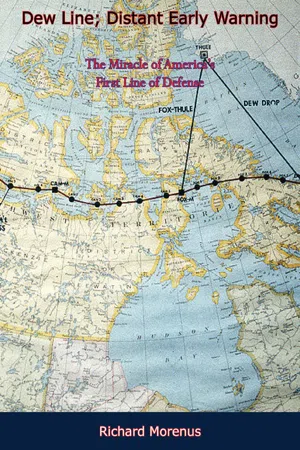
DEW LINE—the story of America's best kept secret now can be told. This is the story of the three-thousand-mile Distant Early Warning line—America's electronic Paul Revere. Spanning the northernmost reaches of the North American Continent, it stands as an impregnable radar fence against large-scale attack across North Polar regions by enemy long-range bombers and fighter planes.
DEW LINE is the dramatic account of how the almost impossible task of building this final link in the 10,000-mile warning loop around our country was accomplished. From the initial period of planning in the summer of 1952, from the building of an experimental span across the Arctic shore of Alaska, to the ultimate completion of the 3,000 miles of radar installation with the back-breaking task of flying in personnel and equipment to build these stations in sub-zero temperatures in the long Arctic nights—all is recounted as the vivid story of accomplishment it is.
eBook - ePub
Dew Line; Distant Early Warning
The Miracle of America's First Line of Defense
- 114 pages
- English
- ePUB (mobile friendly)
- Available on iOS & Android
eBook - ePub
About this book
Trusted by 375,005 students
Access to over 1.5 million titles for a fair monthly price.
Study more efficiently using our study tools.
Information
Subtopic
Military & Maritime HistoryIndex
HistoryCHAPTER ONE— THE LIFELINE
ONE OF THE GREATEST DRAMAS OF ALL time was being produced. The principals were four men whose attention was riveted on a huge map some thirty feet away. Their faces were grave with responsibility as they slowly but inexorably were being forced to issue one of the most critical commands in our history. It was a command that could instantly plunge our country into a state of atomic war. Their decision would be based upon the developments on the map they watched.
The scene was taking place in a large windowless room, thirty by sixty feet and two stories high, built into a block-constructed building located at CONAD, the Continental Air Defense Command at Colorado Springs, Colorado. The room itself was the Combat Operations Center.
The four men were high-ranking officers, the joint command of our Continental Air Defense Command under the Joint Chiefs of Staff. One of the four was the Commander-in-Chief of this operation under whose operational control are all the forces of the Army, the Navy, and the Air Force allocated or in any way assigned for air defense purposes. The other three officers were of the Army, the Navy, and the Air Force.
They were seated at a long desk in the glassed-in command booth set high into a wall of the big room. Below them, between the booth and the floor, two tiers of desks extended the length of the room. Here other men were sitting, singly, their full attention focused on the map. They were trained officer personnel who specialized in operating one of the most intricate and highly efficient communication systems in the world. This system insured direct contact with all Continental Air Defense Command units throughout the United States, Canada, Alaska, and Newfoundland. These men, too, were tensely alert as they watched, waiting for the word to come that they both expected and dreaded.
The room itself was silent; its sound-proofed walls and ceiling swallowed every sound. The semidarkness was broken only by light from the face of the map, from the shaded desk lamps along the tiers, and from the booth above. Although the atmosphere of the place was solemn, it crackled with a sense of vital expectancy.
The map on which their eyes were fastened showed the United States, Canada, Alaska, and the polar region etched on a single pane of plexiglass, twenty by thirty feet. It dominated the entire wall. On it the rapidly changing markings were being studied. The figures and symbols appeared as if by magic and as mysteriously disappeared only to reappear at a new point as operators, working on scaffolds behind, marked the code signs and numbers. Flashing colored lights in panels at either end of the map—yellow for “alert” and red for “impending attack”—completed its function of presenting the position and flight pattern of every unidentified aircraft. This information was received from established radar defense sites unerringly detecting and reporting the presence of planes, and from alert members of the Ground Observer Corps, scanning the skies and funneling their findings through their local Filter Centers. As these data were forwarded to this operations center, the facts and figures appeared on the map. It all took just a few seconds. The markings showed the types of planes, if that had been established, their approximate altitude, and the direction in which they were flying. Their progress was maintained on the map until they were fully recognized and justified, or if necessary, taken out of the air.
This reporting goes on constantly, around the clock, for both the United States and Canada. The map is under continuous observation—the map which is the heart and soul of our country’s system of air defense—the four men sitting in the booth being its brains.
The pattern of the drama was now rapidly developing on the map. Each new marking added positive proof that a climax was close at hand. Hardly more than ten minutes before the map had been clear. Suddenly a light had flashed which indicated an “alert.” This warning was quickly followed by a chalk mark on the map to a place east of Alaska and north of the continental boundary. Apparently a message had been received from the DEW Line, the Distant Early Warning radar line, extending across our northernmost continental limits north of the Arctic Circle. There, at the first showing of an unidentified plane on one of its radar screens, word had been flashed by ionospheric scatter broadcast, which had then been picked up instantly by the CONAD receivers in Colorado Springs, and seconds later the news was chalked on the map.
As new symbols appeared, it was evident to the men watching that trouble was in the making. The latest marks showed alien planes in mass formation, jet-powered, flying at high altitude, and headed south. If these were Soviet planes on an attack mission—and there was every reason to believe they might be—it would be cause for serious concern.
Why the Soviets? There may be other nations equally opposed to our way of doing things, but no other nation, so opposed, has the air force or facilities for launching a large-scale attack against us. The direction from which we could most logically be attacked would be from across the polar regions. By that route any target in the United States is within a flying radius of 4,500 miles from Soviet bases.
As yet, however, in the drama that was progressing there was no detailed identification as to the exact type of aircraft these planes were; and the Soviets have several types. But since the planes had been identified as armed invaders, they must be turned back or destroyed before they could get through to a target and drop their loads of lethal luggage.
The drama being plotted on the map had reached its critical point. The questionable planes, already identified as enemy, had passed over the DEW Line and within four and certainly less than six hours could reach our border and their potential targets.
Throughout the United States and Canada the interceptor units of jet aircraft, and the speediest of fighters, on a constant twenty-four-hour-a-day alert, were ready. Pilots in the base operations readyrooms were prepared as always for all emergencies. (Heretofore, alarms fortunately had resulted in mere investigations of some plane off its course or an unscheduled flight.)
In the command booth, three telephones hung from their hooks at the edge of the desk. One was black, another white. These the Commander-in-Chief had used frequently since the first warning. This time, however, he reached for the third one. He paused just a moment before lifting the instrument and turned toward the officers seated alongside him; they nodded agreement to his unspoken question. This phone, on which his hand rested, was different from the other two. This one was red, bright red—the “hot line” in direct contact with every interceptor unit in the United States and Canada. An order into this telephone would send jets, radar-directed, on the mission of meeting the alien planes. Our entire air arm would then go into action in full-scale defense against invasion, and the battle, for there would be one to the finish, would be fully directed by these four commanding officers from their booth in this Combat Operations Center at Continental Air Defense Command.
The next call would warn commercial and private planes out of the air, alert all cities and towns within the possible danger zone for evacuation, alert all Army ground and antiaircraft units, and activate civil defense units. All this would be accomplished quickly.
Final word would be sent to the Joint Chiefs of Staff in Washington that an attack and its armed defense was in progress, and that it was a possible prelude to war.
The General looked at his watch. From the time the first warning had been received of the unidentified planes flying into our radar range across the Arctic, until the moment he reached for the “hot line” phone, which would in a matter of seconds put our entire air defense in action, was something a little less than fourteen minutes! He took a deep breath, glanced at the officers beside him, and smilingly relaxed.
The play was over, and for the good of all mankind it was fortunate that it was only a rehearsal. In the thoughts of every man who took part were sincere prayers that this drama would never be acted out in real life.
The setting of the foregoing is real, the cast and all the props are true, only the data was improvised to show the sequence of events following the detection of a questionable plane within our defense borders.
Notwithstanding the fact that this briefing session was simulated, those who were present were conscious of tension. These men said that it is not a case of being prepared “if it happens,” but that our maintenance of an infallible defense must be founded upon the premise of “when it happens.” We dare not wait to get ready, we must be ready, strong in defense against this ever-present threat with which we live, if we wish to maintain our safety and peace.
The officers in command at Colorado Springs headquarters were appointed by, and are directly under, the Joint Chiefs of Staff in Washington. Four-star General Earle E. Partridge, USAF, the Commander-in-Chief of CONAD, is flanked by Lieutenant-General Joseph H. Atkinson, Commander of the Air Defense Command; Lieutenant-General Stanley R. Mickelsen, Chief of the Army’s Anti-Aircraft Command; and Rear-Admiral Hugh H. Goodwin, who heads all Naval and Marine forces allotted to the Air Defense mission. This is the first true “joint” command inside the United States in the history of the country. Defense officials feel it is no longer possible to defend our nation in a split-second world without such unified, centralized control.
Later in the afternoon two officers, who had been on duty in the Combat Operations Center during the briefing, were walking toward the officers’ club.
“You know, things like that are good,” one of them said. He was a major in the Air Force. “I wish everybody could see it.”
“How so?” the other asked. He was an Army captain.
“Make people think! Suppose that was for real, that briefing today. And you well know it might be. Suppose we did have a mass attack across the Arctic? And you know as well as I do it could be. And what if we didn’t have the DEW Line? We’d be sitting ducks, that’s what we’d be...gone goslings.
“Why, if those jet bombers could cross the Arctic and get to our border without detection, we wouldn’t have a chance of stopping them from clobbering just about any spot they’d pick. That DEW Line gives us time, and time is what we need. We get from four to six hours of warning, at present jet speeds, from the second a blip hits their radar.
“And do you know how long it took from the first blip until our intercepts were in the air today? Fourteen minutes! And that’s fast! If the real thing happens, we’ll need every minute of time we can get. I say my prayers a dozen times a day, just being grateful for that DEW Line.”
“You ever been up to the DEW Line?” the captain asked.
The major grinned. “Been up there? You’re looking at a man who helped build it. And there’s a story of rough going. Sometime, if you’ve got a week to listen, I’ll tell you. That DEW Line is 3,000 miles of the tightest radar in the world, built in three years, with nothing to start with but an idea and about a million square miles of icebergs and snowdrifts. But she’s finished, and she works, and, if you want to know what I think, the DEW Line is our lifeline. And the building of the DEW Line, Captain, is quite a story!”
CHAPTER TWO—THE SUMMER STUDY GROUP ANSWERS A QUESTION
WHY DO WE NEED THE DEW LINE? anyone might ask.
To get the answer, we first go back to August 6, 1945. On that day the first atomic bomb to be used in war was dropped. After the explosion, Hiroshima, a city then about the size of Atlanta, Georgia, was left a shambles, three-fifths of the city demolished, littered with uncounted dead. And this devastation had been made by a bomb still in its experimental stage. The civilized world, realizing this was just a sample, was stunned by the terrible promise in the ultimate destructive force of the atom.
It was not until some time after the close of World War II that the international race for arms supremacy really began. Many German scientists had found their way into Russia. During the war these scientists had developed a practical rocket missile, the V-l, which brought great destruction to Britain when it was loosed; later they equipped another, the V-2, with a jet motor. No one knows how near Germany was to cracking the atom, but they must have been very close to it. For the Russians, with the aid of the German scientists’ knowhow, have shown such progress in nuclear fission that their developments are on a par with our own, and in some phases, are ahead of our achievements.
However, other German scientists came to America and are now regarded as the most loyal and prominent among our own men, devoting their knowledge and efforts to meet our needs of defense.
Another heritage of World War II was speed. Just at the close of hostilities the jet plane was becoming a possibility as a fighter. Since then supersonic planes have become standard in the air forces of the major powers. With these elements of terrific speed, and tremendous power, and the destructive explosive force of the atom, the whole pattern of warfare has changed, and the aspect is frightening.
The Soviets were quick to change the form of their forces. Soon after World War II they launched a program of building up a strong long-range air arm as rapidly as possible. At that time our own B-29 had made flying history, and this became the pattern of the Russian’s first long-range bomber, which they called the TU-4. It was very close to the B-29 in performance, and the planes were immediately put into heavy production and turned out in large quantities. Next the Soviets began to work on and perfect both jet and turboprop aircraft Today these newer craft are replacing the outdated TU-4 in their air force.
The Russians have also developed a twin-jet bomber quite similar in plan and performance to our B-47. Also in the line of bombers is one of their more recent additions, a four-engine jet. The Soviets claim a great performance record for this one, equal, so they say, to our eight-engine B-52. Then too, they have also produced a long-range turboprop bomber. Our Air Force does not use a turboprop as a bomber, but we do use it successfully as a transport plane. It has long range, power, but relatively not too much speed. In producing this as a bomber, the Soviets apparently decided that it would be better to favor longer range, even at the sacrifice of speed. This turboprop aircraft of theirs can fly over great distances at either low or extremely high altitudes.
The startling thing about all this is not so much that the Russians are producing effective aircraft, but that they are doing so in great numbers, at an alarming rate. And even more disturbing is the fact that any one of their bomber units penetrating our defenses would be capable of striking crippling or annihilating blows with a variety of nuclear, or thermonuclear weapons. The Soviets have them all.
While all this was being accomplished in Russia with the avowed purpose of developing the world’s greatest striking force, the United States dared not let them get ahead. We had no actual wish to pour billions into armaments, but since we were probably the ultimate target there was no alternative. We not only had to build a defense system stronger than any potential attack force, bu...
Table of contents
- Title page
- TABLE OF CONTENTS
- DEDICATION
- Acknowledgments
- CHAPTER ONE- THE LIFELINE
- CHAPTER TWO-THE SUMMER STUDY GROUP ANSWERS A QUESTION
- CHAPTER THREE-PROJECT 572
- CHAPTER FOUR-THE DEW LINE IS CHARTED
- CHAPTER FIVE-THE AIRLIFT
- CHAPTER SIX-THE LABRADOR LENDS A HAND
- CHAPTER SEVEN-THE SEALIFT
- CHAPTER EIGHT-BUILDING THE LINE
- CHAPTER NINE-THE LINE GOES TO SEA
- CHAPTER TEN-INSIDE THE CIRCLE
- Credits for Photographs
Frequently asked questions
Yes, you can cancel anytime from the Subscription tab in your account settings on the Perlego website. Your subscription will stay active until the end of your current billing period. Learn how to cancel your subscription
No, books cannot be downloaded as external files, such as PDFs, for use outside of Perlego. However, you can download books within the Perlego app for offline reading on mobile or tablet. Learn how to download books offline
Perlego offers two plans: Essential and Complete
- Essential is ideal for learners and professionals who enjoy exploring a wide range of subjects. Access the Essential Library with 800,000+ trusted titles and best-sellers across business, personal growth, and the humanities. Includes unlimited reading time and Standard Read Aloud voice.
- Complete: Perfect for advanced learners and researchers needing full, unrestricted access. Unlock 1.5M+ books across hundreds of subjects, including academic and specialized titles. The Complete Plan also includes advanced features like Premium Read Aloud and Research Assistant.
We are an online textbook subscription service, where you can get access to an entire online library for less than the price of a single book per month. With over 1.5 million books across 990+ topics, we’ve got you covered! Learn about our mission
Look out for the read-aloud symbol on your next book to see if you can listen to it. The read-aloud tool reads text aloud for you, highlighting the text as it is being read. You can pause it, speed it up and slow it down. Learn more about Read Aloud
Yes! You can use the Perlego app on both iOS and Android devices to read anytime, anywhere — even offline. Perfect for commutes or when you’re on the go.
Please note we cannot support devices running on iOS 13 and Android 7 or earlier. Learn more about using the app
Please note we cannot support devices running on iOS 13 and Android 7 or earlier. Learn more about using the app
Yes, you can access Dew Line; Distant Early Warning by Richard Morenus in PDF and/or ePUB format, as well as other popular books in History & Military & Maritime History. We have over 1.5 million books available in our catalogue for you to explore.