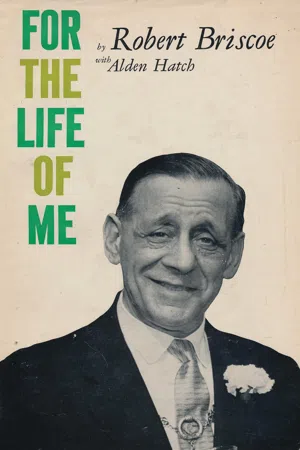
The adventurous autobiography of Robert Briscoe, the Irish Rebel who became the first Jewish Lord Mayor of Dublin. First published in 1958, in this remarkable book the Lord Mayor of Dublin recounts his experiences as a young man during the Irish uprisings and later on in helping persecuted Jews escape to Israel, where he also took part in training of guerrilla leaders.
"Robert Briscoe's FOR THE LIFE OF ME is a wonderful, warm, often humorous, always compassionate autobiography, a tale of many adventures, a history of 20th century Irish politics, and account of Zionism and the founding of Israel, and above all the fascinating story of a complex yet wholly human lovable man and his family."—Boston Herald
"There are so many unusual factors in this book—elements of courage, devotion, religion—that the colorful former Jewish Lord Mayor of Dublin emerges even more picturesque out of the pages of his own book after his story is completed. What makes the Briscoe story all the more valuable is the sense of humor displayed in the frank narrative of this remarkable man."—Detroit Jewish News
"Mayor Briscoe's book can be read as an exciting, human story of adventure or as a portrait of a man who always went all-out for his loyalties, or a study in violence and what comes of it. Whatever the reader's bent, he won't find a boring line."—New York Herald Tribune
"FOR THE LIFE OF ME is a book in which a most unusual man tells about his most unusual activities. Rich in thrilling adventure, it is also bright with humor, and warm with the story of a truly happy family life."—Chicago Tribune
- 310 pages
- English
- ePUB (mobile friendly)
- Available on iOS & Android
eBook - ePub
For the Life of Me
About this book
Trusted by 375,005 students
Access to over 1.5 million titles for a fair monthly price.
Study more efficiently using our study tools.
Information
Subtopic
British HistoryIndex
HistoryCHAPTER I—Against the Odds
DICK WHITTINGTON, the poor country street urchin who rose to prominence and fortune, was the most famous Lord Mayor ever. I do not expect to rival him; though I have achieved a certain notoriety by the accidental fact that I became the first Jewish Lord Mayor of Dublin. But this I can say for certain. Dick’s chances of achieving the great position he held were in the beginning no dimmer than mine; and I believe the road he traveled was less perilous.
For however difficult the conditions of Dick’s rise, at no time were the British Army, and the Royal Navy chasing him. Nor did his own countrymen turn against him as mine did when the Free State Government ordered that I be taken, not as is customary “dead or alive”; they only wanted me dead.
Of all the narrow escapes I had, the closest was the day the Staters had me in their hands and let me slip through their fingers. It was near the beginning of our civil war, which, in the way of such things was even more lacking in civility than our fight for freedom against England. The war against the British had ended with the shameful treaty, signed under coercion in London, by which Ireland’s plenipotentiaries gave up the things we Republicans held most dear, our individuality as a nation and six of the nine countries of the North known as Ulster. We decided to fight for them even against our own countrymen.
That the Free State Government singled me out as such a dangerous character was a tribute I valued, for it showed they knew I had served Ireland well; but it was an uncomfortable sort of honor. The fact that they knew me so well, we having fought together these four years, made it impossible for me effectively to disguise my tall, lean body and long, broken-nosed face. For this reason, our Army Council decided that I was no further use to this underground fight for freedom. But since I knew America well, having been in business there before the Troubled Times, they decided that I could best serve Ireland there.
So I went on the run with orders to report to Republican headquarters in Cork, and then try to slip aboard a ship. I reached Cobh safely; but there I found that a Free State regiment held the road to Cork. In the Irish Republican Army you obeyed orders no matter what stood in the way. I decided to attempt to reach Cork by rowing the six or seven miles up the River Lee.
I stole a rowing boat and began pulling up the estuary with the long, slow fisherman’s stroke I had learned as a boy. The luck went against me. It was unbelievably bad. First thing, coming around a bend, I saw lying at anchor a little old rusty tramp steamer called the City of Dortmund. I recognized her—and should I not! I had owned her myself and used her to run arms through the British blockade. As I came closer I saw a familiar-looking man standing on her stern whom I soon knew to be John Dowling, who had been with me in the gun-running but was now turned Stater. He recognized me, and waved and shouted amiably. Then he did a double take as he remembered that I was now his enemy. I saw him scuttle into the pilothouse and knew that my presence in the Cork area would soon be reported to Free State General Emmet Dalton, commanding there.
Around the next curve of the Lee at a place called Passage were two unpleasant surprises. A platoon of Staters were on the left bank. I slowed up my stroke and tried to act nonchalant, but they decided they wanted to talk to me. Their way of inviting me over for a chat was to start firing just over my head.
Now came the second surprise. A squad of the Irish Republican Army showed up on the right bank. I found out later that they were commanded by my good friend Martin Corry, but it did not help me then. They, too, invited me ashore by shooting in front of me. Then both sides began shooting at each other, with me underneath a bee swarm of singing bullets. I shipped my oars and lay flat in the boat with my nose pressed on her dirty bottom. While those fellows were busy with each other my boat drifted back around the bend.
Sensibly, I decided that the water route to Cork was impracticable, and rowed back to Cobh. There I hid out in Carroll’s Hotel, an obscure little place. I managed to contact a girl working in a chemist’s shop who belonged to Cumann na mBan—the women’s auxiliary of the I.R.A.—and sent a message by her to the MacSwineys in Cork.
During the night the Free State troops took Cobh. In the morning I got word that General Dalton had ordered a search for me, and I knew I had better move fast.
I was just coming out of my room when two troopers closed in on me. They poked pistols in my belly, and I thought it was all up with Bob Briscoe. Once General Dalton saw me, there would be no such amenities as a court-martial or even waiting for sunrise. He would follow his orders to shoot me on sight.
Of course, I tried one last desperate bluff. “What do you want of me, a peaceable wool merchant of Dublin?” I asked.
“We’re after Briscoe,” one of them said. “You fit his description.”
“That doesn’t make me him,” I argued. “I’m just quietly doing me business.”
“Come along and tell it to the general!”
Now I knew I was dead.
While they marched me down the stairs one of them looked at me very curiously. As we got to the main landing, he asked, “Are you a Jewman?”
“Yes,” I said quickly. In a great flash of hope I realized that those former friends of mine were so used to me that they had forgotten to put “Jewish” in my description.
The trooper said to his pal. “Hold on! He’s only a Jewman. We’d be wasting our bloody time with him.”
He swung back his foot, and gave me a great kick in the pants that sent me flying down the stairs and out the door.
I kept on flying into the chemist’s shop where the Cumann na mBan girl sheltered me at the risk of her life. And then secretly onto a ship, and to freedom.
It seems that I have never stopped flying since then. All I have become stems from the impetus of a well-applied boot.
On September 25, 1894, I was born; not that it mattered to anyone but my parents. The place was a small, little one-story house on Lower Beechwood Avenue, Ranelagh, a suburb of Dublin. This house still stands in a solid row of others like it; but it has no particular meaning for me, because my father moved out of it when I was only a few months old.
We then went to live in an apartment above the shop and warehouse of my father’s place of business, Lawlor Briscoe on Lower Ormond Quay down by the Liffey River in the heart of Dublin. That is a place I like to remember.
It is true that before we moved again, we were a little crowded in it. There were my older sister and brother, Rachel and Arthur; then myself, Robert; followed like stair steps by my brothers Herbert David, and Wolfe Tone, the latter named after the Irish hero of the rising of 1798. Then came another sister, Judith. Finally Henrietta, the youngest of the seven Briscoes, was born after we moved away. That made seven children; and with my parents and our two maids there were eleven people living in six rooms.
There were two large rooms to each floor. On the first, right over the premises, was the boys’ dormitory-bedroom, with a place partitioned off for Rachel; and my parents’ bedroom where the current baby also slept. Above that was a dining room-kitchen and a proper drawing room. On the top floor was the maids’ room, and also a back room with a bathtub and toilet; and a place screened off where members of the family could sleep if they felt in need of a change. It sounds miserably congested, but the fact is it was a wonderful place to grow up.
You see, Lawlor Briscoe was a workshop where furniture was made by hand, and also an import-export business and a storage company. In the carpenter shop men were working all day with the fine, sweet-smelling wood. There I learned early how to use a plane and chisel, saw and handsaw, to upholster and to French polish; also how to turn a fine leg—of a table, of course. But it was the long, musty spicy storage warehouse that was our playground. It had a tented skylight running the whole length of its peaked roof and in it were stored the most exciting things a boy ever had to play with. We would gather our friends for a treasure hunt and roam through the place; opening up the old trunks to see what was in them. The greatest find we ever made was a whole set of ancient cap-and-ball revolvers just the thing for playing Indians and the U.S. Cavalry, who had in fact used just such weapons.
British officers used to store their trophies at Lawlor Briscoe. Old hunting rifles, tiger skins and big game heads. One lot consisted of African spears and long oval shields. Picture us, then a bunch of howling Zulus, brandishing spears; fending them off with our great shields taller than we were; fighting from behind wardrobes and bureaus, beautiful Chippendale buffets or Queen Anne chairs, until we debouched into the carpet room, where we rolled the fine orientals up into breastworks.
It is a marvel none of us was killed either in the battle; or by Pappa later. That, by the way, was what we called my father. Indeed, all Dublin called him Pappa.
In the warehouse, too, I learned how to ride a bicycle someone had incautiously left there, tooling over the dark dusty floor, missing crates and furniture by inches until I became a real expert.
One final joyous recollection was the time a large consignment of candy came to Lawlor Briscoe. For the next several days all the little Briscoes were busy as squirrels in Autumn, prying open the cases and carrying boxes of chocolates, toffees, bulls-eyes, aniseed balls, and other sweets upstairs and storing them in secret places, because we could not eat all our eyes could see.
Now you must not get the idea that we spent all our time inside. On fine days we walked along the quays with the dank exciting smell of the river in our noses, watching the Guinness boats which looked huge in the little Liffey, and imagining ourselves seamen sailing to far-off, spice-smelling ports. We took out our spirit of adventure by sailing paper boats among the ducks and swans in the little lake in St. Stephen’s Green.
One time we had a spell of very cold weather, a regular American winter. The lakes in the parks froze solid. Of course we had no skates, nor was Pappa thinking of buying us any. Instead he told us how to make them. Following his advice we went to the butcher’s and each bought two shinbones of an ox. These we tied to our boots with the razor-sharp edge downwards, and were able to skate as merrily as the rich young chaps with fancy British racers.
In summer we had holidays in the country. My mother’s sister, Martha, had married a nephew of my father’s named David Cherrick. They lived in Arklow in County Wicklow, which is a beautiful place with green hills curving out into the sea. Though his house was small, Uncle David always had room for some nephews and nieces. We used to go down in relays for our holidays by the sea.
It was there I got my first, almost my only, hint of racial prejudice. Uncle David was buying a bag of feathers from a countryman. He weighed it and looked surprised. Then he plunged his hand to the bottom and brought up a handful of gray sand. “I’m buying feathers, not sand,” he said angrily.
The huge farmer glared down at him and roared, “You damn Jewman!”
And it was in Arklow that I saw the divil. One night my uncle had occasion to call on a farmer back in the country. He asked me to walk along with him. When we got to the farmer’s house he told me I must wait outside. It was a beautiful soft night with a milky sky and a three-quarter moon shining over a high hedge on the far side of the road. I walked peacefully up and down beside the hedge until suddenly I froze stiff with horror. On the roadway in front of me, black as tar against the white shine of it, was the shadow of the divil. There were his horns and sometimes the long tail of him silhouetted on the ground at my very feet. How long I stood there petrified I cannot tell, but it was years, maybe aeons, while that awesome shadow moved back and forth, coming at me, then retreating. I knew the divil was playing cat-and-mouse with me and would take me the moment he felt like it.
At last the door of the farmhouse opened, letting out warm yellow light, and my uncle walked down the path. At the same moment the divil disappeared.
I ran to Uncle David and clutched his leg. Daring to look back, I saw that my divil was a cow looking over the hedge, and the moon had thrown the shadow of her horns and switching tail to give me the fright of my life.
By now it must be plain that the Briscoes were a close-knit family who had a tremendous amount of fun for very little money. But there were serious things, too. The most important of these were our religion and our love for Ireland. To understand the deep meaning they had for me, and why they never clashed at all, you should first learn something about my father and mother. For it was they who taught me the eternal values which I have held to all my life.
CHAPTER II—Dublin Quays
MY FATHER, Abraham William Briscoe, was born in the village of Zagar, province of Kovno in Lithuania. In a way he was fortunately placed for a subject of the Czar, because Zagar was too small to have a ghetto. Besides, Jews were generally better off in Lithuania than in most other parts of Russia. There were never any pogroms there, and living by the Baltic Sea, they traveled a good deal in the course of business to Russian ports and even to other countries. They were considered the intellectuals of Russian Jewry.
But make no mistake about it, a Russian Jew was always a second-or third-class citizen. There were many professions which—he was forbidden to follow. He could not own land, but must rent it at exorbitant prices from the great landlords; and he was not allowed to live in either Moscow or St. Petersburg. One of the few exceptions to this last rule ...
Table of contents
- Title page
- TABLE OF CONTENTS
- CHAPTER I-Against the Odds
- CHAPTER II-Dublin Quays
- CHAPTER III-A Little Learning
- CHAPTER IV-Prisoner of War
- CHAPTER V-I Make a Very Small Fortune
- CHAPTER VI-Bombs and Bloomers
- CHAPTER VII-Companion in Adventure
- CHAPTER VIII-Dispatches and Diapers
- CHAPTER IX-Saving the Soul of Charley McGuiness
- CHAPTER X-The Guns Get Through
- CHAPTER XI-The Truce and the Treaty
- CHAPTER XII-The Fissure Widens
- CHAPTER XIII-The Choice
- CHAPTER XIV-The Four Courts
- CHAPTER XV-Black Summer
- CHAPTER XVI-The Twilight Deepens
- CHAPTER XVII-We Strike a Blow for Freedom in New York
- CHAPTER XVIII-Return
- CHAPTER XIX-Army of Destiny
- CHAPTER XX-Respectability
- CHAPTER XXI-The Pains of Power
- CHAPTER XXII-Zion
- CHAPTER XXIII-The “Coffin Ships”
- CHAPTER XXIV-I Remain an Irishman
- CHAPTER XXV-...And a Jew
- CHAPTER XXVI-With de Valera in Israel
- CHAPTER XXVII-The Hat and the Chain
- CHAPTER XXVIII-Aaron Go Bragh
- CHAPTER XXIX-“That I Will”
- REQUEST FROM THE PUBLISHER
Frequently asked questions
Yes, you can cancel anytime from the Subscription tab in your account settings on the Perlego website. Your subscription will stay active until the end of your current billing period. Learn how to cancel your subscription
No, books cannot be downloaded as external files, such as PDFs, for use outside of Perlego. However, you can download books within the Perlego app for offline reading on mobile or tablet. Learn how to download books offline
Perlego offers two plans: Essential and Complete
- Essential is ideal for learners and professionals who enjoy exploring a wide range of subjects. Access the Essential Library with 800,000+ trusted titles and best-sellers across business, personal growth, and the humanities. Includes unlimited reading time and Standard Read Aloud voice.
- Complete: Perfect for advanced learners and researchers needing full, unrestricted access. Unlock 1.5M+ books across hundreds of subjects, including academic and specialized titles. The Complete Plan also includes advanced features like Premium Read Aloud and Research Assistant.
We are an online textbook subscription service, where you can get access to an entire online library for less than the price of a single book per month. With over 1.5 million books across 990+ topics, we’ve got you covered! Learn about our mission
Look out for the read-aloud symbol on your next book to see if you can listen to it. The read-aloud tool reads text aloud for you, highlighting the text as it is being read. You can pause it, speed it up and slow it down. Learn more about Read Aloud
Yes! You can use the Perlego app on both iOS and Android devices to read anytime, anywhere — even offline. Perfect for commutes or when you’re on the go.
Please note we cannot support devices running on iOS 13 and Android 7 or earlier. Learn more about using the app
Please note we cannot support devices running on iOS 13 and Android 7 or earlier. Learn more about using the app
Yes, you can access For the Life of Me by Robert Briscoe,Alden Hatch in PDF and/or ePUB format, as well as other popular books in History & British History. We have over 1.5 million books available in our catalogue for you to explore.