Was it true that Washington was...
...cold, cautious, and obsequious—unapproachable even to his friends?
...a man of vital passion and towering dignity—admired and loved by his soldiers?
...a bumbling general forced into victory by the incompetence of his enemies?
...a brilliant military leader, adept at the new ways of guerrilla warfare?
...egocentric, with the dangerous pretensions of a Caesar?
...a humble, modest man, sacrificing his own pleasure in his devotion to public duty?
What was the myth?...What was the man?
Step by step, author Marcus Cunliffe traces the ancestral background, the childhood, the growth, the failures and achievements of George Washington. He shows us a real person—fallible, ambitious, impatient of criticism, but of iron integrity—maturing from an eager youth to a wiser man.
Cunliffe portrays the destiny of America, as it was mirrored for all time in the man who fought ambitions, uncertainties, and loneliness...who lived through Valley Forge and longed for home...who accepted the Presidency and desired peaceful retirement...who had a tender love for children, but childless, became to a young and needy nation the Father of his country...a man, with all his humanity, triumphant over the monument.
"A terse and highly readable biography."—Harrison Smith, Saturday Review
"Fascinating and stimulating."—N.Y. Herald Tribune
"A scholarly, a brilliant, and an illuminating book."—London Times Literary Supplement
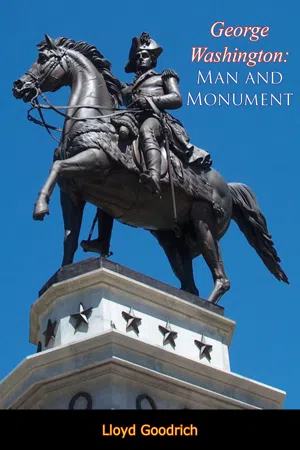
- 168 pages
- English
- ePUB (mobile friendly)
- Available on iOS & Android
eBook - ePub
About this book
Information
Subtopic
British HistoryIndex
History1 — THE WASHINGTON MONUMENT
The shades of Vernon to remotest time, will be trod with awe; the banks of Potomac will be hallowed ground.—“CHARLES PINCKNEY SUMNER, Eulogy on the Illustrious George Washington February, 1800”
THE Washington Monument in Washington, D.C., is, we are told, 555 feet high—higher than the spires of Cologne Cathedral, higher than St. Peter’s in Rome, much higher than the Pyramids. When George Washington died, in December 1799, the new federal capital had already been named in his honor. As a further gesture, the House of Representatives resolved that a marble monument should be built, “so designed as to commemorate the great events of his military and political life.” Washington’s body was to be entombed beneath the shrine. But for various reasons, some unedifying, it was never erected. The soaring obelisk that we call the Washington Monument was a later project, not completed until a hundred years after George Washington had achieved victory and independence for his nation. Many thousand tons of concrete are buried under its base. Yet the bones of the man it celebrates are not there either; they repose a few miles away, in the vault of his Mount Vernon home.
Innumerable tourists visit Mount Vernon. It is a handsome place, as they can testify, refurbished with taste and maintained in immaculate order. But the ghosts have been all too successfully exorcised in the process; Mount Vernon is less a house than a kind of museum-temple. We know that George Washington lived and died there; we do not feel the fact, any more than we can recapture the presence of William Shakespeare at Stratford-on-Avon. Both men are baffling figures to us, prodigious and indistinct. One American writer has said of them that “England’s greatest contribution to the world is the works of Shakespeare; America’s is the character, of Washington.” On this sort of scale are they measured; and it is not a human scale.
There is a difference, of course. Whereas we can find out almost nothing about Shakespeare, we have a vast amount of information about Washington. Only one blank portrait of Shakespeare exists; the portraits of Washington—some of them apparently excellent likenesses—require three volumes to list in full. There are no autobiographical fragments from Shakespeare’s hand; Washington’s letters and diaries fill over forty volumes, in printed form. Hardly any of his contemporaries mentioned Shakespeare; scores of friends, acquaintances and casual callers set down for us their impressions of George Washington. A strange obscurity envelops the figure of Shakespeare; Washington stood in the glaring limelight of world fame. But the result—optically, so to speak—is similar: the darkness and the dazzle both have an effect of concealment.
Trying in vain to discern the actual man behind the huge, impersonal, ever-growing legend, biographers have reacted in various ways. In the case of Shakespeare, some have denied his authorship of the plays and have attempted to substitute a more plausible bard: a Bacon or even a Marlowe. The reaction in the case of Washington has naturally been somewhat otherwise. No one, in face of such a quantity of evidence, can pretend he never existed, or that some other man deserves the credit. But he has become entombed in his own myth—a metaphorical Washington Monument that hides from us the lineaments of the real man. Year by year this monument has grown, like a cairn to which each passer-by adds a stone. Pamphlet, speech, article and book; pebble, rubble, stone and boulder have piled up. Anecdote, monograph, panegyric: whatever the level and value of each contribution it has somehow—ironically, in the instance of more important contributions—smothered what it seeks to disclose.
Indeed, Washington has become not merely a mythical figure, but a myth of suffocating dullness, the victim of civic elephantiasis. Confronted by the shelves and shelves of “Washingtoniana”—all those sonorous, repetitious, reverential items, the set pieces in adulation that are impossible to read without yawning—we seek some sour antidote to so much saccharine, and tend to agree with Emerson: “Every hero becomes a bore at last....They cry up the virtues of George Washington—’Damn George Washington!’ is the poor Jacobin’s whole speech and confutation.” When we have allowed ourselves the relief of this irreverence, though, the monument still looms before us, and must be reckoned with before we can get to grips with Washington the man. We may suspect, however, that myth and man can never be entirely separated, and that valuable clues to Washington’s temperament, as well as his public stature, lie in this fact.
The first thing to note, in exploring the monument, is that the myth-making process was at work during Washington’s own lifetime. “Vae, puto deus fio,” the dying Roman emperor Vespasian is supposed to have murmured: “Alas, I think I am about to become a god.” Such a mixture of levity and magnificence would have been foreign to George Washington. Yet he might with justice have thought the same thing as he lay on his deathbed at Mount Vernon in 1799. Babies were being christened after him as early as 1775, and while he was still President, his countrymen paid to see him in waxwork effigy. To his admirers he was “godlike Washington,” and his detractors complained to one another that he was looked upon as a “demi-god” whom it was treasonable to criticize. “O Washington!” declared Ezra Stiles of Yale (in a sermon of 1783). “How I do love thy name! How have I often adored and blessed thy God, for creating and forming thee the great ornament of human kind!...our very enemies stop the madness of their fire in full volley, stop the illiberality of their slander at thy name, as if rebuked from Heaven with a—’Touch not mine Anointed, and do my Hero no harm!’ Thy fame is of sweeter perfume than Arabian spices. Listening angels shall catch the odor, waft it to heaven, and perfume the universe!”
Here indeed is a legend in the making. His contemporaries vied in their tributes—all intended to express the idea that there was something superhuman about George Washington. We need not labor the point that, after death, “godlike Washington” passed still further into legend, his surname appropriated for one American state, seven mountains, eight streams, ten lakes, thirty-three counties; for nine American colleges; for one hundred and twenty-one American towns and villages. His birthday has long been a national holiday. His visage is on coins and banknotes and postage stamps; his portrait (usually the snaffle-mouthed, immensely grave “Athenaeum” version by Gilbert Stuart) is hung in countless corridors and offices. His head—sixty feet from chin to scalp—has been carved out of a mountainside in South Dakota. There are statues of him all over the United States—and all over the world: you can see them in London and in Paris, in Buenos Aires and Rio de Janeiro, in Caracas and Budapest and Tokyo.
All these are outward signs of Washington’s heroic standing in the world. But we should look a little more closely at the monument. If the metaphor may be extended, we can observe that the monument has four sides: four roles that Washington has been made to play for posterity’s sake. The four are not sharply distinct—nothing is, in this misty Valhalla—but it is worth our while to take a glance at each of them before turning to the actual events from which the legends emanated. This is, of course, not to argue that Washington is undeserving of praise; his merits were genuine and manifold. The crucial point is that the real merits were enlarged and distorted into unreal attitudes, and that this overblown Washington is the one who occurs immediately to us when his name is mentioned. He might occur in any or all of the following four guises: a) the Copybook Hero; b) the Father of His People; c) the Disinterested Patriot; d) the Revolutionary Leader. These are all guises of the hero figure. In each, Washington is a member of a pantheon; and for each pantheon there is a kind of antipantheon of heroes who fell from grace.
The Copybook Hero
Washington’s life lay completely within the eighteenth century, though only just. But Washington as he has descended to us is largely a creation of the nineteenth-century English-speaking world, with its bustling, didactic, evangelical emphasis. This is the world of tracts and primers, of Chambers’s Miscellanies and McGuffey’s Readers, of Samuel Smiles and Horatio Alger, of mechanics’ institutes and lyceum lectures, of autograph albums and gift annuals. Bazaars and bridges are opened, foundation stones laid, prizes and certificates distributed, drunkards admonished and rescued, slaves emancipated. It is, in the convenient term of David Riesman, the age of the “inner-directed” personality whose essential attributes are summed up in the titles of Smiles’s various works—Self-Help, Thrift, Duty, Character—or in a short poem of Emerson’s that is also called “Character.”
“The stars set, but set not his hope:
Stars rose; his faith was earlier up:
Fixed on the enormous galaxy
Deeper and older seemed his eye;
And matched his sufferance sublime
The taciturnity of time...”
Character is the key word in the copybook view of George Washington, as we have already seen in the statement linking him with Shakespeare.{1} Lord Brougham is of the same opinion: “The test of the progress of mankind will be their appreciation of the character of Washington.”
The enterprising Parson Weems, a Victorian before the Victorian era, was the first to fit Washington into what was to become the pattern of the century. His aim in writing a pamphlet biography of Washington was, Weems explained to a publisher in 1800, to bring out “his Great Virtues. 1 His Veneration for the Diety [sic], or Religious Principles. 2 His Patriotism. 3d His Magninimity [sic]. 4 his Industry. 5 his Temperance and Sobriety. 6. his Justice, &c &c.” Here is the copybook canon. Weems was not quite as high-minded as this statement might suggest, though there is no reason to doubt that he shared the general American veneration for Washington. As he told the same publisher, his proposal could win them “pence and popularity.” At any rate, he did not hesitate to fabricate incidents, or to style himself “Rector” of the non-existent parish of Mount Vernon. His pamphlet grew into a book, embodying stage by stage the famous false Weemsian anecdotes: Washington chopping down the cherry tree (“I can’t tell a lie, Pa; you know I can’t tell a lie. I did cut it with my hatchet.”—Run to my arms, you dearest boy, cried his father in transports); Washington upbraiding his schoolmates for fighting—an episode that gradually disappeared from the record, since later generations found it priggish (“You shall never, boys, have my consent to a practice so shocking! shocking even in slaves and dogs; then how utterly scandalous in little boys at school, who ought to look on one another as brothers”); young Washington throwing a stone across the Rappahannock (It would be no easy matter to find a man, now-a-days, who could do it); Washington’s providential escape at Braddock’s defeat (A famous Indian warrior, who acted a leading part in that bloody tragedy, was often heard to swear, that “Washington was not born to be killed by a bullet! For...I had seventeen fair fires at him with my rifle, and after all could not bring him to the ground!”); Washington discovered—by a Quaker “of the respectable family and name of Potts, if I mistake not”—praying at Valley Forge (As he approached the spot...whom should he behold...but the commander in chief of the American armies on his knees at prayer!); and so on.
All through the book, as unremittingly as Horatio Alger was to thump home the message, Weems showed how “duty and advantage” went together. Thus, kindness to his elder brother brought George the Mount Vernon estate when his brother died childless save for one ailing infant; and exemplary conduct subsequently won him the hand of the widow Custis, whose “wealth was equal, at least, to one hundred thousand dollars!” The homily was irresistible; by 1825 Weems’s biography had gone through forty editions, and forty more were to appear in due course. The cherry-tree story—eventually incorporated in McGuffey’s highly popular Readers—became a special favorite in copybook lore. Invention was even added to invention in Morrison Heady’s little life of Washington, The Farmer Boy, and How He Became Commander-in-Chief (1863). Heady describes how a Negro boy was blamed for cutting down the tree, and how young George saved him from a flogging by confessing to the crime. Indeed, in the secular hagiology of the period—the equivalent of Saint Lawrence with his gridiron, or Saint Catherine with her wheel—Washington and the tree joined the company of Newton and William Tell with their respective apples, Watt with his kettle, Bruce with his spider, Columbus with his egg, King Alfred with his cakes, Philip Sidney with his water bottle.
But Washington’s whole career was pressed into service, not merely one episode. The expense accounts that he kept during the Revolutionary War were printed in facsimile, as proof of his patriotic frugality and business efficiency. His religious opinions were recast, by Weems and others, into the nineteenth-century mold. One tale has it that he left the Anglican Church for Presbyterianism. According to another fable, he secretly joined the Baptists. It is unnecessary to emphasize that all such notions, whether they originated in the fertile mind of Weems or elsewhere, were untrue in detail and unhistorical in a larger way. Weems and his successors were not concerned with what they would have thought of as scholastic pedantry. Their object, quite deliberately, was to point a moral and adorn a tale. They agreed with the words of Henry Lee, in praise of Weems (and quoted on Weems’s title page): “No biographer deserves more applause than he whose chief purpose is to entice the young mind to the affectionate love of virtue, by personifying it in the character most dear to these states.” Or, as Horatio Hastings Weld said in his Pictorial Life of George Washington (1845): “The first word of infancy should be mother, the second father, the third WASHINGTON.” We may feel that Weems and the rest of the copybook moralizers must share some of the blame for blurring our image of Washington. In their defense, however, we should add that they did not mean to turn Washington into a plaster saint. They were well aware of this tendency. “In most of the elegant orations pronounced to his praise,” wrote Weems, “you see nothing of Washington below the clouds...‘tis only Washington the HERO, and the Demigod...Washington the sun beam in council, or the storm in war.” Weems wanted to humanize him, as well as present him as a copybook character. Certainly there is not much of the marmoreal in Weems’s racy narrative; with its aid, he managed to impose his apocryphal Washington on a whole nation for a whole century. Weems would no doubt claim that he could not have done s...
Table of contents
- Title page
- TABLE OF CONTENTS
- DEDICATION
- CHRONOLOGY - GEORGE WASHINGTON 1732-1799
- 1 - THE WASHINGTON MONUMENT
- 2 - GEORGE WASHINGTON, ESQUIRE
- 3 - GENERAL WASHINGTON
- 4 - PRESIDENT WASHINGTON
- 5 - THE WHOLE MAN
- ACKNOWLEDGMENTS
- FURTHER READING
- REQUEST FROM THE PUBLISHER
Trusted by 375,005 students
Access to over 1.5 million titles for a fair monthly price.
Study more efficiently using our study tools.
Frequently asked questions
Yes, you can cancel anytime from the Subscription tab in your account settings on the Perlego website. Your subscription will stay active until the end of your current billing period. Learn how to cancel your subscription
No, books cannot be downloaded as external files, such as PDFs, for use outside of Perlego. However, you can download books within the Perlego app for offline reading on mobile or tablet. Learn how to download books offline
We are an online textbook subscription service, where you can get access to an entire online library for less than the price of a single book per month. With over 1.5 million books across 990+ topics, we’ve got you covered! Learn about our mission
Look out for the read-aloud symbol on your next book to see if you can listen to it. The read-aloud tool reads text aloud for you, highlighting the text as it is being read. You can pause it, speed it up and slow it down. Learn more about Read Aloud
Yes! You can use the Perlego app on both iOS and Android devices to read anytime, anywhere — even offline. Perfect for commutes or when you’re on the go.
Please note we cannot support devices running on iOS 13 and Android 7 or earlier. Learn more about using the app
Please note we cannot support devices running on iOS 13 and Android 7 or earlier. Learn more about using the app
Yes, you can access George Washington by Marcus Cunliffe in PDF and/or ePUB format, as well as other popular books in History & British History. We have over 1.5 million books available in our catalogue for you to explore.