- 213 pages
- English
- ePUB (mobile friendly)
- Available on iOS & Android
eBook - ePub
Conquest to Nowhere
About this book
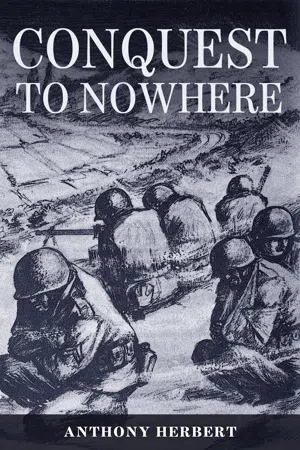
Conquest to Nowhere, first published in 1955, is author Anthony Herbert's account of his harrowing time in Korea in 1950-51. Herbert, wounded numerous times, became America's most decorated soldier of the Korean conflict. He tells a gritty, heart-wrenching story of dangerous patrols, battles against overwhelming Chinese assaults, the anguish of losing comrades-in arms, and his personal struggles to simply survive. Herbert continued his military service in Vietnam where he attained the rank of lieutenant-colonel. Included are several illustrations from the original book.
Information
Subtopic
Central Asian HistoryIndex
HistoryChapter One — “A Speck of Dust In the Eye of Time”
The captain made an effort to lift his head from his chest so he could speak. In his condition, it required super-human strength, but his energy lay on the frozen ground in a pool of blood. He was tied by the wrists and suspended between two houses in a Korean village. Propping my rifle against one of the buildings from which he hung, I moved forward. I strained, reaching up, but unsuccessfully. He was out of my reach. His breath came in a rasping, gurgling sound as he muttered weakly, “Water.”
I was certain it was useless to cut him down. Death was inevitable for him. The captain flinched as another flash of pain ran through his body. The motion caused him to swing ever so slightly, like the delicate branches of a willow tree.
Around him were other men who had fallen prisoner of the Chinese. Their voices calling to us, asking to be shot, asking to be cut down from their crucifixion, blended with the cold winter night’s wind, to form a holocaust of horror. Weird sounds of the night mingled with their pleas. In the rich moonlight, the bodies cast grotesque shadows as they hung suspended by their hands in doorways, between buildings or from the eaves of the Korean houses. To my right hung a corporal, his head pounded in until it resembled nothing human. Suspended behind him was a man with a slash in his abdomen that permitted his entrails to free themselves of their bondage. They were spilled onto the ground, still pulsating, though he scarcely breathed.
Moving quickly from one body to another, not believing our eyes, it became obvious that all of them had been attacked in the same way. Each of the twenty-one men hanging by their arms had been disemboweled by his captors. Six were living, and we hastened to cut them down.
“Don’t move me! Don’t! Shoot me, for chrissake, shoot me!” one of them cried out.
“I can’t shoot you, fella. Just take it easy—you’ll be alright,” I replied. A Turkish soldier stepped into my interlocked fingers and I boosted him up so he could begin cutting the rope which had dug into the man’s wrists.
“It’s no use—he began, but didn’t complete the statement. The rope holding his right arm, parted. He swung like a pendulum, striking the wall of the opposite building. He screamed and then passed out, swinging by his left arm. His feet were almost touching the ground. The Turk balanced himself with his hands on my head and I walked to where the other rope was tied. We cut it and he fell onto the ground in a motionless heap.
I argued with myself, “Better give him a morphine syrette. At least it’ll make it easier for him when he comes to.” I inoculated the thought and cultivated it to good yield. “It’s not good to give morphine with a stomach wound.”
Something within me answered, “It’s too late to worry about that. You don’t think he’s going to live, do you? I think you’d better give it to him. He’s got to have something.”
My Turkish friend motioned for me to go with him, and we moved to the six living men, cutting them down, one by one. The captain was last. Again he asked for a drink of water. I opened my canteen and handed it to the Turk who once more climbed onto the improvised ladder, and lifting the captain’s head, held the canteen to his lips. The water ran into his mouth, and seconds later, gushed forth from a slit in his exposed stomach. It ran down his leg, dripping onto the ground. Almost immediately, he died.
In a matter of minutes he was joined by the remainder of his company, and the entire twenty-one men, spiritually, were together again.
The faces of the men bore testimony of the agony of their tortured death. They were masks of horror. The Chinese had not been content with slashing across their prisoners’ stomachs with bayonets. Footprints in the snow showed that after the entrails of some of them had fallen out of their bodies, they had been ground into the ice by heels of rubber sneakers or American combat boots, possibly taken from these men themselves. None wore shoes. Their pants were missing, too.
Suddenly a noise startled us. A rustling sound from within the room of the house to our left. Maybe nothing—maybe something. Cautiously, we moved to the doorway. A cat scurried from the building, ran through my legs and disappeared into the night. My heart pounded, dangerously near the breaking point. I wanted to leave the town and try to get back to the 23rd wherever it was.
I began to worry; about being AWOL from my outfit, about being caught by the Chinese and strung up the same way, and about how we could ever get back to our troops. The Turks were checking the rest of the town. I could not speak Turkish, and they could not speak English. I worried.
I began staring at the face of the body nearest me. The face of a youth not more than nineteen. It looked familiar. I walked to him, and raising my rifle, caught his forehead with the barrel and pushed skyward. The eyes that saw nothing, stared at me. I was mistaken. I did not know him. Because of that, I felt a relief, then a sense of pity. I felt pity for a meaningless structure of flesh and bone. A dead substance that had been important to someone—at one time or another.
I wondered? Did he die with a question in his mind? A question of why? Not why the war was existing, but rather why, if he had to die, did it have to be this way? If I were to get it this very night, I felt, I would die with some questions answered—and others not.
I hadn’t expected this kind of war. It wasn’t like the movies depicted it; not at all. I felt violent—about many things. Then the fragments of the unexplainable thoughts churning through my brain reassembled into no particular order. I remembered myself when I was full of questions and ideas...some still to be answered. Why would a man ask to get into such a mess? I wished that my legs were long enough to reach out and kick myself right square in the ass.
The first time I tried to get into the Army was during World War II when I was fourteen. I recall my brother, Bud, with his chest full of ribbons earned while battling the Japanese in the Pacific. Bud was in the Navy, a torpedoman. It seemed like a rather tame job, but the way he’d describe how they’d track a sub and blast it out of the water with depth charges or torpedoes, seemed to put more color in the naval war. So until I was about fourteen, I wanted to be in the Navy.
On Saturdays, a bunch of us would go to the local theater and spend the whole day there, seeing the same movie. Then I changed my mind about the Navy, and decided that if I were going to be a soldier, I had to be in the infantry.
Movies where the soldiers were caught in a barrage of artillery, or in hand to hand combat, bayonets flashing, was real war! My older brother, Chuck, was a company commander in the infantry. I can appreciate much more since I’ve seen war, just how big a job he had. I would listen to his stories of war and arrive at one conclusion: We were destined to have another war in my lifetime, and I was to be in it!
Finally when the agonizing desire became too much for me, I went to nearby Pittsburgh and joined the Marine Corps. Tony Spiegel was with me, and everything came along fine. The sergeant in the recruiting station needed recruits at the time, I guess. Anyway, we were in.
We were with a group of men in the railroad station, waiting for the train to take us to Parris Island, S. C., when who should walk up to us but the high school principal. He looked at us two short-lived Marines and said, “Your mothers are looking for you two.”
Tony and I glanced at each other.
“Mr. Gessman, how did you know we were here?”
“That doesn’t matter,” he answered, “come on home.”
“But our train leaves in just a few minutes!”
“Are you going to come or am I to have him arrest you!”
We then noticed a policeman standing by the platform master’s window. There was no further argument; we went with him.
A “trial,” with members of the draft board sitting as a tribunal, winking at each other, dealt out a verdict; no punishment, except to be returned to school and Mr. Gessman’s supervision.
Finally, the whole story of how I had told the draft board that I was eighteen, was revealed. The clerk had figured that if I was crazy enough to say I was old enough to be drafted, she was just crazy enough to register me. I had told my mother I was just going south for the summer to train dogs for the Army’s canine corps. Dad never interfered in things like that. He let me decide for myself. Sometimes he was right, sometimes not. It wasn’t very long before I approached my folks again on the subject of going into the service. I had the draft card, and asked them to approve my enlistment.
“Don’t you think you should stay home and finish high school first, son?” Dad asked. A coal miner for most of his life, he had spent the early part of it in the mines of Lithuania. He could never understand why anyone would want to abandon an education that in the Old Country would have been impossible to obtain.
My only argument was, “I can take the Army’s tests and get my diploma at the same time. I can get two birds with one stone.”
“Sounds good, but you know as well as anybody, you’ll never do it,” Mom chimed in. In my own mind, I knew it, too.
We discussed that for the better part of an evening, until just to get me to shut up, they agreed.
Chapter Two
Periodically during basic, we were called into the orderly room and told that certain schools were open for assignment. None of them were infantry. I held out for that. I was advised that only an idiot would insist on the infantry. That was quite a compliment, considering I was alone in griping for it.
One day Bob Hisey kept me from telling the captain, the lieutenant, and the whole orderly room what I thought of them. Taking me by the arm, he pulled me outside.
“Don’t let them get you down, Herb. What the devil, we’ll be finished here before long, and you can go to any damn outfit you want. But frankly, I think you’re nuts myself.”
Hisey was a good kid who got along with everybody and would help you every chance he got. Then there was his friend, “Tex” Harrington, a guy with a devilish sense of humor.
“Tex” was a big gangling guy from New York. We called him “Tex” because he had worked in Texas for about two months, but to hear him explain their relationship, one would be led to believe he had sponsored it for statehood.
Bob went to the movies one evening, and as soon as he was gone, Tex told us he was going to play a joke on him.
“What kind of a joke?” we asked.
“I dunno. How about nailing his boots to the floor?”
“Nah,” we argued, “he might get into trouble if he turned them in to supply full of holes.”
“So what if he does? Anyway, the supply room will get them before basic’s over the way we’ve been walkin’.”
He assumed the characteristic look he usually acquired when conjuring up these seemingly harmless little gags. Convinced of its harassing possibilities, he hopped off his bunk in one lithe motion.
“Dammit, I’m gonna do it! He didn’t think of me getting restricted last weekend because he put shaving cream in my boots just before inspection. He’s had it! Be back soon’s I get some nails.”
We decided to switch ...
Table of contents
- Title page
- TABLE OF CONTENTS
- Chapter One - “A Speck of Dust In the Eye of Time”
- Chapter Two
- Chapter Three
- Chapter Four
- Chapter Five - November, 1950
- Chapter Six - December, 1950
- Chapter Seven - December, 1950-January, 1951
- Chapter Eight - January, 1951
- Chapter Nine - February, 1951, Hill 570
- Chapter Ten - February, 1951, Hill 570
- Chapter Eleven - March, April, 1951
- Chapter Twelve - April, 1951, “Operation Yo-yo”
- Chapter Thirteen - A “Chicken” Named Pickens
- Chapter Fourteen - “Old Soldiers Never Die...”
- Chapter Fifteen - The Kid Whips A Problem
- Chapter Sixteen
- Chapter Seventeen - Prelude To Hell
- Chapter Eighteen - “Massacre Valley,” May, 1951
- Chapter Nineteen
- Chapter Twenty - “Bugs”
- Chapter Twenty-one - July, 1951, “The World’s A Stage...”
- Chapter Twenty-two - Carlson’s Prophecy
- Chapter Twenty-three - September, 1951
Trusted by 375,005 students
Access to over 1.5 million titles for a fair monthly price.
Study more efficiently using our study tools.
Frequently asked questions
Yes, you can cancel anytime from the Subscription tab in your account settings on the Perlego website. Your subscription will stay active until the end of your current billing period. Learn how to cancel your subscription
No, books cannot be downloaded as external files, such as PDFs, for use outside of Perlego. However, you can download books within the Perlego app for offline reading on mobile or tablet. Learn how to download books offline
Perlego offers two plans: Essential and Complete
- Essential is ideal for learners and professionals who enjoy exploring a wide range of subjects. Access the Essential Library with 800,000+ trusted titles and best-sellers across business, personal growth, and the humanities. Includes unlimited reading time and Standard Read Aloud voice.
- Complete: Perfect for advanced learners and researchers needing full, unrestricted access. Unlock 1.5M+ books across hundreds of subjects, including academic and specialized titles. The Complete Plan also includes advanced features like Premium Read Aloud and Research Assistant.
We are an online textbook subscription service, where you can get access to an entire online library for less than the price of a single book per month. With over 1.5 million books across 990+ topics, we’ve got you covered! Learn about our mission
Look out for the read-aloud symbol on your next book to see if you can listen to it. The read-aloud tool reads text aloud for you, highlighting the text as it is being read. You can pause it, speed it up and slow it down. Learn more about Read Aloud
Yes! You can use the Perlego app on both iOS and Android devices to read anytime, anywhere — even offline. Perfect for commutes or when you’re on the go.
Please note we cannot support devices running on iOS 13 and Android 7 or earlier. Learn more about using the app
Please note we cannot support devices running on iOS 13 and Android 7 or earlier. Learn more about using the app
Yes, you can access Conquest to Nowhere by Anthony Herbert,Robert Niemann in PDF and/or ePUB format, as well as other popular books in History & Central Asian History. We have over 1.5 million books available in our catalogue for you to explore.