- 272 pages
- English
- ePUB (mobile friendly)
- Available on iOS & Android
eBook - ePub
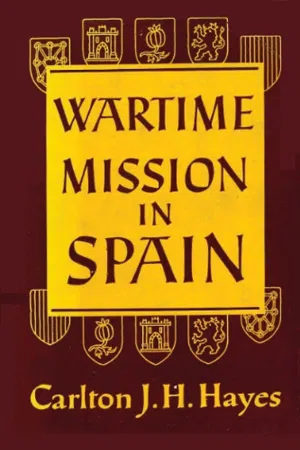
Wartime Mission in Spain, 1942-1945
About this book
This book, first published in 1945, is a fascinating personal account of the late U.S. Ambassador to Spain Carlton J. H. Hayes' diplomatic mission in Spain during World War II, from May 1942 to January 1945. Whilst briefly touching on Spain's internal affairs, the principal focus is firmly on American policy toward Spain during those three wartime years, and Spain's response thereto. Hayes provides the reader with a candid and factual record of this period, gleaned from firsthand eyewitness accounts and sensitive information he was privy to during his tenure. He draws in detail on excerpts from his personal diary kept for those three years, as well as various conversations, documents and correspondence from and with President Roosevelt and others. A fantastic historical record.
Information
Subtopic
European HistoryIndex
HistoryCHAPTER I—HOW I HAPPENED TO GO TO SPAIN—March to May, 1942
I
Since 1910 I had been a professor of modem European history in Columbia University. International law had been one of the subjects I had previously presented for the doctorate; and I continued to take a lively interest in international relations, especially after I, along with several million other Americans, was drawn, as active participant, into the First World War. That experience taught me the practical futility of isolationism for the United States.
I was henceforth a convinced and outspoken advocate of the League of Nations and of any agency or measure which might forward the cause of collective security and lessen the danger of another World War in which many more millions of Americans were sure to be involved. It seemed to me then, and it still does, that we who were decried in the partisan strife of 1920 as “idealists” and “dreamers” were far more realistic than those “realists” who wrecked the League of Nations and pursued narrowly nationalist ends.
Unfortunately for the present generation, there proved to be more “realists” in those days than “idealists.” From the first advent of Fascism and Nazism in the 1920’s and the first aggression of Japanese militarism in Manchuria in the early 1930’s, it should have been obvious that a Second World War, of even greater dimensions than the First, was in the offing. Some of us recognized and warned of the peril. I did my little bit.{1}
The Second World War broke with Hitler’s Blitzkrieg against Poland in September, 1939. Followed in due course, less than two yean later, the naval and air blitz at faraway Pearl Harbor; and in December, 1941, the United States found itself, to its surprise and consternation, at war with the embattled and hitherto victorious Axis Powers of Germany, Italy, and Japan.
II
On March 17, 1942, I received in my study at the University a letter, dated March 16 and marked “personal and confidential,” from the Under Secretary of State, Mr. Sumner Welles, who was Acting Secretary during a temporary absence of Mr. Cordell Hull. It read: “The President has asked me to have an informal talk with you regarding a possibility which he is now considering. Unfortunately, at the present moment, it is impossible for me to leave Washington, and I wonder, therefore, if it would be convenient for you, within the next few days, to come down to Washington to have a brief talk with me regarding the matter. I shall be happy to arrange an appointment any day that proves convenient for you, and I shall appreciate it if you will be kind enough to telegraph me the day before you are planning to come so that a time can be set aside.”
I naturally speculated on what the “possibility” might be which the President was considering, but with meager results. The more I thought about it, the more mystified I became. I knew Mr. Welles, and in 1936 I had received from him an invitation to be one of the American delegates to the Pan-American Conference in Buenos Aires, which I had then declined. Very recently, indeed just a few days before this latest letter from Mr. Welles, one of his associates, Mr. Charles A. Thomson, the Chief of the Division of Cultural Relations, had asked me to make a two to three months’ visit to Brazil. Could the President be considering me for some special mission in South America? That was the nearest I could guess as to what was in store for me.
The letter from Mr. Welles came on a Tuesday. The next day was the only comparatively free day I had for a week. On Thursday I was booked full with university lectures and seminars. On Saturday I was scheduled to give a lecture at Wheaton College in Massachusetts. Accordingly, I telephoned Mr. Welles that I would call on him the next day, Wednesday.
I went to Washington on Wednesday morning, March 18, expecting to return to New York the same night, and unhampered therefore by any luggage save a briefcase containing some student manuscript and a blue pencil. Mr. Welles received me most cordially, and opened discussion by remarking, and repeating with emphasis, that what President Roosevelt wanted me to do would entail heavy sacrifices on my part. Would I be willing in the grave crisis confronting our nation to make unusual sacrifices? I replied that I too recognized the extreme gravity of the current situation and that, of course, no American’s personal interests should now stand in the way of his serving the Government in any position for which he might be fitted. Mr. Welles then got to the point. He said the President wanted to send me as his Ambassador to Spain. It would be a very difficult assignment, but extremely important and critical for our future military fortunes, and one which the President thought I, if anyone, could successfully discharge.
My first reaction was astonishment and something close to panic. Why should I be sent to Spain? True, I had read a good deal of Spanish history and had even written some; and I was a Catholic. But except for a glimpse from Gibraltar over the barbed-wire entanglements of “No-man’s Land” while I was on a Mediterranean cruise in 1938, I had never seen Spain. All that came at the moment to my confused mind was, curiously enough, a recollection of a prank of my youth, when, in the midst of the Spanish-American War of 1898, a school-chum and I had secretly manufactured a big Spanish flag and run it up in the night on the village flagpole to the amazement next morning of the whole community. What this reveals, I must leave to the psychiatrists. Perhaps at an early age I already had a perverse liking for Spain and the Spanish people. Possibly it was a gesture in favor of an “underdog.” More likely, it may only have been an exuberant show of youthful animal spirits.
When the first shock of Mr. Welles’s proposal was over, and as discussion of it developed, I advanced against it several arguments which I regarded as convincing but which he more or less gently brushed aside. I pointed out that I was not a career man, that I had had no experience in the State Department, that I was not trained or used to being a diplomat. To which he rejoined, rather jauntily, that there was no mystery about being a diplomat, that I would be provided with competent foreign-service aides and could learn what was needful of State Department practice within a month, and that, anyway, the President wanted for the emergency in Spain not a routine man but a professor presumed to have imagination, initiative, and a broad knowledge of international affairs.
I said further that while I could read Spanish, I could not speak it, and it seemed highly desirable, if not absolutely requisite, that an Ambassador to Spain should be able to converse fluently with any and every Spaniard. Mr. Welles expressed regret that I did not speak Spanish but insisted that this was no insuperable obstacle to my going to Spain. It would be better, he said, to speak no Spanish than to speak it badly or haltingly, and I would find that many Spaniards spoke English or French. In any event, it was the rule that our Ambassadors and Ministers should make their official representations in English.
Likewise I explained that I was not wealthy and could not afford to maintain such an establishment as might be required to uphold the dignity and advance the prestige of the United States in Spain. Mr. Welles tried to be reassuring about finances. While the ambassadorial salary might hardly suffice to cover my official and family expenses, the exceptionally high cost of living in Spain could be reduced by importation of staple foodstuffs from America and Portugal, and I could count on additional “representation allowances” from the State Department. The President, he said, was anxious that financial obstacles should not stand in the way of a man’s serving wherever he was most needed.
I expressed serious doubt as to whether the existing Spanish Government would be willing to receive me if I were willing to go. I reminded Mr. Welles that I had never been a partisan of General Franco or the Falange. During the Spanish Civil War, while I had signed a protest of American co-religionists of mine against a published statement of other Americans which attacked the Spanish bishops and appeared to condone the killing of priests and nuns by Spanish “Loyalists,” I had also protested in writing against the pro-Franco and pro-Nationalist campaigns which certain publications and individuals were then conducting in the United States.{2} I had never concealed my faith in democracy and individual liberty or my hostility to totalitarianism in any of its forms. In view of the record, I would be surprised if General Franco and his Foreign Minister should not regard me as persona non grata. And with a rebuff from Spain in prospect, would President Roosevelt wish to nominate me? After questioning me about certain details of the record, and remarking on the very small number of our fellow countrymen who had maintained a disinterested and judicious attitude toward the contending forces in the Spanish Civil War, Mr. Welles asked me to leave the question of my acceptability to the Spanish Government. He was sure the President would not hesitate to name me, and while the response from Spain might be slow, he thought it would be favorable. He relied on Spain’s desire, as well as on our need, in the present juncture of affairs, to preserve friendly diplomatic relations between the two countries.
I had no illusions about the difficulties of the task which I was being asked to shoulder. I foresaw difficulties in Spain with a dictatorship which owed its existence in part to Axis military aid and which by common repute was unfriendly to the democracies and sympathetic with Hitler and Mussolini. I likewise foresaw difficulties at home, where the bulk of public opinion was still inflamed over the Spanish Civil War and antagonistic to General Franco and his Falange, and where a considerable number of influential publicists would tend to regard any American Ambassador to Spain as a Fascist or at least as a collaborator with Fascism and hence to campaign against any line of action he might follow. And in view of the current military situation and of the patent advantage to the Axis of its early forceful occupation of the Iberian peninsula, the chances of any new American Ambassador’s getting to Spain and being able to stay for any length of time seemed very slim indeed.
Mr. Welles had no illusions, either. He frankly admitted and even enlarged on the difficulties. But these, he said, were a challenge to the United States and to me personally. Wouldn’t I accept the challenge? At any rate, President Roosevelt wanted to talk directly with me about it and requested that I come to his office the next morning.
When I left Mr. Welles’s office I was pretty well convinced that I should not attempt the mission to Spain. Nevertheless, I could not decline to see the President. So, after telephoning to my wife and to the University that I would not be back in New York until Thursday evening, and after buying a toothbrush and a pair of pyjamas, I spent three hours riding about Washington in search of a vacant hotel-room. Washington was already a war-casualty, an over-occupied town. Finally, thanks to the intercession of an old friend, I was accommodated at the modest but comfortable Carroll Arms, between the Capitol and the railway station. Having no burden of luggage, I paid for my night’s lodging in advance. I slept fitfully, alternating a wakeful array of reasons why I should remain at home with dreams of fantastic and forbidding castles in Spain.
On Thursday morning, March 19, 1942, I went to the White House offices and was promptly ushered into the President’s beautiful oval room. He was sitting with his back to the large windows and in front of a small desk on which were toys and ship-models but no papers. He received me with his usual affability and charm. I had met him casually some years before, but my admiration for the man and for his achievements, both foreign and domestic, was based on general reading and observation rather than on any personal intimacy. Though I had voted for him in 1932 and 1936 and again in 1940, I had never taken an active part in politics, and my adherence to the Democratic Party had been more “independent” than “regular.” At no time then or afterwards did he or any other official of our Government ask me about my “politics.”
My conference with the President lasted an hour. I repeated, I thought with greater cogency, the arguments I had advanced with Mr. Welles, the day before, why I was not the man to go to Spain. The President said he had considered all those arguments and found them unconvincing. He recognized the difficulties—the very serious difficulties—but he was insisting that I could and should grapple with them and surmount them. I should know the great importance he attached to keeping Spain neutral and out of the war and in persuading it to resist to the utmost of its strength any attempt of the Axis to invade and occupy the peninsula. Quite possibly, despite our best endeavors, General Franco would join Hitler or at any rate offer only token resistance to the entrance of Nazi armies. In that event, the whole peninsula—Portugal as well as Spain—would be overrun; the Portuguese Government would probably seek refuge in the Azores; Gibraltar would be doomed, and with it any likelihood of early and successful Allied operations in the Mediterranean or North Africa. It was our urgent business to prevent or, failing that, to postpone as long as possible any such development. Time was of the essence, and we must gain time. He counted on me, he said.
I told the President that I appreciated the confidence he was reposing in me, but I doubted my ability to do what he wanted done. I would need a week to decide finally if I would go. The President said I might have a week in which to think about it, but “the question was not if but when I would go.”
Before leaving Washington that day, I saw Mr. Welles again and told him I would make my decision of “yes” or “no” within the week. He asked me not to talk about the matter with anyone except members of my immediate family, and perhaps with the President of Columbia, Dr. Nicholas Murray Butler, in order to seek possible leave of absence from the university.
III
During the ensuing week, even while I was keeping my engagement at Wheaton College, I kept turning over in my mind the pros and cons of President Roosevelt’s proposal. The cons were so self-evident. I had seen them clearly in my conversations with Mr. Welles and the President, and the more I reflected upon them the more unanswerable they appeared. How could I, a convinced democrat and life-long champion of individual liberty, have any success with a totalitarian government, and at the same time retain the confidence and needful support of those fellow Americans who believed and expected the worst of the existing Spanish régime?
Yet the President had put it up to me so strongly. He apparently had no misgivings, or, if he did, he masterfully concealed them. He was drafting me for a war job. How could I in conscience resist the draft, especially since I had publicly urged for two years past that this Second World War demanded American participation and the drafting of men and materials in the United States with consequent personal sacrifice on the part of all Americans, young and old.
It was conscience and a sense of duty, coupled with a sporting desire to meet a first-rate challenge, which finally decided me. After confidentially informing President Butler and receiving from him the requested leave of absence from Columbia, I notified Mr. Welles, and through him President Roosevelt, on March 25, 1942, that my decision was “yes.” I would go to Spain. Two days later I left New York with my family to spend the Easter holidays at our upstate country home.
The State Department must have acted with extraordinary speed, and obtained quick favorable response from the Spanish Government. On the morning of Thursday, April 2, I read in the paper the news of the resignation of Mr. Alexander Weddell, our previous Ambassador to Spain. On the afternoon of Friday, April 3, which happened to be Good Friday, Dr. Edward Danforth, a local physician and friend, telephoned me he had just heard over the radio that the President had announced my nomination. That evening as my family and I gathered around our own radio at Jericho Farm in Afton, we heard the same news from the broadcast of Mr. Elmer Davis.
There followed a hectic day of packing at the farm, and on Easter Sunday, April 5, we motored back to New York. The ensuing month was a very busy one. I had to arrange for quitting my university work in mid-term. I had to make repeated trips to Washington for instruction and consultation. The house in New York had to be closed and preparations made for removal to Madrid. And hundreds of congratulatory letters and telegrams had to be acknowledged. It was nice to know that my wife and I had so many friends with such good wishes for us, but I could not help wondering, as I read their messages, whether they really understood what we were up against and whether they shouldn’t have sent us condolences instead of congratulations.
The newspaper comment was almost universally favorable and commendatory of the President’s choice. So far as I know, only one editorial expressed dissatisfaction, and that was in the weekly Nation, which could hardly be satisfied by any action of our Government affecting Spain short of a declaration of war. Illustrative of the general comment was the following editorial from the New York Times of April 4:
“The President has shown wisdom and tact in appointing Carlton J. Hayes to succeed Alexander W. Weddell as Ambassador to Madrid. From the American point of view Spain is a post of capital importance. Aside from our interest in keeping the westernmost peninsula of Europe out of the war on the Axis side, the cultural and traditional influence of Spain in South America makes its policy of vital concern to the United States. Through a difficult and dubious period we have managed to keep on good terms with the Spanish Government, and whether our diplomacy or ...
Table of contents
- Title page
- TABLE OF CONTENTS
- DEDICATION
- PREFATORY NOTE
- CHAPTER I-HOW I HAPPENED TO GO TO SPAIN-March to May, 1942
- CHAPTER II-FIRST CONTACTS AND IMPRESSIONS-May to September, 1942
- CHAPTER III-COPING WITH SPANISH NON-BELLIGERENCY-June to November, 1942
- CHAPTER IV-OBTAINING FACILITIES IN SPAIN-November, 1942 to May, 1943
- CHAPTER V-CROSS CURRENTS-Spring of 1943
- CHAPTER VI-PROGRESS IN SPANISH NEUTRALITY-June to November, 1943
- CHAPTER VII-THE WOLFRAM CRISIS-November, 1943 to May, 1944
- CHAPTER VIII-SPAIN’S BENEVOLENT NEUTRALITY-June, 1944 to January, 1945
- CHAPTER IX-HOW I LEFT SPAIN-November, 1944 to March 1945
- REQUEST FROM THE PUBLISHER
Trusted by 375,005 students
Access to over 1.5 million titles for a fair monthly price.
Study more efficiently using our study tools.
Frequently asked questions
Yes, you can cancel anytime from the Subscription tab in your account settings on the Perlego website. Your subscription will stay active until the end of your current billing period. Learn how to cancel your subscription
No, books cannot be downloaded as external files, such as PDFs, for use outside of Perlego. However, you can download books within the Perlego app for offline reading on mobile or tablet. Learn how to download books offline
Perlego offers two plans: Essential and Complete
- Essential is ideal for learners and professionals who enjoy exploring a wide range of subjects. Access the Essential Library with 800,000+ trusted titles and best-sellers across business, personal growth, and the humanities. Includes unlimited reading time and Standard Read Aloud voice.
- Complete: Perfect for advanced learners and researchers needing full, unrestricted access. Unlock 1.5M+ books across hundreds of subjects, including academic and specialized titles. The Complete Plan also includes advanced features like Premium Read Aloud and Research Assistant.
We are an online textbook subscription service, where you can get access to an entire online library for less than the price of a single book per month. With over 1.5 million books across 990+ topics, we’ve got you covered! Learn about our mission
Look out for the read-aloud symbol on your next book to see if you can listen to it. The read-aloud tool reads text aloud for you, highlighting the text as it is being read. You can pause it, speed it up and slow it down. Learn more about Read Aloud
Yes! You can use the Perlego app on both iOS and Android devices to read anytime, anywhere — even offline. Perfect for commutes or when you’re on the go.
Please note we cannot support devices running on iOS 13 and Android 7 or earlier. Learn more about using the app
Please note we cannot support devices running on iOS 13 and Android 7 or earlier. Learn more about using the app
Yes, you can access Wartime Mission in Spain, 1942-1945 by Carlton J. H. Hayes in PDF and/or ePUB format, as well as other popular books in History & European History. We have over 1.5 million books available in our catalogue for you to explore.