- 330 pages
- English
- ePUB (mobile friendly)
- Available on iOS & Android
eBook - ePub
Diary of a Kriegie
About this book
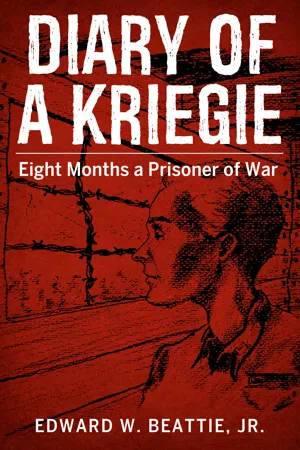
Diary of a Kriegie is the personal account of United Press correspondent Edward Beattie following his capture in France and imprisonment by the Germans for the final eight months of the Second World War. Beattie was kept in a series of internment camps, ending up at Stalag III-A at Luckenwalde, Germany. He was released when the Red Army liberated the camp in April 1945. The book provides a detailed look at camp life, especially the longing for favorite foods (some interesting prisoner recipes are included). The arrival of Red Cross packages were much anticipated and an important addition to the prisoner's otherwise meager diets. Beattie's knowledge of Germany (he had worked as a reporter in Germany before the war) and fluency in the German language add interest to the diary as he was able to gain insights into the workings of the camp and his captors. This version includes 42 pages of drawings made by the author while a prisoner-of-war.
Trusted by 375,005 students
Access to over 1.5 million titles for a fair monthly price.
Study more efficiently using our study tools.
Information
Subtopic
European HistoryIndex
HistoryStalag III-A, Luckenwalde
APRIL 1
EASTER, and what a day for hopes. For the 17,000 men of all nations who have frozen and starved all winter in this limbo of dead dreams it is really a day of resurrection—spiritual if it cannot yet be physical.
In the more than two months between the confiscation of this diary in Berlin and its reappearance yesterday the war in Europe has been won beyond all question. The nightmare of those two months is fading in the certainty that within two weeks or three we shall be free.
The Russians are held along the Oder, almost within cannon shot of Luckenwalde to the east, but we know and so do the Germans that it is only for the moment. To the west, the British are cutting off Northwest Germany and the Americans are coming across Germany with such rush and such power that even the Germans are agape with reluctant admiration.
The Germans at the camp are just going through the motions of guard mount. Some of them already wear civilian clothes underneath their shabby uniforms. There is no hope ahead for them. The prisoners, caught up for the most part out of the wreckage of the eastern Nazi empire and herded here into great pens in medieval conditions of filth, have the dark time behind them, and only hope ahead.
When I left Berlin on January 25, morale had reached its lowest point of the war. The forlorn Volkssturm graybeards on the platform of Zehlendorf station were typical of the gloom which had fallen on the city. At Potsdamer station, where we arrived in Berlin, and at Anhalter station, where we departed, there were thousands of hopeless refugees, screaming, shoving, and crowding their way to the emergency soup kitchens, to the toilets, to the waiting rooms and above all to trains which might carry them farther away from the Russians. They had arrived by every known means of transportation, and wanted only to go on.
These people know how surely the war in the east was lost, even though the Berliners themselves might not. They were stripped of everything but their lives. They wanted a stop to war, and many of them, particularly the women, were making no secret of it as they tried to fight their way into trains already packed beyond endurance.
Teudt, who took me in as far as camp headquarters, left for a half hour or so while Heimpel received me and told me how sorry he was that I could not yet be exchanged, but how I would find the men from Oflag 64 at Luckenwalde. A non-com searched me to the skin, to the innermost end of a roll of toilet paper, and confiscated my diary and sketches. When Teudt came back he said the people outside were talking of a food riot that morning in which the refugees, maddened by the nightmare of hunger and cold, had stormed a depot and been fired on by the SS.
The guards who took me on to Luckenwalde were both close to sixty, and one of them was outspoken. The train in which we traveled was so crowded that he didn’t dare talk much, but when he had the chance he told me that Berlin was finally losing hold on itself, and that a few more days of tension would snap the city’s morale.
We literally barricaded ourselves in the train for Luckenwalde while people by the hundred battered on the doors outside and told us they had more right to travel than we. The jam in my compartment included a wounded soldier and his wife, two ex-soldiers invalided out of the war, an SS colonel on a business trip and two American fliers just caught by the Germans.
Nobody encouraged conversation between myself and the two other prisoners: the crowd, in fact, obviously resented the English we spoke. But we managed to identify ourselves to each other. They had been shot down over Slovakia in a Liberator, had spent twenty-nine days in the high mountains, sleeping in caves and drinking snow water, dependent on the generosity of the peasants. They had surrendered within three miles of the Russian lines because their flying clothes had frozen stiff and they no longer had strength to walk. And they had been blaming themselves ever since for not knowing that they were so close to the Russian outposts. I had their names when I reached Luckenwalde, but they were taken from me. I’d like to remember two people with the kind of courage they had.
The three of us ate some of my bread and cheese and smoked a couple of cigarettes. Finally one of my guards told me we’d better break up the conversation. As we pulled into Luckenwalde, thirty-five miles south of Berlin, the SS major, who had been holding forth optimistically for the benefit of the compartment, said to me in English:
“You three need not worry much. You’re about to end your trials. We are just about to start on ours.”
That was the atmosphere of the train. I’ve often wondered what ever became of the two or three thousand souls it carried south away from Berlin.
Central Germany that day was inevitably panic-stricken along with the refugee thousands with their tales of cold, hunger, and the Russian tank columns which were cutting Silesia to ribbons and driving the routed Wehrmacht back to the Oder. When the Russian offensive finally slowed at the river, still short of Frankfurt, Görlitz and Kottbus, many of these same Germans managed to fool themselves once more. They began talking again of the “exhausted” Red Army, and of how the western front would hold against the storm of British and Americans. A few even managed to think of victory.
All that has been blasted to shreds by the debacle on the west bank of the Rhine and the allied surge forward since the main crossings began.
The fighting has been reduced by now to one last desperate flurry by the Nazi leadership, and the Germans themselves know it. The Nazis apparently still hope blindly for some sort of compromise with the western powers, failing which they will at least have prolonged their own miserable lives for a few weeks longer. Either way, the German people have nothing to gain.
The people deserve better of their leaders for the steadfastness with which they have stood behind them under conditions no modern nation has ever faced before. For two and a half years of disaster, now, the people have kept faith alive. There has been no let-up to the steady pounding of air raids, to the bad food and the bad news except for the phoney flurries of optimism over V-I and V-II.
To some extent, this steadfastness sprang from the devouring fear of “Bolshevism,” the mass hypnotism with the impending Communist chaos, which the Nazis have managed to invoke. Chiefly, however, it comes from the patriotism of a highly-developed people which could get no promise of clemency from its enemies and which managed somehow to adapt itself to each new calamity. In these last few weeks, at least, it draws strength from the strange, mystic streak in each German which glorifies martyrdom—which turns each new disaster into a sort of dismal festival. Hitler, I have always imagined, pictures himself as ending on Siegfried’s funeral pyre. That pyre now threatens to consume a nation.
For the most part the German people have been behind the government. In recent months more and more of them have realized they were being led into chaos. But because the allies would offer them only unconditional surrender and because Nazi propaganda made this mean “surrender to Bolshevism,” they fought on.
They have long since ceased believing the papers or radio. The guards here get their news from us, and make no pretense of interest as to whether it comes from the German communique or the British Broadcasting Corporation, to which we listen regularly on contraband radio sets. The German communique is still accurate geographically, but it is filled with verbal evasions which are so Well known by now that everyone at once discounts them. Germans automatically put the worst possible construction on everything the communique says. If it admits that American troops have fought their way into a given town, the Germans automatically write off the town as captured, even though fighting may go on for days. If the communique says Patton’s Third Army made thirty miles up to yesterday, Germans automatically assume it is a minimum of thirty miles farther east today.
Despite all the disillusionment, Germans believed in the war up to two or three weeks ago and hoped desperately that some new weapon or some new hidden force would be brought into play which might turn disaster into victory, or at least force a compromise peace. They knew enough—even I, as a prisoner, had heard enough—of swarms of jet-propelled planes, of underground rocket factories, even of atomic bombs, to feel that a few months might find Germany in a position to strike terrible blows against her enemies. What they did not realize was that allied ground and air power—and of the two, I think air power rates the number one position—had not left them those months.
The morale which had held up for five and a half years has now collapsed. I have talked to enough guards, enough civilians, enough army officers and enough Nazis to know that for certain. The average German has had five and a half years of the dullest, grayest existence in Europe, short of the mass murder areas which Nazi vindictiveness created. He has made innumerable sacrifices only to discover that times infinitely worse lie ahead.
Today he hears not only the allied planes, which he knows can search him out anywhere in Hitler’s inviolable Reich. He can hear the mutter of the guns, and knows that any hour he may be within their reach. He can see the roads jammed with refugees driving blindly into the hopeless sanctuary of central Germany, into a national chaos which is worse than the battle zone itself.
He can watch foreign slave labor in its millions daily becoming more truculent, and fears what will happen to him when slave labor finally rises—to him who a few months ago was inspecting women prisoners paraded naked, like so many horses, to select the healthiest or the least unhealthy to work for the glory of Hitler.
He knows that the rationing system has broken down completely, that each area has been left to feed itself as best it can, that livestock has been ordered slaughtered by today to save it from the invaders. He knows that Germany’s inadequate fields are not being sown this spring, and that in any event there would be no slave labor this August to take in the vital harvest.
He knows that the great coal producing areas are gone and that the Ruhr, the last mass producer of war tools, is about to crash in ruins. He can see nothing ahead but the hunger, cold and misery which inevitably will scourge the Vaterland.
Finally, at long last, he has ceased paying even lip service to the Nazis. He is no longer behind the government in its pursuit of a hopeless war. He wants only the chance to construct what life he can for himself—just the bare chance to exist for himself and his family.
He hates Hitler and condemns him bitterly, not because Hitler plunged Europe into chaos, not because he trampled over a dozen “inferior” nations or because he ordered the mass destruction of millions of human beings, but purely and simply because Hitler, who told the average German he was of the Herrenvolk and gave him the dream of world domination, has failed to bring it about. It’s because Hitler is a failure—not because of the blood on his hands and with his, on the nations—that the average German today rejects him and his works.
Some nations would do something about it. Even a Nazi dictatorship can no longer function when it is deprived of all support and when the people refuse to go farther. But the average German has become so apathetic under the Nazis, his civic imagination and his moral courage have been so shriveled by the hot blast of propaganda, and his potential leaders have been so thoroughly liquidated or perverted, that there is no chance of a popular movement to end this mass suicide.
The men who might rally such a movement are even now no more, certainly, than a fraction of the fanatics who still intend to fight to the last man, who still snipe from the woods behind the allied advance, who months hence will still plan sabotage against the victors and who still years from now will be carrying on underground in the name of a lost cause and the falsest prophet in history. And the bulk of the population is utterly apathetic.
Germans desperately want the western powers to occupy the entire Reich before the Russians can do so, because they do not fear the British and Americans and hope their regime might provide a reasonably decent existence. But there they stop. There is no organization to their hopes: the Nazis killed its seeds. Therein lies the danger that .Germany in defeat will sink into formless chaos. It seems probable that unless some military group cuts free from the Nazis and strikes the flag, fighting will continue for weeks or even months in southern Germany. And as the allied armies knife deeper and deeper into the country, one province after another will disintegrate socially, morally and economically unless an agency rises which can give life some sort of form.
Since the underground Nazis alone would keep their “integrity” in such a chaos, the prospect would be alarming. They might be forced in defeat to call it by some other name than Nazi, and the old discredited leaders would have no appeal to the nation, but there is little doubt that the old program would have the same attractions to the German nation, and that the fanatical minority could dictate the political tone for the dull, formless majority.
The Nazis, or whatever they called themselves, would re-establish their “Vehm” courts as the arch nationalists did after the last war, and no group in the population would possess the bone to withstand the “Vehm,” whose dreaded hooded tribunals terrorized the Germany of the Middle Ages. Yesterday’s Völkischer Beobachter clearly told the Nazis to use it again in this crisis.
The paper, chief mouthpiece of the Nazi party, carried a short story on the murder of one Max Oppenhof, appointed Mayor of Aachen by the American occupying forces, at the hands of “unknown fighters for freedom.” The paper described it as an execution carried out because Oppenhof had collaborated with the enemy.
“A court established to ...
Table of contents
- Title page
- Table of Contents
- Foreword
- Chaumont-sur-Marne
- Bourbonne-les-Bains
- Bains-les-Bains
- Xertigny
- Dompierre
- Gerardmer
- Colmar
- Outside Strasbourg
- Strasbourg
- Strasbourg railway yards
- A Siding near Frankfurt am Main
- In the Lahn Valley
- Diez Castle, in the Lahn Valley
- Berlin
- Stalag III-D, Berlin
- Stalag III-A, Luckenwalde
- Paris
- Illustrations
Frequently asked questions
Yes, you can cancel anytime from the Subscription tab in your account settings on the Perlego website. Your subscription will stay active until the end of your current billing period. Learn how to cancel your subscription
No, books cannot be downloaded as external files, such as PDFs, for use outside of Perlego. However, you can download books within the Perlego app for offline reading on mobile or tablet. Learn how to download books offline
Perlego offers two plans: Essential and Complete
- Essential is ideal for learners and professionals who enjoy exploring a wide range of subjects. Access the Essential Library with 800,000+ trusted titles and best-sellers across business, personal growth, and the humanities. Includes unlimited reading time and Standard Read Aloud voice.
- Complete: Perfect for advanced learners and researchers needing full, unrestricted access. Unlock 1.5M+ books across hundreds of subjects, including academic and specialized titles. The Complete Plan also includes advanced features like Premium Read Aloud and Research Assistant.
We are an online textbook subscription service, where you can get access to an entire online library for less than the price of a single book per month. With over 1.5 million books across 990+ topics, we’ve got you covered! Learn about our mission
Look out for the read-aloud symbol on your next book to see if you can listen to it. The read-aloud tool reads text aloud for you, highlighting the text as it is being read. You can pause it, speed it up and slow it down. Learn more about Read Aloud
Yes! You can use the Perlego app on both iOS and Android devices to read anytime, anywhere — even offline. Perfect for commutes or when you’re on the go.
Please note we cannot support devices running on iOS 13 and Android 7 or earlier. Learn more about using the app
Please note we cannot support devices running on iOS 13 and Android 7 or earlier. Learn more about using the app
Yes, you can access Diary of a Kriegie by Edward William Beattie in PDF and/or ePUB format, as well as other popular books in History & European History. We have over 1.5 million books available in our catalogue for you to explore.