- 303 pages
- English
- ePUB (mobile friendly)
- Available on iOS & Android
eBook - ePub
The Vatican and the War
About this book
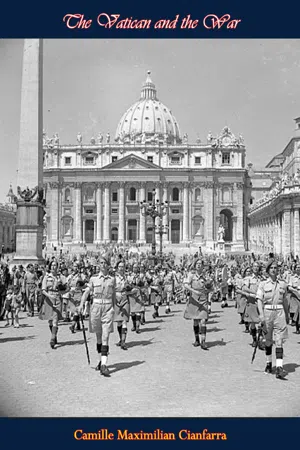
Cianfarra reports his findings on the actions of The Vatican during the Second World War. Famously neutral during a time of intense conflict, Pope Pius XII's public appearances neglected to overtly support either side. In his foreword to the book, the author speculates whether The Vatican would have aligned itself with whichever side ultimately found itself successful after the war. A longtime foreign correspondent for the New York Times, Cianfarra spent seven years living in Rome, and based much of his writing on personal experience.
Trusted by 375,005 students
Access to over 1.5 million titles for a fair monthly price.
Study more efficiently using our study tools.
Information
Subtopic
European HistoryIndex
HistoryEIGHTH CHAPTER
It was one of those dreaded summer afternoons in Rome, when Scirocco, the hot humid south wind, blowing all the way from Africa, saps one’s strength, causes drowsiness, and makes one languidly long for a good-sized, snow-capped mountain. It was the kind of weather which transforms ambition into laziness, an active brain into a vacuum, a vigorous body into a stagnant piece of flesh.
A few unlucky correspondents who had not managed to go to Ostia, Rome’s bathing place, fifteen miles away, were morosely sipping iced drinks, their sagging bodies resting on the comfortable, generously padded armchairs of the modernistic hotel lobby-like, brown-colored hall of the Foreign Press Club bar. There was only one wish in our minds—that Mussolini would take a day off and do nothing that would make a story, for even the most ambitious newspaperman felt that life was already unbearable enough without adding to it the physical and mental exertion involved in the reporting of news. It looked as though our wishes were to be fulfilled. The morning and afternoon newspapers were stating for the nth time Italy’s reasons for intervening in Spain. Even Virginio Gayda, the prolific editor of the Giornale d’Italia, whose main task was to write officially inspired editorials for the almost exclusive benefit of the foreign press, had failed to produce his daily two thousand words.
Then the telephone on the first floor where the working rooms were located pierced the silence. Everyone secretly wished the call were not for him. It would take too much effort to abandon the feet-on-the-table position we all had adopted in our defense against the July climate. The call, we heard with dismay, was for all the correspondents. The two ushers on duty leaned over the circular balustrade carved into the ground floor ceiling and announced:
“The Ministry of Popular Culture has just phoned saying that an important communiqué will be sent here in thirty minutes.”
We sighed and grunted. There was still hope, however. Despite the fact that it had been functioning for many years, the Government press office had a rather vague idea of what was news for foreign consumption. It sent dozens of communiqués containing poorly, written propaganda which inevitably ended in the wastepaper basket. We waited. Finally the messenger bearing the communiqués arrived. We dragged ourselves away from the chairs and listlessly climbed the two flights of stairs to the first floor.
We were so astonished by what we read that we forgot to curse Mussolini, the Ministry of Popular Culture, and Italy in general. Fascism had inaugurated an anti-Semitic policy. A group of anonymous university professors had signed what the Ministry of Popular Culture called an “Aryan manifesto,” advocating a vigorous racial policy to prevent the “Aryan” Italians from being contaminated by “extra-European races” It was the most sensational story that had come out of Rome in many weeks. It confirmed sporadic measures already taken unofficially against the Jews in Italy, and at the same time, it proved the extent of German influence on Fascist policy as well as Mussolini’s decision to cast his lot with Hitler against the democratic powers.
The manifesto was issued on July 14, 1938, and consisted of ten points. It asserted that the majority of the forty-four million Italians were the descendents of families emigrated to Italy a thousand years before; it scotched the “legend” that barbaric hordes had settled in Italy; it affirmed that the influx of non-Italian races had been negligible and that, therefore, the racial characteristics of the Italians had not been altered. One of the professors with whom I talked some time later confided, however, that the whole manifesto had been drawn to include the ninth point which stated that “Jews do not belong to the Italian race...Jews represent only the part of the population that has never been assimilated in Italy, because it is made up of non-European racial elements differing absolutely from the racial elements that have given origin to the Italians.”
For many months the Italian Government had been quietly eliminating Jews from key positions. As soon as they reached the retirement age, they would not be allowed to stay, and their jobs would be taken by non-Jews. The manifesto, then, merely advocated the hastening of this process of elimination. Exactly two weeks before, I had had another confirmation of this unobtrusive anti-Semitism. For years I had been buying books in one of Rome’s largest stores and had come to know many of the employees quite well. The last time I had been in the shop one of the clerks had drawn me aside and shown me a circular issued by the Ministry of Popular Culture. It forbade publishers to print translations of foreign books by Jewish authors. All existing copies of such books were to be returned by booksellers to the publishers who were permitted to sell them privately until the entire stock was exhausted. Publishers were allowed to print books by Italian Jews, but booksellers could not display them in show windows.
With the exception of Berlin, which hailed the issuance of the manifesto as a victory for Hitler’s racial ideology, the first international reaction, and that of the Italian people as a whole, was that Mussolini had imitated his partner. Was there a racial problem in Italy? One could cite scores of statements, including the one Il Duce himself gave to Emil Ludwig—that there was no “anti-Semitism in Italy,” and that “the Jews had fought bravely under the Italian tricolor in the First World War”—to prove it did not exist. Only three months before, Ciano had said that the ratio of Italian Jews was of about one per thousand. True, many German and Austrian Jews had taken shelter in Italy as a consequence of the Nazi pogroms, but the final total of the official census taken in August, 1938, showed that they amounted to a bare 57,145 as compared to 44,000,000 “Aryan” Italians! The figure accounted for both Italian and foreign Jews.
Italy, in modern times, had never proved a fertile field for the Jew because of her economic poverty, low standard of living, overpopulation, strong competition with the quick intuitive Italian mind and the traditional frugality and thriftiness of the lower and middle classes. Even in the prosperous period of the great Florentine bankers and of the powerful maritime republics of Venice and Genoa, which virtually monopolized European trade from the fourteenth to the seventeenth centuries, Jews did not attain a leading position in the economic and political fields. Most of the Jews in Italy had settled in the richer industrial regions of the north or in the commercial and maritime centers. South of Naples, one could almost count them on the fingers of one hand. To give an example, statistics published in the fall of 1938, showed that there were twenty-four in Calabria, ten in Lucania, and four in the whole of Sicily!
Great Jewish fortunes did not exist in Italy. There were certainly none that could compare with those of the Cianos, Alberto Pirelli, and Count Volpi. The press was exclusively in “Aryan” hands, as were the publishing houses. Politically, Jewish influence was nil, owing to the overwhelming majority of Italians in the Chamber of Deputies and the Senate; industrially, the largest plants and combines were under absolutely Italian control; commercially, there were many large stores and wholesale houses which were reliable and had never been accused of shady dealings; educationally, the very few Jewish professors in the Italian universities and schools had devoted their activities exclusively to scientific and cultural fields, and their books had materially contributed to the national culture.
Therefore, no political or economic issue was connected with the Jewish question. As for the religious aspects of the problem, not even the most rabid, anti-Semitic Fascists such as Telesio Interlandi, editor of the extreme right-wing newspaper, Tevere, and Roberto Farinacci, editor of the Regime Fascista, had ever raised it. It was obvious that the Jewish religion could hardly find propitious conditions for its propagation in the country that was the cradle of Christianity.
This was not a situation that had been created by Fascism. Even in the liberal and socialist eras, Italian Jews never identified themselves with left-wing parties as, incidentally, Mussolini himself had done in the days before he organized the Fascist movement.
For all these reasons, Il Duce’s anti-Semitic policy left the Italians cold. They could not understand it. Anne O’Hare McCormick, leading editorial writer on foreign affairs for The Times, arrived in Italy when the racial campaign was at its height in the winter of 1938-39. She found that it was “universally unpopular.” Even one hundred per cent Fascists, she said, were critical and apologetic.
As a matter of fact, thinking Italians suddenly displayed great consideration for Jews and went out of their way to show them that they harbored no racial prejudices. A typical illustration of this reaction was what Trilussa, Italy’s greatest living poet, told Princess Victoria Colonna, leader of Roman society.
Trilussa had a unique social position. His genius, natural wit, culture, perfect manners coupled, with a profound liking for, and understanding of, the humbler folks made him one of the most popular figures not only in literary and aristocratic circles but in the middle and lower classes. He dined indifferently with princely families in their historical palaces or with bricklayers and taxicab drivers in the “osterie” of the Roman suburbs.
His satirical poems in the Roman dialect were as popular in the Italian capital as those of Walt Whitman in the United States during the last century. They always contained a good-humored but dangerously corroding criticism of Fascism. The popularity of his works was such that Mussolini had decided to censor them personally. Though he enjoyed them for their outstanding artistic quality and exquisite humor, Il Duce more often than not sent them back with a laconic “NO” written in red pencil on the margin of the manuscript. Not long before I left Italy, Trilussa showed me quite a number of these poems stored away in his desk.
Princess Colonna, whose salon he had been frequenting for about twenty-five years, telephoned him one morning and said that His Highness, the Duke of Spoleto, nephew of the King of Italy and future King of Croatia, was in town and had asked to hear the ‘latest ones from Trilussa.” Could he come to dinner at her house that evening?
“I am very sorry, but I can’t,” the poet said. “I have been invited by the Foa family. I am sure His Highness will understand that if I canceled the invitation at the last minute I might hurt the feelings of old friends who, through no fault of their own, are now being discriminated against.”
“Could you come after dinner?” the Princess asked.
At eleven in the evening the personal car of the Duke of Spoleto was in Via Pasquale Stanislao Mancini, where the Jewish Foa family still lives, to take Trilussa to the Colonna Palace.
The reasons that had driven Mussolini to create an artificial problem which had antagonized world public opinion and bred more hatred than any other single Fascist measure up to that time were purely political. Having decided to collaborate with Germany against the democracies, the Italian Dictator felt that Italy’s Jewish population would undoubtedly oppose an alliance with a power that had made Jew-baiting one of the most spectacular manifestations of its domestic policy. Il Duce feared that in the event of war, Italian Jews in important positions would exert their influence to sabotage Italy’s war effort. His was a preventive measure, therefore. By eliminating the Jews from key posts and by replacing them with men whom he could trust, he hoped to strengthen his domestic front. His mistake, as many Italians pointed out, was that he need not issue legislations affecting all Jews to strike only at a score who, because of their positions, might have represented a potential threat. Moreover, these men had never been politically active against Fascism, not even during the genesis of the Rome-Berlin Axis. Il Duce himself acknowledged their loyalty to the country and quietly found new jobs for them. Edda, who was studying law at Rome University, reported that one of her professors by the name of De Vecchi affected by the anti-racial laws, was by Mussolini’s express order given a post in the International Institute for the Unification of Private Law, with headquarters in Rome.
Some of the Fascists of the “old guard,” that is, men who had played an important part in the creation of the Fascist regime, did not hesitate to show their hostility to the measures. Their leader was Italo Balbo, the “enfant terrible” of Fascism because of his strong personality, intelligence, ruthlessness, and courage.
After two months of press campaign intended as psychological preparation, the Grand Council of Fascism met on October 6 to endorse officially the “Aryan manifesto.” Three weeks later, Balbo invited a group of foreign correspondents to witness the emigration of eighteen thousand Italian farmers to Libya. The Fascist Government commandeered a dozen merchantmen and shipped the emigrants to many newly built villages on the fringes of the Sirte Desert and in Cyrenaica. There they found a small-sized field, a three-room house with an oven, a stable, a barn, and agricultural implements.
The correspondents were treated with a liberality typical of Balbo. Whenever we stopped at a hotel, the Air Marshal gave us not only rooms and food but the freedom of the bar as well. Don Minifie, of The Herald Tribune, and I were the only two American correspondents. Balbo’s anti-German feelings were never more clearly shown than during that trip. Although a half-dozen Nazi newspapermen had been invited, he constantly avoided them. His attitude was so obvious, that on their return to Rome, the Germans signed a protest which they handed to the Ministry of Popular Culture.
At nearly every meal I was invited to sit next to Balbo. It was while we were dining in Misurata, a small town between Tripoli and Benghazi, that I asked him what he thought of the racial legislation.
“It won’t mean a thing,” he said in his blunt way. “Just between you and me, I fought it tooth and nail (a spada tratta, was the expression he used.) De Vecchi and de Bono did the same. So, when we saw that the Chief (Mussolini) was determined to carry through his plan we proposed that Jews whose loyalty to Italy and the Fascist regime could be proved, be exempted from the laws. The exceptions will mitigate the measures, for they affect the majority of Jewish families which almost all have a member to whom discrimination can be applied.”
Balbo was not giving me a cock-and-bull story. The day after the Grand Council meeting he had flown from Rome to Ferrara, his home town. He made a point of visiting every one of the prominent Jews and went so far as to invite to lunch the Jewish-born podestà, or mayor, of Ferrara, who, of course, had sent his resignation to Rome the same morning. While the press bannered the anti-Jewish measures, hundreds of sympathetic Italians gaped at the daring exhibition of cordiality as Balbo walked into the most popular restaurant of the town arm-in-arm with his Jewish friend.
As was to be expected, Fascist spies reported the gesture of defiance to Rome. The story made the rounds of all government and social circles. It even reached the ears of handsome, dapper, melliferous Dino Alfieri, Minister of Popular Culture, and one of the most servile members in the Italian Cabinet. Alfieri was a political opportunist and a born courtier. He belonged to the Nationalist Party in the period prior to the March on Rome but hastened to change the blue shirt of that organization for the black shirt of the Fascists as soon as Mussolini seized power.
In the lobby of the Hotel Excelsior a few days later, he asked Balbo:
“Is it true that you shook hands with all the Jews in Ferrara?”
“Absolutely,” Balbo confirmed. “And I want to assure you that I’ll do the same with you when all the former ‘Nationalists’ will be banned from the Fascist Party.”
Italy’s racial legislation, when it was finally completed after a series of decrees over a period of many months, defined a Jew; first, he whose two parents are Jews; second, he who is born of a Jewish father and a foreign mother; third, he who though born of mixed marriage, professes the Jewish religion. It did not regard as Jew he who was born of a mixed marriage and professed a religion other than Jewish on October l, 1938.
The laws prohibited marriage between Italians and persons belonging to the Semitic and other “non-Aryan” races. Jews, both teachers and s...
Table of contents
- Title page
- TABLE OF CONTENTS
- DEDICATION
- FOREWORD
- FIRST CHAPTER
- SECOND CHAPTER
- THIRD CHAPTER
- FOURTH CHAPTER
- FIFTH CHAPTER
- SIXTH CHAPTER
- SEVENTH CHAPTER
- EIGHTH CHAPTER
- NINTH CHAPTER
- TENTH CHAPTER
- ELEVENTH CHAPTER
- TWELFTH CHAPTER
- THIRTEENTH CHAPTER
- FOURTEENTH CHAPTER
- FIFTEENTH CHAPTER
- SIXTEENTH CHAPTER
- SEVENTEENTH CHAPTER
- EIGHTEENTH CHAPTER
Frequently asked questions
Yes, you can cancel anytime from the Subscription tab in your account settings on the Perlego website. Your subscription will stay active until the end of your current billing period. Learn how to cancel your subscription
No, books cannot be downloaded as external files, such as PDFs, for use outside of Perlego. However, you can download books within the Perlego app for offline reading on mobile or tablet. Learn how to download books offline
Perlego offers two plans: Essential and Complete
- Essential is ideal for learners and professionals who enjoy exploring a wide range of subjects. Access the Essential Library with 800,000+ trusted titles and best-sellers across business, personal growth, and the humanities. Includes unlimited reading time and Standard Read Aloud voice.
- Complete: Perfect for advanced learners and researchers needing full, unrestricted access. Unlock 1.5M+ books across hundreds of subjects, including academic and specialized titles. The Complete Plan also includes advanced features like Premium Read Aloud and Research Assistant.
We are an online textbook subscription service, where you can get access to an entire online library for less than the price of a single book per month. With over 1.5 million books across 990+ topics, we’ve got you covered! Learn about our mission
Look out for the read-aloud symbol on your next book to see if you can listen to it. The read-aloud tool reads text aloud for you, highlighting the text as it is being read. You can pause it, speed it up and slow it down. Learn more about Read Aloud
Yes! You can use the Perlego app on both iOS and Android devices to read anytime, anywhere — even offline. Perfect for commutes or when you’re on the go.
Please note we cannot support devices running on iOS 13 and Android 7 or earlier. Learn more about using the app
Please note we cannot support devices running on iOS 13 and Android 7 or earlier. Learn more about using the app
Yes, you can access The Vatican and the War by Camille Maximilian Cianfarra in PDF and/or ePUB format, as well as other popular books in History & European History. We have over 1.5 million books available in our catalogue for you to explore.