A stirring tale of the antirent agitation in the Catskills, Hudson Valley and up-state New York in the 1840's.
"As the somewhat cryptic title suggests, this book is concerned primarily with one aspect of a many-sided theme in the economic and social history of New York state, and it deals with that topic in its final stage of popular protest and legal liquidation. During the first two centuries of New York's history the dominant form of landholding in the Hudson Valley was the large estate occupied by tenants on the quasi-feudal terms of annual rentals in kind or equivalent cash and the reservation of rights to share in land sales. Inaugurated by the Dutch and continued under English rule, this system of landholding was extended and reinvigorated after the Revolution in the guise of a permanent leasehold, mainly devised by Alexander Hamilton, the brother-in-law of Stephen Van Rensselaer, the last of the patroons and the principal landlord in the state.
The rising tide of political democracy, coupled with economic distress and the accumulation of arrears, produced an inevitable popular reaction against the burdens of tenancy. The spark of revolt was struck in 1839, on the death of Stephen Van Rensselaer, when his heirs attempted to collect arrears by legal process. The result was an antirent agitation between 1839 and 1845, which flared up into sporadic violence and resistance to the sheriffs of several upstate counties by bands of farmers, summoned to the call of tin horns and disguised in calico robes and Indian masks. This in turn provoked collision with the state authorities upholding law and order."-Journal of Economic History
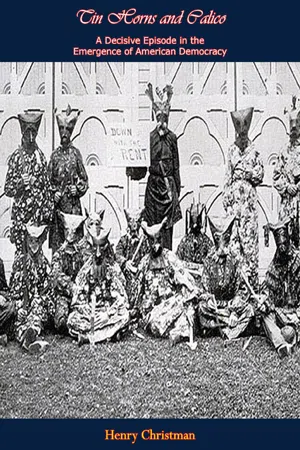
eBook - ePub
Tin Horns and Calico
A Decisive Episode in the Emergence of American Democracy
- 487 pages
- English
- ePUB (mobile friendly)
- Available on iOS & Android
eBook - ePub
Tin Horns and Calico
A Decisive Episode in the Emergence of American Democracy
About this book
Trusted by 375,005 students
Access to over 1.5 million titles for a fair monthly price.
Study more efficiently using our study tools.
Information
Subtopic
American Civil War HistoryIndex
HistoryChapter 1—A Landed Aristocracy
NOWHERE in the America of the late eighteen-thirties were the promises of the Declaration of Independence less fulfilled than in Albany, the capital of New York. Here was the seat of power of a landed aristocracy, the center of an island of semi-feudalism in a nation that had, little more than half a century before, declared its common faith in democracy and free enterprise. Under the patroon system, flourishing as vigorously as it had in the days of the early seventeenth century, a few families, intricately intermarried, controlled the destinies of three hundred thousand people and ruled in almost kingly splendor over nearly two million acres of land.
In Albany class lines were sharp. Democracy was so little known that a veteran of the Revolution might be refused a seat on the Albany-Troy stage because he was shabbily dressed. Newspapers found it sufficiently important to report that cigar-smoking had lost its charm for the elite since almost every shop boy and dirty little urchin had taken it up. Society was geared to a round of pleasure matched only in Washington, and local politicians mapped the nation’s political future over drinks at Eagle Tavern.
Workers left stranded at the completion of the railroad and the Erie Canal, demoralized by the panic of 1837, herded together in the poverty-ridden section on the city’s edge known as the Pasture. They had begun to talk of organizing against low wages, unemployment, and unstable purchasing power. Most of all they were beginning to cry out for land—land through which to escape the vagaries of profits and wages. But almost no land within a radius of one hundred and fifty miles of Albany could belong to the people. The Hudson Valley gentry had owned it for generations, their ownership guaranteed by a charter which was a direct denial of the people’s constitutional rights. The situation, in these unsettled times, was beginning to draw question: How long must this continue? Had it established a principle for the future in a nation rapidly expanding into the territories of the West?
Some of the Hudson Valley gentry bore British names—Livingston, Morris, Jay; others, descendants of Dutch settlers, were named Van Rensselaer, Hardenbergh, Verplanck, Van Cortlandt, and Schuyler. No other was so proud or so influential as the Van Rensselaer family, pioneers in American feudalism, who for more than two hundred years had been the owners of the largest estate in the region. Rensselaerwyck embraced all of Albany and Rensselaer counties and part of Columbia, and by 1838 was maintaining between sixty and one hundred thousand tenant farmers. Their overlord was Stephen Van Rensselaer III, who had become the sixth lord of the manor at the age of five, and was now an urbane old gentleman in his seventies, a former soldier and a former Congressman who rejoiced in the sobriquet of the Good Patroon and was adored by six sons, three daughters, and numerous grandchildren.
2
The patroon system which Stephen and his contemporaries inherited had been engrafted on America by Kiliaen Van Rensselaer in 1629, long after it had been discarded in Holland. An influential pearl-and-diamond merchant in the Dutch capital, Kiliaen joined with other crafty businessmen to obtain a charter for the Dutch West India Company, ostensibly to colonize the New World. However, their true purpose was to wage privateer war against Spanish ships carrying gold and silver from Peru and Mexico, and to re-establish Dutch command of the sea without violating the country’s treaty of friendship with Spain. Armed fleets set sail with orders and authority to “conquer provinces and peoples and administer justice.” Enormous riches returned to the company, and the prize of maritime supremacy kept the government complaisant until other interests, alarmed at the British challenge of Dutch claims in the New World, began to ask what had become of the projected colonization. Shrewdly, the directors explained that settlement of “such a wild and uncultivated country” called for more settlers than they could supply; important inducements would have to be offered before the undertaking could succeed.
It was relatively easy, therefore, for the directors to get authority to offer a grant of land, with absolute power as patroon, to any member of the company who would plant a colony of fifty persons in America within four years. The patroon would have baronial authority, with full property rights and complete civil and military control over the people, who would be bound by contract to fealty and military service as vassals.
Each tract was to be legally purchased from the Indians, and limited to a river frontage of sixteen miles, or if the land lay on both sides of a river, eight miles on each bank. But enterprising Kiliaen made his own laws. He had his agents give a basket of trinkets to the Indian chiefs for title to land stretching twenty-four miles along the Hudson River, with Fort Orange, a fur-trading settlement, as the approximate geographical center. Of six patroonships granted, his was the only one to survive the first six years, for although he never crossed the ocean to his dominions, he was as fortunate in choosing his deputies as he had been in selecting his location.
Tenants imported to secure his title were under absolute control of his agents. They were compelled to buy all supplies from the patroon’s commissary at usurious prices, grind their grain at the patroon’s mill, and pay over to him part of all crops and increase in livestock. Hobbled by such restraints, agricultural settlers were few, but the traffic in beaver skins flourished.
The Van Rensselaer empire stood at the gateway to the fur trade of the inland wilderness, and although the grant of patroonship specifically reserved this trade to the company, Kiliaen had a fort built on Barren Island at the southern end of his domain, and decreed that no ships should pass except those in his personal service. When the company protested that trade rights belonged equally to all members, Kiliaen declared he would enforce his edict “by weapon right,” and from the watchmaster of Barren bland all ships got orders to “strike thy colors for the Lord Kiliaen and the staple right of Rensselaerwyck.”
Peter Stuyvesant, the hot-tempered, peg-legged director general in New Amsterdam, took passage upriver to have it out with Van Rensselaer’s agent at Fort Orange. When the boat docked, he stumped up the hill to the agent’s house and ordered the soldiers to tear down the patroon’s flag. That done, he laid out a town adjacent to Fort Orange, named it Beverwyck, and proclaimed it company property under the jurisdiction of three magistrates whom he himself appointed. Beyond that, the patroon’s influence with the home government proved too strong even for the hot-headed governor.
As the land was cleared and farms became productive, the tribute paid by Kiliaen’s slowly growing nucleus of settlers added measurably to his fortune. “I would not like to have my people get too wise and figure out their master’s profit, especially in matters in which they themselves are somewhat interested,” he wrote in 1629 to William Kieft, director of New Netherland.
After the British seized New Netherland in 1664, the changes were largely superficial. Fort Orange and Beverwyck were combined under the name of Albany, from the Scottish title of the Duke of York, afterward James II of England. Kiliaen’s grandson, then in actual residence, was confirmed in his possession of Rensselaerwyck by provisional orders; in 1685 the governor granted a patent transforming the patroonship into an English manor and the patroon into the lord of the manor. His civil rights were restricted a bit, but there was no change in the relations between landlord and tenant.
The English almost outdid their predecessors in saddling the valley with big estates, for in addition to nine actual manors, they handed out millions of acres in patents to lesser members of the Hudson River aristocracy. It was regarded as good policy to place large tracts in the hands of gentlemen of weight and consideration, who would naturally farm out their lands to tenants, a method which would create subordination and, as the last of the colonial governors expressed it, “counterpoise in some measure the general levelling spirit that so prevails in some of His Majesty’s governments.”
Even the Revolution did not weaken the feudal hold of the big landowners. It merely stripped them of baronial honors and privileges. The rent-distressed tenants of New York State gave themselves and their supplies to the struggle; they fought at Saratoga, Oriskany, and Valley Forge for the right to be independent landholders. Side by side with men seeking freedom for capital enterprise to exploit the wealth of the New World, farmers and wage earners fought for the principles of individual political and economic freedom. With a common rallying cry, two wars were fought, one within the other—and one was lost. The farmers and the wage earners found themselves betrayed in victory, when the new government became a bulwark for the rich and the middle class against the “despised proletariat” and the rising tide of democracy.
Alexander Hamilton, John Jay, and the Livingstons worked unceasingly to keep New York the most conservative commonwealth in the new Union. In 1777 the people of the state guaranteed that nothing in the state constitution should be construed to affect any of the grants made by the authority of the king or his predecessors.
Two years later, however, under Governor George Clinton, the estates of Tories who had been loyal to the Crown during the Revolution were confiscated. In 1780, these and the lands acquired from foreclosures, tax sales, and Indian purchases were promised as bounty for Revolutionary services, but the land office was not created until four years later. By that time, the choicest tracts had been taken by prominent Federalists to satisfy their war claims, and great blocks had been sold to speculators and corporations for a pittance. Wherever impoverished veterans turned, they found the speculators had been there first. The tenant system spread, in flagrant disregard of the broader economic interests of the state. Highly skilled settlers fleeing Old World oppression and class distinctions avoided New York, rejecting its terms of perpetual tribute for the use of soil and water power. Still the great landowners would offer only leases.
3
Thus it was that when Stephen Van Rensselaer III came of age on November 1, 1785, Rensselaerwyck was as extensive as it had been at the death of Kiliaen in 1646, and had grown vastly in wealth and influence.
Hudson River society felt that young Stephen had every quality necessary to a leader of a landed aristocracy. He had been educated by his grandfather, Philip Livingston, one of the signers of the Declaration of Independence. His wife was the lovely Margaret Schuyler, with whom he had eloped at the age of eighteen. In beauty and elegance she was second to no young woman in the region except her sister Elizabeth, who had married Alexander Hamilton. Not since the Hamilton-Schuyler wedding had Albany known a “beef and liquor” dinner such as was spread for Stephen’s coming to power. The flower of society was there. But the social sensation was over-shadowed by the young patroon’s revelation of his business plans—plans which betrayed the skillful guiding mind of Hamilton.
The great manor had always returned income enough to support its lords in luxury, but the farms were few. Only scattered settlers had gone beyond the fertile valley lands to clear the heights of the Helderbergs, where thousands of untouched acres still awaited the ax and the plow. East of the Hudson, thousands more stretched across the rolling hills. Stephen now announced a “liberal” program to people the rest of his seven hundred thousand acres. He would give the patriots of the Revolution homesteads without cost; only after the farms became productive would he ask any compensation.
Surveyors were sent over the hills; farms of one hundred and twenty acres each were blocked out; exaggerated reports were issued about the fertility of the soil, the salubrity of the climate. Men began to come, and to each the patroon said: “Go and find you a situation. You may occupy it for seven years free. Then come in at the office, and I will give you a durable lease with a moderate wheat rent.” Before long, nearly three thousand farms were taken, and villages sprang up around church spires.
Seven years went by, and the tenants came in for their “durable leases.” By this time, protected by the new Federal Constitution which he had helped to frame, Alexander Hamilton had perfected for his brother-in-law a “lease” that would bind the new tenants permanently to the estate. In effect, its terms did not differ radically from those offered by the first patroon to his original settlers. By calling the contract an “incomplete sale,” Stephen Van Rensselaer adroitly sidestepped the issue of feudalism, which had been outlawed in New York State in 1782 by the abolition of entail and primogeniture. He “sold” the property to the farmer and his heirs and assigns forever, on the following conditions:
As “purchase” price for the title to and the use of the soil, the tenant was to pay ten to fourteen bushels of winter wheat annually, and four fat fowls; and he was to give one day’s service each year with team and wagon. He was to pay all taxes, and was to use the land for agricultural purposes only. The patroon specifically reserved to himself all wood, mineral, and water rights, and the right of re-entry to exploit these resources. The tenant could not sell the property, but only his contract of incomplete sale, with its terms unaltered. A “quarter-sale” clause restricted him still further: if he wished to sell, the landlord had the option of collecting one-fourth of the sale price or recovering full title to the property at three-quarters of the market price. Thus the landlord kept for himself all the advantages of landownership while saddling the “tenant” with all the obligations, such as taxes and road-building.
This contract was an expression of Hamilton’s theory of government. He proposed to save the nation from democracy by putting the rich and well-born in a position to check the “unsteadiness” and “imprudence” of the common people. America should be a nation of landed gentry, rich merchants, and professional men, with a strong, coercive government to serve business and capital by guarding against the ambitions of laborer and farmer. He would preserve the old class distinctions by preserving the institutions which made them possible. For his brother-in-law the patroon, he accomplished this objective.
Too late the settlers realized that the terms of the “durable lease” should have been agreed upon in writing when they took possession of the land. One farmer described his experience:
“I was poor. I found a lot that suited me and went to work, cleared me a spot for a log cabin and barn....At the end of seven years a large portion of the forest had disappeared. Myself, wife and little ones had just commenced to enjoy the fruits of our labor. I called at the office for my lease. It was handed to me. I told them I could not read it and requested that it should be read to me, which was complied with. I frankly told them that the lease did not agree with our verbal contract.”
“It’s the only lease given by Mr. Van Rensselaer,” the agent said.
“What does t...
Table of contents
- Title page
- TABLE OF CONTENTS
- DEDICATION
- Acknowledgments
- Introduction
- MAP
- Chapter 1-A Landed Aristocracy
- Chapter 2-Call to Rebellion
- Chapter 3-Seward Takes the Helderbergs
- Chapter 4-They Could Not Stand Idle
- Chapter 5-Justice for Sale
- Chapter 6-Storms and Tempests
- Chapter 7-Big Thunder
- Chapter 8-Political Infiltration
- Chapter 9-A Price on His Head
- Chapter 10-Law and Order
- Chapter 11-King Silas
- Chapter 12-The Bastard War
- Chapter 13-In the Good Cause
- Chapter 14-“For the Land Is Mine”
- Chapter 15-Lead Penetrates Steele
- Chapter 16-“Brimful of Wrath and Cabbage”
- Chapter 17-Packed Court
- Chapter 18-Delhi Justice
- Chapter 19-“November Ides”
- Chapter 20-The Goose Is Plucked
- Chapter 21-“The Prisoners! They Come!”
- Chapter 22-The End of Manor Aristocracy
- Chapter 23-Deep in the Land
- Songs and Ballads
- Bibliography
Frequently asked questions
Yes, you can cancel anytime from the Subscription tab in your account settings on the Perlego website. Your subscription will stay active until the end of your current billing period. Learn how to cancel your subscription
No, books cannot be downloaded as external files, such as PDFs, for use outside of Perlego. However, you can download books within the Perlego app for offline reading on mobile or tablet. Learn how to download books offline
We are an online textbook subscription service, where you can get access to an entire online library for less than the price of a single book per month. With over 1.5 million books across 990+ topics, we’ve got you covered! Learn about our mission
Look out for the read-aloud symbol on your next book to see if you can listen to it. The read-aloud tool reads text aloud for you, highlighting the text as it is being read. You can pause it, speed it up and slow it down. Learn more about Read Aloud
Yes! You can use the Perlego app on both iOS and Android devices to read anytime, anywhere — even offline. Perfect for commutes or when you’re on the go.
Please note we cannot support devices running on iOS 13 and Android 7 or earlier. Learn more about using the app
Please note we cannot support devices running on iOS 13 and Android 7 or earlier. Learn more about using the app
Yes, you can access Tin Horns and Calico by Henry Christman,Carl Carmer in PDF and/or ePUB format, as well as other popular books in History & American Civil War History. We have over 1.5 million books available in our catalogue for you to explore.