eBook - ePub
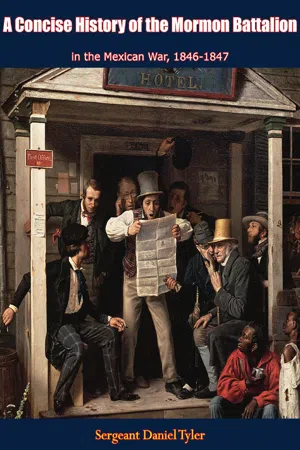
A Concise History of the Mormon Battalion in the Mexican War, 1846-1847
- 371 pages
- English
- ePUB (mobile friendly)
- Available on iOS & Android
eBook - ePub
A Concise History of the Mormon Battalion in the Mexican War, 1846-1847
About this book
Tyler's narrative has long been considered the authoritative work on this heroic battalion of Mormon volunteers. The battalion, numbering about 500 men, was organized at Council Bluffs, Iowa, in July 1846. After reaching Santa Fe, they headed to California following the Gila River. They experienced, as reflected in Tyler's vividly written account, a journey filled with unbelievable hardship. Thirst, starvation, heat, and freezing cold were their constant companions." The reached San Diego in January 1847 and, though they never saw combat, they "established Fort Moore in Los Angeles and strengthened the American hold on California. In addition to telling the story of the trek west, Tyler provides and important overview of the bitter rivalry between Stephen Watts Kearny and John C. Fremont for political control of newly conquered California; life in the pueblos of San Diego and Los Angeles; the return journey to Salt Lake City; and the role of several 'Battalion Boys' who were at Sutter's Mill on that fateful January 1848 morning when John Marshall discovered gold."—Zamorano 80
Trusted by 375,005 students
Access to over 1.5 million titles for a fair monthly price.
Study more efficiently using our study tools.
Information
Subtopic
American Civil War HistoryIndex
HistoryMORMON BATTALION HISTORY.—BY D. TYLER.
CHAPTER I.
From a perusal of the foregoing chapters, the reader will be somewhat acquainted with the condition of the Latter-day Saints previous to and at the time of the mustering of the Mormon Battalion; and indeed, with some subsequent events also, which are anticipated in the address of General Kane. However, that the circumstances connected with the raising of the Battalion may be fully understood, some further explanation should be given.
From the time the Saints first consented to leave Nauvoo in order to secure freedom from persecution, rumors and speculations were rife as to their probable destination. It was confidently asserted by many persons in authority that the Government would interfere to prevent them, if they attempted to journey west of the Rocky Mountains. Governor Ford, in writing to Sheriff Backenstos as early as Dec. 29, 1845, expressed the belief that the Government would prevent their removal, as they would be likely to “join the British.” Soon afterwards Amos Kendall, ex-Postmaster General, who claimed to be familiar with the plans of the President and Cabinet, also informed Elder Samuel Brannan that such was the intention. They were to be prevented upon the plea that it was contrary to law for an armed force from the United States to invade the dominion of another government. Of course, the Saints did not propose to go as a hostile force, but as peaceable citizens, seeking a home. They had, however, suffered so much in the past without cause, that this new threat was regarded with apprehension. Conciliatory letters were therefore written from Nauvoo to Hon. Stephen A. Douglas and several other members of Congress to secure their influence in opposition to such a measure. Efforts were also made by the authorities of the Church to obtain Government patronage while journeying westward with a view to securing protection from persecution as well a means of subsistence.
Oregon at that time was in possession of the United States, and President Polk had recommended to Congress that stockade forts be built along the overland route to that distant part, as a protection to emigrants. In anticipation of a law being passed to this effect, the Saints endeavored to secure the work of building the forts. They knew they could do the work as well and as cheap as any others, as they expected to travel some distance in that direction. Besides, the means to be earned by such work would greatly aid in supporting them; and the fact of their being in the employ of the Government might serve as a guaranty of their good faith.
In alluding to this, in a circular issued by the High Council, at Nauvoo, Jan. 20, 1846, it was stated that, “Should hostilities arise between the Government of the United States and any other power, in relation to the right of possessing the territory of Oregon we are on hand to sustain the United States government to that country. It is geographically ours; and of right no foreign power should hold dominion there; and if our services are required to prevent it, those services will be cheerfully rendered according to our ability.”
President Young also wrote to Elder J. C. Little who was presiding over the Saints in the New England States on the 26th of Jan., 1846, as follows: “If our Government should offer facilities for emigrating to the western coast, embrace those facilities if possible. As a wise and faithful man, take every honorable advantage of the times you can. Be thou a savior and a deliverer of the people, and let virtue integrity and truth be your motto—salvation and glory the prize for which you contend.”
On receipt of this letter, Elder Little obtained letters of introduction to Vice President Dallas, Hon. George Bancroft, Secretary of the Navy, and other officials at Washington, and soon afterwards proceeded to the seat of government. He obtained an interview with President Polk, and also called upon Hon. Amos Kendall, ex-Postmaster General, who promised to take an interest in his case and see the President about it.
Two days subsequently he was informed by Mr. Kendall that the President designed to take possession of California by the aid of the “Mormons,” who would receive orders to push through, take the country and fortify it in the name of the United States.
To execute his design Elder Little was to go forthwith to the camps and raise one thousand picked men to make a dash into and take possession of the country as before stated. They were to have their own officers except the commander, who was to be an appointee of the President. Another thousand were to be sent by way of Cape Horn in a U.S. transport, for the same service.
This was the plan which the President laid before the Cabinet.
Elder Little remained at Washington several days, awaiting definite instructions in regard to the matter, and in the meantime addressed an appeal to the President, setting forth some of the grievances of the Saints, alluding to their intention to journey westward and testifying to their loyalty.
Afterwards Elder Little had another interview with the President, which lasted about three hours. The President informed him that he had read the petition with interest, and that his people should be protected as good citizens, which he believed them to be.
Before leaving, however, the Elder learned, by a subsequent interview, that the design of the President had been changed, and that only five hundred men would be called for. He also learned that the President had instructed the Secretary of War to make out dispatches to Colonel Kearney, commander of the Army of the West, relative to the contemplated Mormon Battalion.
The foregoing will perhaps be sufficient to give the reader a general idea as to how the plan of raising the Battalion was at first conceived.
COL. KEARNEY’S ORDER TO CAPT. ALLEN.
I now give Colonel Kearney’s order to Captain Allen.
“HEADQUARTERS, ARMY OF THE WEST,
“FORT LEAVENWORTH,
“June 19, 1846.
“SIR:
“It is understood that there is a large body of Mormons who are desirous of emigrating to California, for the purpose of settling in that country, and I have, therefore, to direct that you will proceed to their camps and endeavor to raise from among them four or five companies of volunteers to join me in my expedition to that country, each company to consist of any number between seventy-three and one hundred and nine; the officers of each company will be a captain, first-lieutenant and second lieutenant, who will be elected by the privates and subject to your approval, and the captains then to appoint the non-commissioned officers, also subject to your approval. The companies, upon being thus organized, will be mustered by you into the service of the United States, and from that day will commence to receive the pay, rations and other allowances given to the other infantry volunteers, each according to his rank. You will, upon mustering into service the fourth company, be considered as having the rank, pay and emoluments of a lieutenant-colonel of infantry, and are authorized to appoint an adjutant, sergeant-major and quartermaster-sergeant for the battalion.
“The companies, after being organized, will be marched to this post, where they will be armed and prepared for the field, after which they will, under your command, follow on my trail in the direction of Santa Fe, and where you will receive further orders from me.
“You will, upon organizing the companies, require provisions, wagons, horses, mules, etc. You must purchase everything that is necessary, and give the necessary drafts upon the quartermaster and commissary departments at this post, which drafts will be paid upon presentation.
“You will have the Mormons distinctly to understand that I wish to have them as volunteers for twelve months; that they will be marched to California, receiving pay and allowances during the above time, and at its expiration they will be discharged, and allowed to retain, as their private property, the guns and accoutrements furnished to them at this post.
“Each company will be allowed four women as laundresses, who will travel with the company, receiving rations and other allowances given to the laundresses of our army.
“With the foregoing conditions, which are hereby pledged to the Mormons, and which will be faithfully kept by me and other officers in behalf of the government of the United States, I cannot doubt but that you will, in a few days, be able to raise five hundred young and efficient men for this expedition.
“Very respectfully, your obedient servant,
(Signed) S. F. KEARNEY,
Colonel of First Dragoons.
“To CAPTAIN JAMES ALLEN,
“First Reg. Dragoons,
“Fort Leavenworth.”
Acting upon this order, Captain Allen proceeded to Mount Pisgah, one of the camps of the Saints, and explained the object of his visit by issuing the following:
CIRCULAR TO THE MORMONS.
“I have come among you, instructed by Colonel S. F. Kearney, of the U.S. Army, now commanding the Army of the West, to visit the Mormon camps, and to accept the service, for twelve months, of four or five companies of Mormon men who may be willing to serve their country for that period in our present war with Mexico; this force to unite with the Army of the West at Santa Fe, and be marched thence to California, where they will be discharged.
“T...
Table of contents
- Title page
- TABLE OF CONTENTS
- PREFACE.
- INTRODUCTORY.
- THE MARTYRDOM OF JOSEPH SMITH.
- THE MORMONS.
- THE MORMON BATTALION, AND FIRST WAGON ROAD OVER THE GREAT AMERICAN DESERT.
- MORMON BATTALION HISTORY.-BY D. TYLER.
Frequently asked questions
Yes, you can cancel anytime from the Subscription tab in your account settings on the Perlego website. Your subscription will stay active until the end of your current billing period. Learn how to cancel your subscription
No, books cannot be downloaded as external files, such as PDFs, for use outside of Perlego. However, you can download books within the Perlego app for offline reading on mobile or tablet. Learn how to download books offline
Perlego offers two plans: Essential and Complete
- Essential is ideal for learners and professionals who enjoy exploring a wide range of subjects. Access the Essential Library with 800,000+ trusted titles and best-sellers across business, personal growth, and the humanities. Includes unlimited reading time and Standard Read Aloud voice.
- Complete: Perfect for advanced learners and researchers needing full, unrestricted access. Unlock 1.5M+ books across hundreds of subjects, including academic and specialized titles. The Complete Plan also includes advanced features like Premium Read Aloud and Research Assistant.
We are an online textbook subscription service, where you can get access to an entire online library for less than the price of a single book per month. With over 1.5 million books across 990+ topics, we’ve got you covered! Learn about our mission
Look out for the read-aloud symbol on your next book to see if you can listen to it. The read-aloud tool reads text aloud for you, highlighting the text as it is being read. You can pause it, speed it up and slow it down. Learn more about Read Aloud
Yes! You can use the Perlego app on both iOS and Android devices to read anytime, anywhere — even offline. Perfect for commutes or when you’re on the go.
Please note we cannot support devices running on iOS 13 and Android 7 or earlier. Learn more about using the app
Please note we cannot support devices running on iOS 13 and Android 7 or earlier. Learn more about using the app
Yes, you can access A Concise History of the Mormon Battalion in the Mexican War, 1846-1847 by Sergeant Daniel Tyler,Thomas Leiper Kane,John Taylor in PDF and/or ePUB format, as well as other popular books in History & American Civil War History. We have over 1.5 million books available in our catalogue for you to explore.