DUEL AT SEA
From the moment the radar indicated a German sub, the captain of the destroyer Hecate knew he would achieve his life's ambition—a duel to the death in deserted waters between his ship and an enemy submarine.
Below the choppy sea sped the U-121 commanded by Kapitän von Stolberg, an efficient, brutal sailor who also welcomed a fight to the finish—but for a different reason. His submarine was entrusted with a mission that could prove catastrophic to the Allied war effort. Nothing—least of all a British destroyer—must stand in his way.
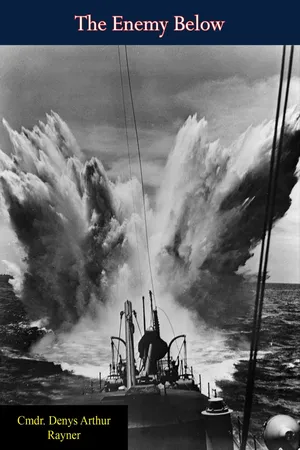
Plotting his strategy like a deadly game of chess, the destroyer captain doggedly tailed the elusive sub. Depth charge answered torpedo, cannon matched gun and finally man faced man in a climactic battle for supremacy at sea.
THE ENEMY BELOW was also made into the Academy Award winning 1957 movie, starring Robert Mitchum and Curt Jürgens, and produced and directed by Dick Powell.
THE ENEMY BELOW..."Simply terrific!"—Christian Herald
THE ENEMY BELOW..."Commander Rayner has spun a grand yarn. The battle he has described is a thriller, a cross between a game of chess and a hunt to the death. He tells it well, with mounting suspense, much clever manipulation of the possibilities of naval action and with a slam-bang climax which ought to be terrific in the forthcoming movie."—The New York Times
THE ENEMY BELOW..."A thumping good narrative of primordial war at sea told from an unusual point of view..."—The New York Times Book Review
- 130 pages
- English
- ePUB (mobile friendly)
- Available on iOS & Android
eBook - ePub
The Enemy Below
About this book
Information
Subtopic
European HistoryIndex
HistoryBOOK TWO — Asdic Duel
06.35, Zone Time, Wednesday, 8 September. Position 06° 23′ N. 33° 28′ W.
1
THE Hecate advanced upon her quarry. Circumstances had decided her Captain that he must attack up his adversary’s tail. There was no time to work out on her beam, and he did not wish to risk another torpedo attack by delaying his first too long. In any case an alert U-boat, fighting a single escort, would nearly always present her opponent with a stern attack by continually turning away from his approach. He was not to know either the urgency that existed in von Stolberg’s mind or the desperate attempts that that determined man would make in order to keep his rendezvous. The Hecate’s Captain knew nothing of the time nor place, nor could he realize the efforts that must be made if the rendezvous was to be achieved with the last twenty-eight hours submerged.
The British Captain was not entirely happy. Trained before the war in asdic trawlers, and until recently commanding a corvette, he was used to carrying out attacks by going into the asdic hut and there donning one set of headphones himself. In the destroyer, instead of leaving the bridge, he was expected to do the work with the aid of a loud-speaker. Mechanically the loud-speaker gave a faultless performance, but it had always seemed to him that slipping the headphones over his ears had the psychological effect of putting him in direct contact with the delicate instrument that was fixed to his ship’s bottom. Accustomed to one method, he found that the new one, dictated by the larger ship, was irksome in the extreme. Not being gifted with a really musical ear, he had managed by practice to teach himself to detect the smallest alteration in the tonal qualities of the echo that came back from the submarine. Alterations of tone that, betraying a change of course on her part, would be used to form his own decisions. This affinity with his instrument he found to be much more difficult to achieve now that the sounds came to him through the voice of a loud-speaker.
“Steer two-oh-eight.”
“Steer two-oh-eight.” The First Lieutenant at his action station by the standard compass relayed his Captain’s order to the wheelhouse. Here was cause for yet another vexation—the slight delay in time that relayed orders must cause, for he dared not imperil his hearing by mounting the raised plinth that surrounded the compass. To do so meant his leaving the sheltered corner of the bridge from whence he could best hear the loud-speaker. Another minor complaint, and one that did not in the early hours trouble him in any way, was that the Captain’s chair, which he alone had the right to use (although he assumed correctly that every officer of the watch used it too during the darkness of the night), was fixed beside the standard compass. At the moment he was far too excited to consider its use; but if the battle should be a prolonged one, it would have afforded rest to tired limbs.
“Echo bearing two-oh-nine. Going away. Range fifteen hundred,” announced the voice pipe from the asdic cabinet.
“Steer two-oh-nine.”
He had a well-trained ship. Everything should be functioning smoothly—as indeed it was. He crossed to a conical metal table on the port side of the bridge and raised the lid. This allowed him to view the automatic plot below. At the moment all he could see was the head and shoulders of the navigator.
“Stand back, Pilot, and let me have a look,” he said. On the deck below him the navigator straightened his back.
There the battle was laid out in colored chalk. Red for the enemy, blue for his own ship.
“Echo bearing two-one-oh. Going away. Range thirteen hundred.”
The navigator glanced inquiringly at his Captain.
“Plot it,” the Captain told him, and to the First Lieutenant: “Steer two-one-oh. I wonder where I’ve heard that course before!” He glanced again at the plot. The navigator, who had hurriedly marked up yet another red cross, was standing back again.
“He certainly is wedded to his course,” the Captain remarked.
“Double echoes, the first at twelve hundred, the second at a thousand,” the asdic voice pipe said.
The Captain crossed to the voice pipe. “Don’t lose the further one. Try and give the plot the range of both.” He went back to the plot.
“Asdic reports ‘double echoes.’ The wily bird may have slipped a pillenwerfer. I’ve told them to give you both ranges. If you find the first one stationary, tell me at once, and I’ll tell asdic to disregard it.”
“Echoes two-one-oh degrees. The first range seven hundred, the second nine hundred. First echo stationary,” the navigator said.
“Thank you, Pilot,” and to the asdic: “Disregard the first echo. It’s a pill.”
So the German thought to fox him with that old game. It was one that every escort knew well. The bubble-making canister would temporarily give off an echo that was very similar to one made by a submarine. The Germans had hoped that behind this underwater smoke screen they could slip away. But accurate plotting had detected the device.
“Submarine echo bearing two-one-oh seven hundred.”
The Captain noted the word “submarine” inserted in the report to show that the asdic officer knew the position. Hopkins certainly had his head screwed on correctly.
The Hecate bore down on her quarry. There was no last-minute dash or excitement. She did not tear into her prey with a wave leaping from either bow. At fifteen knots she trundled over the sea, much as the popular conception of a grizzly bear—rolling slightly and with plodding gait.
“Echo bearing two-one-oh. Five hundred. Interrogative depth settings, sir?” the asdic queried.
“I’d like to wait as long as I can before deciding on the depth. Set the charges to seventy-five feet. If I want to make a last-minute alteration, I may do so,” the Captain replied.
Hopkins in the asdic hut turned the dial that repeated the seventy-five-foot depth-setting order to the depth-charge party aft. That would start the ratings there in a hurried scamper to set the correct depth on the ten charges that were being prepared.
The Hecate’s Captain had no idea of the depth of his enemy; and the charges must be released correctly in plan and also set to fire at the right depth. The enemy could be anything up to six hundred feet below the surface. He would get some idea from the last contact with the U-boat. The asdic beam did not go straight down. Beneath the ship there was a cone of silence, the sides at an angle of sixty degrees. Within this cone the U-boat could not be detected. The farther away it was when it passed inside the cone, the deeper it must be. This presented still another problem for the Captain. When two escorts were present, the one attacking could estimate the depth with some accuracy and the other ship would then have an idea what depth to set on her charges when the time came for her own attack.
“Two-one-oh; four hundred.”
If only another escort was with him! Someone to whom he could signal, “Come over here, and help me with this one.” Another escort would enable him to break what he guessed would be an endless series of stern attacks. By working out on the beam the other ship would have come in across the submarine’s track as soon as the disturbance of his own bursting charges had subsided. Already he half regretted his grandiloquent words to the Doctor the night before. This “Chesapeake and Shannon,” single-ship fight was going to be a problem.
“Two-one-oh; three hundred.”
He must think of the depth-charge position too. He’d got to sink the enemy in ten tries—or if not sink her, then to force her to the surface, so that gun or ram could finish her off. Already he considered that she had shown too much spirit to hope for a surrender. The Hecate’s full complement of charges was one hundred and ten. When they had been with the convoy, ten charges had been spent on an attack on what was afterward classified as a non-submarine target. That left her only a hundred. Two ships would have had at least two hundred depth charges and would have been able to lay them more correctly.
“Lost contact ahead, sir,” said the asdic hut.
“Set charges to one fifty feet,” the Captain ordered.
Hopkins spun the wheel of the repeater. At the same moment he pressed the buzzer that was the “Stand By” for the depth-charge firing party mustered on the afterdeck.
Mr. Grain, Commissioned Torpedo Gunner in charge of the depth-charge parties, heard the buzzer.
“Stand by charges,” he shouted. Then his ear caught the higher, smaller note of the repeater bell, and out of the corner of his eye he saw the repeater begin to tick. “Set charges to one fifty,” he yelled and dashed to help set as many as he could in the short time available.
The procedure was now automatic. No one in the Hecate could know what the submarine was doing, for the destroyer was passing over the U-boat. They only knew what the boat had been doing. This knowledge had been put on the instruments that would fire the charges by electrical impulses.
Two charges were automatically released from the after rails. Leading Torpedoman Ellis was resetting the depth on the last of the ten charges. To steady himself he put his hand on one of the rails. The heavy depth charge rolled over it, shattering his wrist. He was assisted forward to the sick bay swearing softly and continuously. The accident was not known on the bridge until after the attack.
The depth-charge throwers barked, sending their charges wobbling through the sunlit air. Two on each side, four in all. Two more pairs of death-dealing canisters rolled from her rails. The eggs had been laid by the bird of death, but there was no time for the depth-charge crews to watch the explosions. Already Grain was lashing his men with his tongue to get the throwers reloaded and the rails refilled, for it was a point of honor in all the ocean escorts to reload at once. Two minutes was considered a bad time by a smart ship, where the difference between a good and a bad time was measured in seconds.
High on the bridge, expectant faces peered aft. The rising sun into which they looked warmed their tanned skins. The water astern shimmered golden and was broken by the wide, dark arrow of the Hecate’s wash. Then the explosions came—the bursting of the first charges, followed by more surface-shaking explosions, until the watchers wondered how anything made by man could possibly withstand the terrible shock.
The silence after the last explosions was almost palpable, and for a while men lowered their v...
Table of contents
- Title page
- TABLE OF CONTENTS
- AUTHOR’S NOTE
- BOOK ONE - Radar Sparring
- BOOK TWO - Asdic Duel
- BOOK THREE - Gun Battle
- BOOK FOUR - Cold Steel
- BOOK FIVE - Fisticuffs
- REQUEST FROM THE PUBLISHER
Trusted by 375,005 students
Access to over 1.5 million titles for a fair monthly price.
Study more efficiently using our study tools.
Frequently asked questions
Yes, you can cancel anytime from the Subscription tab in your account settings on the Perlego website. Your subscription will stay active until the end of your current billing period. Learn how to cancel your subscription
No, books cannot be downloaded as external files, such as PDFs, for use outside of Perlego. However, you can download books within the Perlego app for offline reading on mobile or tablet. Learn how to download books offline
Perlego offers two plans: Essential and Complete
- Essential is ideal for learners and professionals who enjoy exploring a wide range of subjects. Access the Essential Library with 800,000+ trusted titles and best-sellers across business, personal growth, and the humanities. Includes unlimited reading time and Standard Read Aloud voice.
- Complete: Perfect for advanced learners and researchers needing full, unrestricted access. Unlock 1.5M+ books across hundreds of subjects, including academic and specialized titles. The Complete Plan also includes advanced features like Premium Read Aloud and Research Assistant.
We are an online textbook subscription service, where you can get access to an entire online library for less than the price of a single book per month. With over 1.5 million books across 990+ topics, we’ve got you covered! Learn about our mission
Look out for the read-aloud symbol on your next book to see if you can listen to it. The read-aloud tool reads text aloud for you, highlighting the text as it is being read. You can pause it, speed it up and slow it down. Learn more about Read Aloud
Yes! You can use the Perlego app on both iOS and Android devices to read anytime, anywhere — even offline. Perfect for commutes or when you’re on the go.
Please note we cannot support devices running on iOS 13 and Android 7 or earlier. Learn more about using the app
Please note we cannot support devices running on iOS 13 and Android 7 or earlier. Learn more about using the app
Yes, you can access The Enemy Below by Cmdr. Denys Arthur Rayner in PDF and/or ePUB format, as well as other popular books in History & European History. We have over 1.5 million books available in our catalogue for you to explore.