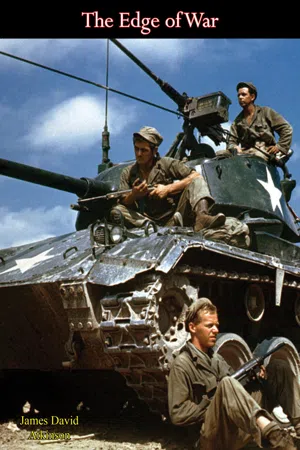
Originally published in 1960, in The Edge of War Georgetown University associate professor and author James David Atkinson provides an examination of both the Western and Communist approaches to war. He also covers the evolution of unconventional war, and includes case histories of Guatemala and the stand-up of the Shah of Iran.
"It is a privilege to have the opportunity to state my agreement with Dr. Atkinson's general thesis and especially his observation that 'warfare of the latter part of the 20th Century is, above all, a battle of the spirit, of ideas, and of the human will.' This battle will be fought in the hearts, in the minds, and in the souls of men everywhere. It is hoped that this book will serve to awaken many to this fact."—Adm. Arleigh A. Burke
- 221 pages
- English
- ePUB (mobile friendly)
- Available on iOS & Android
eBook - ePub
The Edge of War
About this book
Information
Subtopic
European HistoryIndex
HistoryThe Edge of War
CHAPTER 1 — The American Approach to War
“The successful development of the Bolshevist doctrine throughout the world can only be effected by means of periods of rest during which we may recuperate and gather new strength for further exertions. I have never hesitated to come to terms with bourgeois governments, when by so doing I thought I could weaken the bourgeoisie. It is sound strategy in war to postpone operations until the mortal blow possible.”{1} So wrote Lenin. We Americans have often acted as though warfare were a matter of bullets, bombs, and bloodshed. It may be all of these. But long before nuclear weapons or guided missiles, warfare was also ideas. Nuclear weapons and guided missiles have not changed the power of ideas. They have, instead, raised them to a higher threshold of man’s consciousness. Today, as Lenin recognized, the ideas which soften up a nation for the knockout blow may be more important than the blow itself.
For in either the long or short run, it is ideas, not material things, which are portentous for right or wrong. It has not been until our own times that men generally have come to see how intimately their own daily lives may be affected by the theories—often seemingly esoteric—propounded by ideologues remote from the seats of power and responsibility. It is, perhaps, grimly paradoxical that in an age when scientific endeavor has reached undreamed of heights of achievement, ideas have become even more portentous for human destiny. This is so because political and military theorists more and more direct, guide, and condition the awesome forces of the atom and the mechanical creations of man in the latter part of the twentieth century. Twenty years ago who among us would have attached much significance to the theories of war and politics propounded by an almost unknown Chinese named Mao Tse-Tung? And even today Americans tend to be much more concerned about the fact that Sputniks have been put into orbit rather than about the implications which such devices may have as regards the creation of a fear psychosis, the creation of a feeling of insecurity and lack of confidence in our American government and way of life, and in the possibilities thereby raised for Communist nuclear blackmail.
Americans have, in general, been more inclined to disregard theoretical concepts in this way than have Europeans or Asians. The story is told of the famous Madison Avenue tycoon who, in the midst of a business conference, rushed to a dictating machine and bellowed, “Have somebody give me a memo on what this philosophy of Thomas Aquinas is all about.” Whether apocryphal or not, the story is revealingly typical of our approach toward speculative thinking generally. It can even be more strongly underscored with reference to the American attitude towards speculative thinking about warfare. Sir Charles Oman, the British military historian, declared that not only the historians of medieval days but also the nineteenth-and twentieth-century historiographers had no precise understanding of the true nature of war. They often did not look beyond the aspect of losses or brutalities. Medievalists and moderns alike tended to cover up their lack of knowledge or often their disdain of military affairs by downgrading the historical significance of such events.
Sir Charles’ observations are even more valid with reference to the United States, since our historians, and our writers generally, have, with some exceptions, given scant attention to military history and even less to philosophical speculation about war. As the brilliant historian of naval affairs Professor Samuel Eliot Morison has said, there has been, especially in the historical writing in the United States in the 1920’s and 1930’s, a trend that has “ignored wars, belittled wars, taught that no war was necessary and no war did any good, even to the victor.” Happily, an opposite tendency has been developing in intellectual circles within the past decade; yet even today military history often remains a minute chronicle of commanders, battles, and places; and many of us still shy away from speculative thinking about war. This tendency may be, in part, because the study of the history of ideas has only recently attained a firm place among thinkers and critics. Now that many scholars are at work exploring the ideas behind literature and the fine arts as well as all forms of scientific endeavor, it would seem that the time is ripe for broad investigations into the ideas behind military strategy and tactics and the development of weapons and communications.{2}
THE ROLE OF FORCE IN AMERICAN THOUGHT
The American intellectual heritage has been to regard warfare (that is, organized force) either as absolutely immoral and hence to be abolished—root and branch—or as so unreasonable and repugnant to those of intellectual attainments that it will, in some mysterious way, be exorcised by the spirit of reason. Those of our philosophers who have taken up the study of war have usually been content either to dwell on its immoral nature and to look to some legal means for suppressing it or to view war as so unreasonable that it will eventually disappear or can, in some way, be driven from the minds of men. “The fatalistic view of the war-function is to me nonsense,” declared the American philosopher William James, “for I know that war-making is due to definite motives and subject to prudential checks and reasonable criticisms, just like any other form of enterprise. And when whole nations are the armies, and the science of destruction vies in intellectual refinement with the sciences of production, I see that war becomes absurd and impossible from its own monstrosity. Extravagant ambitions will have to be replaced by reasonable claims and nations must make common cause against them.”{3} Remarkably, we see in the world of the latter part of the twentieth century echoes of this view that war has become absurd and impossible from its own monstrosity.
Today such views take as their basis the idea that the terrible destruction which would be wrought by the use of large-scale nuclear weapons has brought warfare to a dead-end street. Thus, much credence is given to expressions in the press, over the air waves—and especially in intellectual circles—that war is unthinkable, that war is too horrible to contemplate in the nuclear era, and, wonder of wonders, that war has finally abolished itself! The unfortunate fact is that while war may have reached a stage in which it is unthinkable to many in the civilized world, war, or at least new forms of warfare, may still remain thinkable to Russian, Chinese, and other Communist leaders. This tendency to consider war as unthinkable is, however, not really new in the American experience. Despite Jefferson’s suggestion that military affairs should constitute a definite part of American education, we have often looked askance at the role of military power—of organized force—in human affairs and, as a result, have usually failed to understand the raison d’être for the employment of force. When the preponderance of the intellectual climate of opinion regards warfare as intrinsically evil, there is apt to grow up, equally, a climate of opinion which does not understand how force can best be employed and which therefore may oscillate between the extremes of abdication of the use of force in any eventuality and the unlimited use of force.
Although not an American, Lord Bertrand Russell, the well-known philosopher, might be said to exemplify one extreme attitude toward the employment of force in the present nuclear age. He has been reported as having stated in an interview that it would be preferable to live in a Communist-dominated world rather than risk a nuclear war. While it is difficult to quarrel with Lord Russell’s efforts to obtain peace, it would appear that such efforts are out of touch with reality. In fact, one might employ the idiom of that well-known television and screen personality, Mr, Elvis Presley, to ask the noble lord whether existence under Soviet control would really be living? The student of military affairs must refuse to accept such a simple answer to a problem so complex as modern warfare. In the first place, the values at stake—human dignity itself and a host of others precious to our heritage—are so great that the risk even of an all-out war is far preferable to an abject surrender. More probable, also, is the fact that the warfare of the future will not involve a nuclear holocaust since the parties involved will retain their freedom of action to prosecute the war by measures short of total destruction.
That the problem is by no means a simple question of either total submission or total destruction has been presented in a challenging fashion by Pope Pius XII, who speaking on the subject of war stated: “the battlefield and the weapons ready for use are of unimaginable power. Thus the problem of national defense assumes an ever increasing importance, its problems are as complex as they are difficult to solve. This is why no nation which wishes to provide for the security of its frontiers, as is its right and absolute duty, can be without an army proportionate to its needs, supplied with all indispensable material; ready and alert for the defense of the homeland should it be unjustly threatened or attacked.” The prevention of the dilemma of having to choose between surrender in the face of nuclear blackmail threats on the one hand and total nuclear war on the other may, therefore, be precluded by the maintenance of powerful defense forces which possess a wide range of capabilities—land, sea, air, and unorthodox warfare combat potentials. Equally essential for survival—and almost infinitely more basic—is the possession of a philosophical approach which recognizes, above all, the necessity for the defense of the values of our Judaeo-Christian civilization and which, secondly, prepares an intellectual atmosphere conducive to the selection of the proper amount of force for the needs of the particular situation which arises. We will not be well served, however, by the dogmatic acceptance of the idea that any use of force is to be avoided under any circumstances.
AMERICAN MILITARY THINKERS
American scholars—whether philosophers, historians, or political scientists—have in the past tended to avoid coming to grips with the theoretical side of warfare. This has perhaps been the result of the seeming security, throughout our history, offered by the vastness and the geographical location of America. In his classic history of the United States during the administrations of Jefferson and Madison, Henry Adams held that in the American mentality repugnance to war held first place among political characteristics. As a result of their relative security most Americans looked at war in a peculiar light.{4} In addition to this antipathy of the American character towards war—which observers from De Tocqueville onwards have noted—there has been a somewhat opposing tendency noted by some writers. This might be called the myth that a million men will spring to arms and that one true-blue American is, at least in military matters, a match for ten other men. Nothing has been so persistent in our mythology; yet nothing has been so lacking in actual fact. As that peculiarly American genius Homer Lea wrote in the early twentieth century, “the modern American’s conception of military efficiency is but a succession of heroics culminating in victory. This heroism of dreams, this valor of the rostrum, is based, not upon the real history of past military achievements, but upon the illusions of them...[and] as the social and industrial, ethical and political organism of this nation becomes more and more complex...the self-deception of the people as regards their inherent military capacity becomes more dominant and unreasonable.”{5} And he went on to issue the warning, more prophetic for the 1960’s than for the early 1900’s, that “the self-deception of a nation concerning its true militant strength increases at the same ratio as its actual militant capacity decreases.”{6}
Thirty-eight years and two world wars after Homer Lea’s prophetic words, Americans in Korea were confronted with a display of force by a ruthless and determined enemy. Once again we had failed to remember that blind confidence in our industrial superiority or the wonders of our twentieth-century civilization was not a substitute for armed might.{7} In spite of the terrible lessons of two world wars, we neglected to do our homework in the vital area of military thinking. Americans still possessed, as they had from Bunker Hill to the Battle of the Bulge, courage to fight against odds, but their country still retained the tradition of unpreparedness for war.{8}
Thus two essentially opposing currents of thought in the American heritage—the concept of warfare as essentially evil and hence to be avoided by pretending that it is not there, and the concept of a million men springing to arms (sometimes to non-existent arms) and winning glorious victories—would seem to have hindered the development of speculative thinking among our scholars and publicists about the nature of warfare. One might add, too, a third factor: geographic location, which has long been embodied in the concept that America’s remoteness from the rest of the world and her boundaries with relatively weak and friendly powers offered us long-range security. This has permitted American scholars and thinkers to speculate along almost any lines except those of a military nature and has led them to regard the necessity for military studies as something in the nature of a temporary aberration which could be quickly disposed of to permit a return to more pleasant pursuits of the mind.
Since the armed forces of a nation are an outgrowth of the national character and of the total cultural heritage of the nation, it might be expected that our professional soldiers, sailors, marines, and airmen would, as a reflection of that national character, likewise tend to avoid coming to grips with the theoretical side of warfare. Such has been the case. Americans have distinguished themselves in the fields of military tactics, ordnance, engineering—indeed, in the military arts in almost every area—but we have contributed much less to the speculative side of warfare. Our outstanding contributions to war have been in the areas of logistics, tactics, and technics. When forced into a war, however, we have been more than a match in intellect, resourcefulness, and resolution than those with whom war is an avocation. But Admiral Mahan remains our sole military philosopher of a stature comparable to Clausewitz or Jomini.{9}
ADMIRAL MAHAN
With the possible exception of General William “Billy” Mitchell, the only American who stands out as a great military theorist in the ranks of those philosophers or theorists of warfare on a global basis is Admiral Alfred Thayer Mahan. General Mitchell was the first military theorist to conceive of the employment of air power in worldwide terms and, in many respects, must be considered as having contributed more to the theory of air warfare than the other great speculative thinker about air power, the Italian General Giulio Douhet. General Mitchell must be recognized as an original thinker about the military art He is, however, so close to our own times that it remains rather difficult to obtain a completely fair judgment on his contributions to military theory and his exact place in the galaxy of philosophers of the military art. A detailed scholarly study of General Mitchell’s contributions to the theory of war is very much needed.
About Admiral Mahan there is little room for doubt. Historians have rightly assigned to Mahan a place among the greatest of the military theorists of all time. In a series of books and articles which began with his classic The Influence of Sea Power Upon History (1890) Mahan not merely developed a historical chronicle of war at sea but evolved theoretical doctrines for the employment of sea power to such an extent that he may well be said to have been the creator of the first unified body of theory and doctrine on this subject. One modern analyst considers that Mahan soon came to hold a place akin to that carved out in the theory of land warfare by Clausewitz and others.{10} Professor Margaret Tuttle Sprout goes even further when she states that “no other single person has so directly and profoundly influenced the theory of sea power and naval strategy as Alfred Thayer Mahan.”{11} This is certainly not an extravagant claim, since Admiral Mahan’s contributions to military theory went well beyond his concepts of sea power. The great German authority on geopolitics, General Karl Haushofer, has written that it was Admiral Mahan who educated America’s political leaders so that they began to think in terms of global power and expanded space, and writers on geopolitics generally have recognized Mahan’s contributions to this field. More recently, one of Britain’s most distinguished writers in the field of strategy, Air Vice-Marshal Kingston-McCloughry, has indicated that he believes Mahan to have been even greater than Clausewitz, since Mahan’s “method resembled a two-way traffic system: sea-power/history, and history/sea strategy: Clausewitz’s method...
Table of contents
- Title page
- TABLE OF CONTENTS
- DEDICATION
- FOREWORD
- PREFACE
- CHAPTER 1 - The American Approach to War
- CHAPTER 2 - The Communist Approach to War
- CHAPTER 3- The Evolution of Warfare: Attempts to Eliminate War and Two World Wars
- CHAPTER 4 - The Evolution of Warfare: Unconventional Warfare
- CHAPTER 5 - American Experience in Unconventional Warfare
- CHAPTER 6 - The Fusion of War and Peace
- REQUEST FROM THE PUBLISHER
Trusted by 375,005 students
Access to over 1.5 million titles for a fair monthly price.
Study more efficiently using our study tools.
Frequently asked questions
Yes, you can cancel anytime from the Subscription tab in your account settings on the Perlego website. Your subscription will stay active until the end of your current billing period. Learn how to cancel your subscription
No, books cannot be downloaded as external files, such as PDFs, for use outside of Perlego. However, you can download books within the Perlego app for offline reading on mobile or tablet. Learn how to download books offline
Perlego offers two plans: Essential and Complete
- Essential is ideal for learners and professionals who enjoy exploring a wide range of subjects. Access the Essential Library with 800,000+ trusted titles and best-sellers across business, personal growth, and the humanities. Includes unlimited reading time and Standard Read Aloud voice.
- Complete: Perfect for advanced learners and researchers needing full, unrestricted access. Unlock 1.5M+ books across hundreds of subjects, including academic and specialized titles. The Complete Plan also includes advanced features like Premium Read Aloud and Research Assistant.
We are an online textbook subscription service, where you can get access to an entire online library for less than the price of a single book per month. With over 1.5 million books across 990+ topics, we’ve got you covered! Learn about our mission
Look out for the read-aloud symbol on your next book to see if you can listen to it. The read-aloud tool reads text aloud for you, highlighting the text as it is being read. You can pause it, speed it up and slow it down. Learn more about Read Aloud
Yes! You can use the Perlego app on both iOS and Android devices to read anytime, anywhere — even offline. Perfect for commutes or when you’re on the go.
Please note we cannot support devices running on iOS 13 and Android 7 or earlier. Learn more about using the app
Please note we cannot support devices running on iOS 13 and Android 7 or earlier. Learn more about using the app
Yes, you can access The Edge of War by James David Atkinson in PDF and/or ePUB format, as well as other popular books in History & European History. We have over 1.5 million books available in our catalogue for you to explore.