Many people will be made angry by this book. They will be angry first at its author for daring to attack the memory of Franklin Delano Roosevelt. Then, as they read with an increasing sense of shame this shocking story of the summit conferences of World War II, they will be moved to anger at F.D.R. himself.
The trust which the American people bestowed in the leadership of Roosevelt is a matter of historical record. The manner in which the four-times President used that trust is only little by little coming to be realized.
The truth is that ever since "victory" was won, western civilization has been at bay, with men everywhere preparing for new wars. What went wrong? Was there a monstrous miscalculation? Bad faith in high places? Incompetence? What really happened at the fateful summit conferences of World War II? The documents, notes, and memoirs of men who were there—at Casablanca, Teheran, and Yalta and the others—how now dredged up the pieces of a horrendous jigsaw puzzle. ROOSEVELT'S ROAD TO RUSSIA, for the first time, puts the pieces together.
"Crocker has presented this sad epoch in American history more interestingly and more competently than any previous writer…[he] gives the first complete picture of just how and why we lost the peace…[it] is an important contribution to the history of our times. We are in danger of being deceived by Khrushchev as Roosevelt was deceived by Stalin. Let us read this record as Crocker has faithfully compiled it and heed the warning!"—H. V. Kaltenhorn
"A tale of colossal incompetence, monstrous misunderstanding, outrages of freedom...it should be read by everyone who wants to understand the world today."—The Chicago Tribune
"…a scholarly brief with all the logic and persuasion of a grand jury presentation…"—Columbus Dispatch
- 266 pages
- English
- ePUB (mobile friendly)
- Available on iOS & Android
eBook - ePub
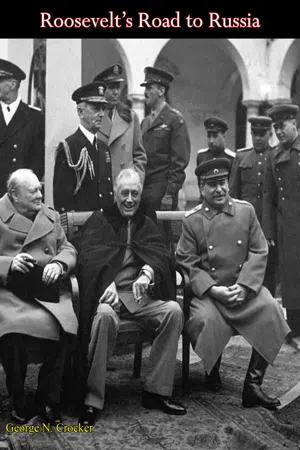
Roosevelt's Road to Russia
About this book
Information
Subtopic
European HistoryIndex
HistoryPART ONE — Two Men and a Secret
...for that nothing doth more hurt in a state than that cunning men pass for wise.
SIR FRANCIS BACON
Chapter I — “...AND BY ME.”
LORD ACTON’S famous dictum that power tends to corrupt and absolute power corrupts absolutely may have come to the minds of many Americans as they sat before their radios on March 1, 1945. President Roosevelt was addressing Congress, reporting on his trip to Yalta. Poland had been partitioned, and the Lublin Committee, the coterie of Polish Communist puppets, coached by Stalin, had in effect been made masters of the remnants of that unhappy country. To veil this outrage, Roosevelt pretended that what had occurred was a harmless compromise by men of good will. But in expressing this thought, he gave his listeners a glimpse into the workings of his mind by means of a peculiar choice of words, carelessly ad-libbed (and later expurgated from the authorized Roosevelt Public Papers). The solution to the Polish question, said he, had been “agreed to by Russia, by Britain and by me.” Explaining further, he added that “we couldn’t go as far as Britain wanted to go in certain areas, as far as Russia wanted in certain areas, and as far as I wanted in certain areas.”{4}
L’état c’est moi! Had a creeping megalomania eaten into the mind of this failing man, who was now in his thirteenth year as President of the world’s mightiest nation and who had been giddily consorting with kings, potentates, and dictators? Had the plenitude of power which had been entrusted to him to distribute vast American resources throughout the world led him gradually to identify himself personally as the source of this largesse and to project this conception to the whole field of foreign affairs? Or was he trying to be meticulously Constitutional, being aware that treaties may be entered into by the sovereign United States only with the consent of the Senate?
Roosevelt did not then, or ever, present the Yalta agreement to the legislative branch of the government as a treaty.{5} He obviously did not care to treat it as such. What was it, then? An “executive act” within any Constitutional area of jurisdiction of the President? It was never made clear what Roosevelt considered it to be from the legal standpoint, either under national or international law—if he ever gave the matter a thought. In essence, it was a personal agreement by Roosevelt with the Prime Minister of Great Britain and Stalin of Russia changing boundaries of Poland and other nations and determining the nationality of some millions of unconsulted human beings. Manifestly seeing neither the comedy nor the tragedy in such a performance and as unabashed as he would be if announcing a plan for the exchange of some grain and timber, Franklin D. Roosevelt had it within his nature to say to the world that all of this had been agreed to by Russia, by Britain, “and by me.”
It was this agreement that Arthur Bliss Lane, our Ambassador to Poland, branded “a capitulation on the part of the United States.” Horrified and saddened, he resigned and wrote a book entitled I Saw Poland Betrayed.{6} A secret document concerning the Far East had also been signed “by me” at Yalta. Of it, William C. Bullitt, who had been American Ambassador to Russia and to France, later wrote: “No more unnecessary, disgraceful and potentially dangerous document has ever been signed by a President of the United States.”{7}
The “by me” spirit pervaded all of Franklin D. Roosevelt’s conduct of foreign affairs. With the pushful Harry Hopkins at his side and with a powerful government war information agency under his thumb, he made foreign policy his private province. His Secretary of State, the conscientious Cordell Hull, became a figurehead. Both the President and Hopkins, who saw alike on all important issues, including the desirability of getting Franklin D. Roosevelt re-elected ad infinitum, were pertinacious men and were not tolerant of opposition or interference. When Hull resigned his cabinet post right after the election of 1944 (Roosevelt having persuaded him to stay until the election was over), James F. Byrnes was a possible choice to succeed him. Hopkins opposed Byrnes on the ground that Roosevelt was going to be his own Secretary of State, particularly in direct dealings with Churchill and Stalin, and Byrnes (who had once told Hopkins to “keep the hell out of my business”) was not one to fit himself placidly into the role of a mere mouthpiece. So the obliging Edward R. Stettinius, who already had a perfect record in taking orders from Hopkins as Lend-Lease Administrator and as Under Secretary of State, was selected to be the “mouthpiece.{8}
At the close of World War I, Woodrow Wilson had gone abroad to negotiate a treaty of peace. Franklin D. Roosevelt, both before and during World War II, traveled far and wide as no American President had ever done before. On those trips he made vast commitments of a military and political nature, some of which were long kept secret. The Congress, first on his pretension that he would keep the country out of war and later on his assurance that his policies would “win the peace,” made available to him, for disposal at his almost unlimited discretion, billions upon billions in dollars and resources. No President of the United States ever exercised such enormous powers nor in so autocratic a manner. Therefore, a heavy responsibility must inevitably overshadow his memory. The tragic consequences which have followed so many of his acts, and so many of his almost incredible omissions, cannot justly be laid at the door of fate or charged alone to the wickedness or intransigence of other men.
It was Roosevelt who impetuously blurted out the “unconditional surrender” ultimatum at a press conference in Casablanca, to the surprise of Winston Churchill, who was sitting at his side and who had no alternative but to nod approval.{9} This ill-considered policy has been branded by Hanson W. Baldwin and other sober authorities in this country and in England as one of the blunders that prolonged the war and lost the peace.{10} It was Roosevelt who, at Quebec, put his initials to the barbaric Morgenthau Plan for the pastoralization of Germany, a scheme which later years were to prove so unfortunate and which had to be abandoned for the good of all Europe before it was ever fully implemented. When Roosevelt returned to Washington from Quebec, he confided to his shocked Secretary of War, Henry L. Stimson, that “he had evidently done it without much thought.”{11} But this is not a very convincing disclaimer, for the Morgenthau Plan meshed too well with the rest of the Roosevelt-Hopkins pattern for Europe.
It was Roosevelt who obstinately blocked Churchill’s plan for attacking Germany through the Balkans and insisted instead upon the Russian-favored strategy of the Normandy invasion. This was another decision that had disastrous consequences for the future, delivering eastern Europe to the Communist terror and making another war virtually inevitable.{12} It was Roosevelt who would brook no stint in the lavishing of Lend-Lease upon the Russians and who exacted no conditions to safeguard the future security of Russia’s neighbors or of this country itself while the power to do so was still in his hands. And it was Roosevelt—personally and willfully and with the ominous shadow of the world’s next great threat already plain for such as he to see—who took such men as Harry Hopkins and Alger Hiss with him halfway around the world to the suburbs of Russia, in the year 1945, to talk to Stalin and to bribe the Soviet Union to enter the war with Japan just in time to pluck the fruits of victory.
As the record unfolds and as events come to be seen in the perspective of time, it becomes more and more difficult to exculpate Franklin D. Roosevelt. Even the men who were of his official family have, in later days, either given up the attempt or have drifted into a morass of mutual contradiction. Stettinius, last Secretary of State, who was at Yalta with the President, felt impelled to produce, four years after Roosevelt’s death, a lengthy apologia for the Yalta Conference. Although by that time it had become apparent to all the world that the fruits of Yalta were sour indeed, Stettinius was unabashed to write in his book that it was, “on the whole, a diplomatic triumph for the United States and Great Britain.”{13} James F. Byrnes, who was also at Yalta and who succeeded Stettinius as Secretary of State under President Truman, chooses to wash his hands of most of the ill-fated agreements made at that conference and takes pains to point out that the secret protocol promising Russia certain Japanese territory and important concessions in China was signed by Roosevelt the day after Byrnes, thinking the conference was over, had left for home. The impression that Roosevelt, or those who had his ear at the time, did not want Byrnes to know about this deal is irresistible. It was not until some time after Roosevelt’s death that a safe in the White House yielded the astonishing document.{14} General Patrick J. Hurley, Roosevelt’s wartime Ambassador to China, has characterized this secret agreement as a “blueprint for Communist conquest of China.” With a lingering loyalty, perhaps, to his old chief, he explained that Roosevelt was “a sick man” at Yalta.{15} Farley, Stimson, Hull, and others have said or implied the same thing. Even Robert E. Sherwood, one of the White House ghost writers and certainly never one to tarnish the memory of his idol, is constrained to say that when Roosevelt agreed to the provisions concerning Manchuria (which he did in China’s total absence from the conference, and clandestinely) he was “tired and anxious to avoid further argument”{16} Perhaps this appeals to Sherwood as a felicitous explanation of what happened at Yalta. The moral monstrousness of diplomacy, touching the fate of millions of people, being conducted on such a basis seems not to have occurred to him.
One tragicomic facet of this illicit bargain was that it would be Russians, not Americans or Chinese, who would accept surrender of Japan’s Kwantung Army. That Army’s huge stores, the Mukden Arsenal, and the industrial facilities of Manchuria were to be handed on a platter to the Russians, who were to arrive on the scene in American-made jeeps, tanks, and trucks, uniformed, booted, and armed out of the supplies pledged by President Roosevelt at Yalta, to be carried on a hundred American ships across the Pacific Ocean to Vladivostok.
The “blueprint,” to use General Hurley’s metaphor, served its purpose well. The next five years saw the carrying out of the Communist conquest of China, followed by the embroilment of the United States in war in Korea in a belated and costly move to stem the tide of Russian expansionism.
When Joseph C. Grew, the pre-war Ambassador to Japan, learned about that secret Yalta deal, he wrote a grave memorandum which the State Department promptly locked up out of sight. Once Russia is in the Japanese war, he predicted, “Mongolia, Manchuria and Korea will gradually slip into Russia’s orbit, to be followed in due course by China and eventually Japan.”{17}
Time has not yet run out on that prediction. For Japan, the word was “eventually.” There is no mystery about why, year after year, the East China Sea and the Sea of Japan must bristle with American warships and planes patroling in battle readiness.
Nor is there any mystery about how the Soviet empire expanded during and soon after World War II to the point where 800,000,000 people were under its rule instead of the pre-war 170,000,000. Estonia, Latvia, Lithuania, half of Poland, a chunk of Finland, a big slice of Rumania, pieces of Manchuria, the Japanese half of Sakhalin, and all of the Kurile Islands were annexed. Mongolia was torn from China and practically incorporated into Russia’s Siberian hinterland. Poland, Hungary, Rumania, Bulgaria, Czechoslovakia, East Germany, China, and North Korea became satellite states. Of these gains, the industrial areas of East Germany (Silesia) and Czechoslovakia were the most valuable asset in modern resources. In Asia, Manchuria was the key to enormous industrial potentials, while China as a whole represented an inexhaustible source of manpower for almost any purpose—agricultural, industrial, or military. This vast Eurasian storehouse, workshop, and labor pool, all to be put to the service of Russian foreign policy, was the prize Stalin sought and won.
That Roosevelt was “a sick man” at Yalta—in truth, a dying man—is hardly to be disputed in view of the evidence concerning his physical condition which has subsequently come to light. His extraordinary statement to Congress on March 1,1945, in his report on the conference, that “I was well the entire time” and “I was not ill for a second until I arrived back in Washington” can only be taken as an example of the duplicity to which he so frequently felt free to resort in order to allay public suspicions. There is pathos in the picture of this pale and shaking man, with sagging jaw and cavernous eyes, addressing the Congress and feeling it politic to say, in a speech broadcast to his country and to the world, that he had just returned from his trip “refreshed” and that he had not been ill “for a second.” It is shocking to reflect that he could treat the truth so casually and to be reminded by so glaring an example that the half-truth or, if need be, the plain prevarication came so easily to his lips whenever political repercussions unfavorable to him might ensue from honesty.
However, to blame the Yalta debacle on Roosevelt’s state of health or to shield him from culpability on that ground is to take too easy a way out. Yalta followed the pattern of statesmanship—if it can be called that—which Roosevelt, Hopkins, and the other favored Presidential intimates, “advisers,” and “experts” had already established in their handling of the foreign affairs of the country. It was a natural extension of the habitual procedure of abject and reckless appeasement of the appetites of the Soviet Union. If that was Roosevelt’s policy when he was sick, it had also been his policy when he was well. From the Atlantic Charter through Quebec, Casablanca, Cairo, Teheran, and Yalta, as well as by his instructions to the emissaries he sent to other meetings in London and Moscow, the role he played in this respect was always the same, as the following chapters of this book will show. By intention and deed he not only built up the pow...
Table of contents
- Title page
- TABLE OF CONTENTS
- INTRODUCTION
- PART ONE - Two Men and a Secret
- PART TWO - The Atlantic Charter: Platform for a War
- PART THREE - Wastebasket Road: Casablanca to Yalta
- APPENDIX
- REQUEST FROM THE PUBLISHER
Trusted by 375,005 students
Access to over 1.5 million titles for a fair monthly price.
Study more efficiently using our study tools.
Frequently asked questions
Yes, you can cancel anytime from the Subscription tab in your account settings on the Perlego website. Your subscription will stay active until the end of your current billing period. Learn how to cancel your subscription
No, books cannot be downloaded as external files, such as PDFs, for use outside of Perlego. However, you can download books within the Perlego app for offline reading on mobile or tablet. Learn how to download books offline
Perlego offers two plans: Essential and Complete
- Essential is ideal for learners and professionals who enjoy exploring a wide range of subjects. Access the Essential Library with 800,000+ trusted titles and best-sellers across business, personal growth, and the humanities. Includes unlimited reading time and Standard Read Aloud voice.
- Complete: Perfect for advanced learners and researchers needing full, unrestricted access. Unlock 1.5M+ books across hundreds of subjects, including academic and specialized titles. The Complete Plan also includes advanced features like Premium Read Aloud and Research Assistant.
We are an online textbook subscription service, where you can get access to an entire online library for less than the price of a single book per month. With over 1.5 million books across 990+ topics, we’ve got you covered! Learn about our mission
Look out for the read-aloud symbol on your next book to see if you can listen to it. The read-aloud tool reads text aloud for you, highlighting the text as it is being read. You can pause it, speed it up and slow it down. Learn more about Read Aloud
Yes! You can use the Perlego app on both iOS and Android devices to read anytime, anywhere — even offline. Perfect for commutes or when you’re on the go.
Please note we cannot support devices running on iOS 13 and Android 7 or earlier. Learn more about using the app
Please note we cannot support devices running on iOS 13 and Android 7 or earlier. Learn more about using the app
Yes, you can access Roosevelt's Road to Russia by George N. Crocker in PDF and/or ePUB format, as well as other popular books in History & European History. We have over 1.5 million books available in our catalogue for you to explore.