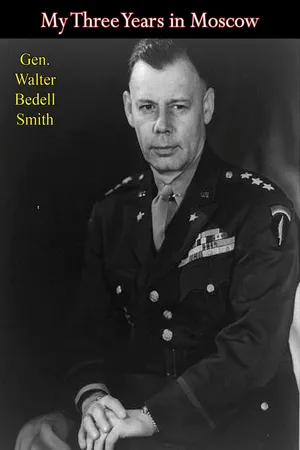
MY THREE YEARS IN MOSCOW is a good deal more than an account of diplomatic negotiations. General Smith undertook to study the whole framework of Soviet life-the people, their leaders and their institutions. In this study he had the help of a large and well-informed staff and, in addition, he has had the advantage of closer personal contact with Marshal Stalin than any other Westerner.
There are vivid portraits of the men who run the Soviet Union, all the way from the members of the all-powerful Politburo to the director of a small collective farm. There are revealing discussions of the efficiency of Soviet industry and agriculture. In the course of his duties General Smith met numbers of Russians of all kinds, and his pages contain fascinating sketches of them, thus building a picture of the life of the ordinary man in a collectivized economy. The American Ambassador had his own housekeeping problems, like the incident of the supply of fresh eggs, which eventually involved ponderous governmental machinery.
MY THREE YEARS IN MOSCOW is one of the important books of our time distinguished in its character and permanent in historical value.
"…casts more light on the Soviet system, on Marshal Stalin and on the tortuous twists and turns of Soviet policy than anything published thus far."—The New York Times
- 304 pages
- English
- ePUB (mobile friendly)
- Available on iOS & Android
eBook - ePub
My Three Years in Moscow
About this book
Information
Subtopic
European HistoryIndex
HistoryVIII — WAR OF WORDS
I had a good deal last winter to try my patience, for this Government possess in an exquisite degree the art of worrying a foreign representative, without giving him even the consolation of an insult. I was apprehensive for some time that there would be a breach of diplomatic intercourse. But the occasion that gave rise to this suspicion having passed off, nothing remains of a tangible nature to excite any disquietude.
—Excerpt from a dispatch of the American Minister to Russia, Neill S. Brown, dated St. Petersburg, May 27, 1852
NOT very many people have had the dubious distinction of being used to start a “peace offensive” in the middle of a “cold war,” with the Soviet Foreign Office mobilizing all its resources in a full-scale propaganda campaign designed to disrupt the diplomatic unity of the West.
Although this particular Soviet venture failed, the incident remains important because it taught all of us, the hard way, that the men in the Kremlin had carried over into peace the tactics of breaking confidence, of indulging in practices of deception, falsification and evasion which we had always hitherto associated only with relations between enemy states in time of shooting war. For us, it was the clinching evidence that propaganda as employed by the Soviet Union was a full-scale aggressive device which shifts its emphasis with the greatest flexibility from one to another of the political and psychological fronts in the struggle for men’s minds now being waged around the globe by the great powers.
The occasion was the now well known, but supposed-to-be-confidential series of talks which I had with V. M. Molotov, then Soviet Foreign Minister, in May of 1948. I had sought an interview with Mr. Molotov, on instructions from the State Department, to emphasize to the Soviet leaders the firmness and continuity of the bipartisan foreign policy of the United States Government and its intention to contain further Communist expansion by aggression, lest they be led astray by the sound and fury of American campaign oratory. This was at a time when at least a three-way race for the Presidency was assured in the 1948 elections, with Henry A. Wallace bidding for the pacifist vote in a Communist-supported attack upon the leaders of both the Democratic and Republican parties, whom he accused of courting war by being “too tough” with Russia. Neither the Republicans nor the Democrats had picked their candidates yet, and many men of varying opinions on domestic and foreign issues sought preferment. As the campaign developed, it was certain, regardless of the general agreement of an overwhelming majority of the American people on the fundamentals of foreign policy, that the conduct of international affairs would be debated; certain policies which the Administration had adopted and acted upon, and other proposals which it had rejected would be challenged and discussed. The men in the Kremlin are isolated and, because their own elections are rigged, cut-and-dried affairs, have no real conception of the interplay of opposing forces in a free election such as America holds every four years. We did not want them to get the idea that America was divided on basic issues or that its people were so concerned with domestic politics that they had relaxed their vigilance toward the tension spots of the international scene. We also did not want them to accept too blindly their own Marxist propaganda that an economic collapse was so inevitable in the United States that its strength as a world power could be discounted. The Soviet authorities had mistakenly attributed to Mr. Wallace far greater strength and significance than his campaign deserved. As a result, pressure on the Iranian and Turkish frontiers, and Communist support for the Greek guerrilla movement, had greatly increased.
These were the considerations which were in the minds of the President and the Secretary of State when I was instructed to call upon Mr. Molotov and to differentiate for him-and through him for the Politburo–the distinction between campaign speeches and statements, and the definite, firm, bipartisan character of the foreign policy of the United States, which had not and would not be changed however the election resulted. I was carefully prepared for this interview, and the State Department approved in advance the notes from which I made my principal statement of American policy.
My first meeting with Mr. Molotov, in this series, took place on May 4. I told him that I had been instructed to communicate to him informally, frankly and confidentially the position of my government. Our talk was courteous but grave. We discussed for several minutes the value of such informal and confidential communications in establishing a mutual understanding, as compared with the more formal conferences where publicity was unavoidable. There was no misunderstanding whatever of the confidential nature of this communication between an Ambassador and a Foreign Minister.
I then read from notes the following declaration, which has been published before, but which remains important today because it still represents the basic policy of the American Government:
“Two years ago, during my initial conversation with Generalissimo Stalin and yourself, I stated as clearly as possible my estimate of the inevitable reaction of the American people to the continuance of a policy by the Soviet Government which would appear to have as its purpose the progressive extension of the area of Soviet power. At that time I pointed out that it would be a grave misinterpretation of the fundamentally pacific character of the American people to believe that they would not react strongly and vigorously to the progressive domination by one country of its neighbors and the clear threat to the world community which such actions would imply.
“I emphasized at that time that the United States had no desire whatever to see the world divided into two major groupings, nor to divert a large part of its income to the maintenance of a military establishment which such a world situation would necessitate in elementary self-defense. It seemed apparent then that such a line of policy as that described would lead inevitably to a crystallization of the non-Soviet areas of the world, whose people would quite understandably feel themselves progressively threatened by such developments. It seemed also inevitable in such a case that the United States, as the strongest nation in this community, would be forced to take a leading part in this movement and to divert a large portion of its energy, which by preference our people would prefer to utilize for assistance in the reconstruction of the ravages of the war, to the maintenance of a military establishment adequate to meet the developing world situation.
“Unhappily, the apprehensions I felt at that time have been realized.
“Since that date, Soviet policies in Eastern Europe have produced the reaction which was predicted. The situation which has resulted is obviously one of great seriousness.
“The European community and the United States have become alarmed at the implications of Soviet policy, and are drawing closer together in mutual self-protection, but only in self-protection.
“It is for this reason that my government desires me to outline to you with complete clarity and frankness the position of the United States Government.
“There should be no mistake about the determination of the United States to play its part in these cooperative movements for recovery and self-defense. The concern and the determination of the people of the United States have been intensified by the inexplicable hostility of the Soviet Government to the European Recovery Program—a measure which in its inception and subsequent development is so obviously only a measure of American assistance for reconstruction on a cooperative basis without menace or threat to anyone.
“The tense situation which now prevails has been produced by the policies of the Soviet Government or by the actions of political groups apparently under its control, and there has followed a natural and inevitable reaction on the part of other countries, including the United States.
“My government has no idea what conclusions the Soviet Government has reached concerning the present attitude of the United States. It has noted that the picture of this attitude given by the Soviet press is dangerously distorted and erroneous. Whether, or in what degree, the members of the Soviet Government themselves believe this distorted version, my government has no means of estimating. For this reason I wish to make plain certain points on which my government considers it extremely important that there be no misunderstanding at this time.
“1. The policies of the United States Government in international questions have been made amply clear in recent months and weeks. They have the support of the overwhelming majority of the American people. They will continue to be vigorously and firmly prosecuted.
“It would be a grave error if others were to assume that domestic considerations, such as the forthcoming elections, would in any way weaken the determination of the United States to support what it believes to be right. The American people have always known how to separate domestic and foreign policy at the proper moment.
“Similarly, my government is aware that Communist organizations here and there have been disseminating propaganda to the effect that a forthcoming economic crisis in the United States will soon produce a radical change in American policies. It is hoped that no one will be so foolish as to forfeit the chances of progress toward world stability for the sake of an economic prognostication which has been proven wrong time and time again. Even those who persist in believing such a prognostication must, at the very least, realize that an economic crisis would not affect in any way our basic productive capacity nor our concept of the basic factors underlying our foreign policy.
“It must be emphasized that the present state of world affairs involves issues which the people of the United States consider to be vital to United States national security and to world peace. No one should deceive himself as to the seriousness of United States policy with respect to these issues.
“2. On the other hand, my government wishes to make it unmistakably clear that the United States has no hostile or aggressive designs whatever with respect to the Soviet Union. Assertions to the contrary are falsehoods which can result only from complete misunderstanding or malicious motives. United States policies have been so devised that they cannot possibly affect adversely the interests of a Soviet Union which seeks to live at peace with its neighbors and to refrain from attempts to exercise undue influence, directly or indirectly, in their affairs.
“In fact, many of the elements of United States foreign policy to which the Soviet press takes such strong exception today would never have come into existence if it had not been necessary for the United States to aid other countries to defend their own political integrity from attempts, on the part of Communist minorities, to seize power and to establish regimes subservient to foreign interests. Should these attempts cease, the necessity for some of the manifestations of United States foreign policy, which are apparently unwelcome in Moscow, would cease with them.
“The present state of United States-Soviet relations is a source of grievous disappointment to the American people and to the United States Government. As far as we are concerned, it represents a painful and undesired alternative toward which we have been driven, step by step, by the pressure of Soviet and world Communist policy. We still do not despair by any means of a turn of events which will permit us to find the road to a decent and reasonable relationship between our two countries, with a fundamental relaxation of those tensions which today exercise so unhappy an influence on international society everywhere. As far as the United States is concerned, the door is always wide open for full discussion and the composing of our differences.
“My government earnestly hopes that the members of the Soviet Government will not take lightly the position of the United States Government as here expressed. They have it in their power to alleviate many of the situations which today weigh so heavily on all international life. It is our earnest hope that they will take advantage of these possibilities. If they do, they will not find us lacking in readiness and eagerness to make our own contribution to a stabilization of world conditions entirely compatible with the security of the Soviet peoples.”
When I had concluded, Mr. Molotov, as we had anticipated he would, immediately moved to the counterattack, blaming the United States, instead of the Soviet Union, for the worsening of relations between the two Allies since the termination of shooting hostilities between the Axis powers, but said the new statement of American policy would be carefully considered by the Soviet Government—meaning the Politburo—without whose authorization he could not speak. I told him that if it would be of any assistance to him and the Soviet Government I would be glad to provide him, informally, with a copy of the notes from which I had spoken. He accepted, and a copy was sent to the Foreign Office as soon as I had returned to the Embassy on Mokhovaya Ulitsa, just across the street from the north wall of the Kremlin.
Five days later, the Soviet Foreign Office telephoned and said that Mr. Molotov would receive me to give his government’s answer to my statement. When I reached his office, Mr. Molotov, grave and unsmiling, began, as I had done before, to read from notes the statement of his government.
He said, first of all, that the Soviet Government “shared the desire expressed by the government of the United States of America to better these [Soviet-American] relations,” and would agree to the American proposal that the two governments should begin “a discussion and settlement of the differences existing between us.”
That was the only harmonious note in the long statement that followed, and that single note of harmony was based upon a misinterpretation, unconscious or deliberate, that we were willing to discuss with the Soviet Union alone and without the participation of France, England, China and the other great powers the issues of transcendant world importance which I had stated to Mr. Molotov earlier were the causes of worsening relations between his country and mine.
In any event, it became clear as Mr. Molotov proceeded that the leaders of the Soviet Government had missed or deliberately ignored the principal points I had sought to make—that the American public was overwhelmingly united in support of a bipartisan foreign policy of containing aggressive Communist expansion and would not change nor relax its vigilance, whatever might be the superficial indications of a heated domestic election campaign.
The remainder of Mr. Molotov’s statement was and is so familiar from its constant repetition that it need not be reproduced textually here. It was devoted entirely to the theme that Russia is always right, the United States is always wrong; that Russia was blameless for international ten...
Table of contents
- Title page
- DEDICATION
- ILLUSTRATIONS
- I - PREFACE TO MOSCOW
- II - THE MISSION STARTS
- III - STALIN
- IV - MEN OF THE KREMLIN
- V - FOREIGNERS IN MOSCOW
- VI - MECHANICS OF A POLICE STATE
- VII - INDUSTRY AND AGRICULTURE
- VIII - WAR OF WORDS
- IX - COMINFORM AND TITO
- X - THE MOSCOW CONFERENCE
- XI - BERLIN BLOCKADE
- XII - RELIGION IN RUSSIA
- XIII - CULTURE AND THE PURGE
- XIV - WAR OR PEACE?
- XV - POSTSCRIPT TO MOSCOW
- REQUEST FROM THE PUBLISHER
Trusted by 375,005 students
Access to over 1.5 million titles for a fair monthly price.
Study more efficiently using our study tools.
Frequently asked questions
Yes, you can cancel anytime from the Subscription tab in your account settings on the Perlego website. Your subscription will stay active until the end of your current billing period. Learn how to cancel your subscription
No, books cannot be downloaded as external files, such as PDFs, for use outside of Perlego. However, you can download books within the Perlego app for offline reading on mobile or tablet. Learn how to download books offline
Perlego offers two plans: Essential and Complete
- Essential is ideal for learners and professionals who enjoy exploring a wide range of subjects. Access the Essential Library with 800,000+ trusted titles and best-sellers across business, personal growth, and the humanities. Includes unlimited reading time and Standard Read Aloud voice.
- Complete: Perfect for advanced learners and researchers needing full, unrestricted access. Unlock 1.5M+ books across hundreds of subjects, including academic and specialized titles. The Complete Plan also includes advanced features like Premium Read Aloud and Research Assistant.
We are an online textbook subscription service, where you can get access to an entire online library for less than the price of a single book per month. With over 1.5 million books across 990+ topics, we’ve got you covered! Learn about our mission
Look out for the read-aloud symbol on your next book to see if you can listen to it. The read-aloud tool reads text aloud for you, highlighting the text as it is being read. You can pause it, speed it up and slow it down. Learn more about Read Aloud
Yes! You can use the Perlego app on both iOS and Android devices to read anytime, anywhere — even offline. Perfect for commutes or when you’re on the go.
Please note we cannot support devices running on iOS 13 and Android 7 or earlier. Learn more about using the app
Please note we cannot support devices running on iOS 13 and Android 7 or earlier. Learn more about using the app
Yes, you can access My Three Years in Moscow by Gen. Walter Bedell Smith in PDF and/or ePUB format, as well as other popular books in History & European History. We have over 1.5 million books available in our catalogue for you to explore.