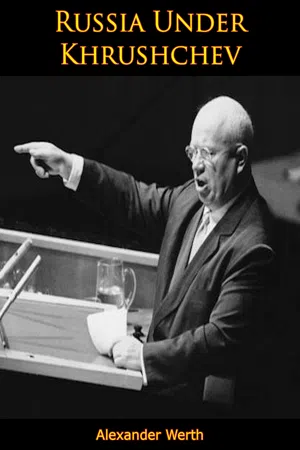
Nikita Sergeyevich Khrushchev (1894-1971) was a politician who led the Soviet Union during part of the Cold War. He served as First Secretary of the Communist Party of the Soviet Union from 1953-1964, and as Chairman of the Council of Ministers, or Premier, from 1958-1964. Khrushchev was responsible for the de-Stalinization of the Soviet Union, for backing the progress of the early Soviet space program, and for several relatively liberal reforms in areas of domestic policy. Khrushchev's party colleagues removed him from power in 1964, replacing him with Leonid Brezhnev as First Secretary and Alexei Kosygin as Premier.
Originally published in 1961, "concerns what I call the Khrushchev phase, rather than the Khrushchev epoch. An "epoch" suggests something complete, with clearly-defined limits and contours, and sharply-marked characteristics. A "phase," especially one still in progress, is something much more fluid. During these years, dominated by Khrushchev, the most changeable, most empirical and sometimes most unpredictable of Soviet leaders, Russia continues to be in a state of flux and transition." (Author's Note)
The book is a political and cultural analysis of Khrushchev's Russia and its relations with the West, and particularly with the United States.
"From inside the Iron Curtain…a very human portrayal."—The Times, London
- 335 pages
- English
- ePUB (mobile friendly)
- Available on iOS & Android
eBook - ePub
Russia Under Khrushchev
About this book
Information
Subtopic
Russian HistoryIndex
HistoryRUSSIA UNDER KHRUSHCHEV
Chapter 1 —THAT MAN KHRUSHCHEV
IT HAS OFTEN been said that the Russians are monarchists at heart, in the sense that they are used, throughout their history, to seeing one boss at the top, ostensibly taking care of everything—first the Tsars, then Lenin, then Stalin and then, after a brief confused interval, Khrushchev. When there is no real boss—as during the first years of the seventeenth century—then it’s called smutnoie vremia, the “troubled times” or it’s branded Kerenshchina, as it was during the eight months between the first and second 1917 revolutions. For Kerensky, who more or less ran the weak and disorganized Provisional Government of March-November, 1917, was only a bogus boss.
But Khrushchev is an entirely different boss from what the Russians had ever known before. Even the most disreputable of Tsars lived somewhere far, far above the people, wrapped in a mystical kind of cloud; Lenin, though kindly, approachable and profoundly human in present-day Lenin folklore, kept his distances, while Stalin became more and more the “genius,” the “superman,” hidden, except for rare appearances in the Red Square, from the eyes of the people; the great man, the oracle, who seldom spoke. But every word he spoke had been carefully weighed in advance, and it weighed a ton. He may have been hated by many, and dreaded by most, but he was respected by all; he was essentially the great State Builder, in the lineage of Ivan the Terrible and Peter the Great—a man with a vast Design, but to whom human life and human suffering were of no great importance. Occasionally, especially during meetings with foreign statesmen, Stalin could be witty and amusing in his own peculiar way; in 1944, for instance, he hugely enjoyed himself pulling de Gaulle’s leg.{1} But, with his own people, no man was less of a back-slapper than he. Occasionally, too, he would summon to his office certain people not belonging to his immediate entourage; generals or top industrial executives, and even leading writers. And he would say to them caustic and unexpected things, sometimes curiously different from the official party line. Thus, in 1944, he called in a number of writers and said to them: “I don’t know what’s the matter with you people; when I read Dostoevsky, it makes me think about it at night; when I read the stuff you people write, it leaves absolutely no impression.”
Especially during the war, Stalin became to the Russians the absolutely essential father figure, and if the “secret” Khrushchev Report denouncing the “cult of personality” at the Twentieth Congress in 1956 was resented by very many, it was because Khrushchev accused Stalin of having been an incompetent war leader. No doubt, grave mistakes had been made, especially at the beginning; the Germans had crashed into Russia with terrifying speed, overrunning vast territories within a few weeks; the three top commanders of 1941—Timoshenko, Budienny and Voroshilov—had proved absolutely incapable of coping with a war of this kind; and yet, collecting what first-class reserves he had, Stalin had saved Moscow and Leningrad in the nick of time. At the most critical moment, when all seemed lost, he had sent Zhukov to replace Voroshilov at Leningrad; and, in the end, it was the Red Army which, in Churchill’s phrase, tore the guts out of the German Army. When things began to look desperate, Stalin appointed to the head of the Army all those brilliant generals—Zhukov, Rokossovsky, Vatutin, Malinovsky, Konev and the rest—who led the Red Army to victory. And he had nerves of steel: on October 16, 1941, when half the population of Moscow fled in a panic, Stalin had stayed on; when it was announced on the 17th that Stalin was there, people knew instinctively that Moscow would not be surrendered. And he had also cleverly handled Roosevelt and Churchill.
Although, with the “Jewish Doctors’ plot” and the rest of it, the atmosphere was terribly unhealthy at the beginning of 1953, the news of Stalin’s death nevertheless caused complete bewilderment. It was impossible to imagine who could replace Stalin. There was something like a panic during the days that followed Stalin’s death, and several people were crushed to death in the wild stampede among the people anxious to have a last look at the dead leader. Memories of the war were still fresh, and many had gone into battle with the cry “Za rodinu, za Stalina!” (For country and Stalin). No doubt he had become strange, very strange in the last few years of his life....Not that many things, worse than strange, had not happened before—in the days of collectivization and the Purge Trials of ‘36–’38.
Khrushchev did not succeed Stalin immediately; nor did his popularity come to him overnight. It was a long, arduous, tortuous uphill fight. After Stalin’s death, Khrushchev was still relatively unknown, and was considered one of the least “probables”; the struggle for supreme power seemed at first to be between Molotov, Malenkov and Beria. For a time, Malenkov seemed to be the popular favourite; he was firmly believed to be the “consumer goods” man, the friend of the consumer and of the sorely-neglected peasant. After the liquidation of Beria only a few months after Stalin’s death, the real struggle for supremacy began between Khrushchev and Malenkov. Right up to 1957, however, the semblance of the collective leadership was kept up. But Khrushchev, as First Secretary, was gaining an increasingly firm hold over the Central Committee which, with the help of men like Kirichenko (the boss of the Ukraine and for many years a close Khrushchev associate),{2} he gradually filled with as many “Khrushchev men” as possible. His technique in gaining supremacy was not all that different from the technique employed by Stalin during the years following Lenin’s death. One of the greatest mysteries is the question why Malenkov, for years a Stalin man, did not realize that to be Premier in Russia was nothing, and to be Secretary-General of the Party was everything—in terms of power.
Always interested in agriculture, and realizing that this was the weakest point in Soviet economy, Khrushchev started on his famous maize campaign, earning in the process the contemptuous nickname of kukuruznik (the fellow gone crazy on maize), but also eliminating Malenkov from the premiership on the ground that Malenkov—as he himself was made to admit—was incompetent to deal with so vast and unfamiliar a problem. Khrushchev was determined to build up a new kind of peasant economy, in which the kolkhozes would be well paid, and would put all their energy into enormously increasing the country’s livestock—so that there would, in Khrushchev’s phrase, be more milk, butter and meat and other produce per head of population than in the most advanced of the capitalist countries, the United States. For years, as party boss of the Ukraine and before, Khrushchev had studied agriculture; no doubt he overdid his kukuruza campaign, making everybody plant maize, even in the most unsuitable climatic conditions. In some areas the cultivation of maize was subsequently abandoned; but where it had grown successfully, it continued to be cultivated in a big way; self-interest was proclaimed to be a principle essential for obtaining good results from agriculture; and already in 1958–59 a spectacular improvement in food production could be seen almost throughout the Soviet Union. The vast expanses of the Virgin Lands in Western Siberia and Kazakhstan were put under the plow by half-a-million young “volunteers”—boys and girls from the Komsomol, soldiers and others; there, as well as in Siberia, where “volunteers,” but also some well-paid labor, had now replaced the slave labor of the NKVD, facilities were being created for a considerable number of people settling down permanently.
The decentralization of the Moscow bureaucracy through the creation of over a hundred sovnarkhozy, the Regional Economic Councils, was also largely Khrushchev’s work.
He was a man of quite fantastic energy and vitality. He loved traveling about the country, talking endlessly to peasant meetings, and going, in the process, into no end of technical details on stock-breeding and the growing of various crops. Nor did it take long before, much to the annoyance of Molotov, he started on his globe-trotting career, first visiting Yugoslavia where he made almost abject apologies to Tito, then going on to India, Burma and Afghanistan, together with the meek, polished and already slightly senile Bulganin (who had, by this time, replaced Malenkov at the head of the government). Then came the Twentieth Congress which ended with the “secret” Khrushchev Report on the “crimes of Stalin” and the evils of the “personality cult.” The report was received in Russia with some dismay, and even resentment, if only because it made everybody feel a bit of a fool, and raised the inevitable question: “And what were you doing at that time?” For hadn’t Khrushchev, too, as late as the Nineteenth Congress in October 1952, crawled on his belly before veliki Stalin like everybody else?
It was a dangerous game; and yet all this outrageous exhibitionism on Khrushchev’s part gradually gave people the idea that here was the most forceful personality among all the leaders. Did they like him? Numerous groups no doubt felt that he was the man to back. He seemed to represent a new hope for the peasantry. The technocrats—who were largely Kaganovich’s men—did not care for Khrushchev; he was encouraging “criticism from below,” against which they had been well protected before. But, on the other hand, he symbolized change·, something had clearly changed if anyone could speak of Stalin as he had done.
This was not without dangers; the repercussions of the Twentieth Congress and of “destalinization,” though serious enough in Russia, were threatening, by the summer of 1956, to become catastrophic in Poland and Hungary. In Poland, largely thanks to the careful handling of a highly explosive situation by Khrushchev himself, an uneasy compromise was reached with Gomulka; in Hungary, the situation got out of hand in a much more threatening manner, and Khrushchev found there was no alternative to sending in the Army to “restore order.”
Hungary was a serious setback to Khrushchev; already in April 1956, during his (not entirely satisfactory) visit to London, people around Khrushchev were openly saying that this visit to England was not very important except as a first step to a visit to the United States. In foreign policy, a rapprochement with the United States was Khrushchev’s prime objective. Hungary stopped this process for a time.
Khrushchev’s policy—or rather his ensemble of policies—met with sharp opposition inside the Party Presidium. In June 1957 it came to a showdown; since Khrushchev appears to have had the majority of the Presidium against him, he demanded that the Central Committee as a whole be convened; and here the majority of the members were his men.
It was touch-and-go; if Malenkov, Molotov, Kaganovich and Shepilov had won, Khrushchev would have been destroyed, perhaps not only politically, but also physically. But luck and cunning were on his side. The Central Committee supported him against what soon came to be known as “the Anti-Party Group”; before long, others, too, were eliminated. First the immensely popular Marshal Zhukov, the victor of Moscow, Leningrad, Stalingrad and Berlin, was removed, ostensibly for merely having used a phrase to the effect that “the Army would not stand any nonsense from the Anti-Party Group”—against which he (Zhukov) had supported Khrushchev; but the phrase implied that the Army was an independent political force, and this was intolerable to the Central Committee, in fact the highest authority in the land. He was also accused of having started his own “personality cult” inside the Army. Later, too, Bulganin was first demoted and then finally pensioned off. Molotov—it was like a cruel practical joke—was appointed Ambassador to Outer Mongolia (of all places); Shepilov given a teaching job; Kaganovich and Malenkov put in charge of remote industrial enterprises. All except Malenkov, the most dangerous of Khrushchev’s rivals, used to turn up in Moscow occasionally, and Kaganovich, too, was, like Bulganin, to be pensioned off before very long. Khrushchev added to his popularity by giving these people more or less ridiculous jobs, instead of having them shot, as they would have been in the old days.
On the face of it, Khrushchev had become supreme boss in the summer of 1957, after the liquidation of the Anti-Party Group. But he had not yet become the great popular leader he was to become soon afterwards.
Although there was perhaps no reason at all for personally crediting him with the tremendous technical victories of the Soviet Union during the next two years, there is no doubt that Khrushchev’s great popularity began about the time of the Sputniks. He made enormous capital out of it, both for the Soviet Union and—for himself. He now became the spokesman of the technically mightiest and militarily most powerful country in the world. In popular imagination, the three Sputniks, the ICBMs (which were mightier than anything the USA could boast of), and, later, the “sun satellite,” the rocket that hit the moon and the other one that went round the moon and photographed its unknown side, all became associated with the name of Khrushchev.
In the winter of 1959–60 Khrushchev was at the height of his glory. Gone were the days when in the villages people sang disrespectful and even ribald chastushki about Khrushchev, and when he was being referred to in derision as “kukuruznik,” when people, especially intellectuals, thought him garrulous, vulgar and undignified.
Khrushchev’s visit to the USA in September 1959 seemed at the time the crowning achievement of his career. Not only was he no longer thought to be undignified; on the contrary, he had acquired a striking new dignity of his own; he had represented his country with immense skill and virtuosity during his by no means easy visit to the United States. In Russian eyes, he had now become the indefatigable fighter for peace and disarmament, the man who had spoken as a perfect equal to the President of the United States; who had made real friends of “peace-loving” Americans and had shown the others where they got off. He had said on every occasion that he was a Communist, and was proud of it, and the Americans had been made to realize that a Russian Communist leader was human, friendly and immensely intelligent and resourceful; he had done much to persuade them, despite years and years of Cold War and Dullesism, that peaceful coexistence and peaceful competition were the only way; perhaps he had even persuaded many that disarmament was in everybody’s (except the “monopolies’”) interest. “And think,” people were saying in Moscow, “how many houses we could build if we didn’t have to spend 25 billion dollars a year on armaments.” (This, according to Khrushchev, was the amount, calculated in dollars, that the USSR was spending on “defense,” as against the USA’s 42 billions.)
And now people in Moscow were referring to Khrushchev more and more frequently by name-and-patronymic. To all he had become “Nikita Sergeievich.” The use of the name-and-patronymic is a sign of “acceptance.” But although they used to talk in the past of “Vladimir Ilyich” (Lenin) and “Joseph Vissarionovich” (Stalin), they never used these names with the same warm affection and familiarity with which they were speaking of “Nikita Sergeievich” now.
One could not but help wondering whether a new “personality cult” was not being built up.
For Khrushchev was now certainly receiving quite unprecedented publicity. Pages and pages of his speeches (often highly entertaining ones) were appearing day after day in the Soviet press—and this had now been going on for weeks; he had overshadowed completely all other Soviet leaders; everywhere a film was showing about his visit to the USA (the more unpleasant episodes had been cut out), and another film was also being shown—a documentary describing Khrushchev’s progress, all the way from the “barefooted miner boy” to the two greatest leaders of the world shaking hands on the steps of the White ...
Table of contents
- Title page
- TABLE OF CONTENTS
- AUTHOR’S NOTE
- Chapter 1 -THAT MAN KHRUSHCHEV
- Chapter 2 - END OF AN OPTIMISTIC ERA?-OR “WAITING FOR KENNEDY?”
- Chapter 3 - KHRUSHCHEV IN SIBERIA
- Chapter 4 - THE STALIN “PERSONALITY CULT”
- Chapter 5 - BACK IN MOSCOW
- Chapter 6 - SOCIALIST LEGALITY
- Chapter 7 - THE DEPORTEES’ RETURN
- Chapter 8 - THE ANTONOVS
- Chapter 9 - BRIEF ENCOUNTERS-SOME OF THEM GRUBBY
- Chapter 10 - FIFTY-YEAR-OLD INTELLECTUAL
- Chapter 11 - STUDENT OF LITERATURE
- Chapter 12 - THE “TRANSITION TO COMMUNISM”
- Chapter 13 - SOVIET MAN
- Chapter 14 - A DIGRESSION ON LENIN: LEGEND AND REALITY
- Chapter 15 - SOVIET MAN: PRIVATE LIFE AND SEX
- Chapter 16 - SOVIET MAN: THAT DAMNED HOUSING PROBLEM
- Chapter 17 - SOVIET MAN: “BOARDING SCHOOLS, THE HIGH ROAD TO COMMUNISM,” AND ALL THAT
- Chapter 18 - SOVIET MAN: NATIONALITIES-THERE ARE TWO “JEWISH PROBLEMS” IN THE SOVIET UNION
- Chapter 19 - SOVIET MAN: IS THERE AN ANTI-GERMAN COMPLEX?
- Chapter 20 - MOSCOW CONVERSATION PIECES ON AMERICA, CHINA AND MUCH ELSE
- CHAPTER 21 - “CULTURAL RELATIONS” AND IDEOLOGICAL WAR
- CHAPTER 22 - THE LITERARY SCENE
- Chapter 23 - MUSIC: ALL’S WELL-SHOSTAKOVICH AND DODECAPHONIC MUSIC
- Chapter 24 - BETWEEN WASHINGTON AND THE SUMMIT
- Chapter 25 - COLLAPSE OF THE SUMMIT
- Chapter 26 - FROM SUMMIT TO UN ASSEMBLY-ENTER AFRICA
- Chapter 27 - THE SOVIET UNION ENTERS THE DECISIVE (?) SIXTIES: REVOLUTIONS, COEXISTENCE-OR BOTH?-LAST WORDS ON GERMANY
- Chapter 28 - EPILOGUE: THE TWENTY-SECOND CONGRESS AND AFTER
- REQUEST FROM THE PUBLISHER
Trusted by 375,005 students
Access to over 1.5 million titles for a fair monthly price.
Study more efficiently using our study tools.
Frequently asked questions
Yes, you can cancel anytime from the Subscription tab in your account settings on the Perlego website. Your subscription will stay active until the end of your current billing period. Learn how to cancel your subscription
No, books cannot be downloaded as external files, such as PDFs, for use outside of Perlego. However, you can download books within the Perlego app for offline reading on mobile or tablet. Learn how to download books offline
Perlego offers two plans: Essential and Complete
- Essential is ideal for learners and professionals who enjoy exploring a wide range of subjects. Access the Essential Library with 800,000+ trusted titles and best-sellers across business, personal growth, and the humanities. Includes unlimited reading time and Standard Read Aloud voice.
- Complete: Perfect for advanced learners and researchers needing full, unrestricted access. Unlock 1.5M+ books across hundreds of subjects, including academic and specialized titles. The Complete Plan also includes advanced features like Premium Read Aloud and Research Assistant.
We are an online textbook subscription service, where you can get access to an entire online library for less than the price of a single book per month. With over 1.5 million books across 990+ topics, we’ve got you covered! Learn about our mission
Look out for the read-aloud symbol on your next book to see if you can listen to it. The read-aloud tool reads text aloud for you, highlighting the text as it is being read. You can pause it, speed it up and slow it down. Learn more about Read Aloud
Yes! You can use the Perlego app on both iOS and Android devices to read anytime, anywhere — even offline. Perfect for commutes or when you’re on the go.
Please note we cannot support devices running on iOS 13 and Android 7 or earlier. Learn more about using the app
Please note we cannot support devices running on iOS 13 and Android 7 or earlier. Learn more about using the app
Yes, you can access Russia Under Khrushchev by Alexander Werth in PDF and/or ePUB format, as well as other popular books in History & Russian History. We have over 1.5 million books available in our catalogue for you to explore.