- 283 pages
- English
- ePUB (mobile friendly)
- Available on iOS & Android
eBook - ePub
50 Years of Research on Man in Flight
About this book
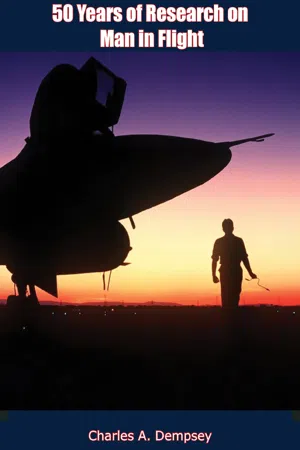
This 50th Anniversary Celebration is a gala review of the last half century of research in aviation medicine. This research has fundamentally shaped the evolution of aircraft design from the wood and wire biplanes to the Space Shuttle. Many renowned scientists have worked in this creative multidisciplinary environment, to evolve pioneering knowledge and established World records that have stood the test of time. Their numbers are legend. Their efforts are unsurpassed anywhere in the world. The published literature from 1935 to 1985 has set the standard for air vehicle design in this country and abroad. Wherever man interfaces with the air vehicle, the mark of aeromedical research is clearly evident in both the hardware design and its functional operation. It is the integration of engineering and medicine which made these achievements possible. The next half century will make even bolder strokes in manned flight.
Trusted by 375,005 students
Access to over 1.5 million titles for a fair monthly price.
Study more efficiently using our study tools.
Information
Subtopic
Military & Maritime HistoryIndex
HistoryCHAPTER ONE—EARLY AEROMEDICAL RESEARCH 1934-1940
ORGANIZATION AND COMMAND
Lieutenant Harry G. Armstrong was assigned to duty as Flight Surgeon in the First Pursuit Group, Selfridge Field, Michigan, on September 15, 1931. He regularly flew with the Group in the P-16 aircraft, a two place open cockpit biplane. These flights exposed the aircrew to extremely cold temperatures, windblast, noise, high altitude, vibration and high acceleration forces in combat maneuvers. This flying environment prompted Armstrong to begin a series of efforts to develop better aircrew protective equipment. He quickly encountered local resistance to his activities. Frustrated, Armstrong wrote a letter to Major Beaven, Air Surgeon, Hq. Army Air Corps, in June 1934. He described the flight environment and the resistance to his efforts. He requested assistance from the Air Surgeon and the Engineering Section at Wright Field. Armstrong did not receive a reply to his letter. Instead he was issued orders in July, 1934, transferring him to the Medical Branch at Wright Field. Captain Armstrong, who had no research or development experience, flew to Washington and contacted Major Beaven about the assignment. Major Beaven told him “you are the one that complained and you are the logical man to try and solve it.” Captain Armstrong flew to Wright Field in August 1934 to meet the resident medical officers and obtain information about the assignment. He had lunch with Major Grow, Flight Surgeon, Patterson Field, and Major Reed, Chief, Medical Branch, Wright Field. Armstrong had never met or been acquainted with either of these officers prior to this luncheon. A heated argument developed between these two men over the assignment of Captain Armstrong. Shortly after his return to Selfridge Field, Armstrong was advised that his orders had been changed and he was now assigned to the Engineering Section, Equipment Branch.
Captain Harry Armstrong was transferred to the Materiel Division, Engineering Section, Equipment Branch, at Wright Field on September 16, 1934. He was the only medical officer in the entire Engineering Section. When Captain Armstrong reported for duty in the Equipment Branch, Bldg 16, he was treated as a consultant and not assigned to any project. He spent the next few days getting acquainted with the people, programs, and facilities in the Equipment Branch. The Branch was responsible for research, development, and testing of all subsystem equipment used in support of Army Air Corps flight operations. To accomplish its mission, the Branch had available in the basement of Bldg. 16, an extensive machine shop, an engineering group, photo department and a drafting group. To reach these facilities from the first floor of Building 16, there was a circular stairway within the Equipment Branch that descended to the basement. Also located in the basement was the altitude chamber which had been used previously for training in the School of Aviation Medicine at Mineola, New York. The chamber was in good operating condition. The Equipment Branch used this chamber plus two smaller chambers and a cold box for testing new experimental equipment. When the chamber tests involved human subjects, the Equipment Branch requested a medical officer from the dispensary. Two months before Armstrong’s arrival, the chamber had been used to test a full pressure suit designed by the world famous pilot, Wiley Post (E.O. 666-2, Serial No. 1-54-431, June 21, 1934, Capt. Hagenberger)
For the next few months, Armstrong worked on the problems he encountered at Selfridge Field and the projects assigned by the Chief, Equipment Branch. He was also assigned to work involving the Explorer II sealed gondola being manufactured in Building 16. Captain Armstrong served as the Flight Surgeon for this record breaking balloon flight which attained an altitude of 72,000 feet. Concerned that he might be working on misdirected efforts, he sought guidance from Major Echols, Chief Engineering Section. Major Echols stated “that he was not a physician and that he felt research in the field of medicine should be Armstrong’s responsibility and that he should pursue his own ideas.” Echols further said “that if Armstrong got into trouble with his work, that he would back him one hundred percent.” Captain Armstrong then prepared and sent to Major Echols a proposal to establish a Physiological Research Laboratory within the Equipment Branch. Major Echols favorably reviewed the proposal and forwarded it through the Materiel Division to Hq. Army Air Corps.
Captain Armstrong flew to Washington on April 16, 1935 and met with Lt/Col Grow, Chief, Medical Division, Office of the Chief, Army Air Corps, and the Army Surgeon General. Captain Armstrong presented the proposal he had submitted to Major Echols. The Armstrong proposal was accepted by those senior medical officers. Their only guidance was to establish a coordinated relationship between the Physiological Research Laboratory and the School of Aviation Medicine to avoid duplication of effort. The Materiel Division, Engineering Section, formally recommended the establishment of a Physiological Research Laboratory on April 25, 1935. The Chief, Army Air Corps, issued a directive on May 29, 1935, establishing the Physiological Research Laboratory within the Equipment Branch.
(Historical Note:) In 1935 there was a rapidly evolving need for a formalized medical research activity at Wright Field. Headquarters, Army Air Corps, had directed the Engineering Section to initiate a sealed pressure cabin airplane development program on April 29, 1935. The Equipment Branch was assigned responsibility for development of the sealed pressure cabin. The Branch was also directed to conduct a comprehensive study of the combined engineering and physiological requirements and to incorporate the data into an engineering specification. The Chief, Equipment Branch, assigned Armstrong the job of providing the physiological data. Armstrong’s report, ACTR #4165, dated December 19, 1935, was used in the aircraft specification. A contract was awarded to the Lockheed Corporation in 1936 and the XC-35 aircraft was delivered to Wright Field in the spring 1937. It was a derivative of the commercial Lockheed Electra. Amelia Ear hart used this type of aircraft on her ill-fated flight around the world.
The mission of the new Physiological Research Laboratory was established at Langley Field, Virginia, on June 19, 1935.
The approved mission defined three research goals which were necessary for the satisfactory performance of tactical combat flights.
• Physical discomfort • Mental distraction • Fatigue
These goals were further refined into prime technical areas.
• Protection from...
Table of contents
- Title page
- TABLE OF CONTENTS
- AERO MEDICAL LABORATORY
- INTRODUCTION
- ACKNOWLEDGMENTS
- ILLUSTRATIONS
- IN MEMORY
- BUILDINGS
- FOUNDER
- PROLOGUE
- CHRONOLOGY - ORGANIZATION & COMMAND
- CHAPTER ONE-EARLY AEROMEDICAL RESEARCH 1934-1940
- CHAPTER TWO-THE WAR YEARS 1941-1945
- CHAPTER THREE-JET FLIGHT RESEARCH 1946-1958
- CHAPTER FOUR-SPACE FLIGHT RESEARCH 1959-1969
- CHAPTER FIVE-ADVANCED FLIGHT RESEARCH 1970-1984
- IN MEMORY
- EPILOGUE
- BUILDINGS
- REFERENCES
Frequently asked questions
Yes, you can cancel anytime from the Subscription tab in your account settings on the Perlego website. Your subscription will stay active until the end of your current billing period. Learn how to cancel your subscription
No, books cannot be downloaded as external files, such as PDFs, for use outside of Perlego. However, you can download books within the Perlego app for offline reading on mobile or tablet. Learn how to download books offline
Perlego offers two plans: Essential and Complete
- Essential is ideal for learners and professionals who enjoy exploring a wide range of subjects. Access the Essential Library with 800,000+ trusted titles and best-sellers across business, personal growth, and the humanities. Includes unlimited reading time and Standard Read Aloud voice.
- Complete: Perfect for advanced learners and researchers needing full, unrestricted access. Unlock 1.5M+ books across hundreds of subjects, including academic and specialized titles. The Complete Plan also includes advanced features like Premium Read Aloud and Research Assistant.
We are an online textbook subscription service, where you can get access to an entire online library for less than the price of a single book per month. With over 1.5 million books across 990+ topics, we’ve got you covered! Learn about our mission
Look out for the read-aloud symbol on your next book to see if you can listen to it. The read-aloud tool reads text aloud for you, highlighting the text as it is being read. You can pause it, speed it up and slow it down. Learn more about Read Aloud
Yes! You can use the Perlego app on both iOS and Android devices to read anytime, anywhere — even offline. Perfect for commutes or when you’re on the go.
Please note we cannot support devices running on iOS 13 and Android 7 or earlier. Learn more about using the app
Please note we cannot support devices running on iOS 13 and Android 7 or earlier. Learn more about using the app
Yes, you can access 50 Years of Research on Man in Flight by Charles A. Dempsey in PDF and/or ePUB format, as well as other popular books in History & Military & Maritime History. We have over 1.5 million books available in our catalogue for you to explore.