eBook - ePub
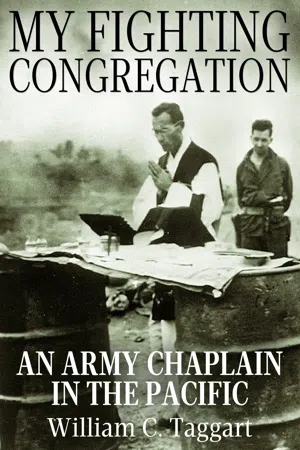
My Fighting Congregation
An Army Chaplain in the Pacific
- 143 pages
- English
- ePUB (mobile friendly)
- Available on iOS & Android
eBook - ePub
My Fighting Congregation
An Army Chaplain in the Pacific
About this book
My Fighting Congregation, first published in 1943, is the moving war-time account of U.S. Army Chaplain William Taggart as he describes his work with U.S. servicemen aboard ships in the Pacific, with troops fighting on Java, and while stationed in Australia. Simply told and an inspirational story of the valuable services performed by the Army's chaplain service during World War II.
Information
Subtopic
European HistoryIndex
HistoryChapter One
WAR came to us as I was conducting a Sunday service on a transport bound for the Philippines.
While we were gathered to pray and hear God’s word on the old S.S. Republic, ten days out of Honolulu, the news of Pearl Harbor reached us.
There are some situations for which a man can just never be prepared. At religious school we never considered what to do if, while leading a service, we suddenly learned that our congregation was at war.
Yet that is exactly what I faced on that peaceful Sunday morning. At nine o’clock I had a khaki-clad congregation whose thoughts were far removed from war. Within a half-hour we were on a journey that would leave some of us sick and crippled; a journey from which many of us would never return; a journey that none of us would ever forget.
Sunday chapel was becoming more popular with the men each succeeding week. There’s not much activity for soldiers on a transport. The navy personnel handles the ship while the soldiers, aside from a few duties, are passengers. After a couple of weeks at sea most of the men began to look forward to religious services. They wandered into the big lounge from the deck, from their posts, and from the hold of the ship. It was unbearably hot, for we had only yesterday crossed the equator. Although it wasn’t yet nine o’clock the men’s shirts were already visibly wet with perspiration. And while we waited for the others to come we stood about in groups talking—just as we used to at home in front of the church.
I liked seeing Hal Walling and Tommy Whitehead at services. Hal and Tommy had both attended my mission in Wichita Falls, Texas.
“Just like home, eh, Chaplain Bill?” said Hal as he passed with Tommy at his side. In the middle of the Pacific a simple religious service helped bring home closer to many of us.
“Chaplain,” a soldier said as I was putting the hymn-books on the table, “you know that sermon you preached last Sunday reminded me of one I heard more than a year ago. My mother and wife were with me...”
It reminded me, too, of another sermon on another Sunday in Big Springs, Texas. I had already made my decision. A minister belonged with the men being prepared for the inevitable war. A minister belonged with the men who would soon be called upon to rid the world of the pagan menace. I was no different from Hal Walling or Tommy Whitehead. I, too, had a service to give to my country.
But because of my decision several of the congregation would not come to church that Sunday. I was “participating in war,” they said. A minister, they insisted, should not help his country even if its existence was at stake. He should just stay at home while the men in his congregation gave their lives for the very religion he was preaching.
Excited voices off to my right brought me out of my thoughts. Charlie was demanding, “Tell me, somebody, what’s today’s date?”
Someone demanded: ‘Why, y’gotta date, Charlie?” Another: “Yeh, you goin’ sumplace?”
“It’s December 7, Charlie,” I managed to squeeze in.
“Then it may be here now?”
That brought more questions. “What may be here now?” Teh, what’re you talkin’ about?”
Charlie tried to get away from the group. “Need some help, Chaplain Taggart?”
“Come on, tell what may be here now!” they persisted. “You can’t get away from us now.”
“It’s just my baby, fellers.” Charlie gulped, embarrassed. “Jean, my wife, said that a couple of weeks before Christmas I might be a father...
That’s the way it went that morning. Before beginning our services we just stood around talking about the things dearest to us: our homes, our families, our sweethearts, our friends. Above the scraping of the chairs, as the men settled down with their life vests at their side, I heard a friendly voice call: “Give us a good sermon today, Chaplain Bill.”
I wish there could have been a good sermon that Sunday morning—a sermon that would have helped prepare them for what was to come. But on that Sunday, December 7, there was no sermon. The Japs interrupted it.
We had finished our prayer and had sung our second hymn with George Barker leading the singing. I had just concluded the reading from the Scriptures and was about to begin my sermon when I noticed Chaplain John Kinney, the transport chaplain, coming toward me from the back of the room.
I sensed something was wrong. Chaplain Kinney had been conducting services for officers at another end of the deck. One lounge couldn’t hold both the officers and enlisted men. Chaplain Kinney should have been in the middle of his service. I went to meet him.
“It’s happened, Bill!” he whispered. “The Japs have attacked Pearl Harbor. We’re at war!”
“Shall I tell the men?”
“No, just dismiss them.”
I walked quickly to the front of the room and looked into the faces of my congregation as they waited for me to begin my sermon. I looked over their heads and through a porthole and saw an ocean that might now be hiding enemy submarines. I caught a glimpse of the hot blue sky that might at any moment become a backdrop for bombers to blast at our ship. I saw in front of me Hal Walling and Tommy Whitehead and began to think of peaceful Wichita Falls. I heard the murmur of voices as the men became restless and wondered why I didn’t proceed, so I quickly said, “You are dismissed.”
They started to come to the front of the room as they usually did. But this time they would want to know why the service hadn’t been finished. Before they got to me the order boomed over the public-address system: “Lay down to your quarters...lay down to your quarters...lay down to your quarters.”
Chapter Two
WHY did the news that we were at war leave me so stunned? I had felt all along that it was coming.
While in Wichita Falls, Texas, words like “isolationist” and “interventionist” were becoming popular, millions throughout the world were being starved, crippled, left homeless, and slaughtered. Churches were being razed. At the point of the bayonet the Bible was being replaced by Mein Kampf. If it could be done in Europe, then they would sooner or later try it in the United States—in Wichita Falls.
No, the war came as no great surprise. I was on this transport, wearing a soldier’s uniform, just because I expected war. And what I had seen in Honolulu only confirmed my expectations. Newspaper headlines on November 28 screamed: “HONOLULU ON ALERT.” At cafés, in hotel lobbies, at railroad stations, wherever I went it was apparent in the conversations I overheard that an early attack was feared. On the streets of Honolulu were armed guards and roving patrols.
It was the sudden realization of my responsibilities that perplexed me. I was a soldier in this army charged with helping to defeat the enemy just as surely as the gunner or the bombardier in a B-17; just as surely as the soldier in the artillery or infantry. I could give cheer, encouragement, and God’s blessing to men embarking on dangerous missions. In combat, when men’s minds, nerves, and body have been tried beyond all possible endurance, I could give them renewed strength and courage. My work, if properly performed, could help attain victory as directly as a well-placed bomb on an enemy warship.
I paused for a moment at the deck railing and prayed that God would give me the strength, the courage, and the wisdom to properly serve my fighting congregation.
I went down the stairs and through the narrow corridors to my stateroom on the deck below. I was gripped with fear for the safety of the eight transport and cargo ships that made up our convoy. I couldn’t get out of my mind the smiling face of the cabdriver in Honolulu who said as we entered his taxi, “We were expecting you.”
“Expecting us?” I asked.
“Yes.”
“You knew we were coming?”
“Oh yes, we knew you were coming. And your convoy is going to the Philippines.”
We looked at each other in the taxi, astonished. He knew the name of our ships, when we were expected, where we were going. Our destination was “Plum.” That’s all we knew. And here was a taxi driver in Honolulu saying that everyone knew our destination. We thought about it for a few minutes, but soon forgot the incident as we tried to see as much of Honolulu in the few remaining hours before sailing time.
But now the taxi driver’s face was before me. His words kept going through my mind: “We were expecting you. You’re on your way to the Philippines.” The words took on new significance. If everyone in Honolulu knew about us, then the Japs would know too. Would our escort, the U.S.S. Pensacola and the light yacht that served as our subchaser, be able to hold off a pack of submarines or a squadron of Zeros?
• • •
When I entered my cabin Lieutenant James Tull, who shared quarters with me, was about to leave.
“What do you think, Jim?”
“Quicker it starts, the quicker it’ll be over,” he replied casually as he left the cabin.
I sat on my bunk and thought how swiftly events had moved since I first met Jim at the army air base in Salt Lake City, Utah. We were both reporting for duty, Jim as a lieutenant in the Air Corps and I as a chaplain. Jim noticed the cross on my shirt, one of the insignia of the Corps of Chaplains, and introduced himself.
He, too, had been a minister until he had been called up as a reserve line officer. His pastorate had been in Frankfurt, Kentucky. So we sat there outside the commanding officer’s quarters chatting about his wife, my parents, and our mutual friend, Homer Reynolds, now an army chaplain at the Davis-Montham Field in Tucson, Arizona.
Tull, who has since become a chaplain with one of the fighter groups under General Chennault in the Far East, was a serious student of Greek. We spent many pleasant hours at his apartment with his wife, Virginia, discussing religious literature and the relationship of the Church to war.
All this debate about whether or not ministers should join the Army was so academic, we agreed. Did they think that when men became soldiers they ceased to be Gods children? Did a uniform eliminate the need of the influence of the Church? Why didn’t they visit the army camps and see for themselves that military life often intensified emotions and created problems which a chaplain could best solve.
I sat on my bunk and wondered if, now that war had finally come, they were still debating in Wichita Falls—and in thousands of other towns and cities—if it’s right for a Christian to fight; if it’s right for a clergyman to minister to the men at war.
I saw Jim Tull’s civilian suit hanging on the wall. It had been nice to change into civvies every evening for dinner on board ship, I thought. It would be a long time, I was sure, before I’d be needing my civvies again. We were now wartime officers, and the orders would undoubtedly come through soon to wear army uniforms only. When we left San Francisco on ...
Table of contents
- Title page
- Table of Contents
- Foreword
- Introduction
- Chapter One
- Chapter Two
- Chapter Three
- Chapter Four
- Chapter Five
- Chapter Six
- Chapter Seven
- Chapter Eight
- Chapter Nine
- Chapter Ten
- Chapter Eleven
- Chapter Twelve
- Chapter Thirteen
- Chapter Fourteen
- Chapter Fifteen
- Chapter Sixteen
- Chapter Seventeen
- Chapter Eighteen
- Chapter Nineteen
- Chapter Twenty
- Chapter Twenty-One
- Chapter Twenty-Two
- Chapter Twenty-Three
- Chapter Twenty-Four
- Chapter Twenty-Five
- Appendix
Trusted by 375,005 students
Access to over 1.5 million titles for a fair monthly price.
Study more efficiently using our study tools.
Frequently asked questions
Yes, you can cancel anytime from the Subscription tab in your account settings on the Perlego website. Your subscription will stay active until the end of your current billing period. Learn how to cancel your subscription
No, books cannot be downloaded as external files, such as PDFs, for use outside of Perlego. However, you can download books within the Perlego app for offline reading on mobile or tablet. Learn how to download books offline
Perlego offers two plans: Essential and Complete
- Essential is ideal for learners and professionals who enjoy exploring a wide range of subjects. Access the Essential Library with 800,000+ trusted titles and best-sellers across business, personal growth, and the humanities. Includes unlimited reading time and Standard Read Aloud voice.
- Complete: Perfect for advanced learners and researchers needing full, unrestricted access. Unlock 1.5M+ books across hundreds of subjects, including academic and specialized titles. The Complete Plan also includes advanced features like Premium Read Aloud and Research Assistant.
We are an online textbook subscription service, where you can get access to an entire online library for less than the price of a single book per month. With over 1.5 million books across 990+ topics, we’ve got you covered! Learn about our mission
Look out for the read-aloud symbol on your next book to see if you can listen to it. The read-aloud tool reads text aloud for you, highlighting the text as it is being read. You can pause it, speed it up and slow it down. Learn more about Read Aloud
Yes! You can use the Perlego app on both iOS and Android devices to read anytime, anywhere — even offline. Perfect for commutes or when you’re on the go.
Please note we cannot support devices running on iOS 13 and Android 7 or earlier. Learn more about using the app
Please note we cannot support devices running on iOS 13 and Android 7 or earlier. Learn more about using the app
Yes, you can access My Fighting Congregation by Chaplain William C. Taggart,Christopher Cross in PDF and/or ePUB format, as well as other popular books in History & European History. We have over 1.5 million books available in our catalogue for you to explore.