In this remarkable memoir, Dr. Kenneth W. Iliff—the recently retired Chief Scientist of the NASA Dryden Flight Research Center—tells a highly personal, yet a highly persuasive account of the last forty years of American aeronautical research. His interpretation of events commands respect, because over these years he has played pivotal roles in many of the most important American aeronautics and spaceflight endeavors. Moreover, his narrative covers much of the second half of the first 100 years of flight, a centennial anniversary being celebrated this year.
Dr. Iliff's story is one of immense contributions to the nation's repository of aerospace knowledge. He arrived at the then NASA Flight Research Center in 1962 as a young aeronautical engineer and quickly became involved in two of the seminal projects of modern flight, the X-15 and the lifting bodies. In the process, he pioneered (with Lawrence Taylor) the application of digital computing to the reduction of flight data, arriving at a method known as parameter estimation, now applied the world over. Parameter estimation not only enabled researchers to acquire stability and control derivatives from limited flight data, but in time allowed them to obtain a wide range of aerodynamic effects. Although subsequently involved in dozens of important projects, Dr. Iliff devoted much of his time and energy to hypersonic flight, embodied in the Shuttle orbiter (or as he refers to it, the world's fastest airplane). To him, each Shuttle flight, instrumented to obtain a variety of data, represents a research treasure trove, one that he has mined for years.
This book, then, represents the story of Dr. Ken Iliff's passion for flight, his work, and his long and astoundingly productive careen. It can be read with profit not just by scientists and engineers, but equally by policy makers, historians, and journalists wishing to better comprehend advancements in flight during the second half of the twentieth century.
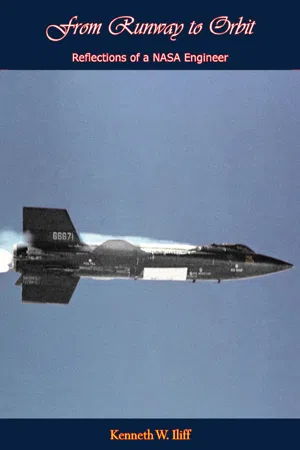
- 515 pages
- English
- ePUB (mobile friendly)
- Available on iOS & Android
eBook - ePub
About this book
Trusted by 375,005 students
Access to over 1.5 million titles for a fair monthly price.
Study more efficiently using our study tools.
Information
Subtopic
Military & Maritime HistoryIndex
HistoryX—STS-1
Well before sunrise on April 12, 1981, I found myself in the Dryden control room, waiting for activities at Kennedy Space Center to begin. I knew the time lines and I knew the holds beforehand, but my memory is that we had our strip charts ready to go two hours before the Shuttle Columbia was scheduled to be launched on the STS-1 flight, wanting to make sure we had everything that we thought we would need. There was the possibility that for some reason the Shuttle might need to do an abort-once-around (AOA). If so, Columbia would end up landing at Edwards less than two hours from engine ignition. In that case, our activities in the control room would be much different than the ones officially planned.
Wings into Space
As the STS-1 countdown was just prior to zero, the pumps on the Space Shuttle’s main engines started, and we could start to see the vapor. Within a few seconds, we started to see the thermal plume from the hydrogen/oxygen combustion in the chamber. Just as that happened, there was a little gimbling on the nozzles. Then, the solid rocket boosters lit, and, almost instantaneously, the vehicle started to lift off. We were now enjoying the show, not worrying so much that something might go wrong, because there was nothing we could do anyway. We might as well enjoy the launch.
It was, from my point of view, a perfect launch. Television, of course, made it very easy for me and millions of other people watching the launch. We were watching a first flight by John Young and Bob Crippen, the first astronauts to be launched into space by solid rocket boosters, as well as the first to be launched into orbit on a winged reusable vehicle. It was also the first flight for a crew with Space Shuttle Main Engines (SSMEs), and for that particular Shuttle configuration. The Shuttle stack looked ungainly at liftoff, but I’d become used to seeing it, so it looked normal to me by then. As the Shuttle cleared the tower, Houston took over. A few hundred feet in the air, Young and Crippen went into their programmed roll which put them heads down and downrange to the east to go into orbit. That’s the optimum combination to get the vehicle out of the atmosphere as soon as possible, but not end up having to make a right-angle turn once it gets out of the atmosphere. The trajectory optimizations all come out with something fairly close to what the Shuttle does with its programmed trajectory.
The controller was talking everybody through as the strange configuration got further and further away, until only the exhaust from the solid rocket boosters (SRBs) was visible. The separation of the SRBs from the external tank was easily visible with a telephoto lens. My recollection is that the first time I saw it, I was surprised to see how much plume was still coming out of the SRBs, and I wondered if they had separated at the right time. But that is the way it’s supposed to go. We watched on long range optics, and by the time the SRBs dropped away, we could see the high-intensity light coming from the three main engines on the base of the Shuttle. Then, little by little, that began to flicker in and out. Due to the thickness of the atmosphere, the humidity in Florida, and the curvature of the Earth, the camera eventually couldn’t pick it up anymore.
We, of course, had continuous information from the control room at Johnson Space Center. They could hear conversations that were not on the public transmissions. The astronauts were going through their various checks, and we had good information that things were nominal all the way to orbit. They did their lob of the external tank, and then they finished circularizing the orbit they were to stay in for two days. Only about 20 minutes had passed from the time it took off until it was more or less in orbit at about 25,000 feet per second.
When it was clear that the Shuttle was not going to abort to Edwards, I felt a great deal of relief. Most scenarios for aborts are not very good, so all of us at Dryden were very pleased to see it in orbit. Then we started hearing some concerns about things that we hadn’t noticed on the launch. Specialists in various areas were talking about things that were off nominal, such as overlofting, debris, and other things not quite as expected. None of them sounded particularly serious to me, except when they started noting some of the close-up telephoto shots they had of the launch. They showed a lot of debris, and a lot of it had hit the Shuttle. Some of the debris, I think, was coming out of the trench below the Shuttle’s engines, and included various expendable equipment that was nearby, as well as ice coming off the external tank.
The next exciting thing that happened on the flight was the opening of the payload bay doors. If they didn’t open right away, the astronauts were coming back to Edwards at the next opportunity. I don’t think the doors opened as smoothly as I thought they would. There was probably uninformed concern at Dryden about all of the activities, because although we knew roughly what should happen, none of it had anything to do with our specialty. Once the payload bay doors were open, they had video coverage of the Shuttle, They could see damaged tiles on the orbital maneuvering system (OMS) pods, as well as what looked like dings on various parts of the vehicle.
The astronauts on STS-1 were launched wearing space suits so they were prepared to use their SR-71 ejection seats if something happened at Mach 3 or below. I think Mach 3 on the Shuttle occurs around 90,000 to 100,000 feet, so that probably would have been okay for using the SR-71 ejection seats. However, I remember some talk at the time that there might be some way, once in orbit, that the crew could go outside and take a look to see if anything was damaged on the bottom of the Shuttle, where the greatest heating and aerodynamic forces were going to be if any tiles there had been damaged.
Otherwise, things seemed to be going fairly well, despite little gripes about things that would be fixed before the next flight. I remember being very concerned about whether the Shuttle had significant tile damage on the bottom. Depending on what the damage was, the vehicle could re-enter with a significant sideslip. If there were very much more than one degree of sideslip, the thermal protection nosecap would not be the highest heating point, so we would get a burn-through on the vehicle. There were also concerns that if a large enough group of tiles was missing, the heating would get into the wing’s aluminium structure and damage it to the point where the vehicle could no longer fly.
I don’t know how Young and Crippen felt about it, but to me it did seem risky. There was talk of using our classified military cameras to take pictures and see if there was significant damage to the tiles. Information about our capability for taking pictures of things in orbit was classified. At any rate, I remember hearing less talk as we approached the time for the Shuttle to do its deorbit burn. I assume that they got enough verification with those classified cameras that there wasn’t a significant bunch of tiles missing, although I never heard directly that they were no longer concerned.
Heading Home at Mach 28
On the day of the landing for STS-1, I remember leaving home quite early. I knew they were allowing visitors into Edwards. There also were visitors with passes specifically for Dryden. There were also visitors who were supposed to go to other parts of the lakebed to the south and east. I knew there would be a lot of traffic and a lot of people in the wrong place, making for even more traffic. The base security people were going to let only the right people into any given site for viewing the landing. There were also a lot of us who were supposed to be there for work, as well as a large contingent of support people, who took care of the crew and the Orbiter after landing. We also had a large percentage of Dryden people serving as escorts and guides for the public affairs office. They were all proud to be doing this.
This was a big day. It was going to be a crowd bigger than anything we had seen before at Dryden. I had seen this commotion and heard about it on the Apollo flights, so I knew of many sad stories of people who were in a traffic jam somewhere because they’d waited a little bit too late to start for their destination. I didn’t want to be one of those people for two reasons. The most important one was that I wanted to watch the Shuttle come in. The second reason was I actually had official duties in the control room and might be of some use in case of certain contingencies. It’s hard to interact and save the Shuttle, but there are always questions that the sooner they’re answered by somebody, the better off everyone is.{7}
I had the duty of being at the strip charts for the flight dynamics parameters from the Orbiter’s operational instrumentation system. The parameters from that system were telemetered to the ground, and at Mach 14 the telemetry signal would be coming into Vandenberg. It was then merged with our data, and we’d have it from Mach 14 all the way down. Rich Maine was also with me in the control room, along with Milt, Archie Moore (who was Dryden’s range manager at the time), Al Carter, Joe Weil, Dick Day, Bruce Powers, and Tim Horton, who were also working on the Shuttle. There were a number of people from outside Dryden who were there as well. We also had our world-class control room technicians who not only assured us of the Shuttle real-time data, but also had always provided Dryden with real-time flight data and communications for all of the research aircraft flights I had worked on over my entire career. They always came through with this vital data, without which we could not proceed.
At any rate, I don’t remember the people as much as I remember the event. Rich and I had been through the time tine dozens of times, putting forth our own uncertainties regarding at what Mach number the initial bank maneuver would take place, where the various bank reversals would take place, and when, in terms of the clock, we would be able to hear the Shuttle emerge from blackout. We had displayed Greenwich Mean Time in the control room so we had our own little time line, independent of the official person who announced all events from Houston.
Having left home many hours before the Shuttle was due to land, I spent some time working in my office. I noticed a lot of other people who also had duties who decided that an extra half-hour or an hour of sleep wasn’t going to do them any good, so they might as well get here before the traffic made it impossible. I don’t know actually how many people were required to be at Edwards that day, but there were large Air Force groups involved in rescue and such contingencies as security and closing the base to any air traffic during the re-entry. There had to be a couple of thousand people there on official duty from Dryden, the other NASA centers, the various contractors supporting the Shuttle, and the Air Force along with their involved contractors. In terms of Kennedy Space Center, that may not be a big number, but for any operation at Edwards, it was the largest by far of any that I had seen.
After a while Rich and I decided to go to the control room, get into position, and get into the flow of things to be ready for the actual deorbit burn. On the earlier orbits, they’d had conversations through Hawaii, I believe. This time, on final orbit, Guam was going to have the last contact with the crew until we heard from them either through Vandenberg or Dryden communications. We believed, based on the antenna patterns and the altitude, that we would pick up data from the Orbiter’s operational instrumentation (OI) and development flight instrumentation (DFI) systems at about Mach 14.{8}
They did the 2-minute-40-second deorbit burn with a delta-V of about 300 feet per second with the OMS engines. It was about 60 minutes from the start of this deorbit burn to wheel stop after touchdown. The vehicle then went to the next event that the entry community talks about-entry interface, a useful point from which to time things. The entry interface would occur about 25 minutes or so after the deorbit burn ended, just after the Shuttle passed Guam. That’s roughly a half hour before it was to touch down at Edwards, so it would still be quite a ways out. Entry interface to an airplane guy is simply a mark in the sky, there being nothing at all special about it.
The Shuttle was going close to 25,000 feet per second. As we would discover after we had obtained all of the onboard data, the first time that we can see any significant deceleration on the Shuttle is when it reaches an altitude of about 350,000 feet. Then, we can start to see micro-deceleration on our aerodynamic coefficient identification (ACIP) instruments, which are very sensitive. So at about 350,000 feet we start to see about one tenth of a pound per square foot of dynamic pressure. That’s what I define as the place where interesting things start to happen. The first place I try to extract aerodynamic data from the Shuttle is about 350,000 feet. It’s an interesting coincidence to me that 350,000 feet also was roughly the maximum altitude the X-15 flew. Of course, the X-15 had much lower dynamic pressure than the Shuttle, because dynamic pressure is a function of velocity squared. In thousands of feet per second, roughly 25 squared is 625, and 4.3+ squared of the X-15 at 350,000 feet was roughly 19. So the ratio in dynamic pressure at that condition is more than a factor of 30 lower on the X-15 compared to the Shuttle,
We knew that about 47-48 minutes after the initiation of the deorbit burn, or 12-13 minutes before wheel stop after landing, we were going to start receiving data, so we were watching the clock. Depending on antennas, orientation of the vehicle at the time, and various other things; we knew that the Mach number might be a little bigger or smaller than Mach 14, but it would not be much different if the Shuttle was still on its planned entry trajectory. All of the significant parameters that we were interested in, even at low sample rate and poorer resolution than we desired, were going to be telemetered and we’d be able to see them on the strip charts.
Consequently, we were well prepared for that approximately 47-48-minute point after initiation of the deorbit burn. We had our own little conversations in the control room. We were paying attention, but we knew we weren’t going to hear anything very interesting for awhile. The mission announcer made reports on the Shuttle’s position and its altitude. We kept hearing those and that was encouraging. He was getting those from the planned profile obviously, as nobody was in contact with the Shuttle at that point.
We heard the entry interface announced. Then with the Shuttle at 350,000 feet, 44 minutes after the start of the deorbit burn, and about 16 minutes before wheels stop, the announcer in Houston said, “We should be leaving blackout and re-establishing contact with the Shuttle at any second now.” Rich and I looked at each other fairly shocked, wondering if we were two or three minutes off or had missed a calculation somewhere. We stared at our strip charts, listening for communication, but there was nothing but silence. That was the worst thing that we could have experienced at that point, because if we don’t hear anything it could mean there’s nothing to hear from. Since this was a first flight on a very ambitious full flight-envelope entry, it was very scary. Whatever my heart rate had been before that, it went up a great deal more, because I started having this feeling that this was not going to be a good day. Then, probably a minute later, the announcer corrected himself and said that we should acquire data in 30 seconds.
That made us feel better, but it gave me a bad couple of minutes. Then, the strip charts made a noise as they started responding to telemetered signals and the needles started scratching back and forth across the paper. At various places in the control room, displays came alive, and it was clear that we were getting data. The Shuttle was going the speed it should be going, it was at the altitude and the angle of attack expected, and it was at the position we expected for Mach 14. The Orbiter was off the coast of California, north of Santa Barbara, and coming in to land at Edwards. The first data was actually received at Dryden, not at Vandenburg, because one of our tracking gurus, Jack Kittrell, had set our antennas at a lower angle than officially stated. His intuition based on other research flights, including X-15s, gave him a hunch on where to look.
Then we had something very real to do. We monitored what are called “bank reversals,”{9} (Appendix F) which are energy management maneuvers.[58] We knew where they would be. They vary a little bit, depending on how far the Shuttle is from its landing point compared to its Mach number and altitude at any given time. Those are adjusted for any given orbit. There were no planned maneuvers for stability and control or for performance evaluation on STS-1. Each time the Shuttle entered or left one of those bank reversals, we would get aileron and yaw jet data, and then, at the last one, there’s a possibility of getting some rudder as well. For the most part on that mission, we were watching for the bank reversals. The initial bank was up at Mach 24, which, of course, was before we had communications from the vehicle. The next one was just before we received the first telemetry data. We saw the last two bank-reversal maneuvers and got to see that we had the control positions, angle of attack, roll rates, yaw rates, and pitch rates that we were expecting. Things were looking quite nominal to us, which was a very good thing.
Milt and I had made a deal that if everything was going well at Mach 2, since we didn’t have any duties that required us to be in the control room, we were going to leave our strip charts and go out on the roof and see if we could spot the Shuttle. We went out, and just about the time we got in position. Milt pointed up and said, “There it is.” I saw it shortly thereafter. We watched it come over Edwards, go out toward Boron...
Table of contents
- Title page
- TABLE OF CONTENTS
- DEDICATION
- Acknowledgements
- Preface
- Foreword
- Introduction
- I-Apprenticeship of a Young Engineer
- II-Birth of the Lifting Body
- III-Building the Heavyweight Lifting Bodies
- IV-Flying the M2-F2 and Other Adventures
- V-Flight Research in the 1960s and Early 1970s
- VI-Origins of the Space Shuttle
- VII-Getting Ready to Fly
- VIII-The Approach-and-Landing Tests
- IX-Counting Down to Launch
- X-STS-1
- XI-Analyzing the Data
- XII-Becoming Operational: STS-3 Through STS-5
- XIII-STS-6 to the Loss of Challenger
- XIV-Return to Flight: The Shuttle Program in the 1990s and Beyond
- XV-Going Nowhere Fast: The NASP Program
- XVI-Hypersonics in the 1990s
- Epilogue
- Appendices
- Acronyms
- References
- About The Authors
Frequently asked questions
Yes, you can cancel anytime from the Subscription tab in your account settings on the Perlego website. Your subscription will stay active until the end of your current billing period. Learn how to cancel your subscription
No, books cannot be downloaded as external files, such as PDFs, for use outside of Perlego. However, you can download books within the Perlego app for offline reading on mobile or tablet. Learn how to download books offline
Perlego offers two plans: Essential and Complete
- Essential is ideal for learners and professionals who enjoy exploring a wide range of subjects. Access the Essential Library with 800,000+ trusted titles and best-sellers across business, personal growth, and the humanities. Includes unlimited reading time and Standard Read Aloud voice.
- Complete: Perfect for advanced learners and researchers needing full, unrestricted access. Unlock 1.5M+ books across hundreds of subjects, including academic and specialized titles. The Complete Plan also includes advanced features like Premium Read Aloud and Research Assistant.
We are an online textbook subscription service, where you can get access to an entire online library for less than the price of a single book per month. With over 1.5 million books across 990+ topics, we’ve got you covered! Learn about our mission
Look out for the read-aloud symbol on your next book to see if you can listen to it. The read-aloud tool reads text aloud for you, highlighting the text as it is being read. You can pause it, speed it up and slow it down. Learn more about Read Aloud
Yes! You can use the Perlego app on both iOS and Android devices to read anytime, anywhere — even offline. Perfect for commutes or when you’re on the go.
Please note we cannot support devices running on iOS 13 and Android 7 or earlier. Learn more about using the app
Please note we cannot support devices running on iOS 13 and Android 7 or earlier. Learn more about using the app
Yes, you can access From Runway to Orbit by Kenneth W. Iliff,Curtis L. Peebles in PDF and/or ePUB format, as well as other popular books in History & Military & Maritime History. We have over 1.5 million books available in our catalogue for you to explore.