- 144 pages
- English
- ePUB (mobile friendly)
- Available on iOS & Android
eBook - ePub
Georgetown University
About this book
Georgetown University is a new book by alumni Paul ONeill (C'86) and Bennie Smith (C'86). The book includes 200 images from Georgetown University's archives along with captions that tell the story of the university's first 200 years. Georgetown University, the oldest Catholic university in America, was founded in 1789 by Archbishop John Carroll, SJ, as an academy for boys that was open to "Students of Every Religious Profession" and "every Class of Citizens." Carroll established the school on a hilltop overlooking the Potomac River, "delightfully situated" as Charles Dickens would observe several decades later. Georgetown welcomed its first student, William Gaston, in 1791 and was chartered by Congress in 1815, but by the time of the Civil War, when Federal troops occupied the campus, the school was on the brink of collapse. It was not until the presidency of Patrick F. Healy, SJ, in 1873 that Georgetown would recover and be set on a course to become a university, linking Georgetown College with professional schools of medicine and law. The early 20th century was marked by the founding of the schools of dentistry, nursing, foreign service, languages and linguistics, and business. Now among the top universities in America, Georgetown is continuously reinvigorated by teaching and scholarship dedicated to serving the nation and the world.
Information
Topic
EducationSubtopic
Education GeneralOne
FOUNDING AND EARLY YEARS
In the early years, especially its first decade, Georgetown struggled to become viable. There were five presidents in the first 10 years, enrollment climbed and dropped unpredictably, and buildings were left unfinished for lack of funds. In 1806, John Carroll suggested in a letter to Pres. Robert Molyneux, SJ, that operations of the college be suspended. As Emmett Curran has commented, “It was scarcely an auspicious start.”
Georgetown began to find its footing in its third decade under the leadership of Pres. John Grassi, SJ. During Grassi’s presidency, in August 1814, the Society of Jesus was restored after 41 years of suppression. The restoration of the society provided Grassi with Jesuit faculty from Europe, who added numbers and intellectual depth to the college. In March 1815, Georgetown received a federal charter to grant academic degrees. As Curran wrote about Grassi’s tenure, “Georgetown was becoming [at Carroll’s death in 1815] the national college that Carroll had envisioned a generation earlier, open to students of every religion and class” and “the major domestic producer of clergy for his [the Catholic] church.”
A burst in enrollment and a major building campaign under Pres. Thomas Mulledy, SJ, in the 1830s increased the prestige of the college further but left the school badly in debt. The sale in 1838 of 272 enslaved persons owned by the Jesuit province marked a dark chapter in Georgetown’s history, as proceeds from the sale were used, in part, to pay down the college’s debt.
Mulledy was part of what Curran described as the “Irish Troika,” which included Mulledy, Pres. William McSherry, SJ, and Pres. James Ryder, SJ, each of whom was a Jesuit novice at the same time in Rome and returned to America with ambitious plans for Georgetown. When the President and Directors of Georgetown College was incorporated by Congress in 1844, Georgetown was the oldest and most prosperous of the 31 Catholic colleges in the United States.
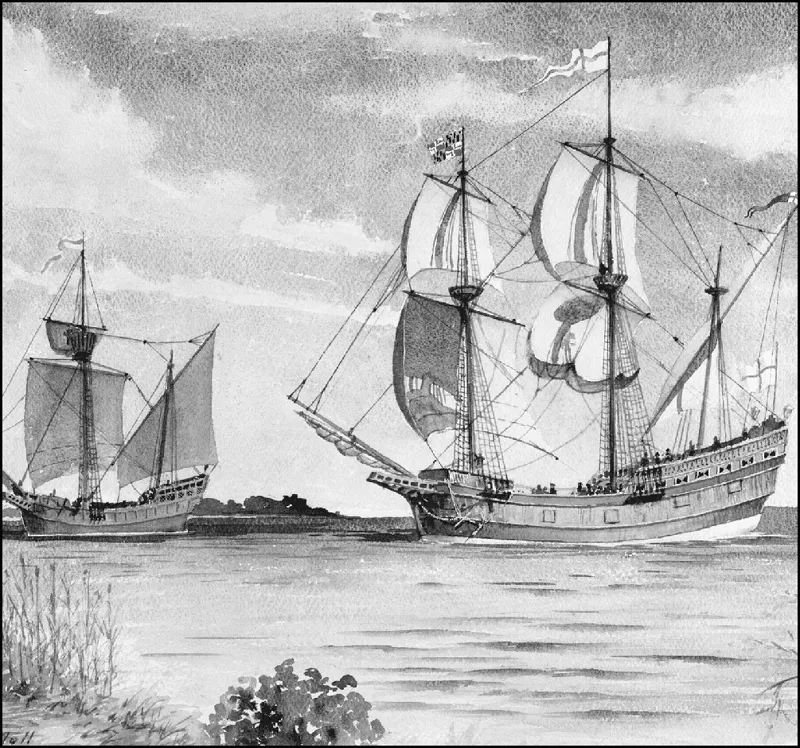
This painting by John Moll depicts the Ark and the Dove, the two ships that in 1634 carried the first English settlers to the Maryland colony. Founded by Sir George Calvert, the first Lord Baltimore, the Maryland colony was unique at the beginning for permitting the free practice of Catholicism. Later in the 17th century, however, penal laws in Maryland prohibited Catholics from voting, worshipping publicly, or holding public office. These restrictions remained until the US Constitution guaranteed freedom of religion. (Courtesy of the Maryland Historical Society.)

The Settlement of Maryland by Lord Baltimore was painted in 1884 by Emanuel Gottlieb Leutze. The first English settlers in Maryland included Fr. Andrew White, SJ (standing left), accompanied by Fr. John Gravenor, SJ, and Brother Thomas Gervase, SJ, who came to minister to Catholic colonists and convert the native population. Despite British penal laws restricting the establishment of Catholic schools, the Jesuits operated covert schools for short periods. These early schools included one at Bohemia Manor on the eastern shore of the Chesapeake Bay, where John Carroll studied as a boy. (Courtesy of the Maryland Historical Society.)

Upon the arrival of the first Jesuits in Maryland in 1634, a Jesuit mission was established. Like lay settlers, Jesuit priests arriving from England received land grants from the Maryland lord proprietor under the headright system. By the turn of the 18th century, the Jesuit settlers collectively had amassed several large plantations. Estimates by Emmett Curran put the Jesuits’ landholdings at more than 12,000 acres. Proceeds from the plantations were a source of financial support for the Jesuit mission and also eventually for Georgetown University. First worked by indentured servants, by 1700, the plantations relied on the labor of enslaved people. Georgetown’s 2015 Working Group on Slavery, Memory and Reconciliation documented the link between Georgetown’s origins and growth to the profits of the Jesuit-owned and -operated plantations in Maryland. (Courtesy of the Maryland Historical Society.)

This portrait of Archbishop John Carroll, SJ, founder of Georgetown University, was completed by renowned portrait artist Gilbert Stuart around 1804. Carroll was born in 1735 to Daniel, an Irish immigrant, and Eleanor Darnall, Daniel’s distant cousin and a wealthy heiress. Because Catholic education was illegal in Maryland at the time, Carroll attended a covert Jesuit school at Bohemia Manor in Maryland until 1748, when he was sent for further studies at the Jesuit College of St. Omers in French Flanders. Carroll entered the Society of Jesus in 1753 in the Netherlands and was ordained in 1761. The suppression of the Jesuits in 1773 prompted Carroll to return to Maryland, where the American Revolution was underway. Carroll himself was not substantially involved in the Revolution, but the Carroll family was well represented. His cousin Charles Carroll, notably, was the only Catholic signer of the Declaration of Independence, and his brother Daniel served in the first US Congress. For his part, John Carroll emerged as the leader of the 24 Catholic priests in America. When the Catholic Church established the first diocese in America in 1789, Carroll was appointed its first bishop. As bishop of Baltimore, Carroll assumed the burden of providing clergy for the church. He believed that a school was essential to offer “intellectual and moral training” for young men who could become priests.

“Proposals for Establishing an Academy at George Town, Patowmack-River, Maryland,” dated November 1786, is the earliest printed document relating to Georgetown’s founding. It describes Carroll’s plan to establish a school open to “students of every religious profession” and “every class of citizens.” Aligned with the academy’s academic mission were strict provisions for “guarding and improving the morals of youth,” as well as the “cultivation of virtue.” Although the word “Catholic” does not appear anywhere in the document, printed copies of the Proposals were broadly distributed among Catholic elites in America and abroad whom Carroll hoped would fund his new venture.

Carroll’s letter initiating fundraising for his proposed school, dated March 1787, was sent to prospective donors along with his Proposals. Without the benefit of state sponsorship or private endowment, Carroll relied on revenue from student tuition, the labor of enslaved persons on Jesuit-owned plantations, and periodic but typically small bequests from individuals. Carroll’s dogged determination to open the school without an endowment created a condition that plagued the school, almost fatally, for much of its first century.

This is the campus as it appeared in 1792 when Georgetown’s first classes were held in Old South, a small Georgian-style redbrick structure with a commanding view of the Potomac River. Construction of Old South began in April 1788 and took three years to complete because of regular shortfalls in money to pay for materials and laborers. Old South stood for more than 100 years before it was demolished and replaced by Ryan Hall.
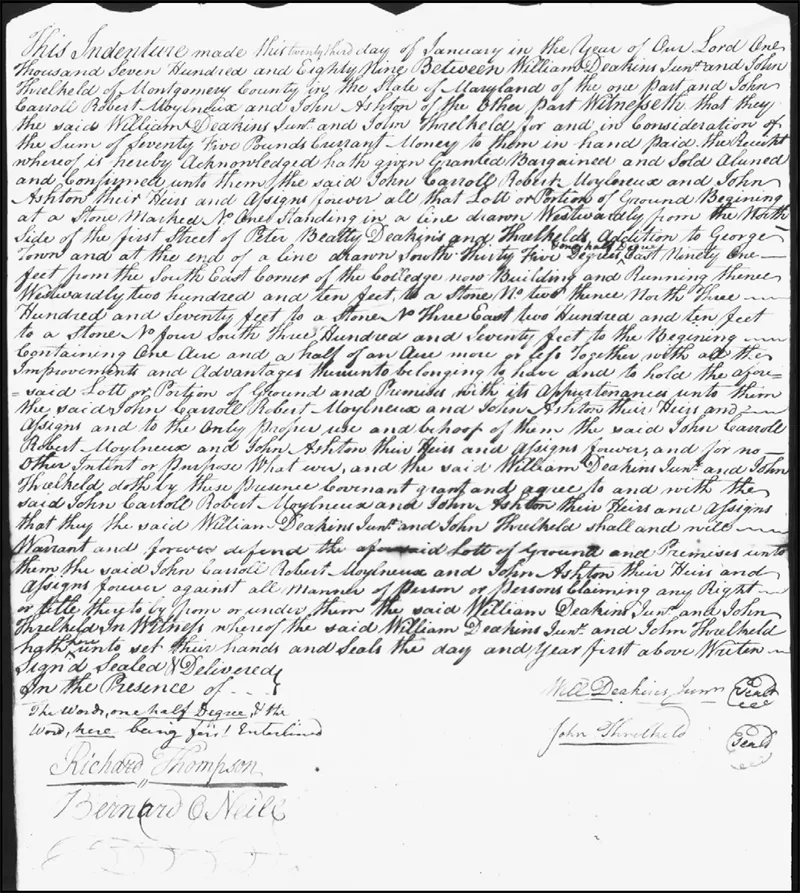
Since the mid-1800s, Georgetown’s founding has been tied to the date of this deed, January 23, 1789, when John Carroll acquired the title to a one-acre plot of farmland where Old South was already under construction. Carroll’s selection of this hilltop property was influenced by many factors, including the “salubrity of air” and “cheapness of living,” as mentioned in the Proposals. Unbeknownst to Carroll, however, the location would become significant when the Residence Act of 1790 located the District of Columbia nearby and forever tied Georgetown’s history with that of the nation’s capital.

Robert Plunkett, SJ (1791–1793), was the first president of Georgetown. Recruiting someone to serve as president proved an onerous task for John Carroll, and many of his preferred candidates declined his entreaties to serve. Plunkett took the job but served for only 18 months. When it opened, the “Academy” comprised three divisions: elementary, preparatory, and college. Georgetown was more geographically diverse than other American schools at t...
Table of contents
- Cover Page
- Title Page
- Copyright Page
- Dedication
- Table of Contents
- Acknowledgments
- Introduction
- 1. Founding and Early Years
- 2. The “Second Founding”
- 3. The New Century
- 4. The World Wars and Global Focus
- 5. Toward a Third Century
- Bibliography
Trusted by 375,005 students
Access to over 1.5 million titles for a fair monthly price.
Study more efficiently using our study tools.
Frequently asked questions
Yes, you can cancel anytime from the Subscription tab in your account settings on the Perlego website. Your subscription will stay active until the end of your current billing period. Learn how to cancel your subscription
No, books cannot be downloaded as external files, such as PDFs, for use outside of Perlego. However, you can download books within the Perlego app for offline reading on mobile or tablet. Learn how to download books offline
Perlego offers two plans: Essential and Complete
- Essential is ideal for learners and professionals who enjoy exploring a wide range of subjects. Access the Essential Library with 800,000+ trusted titles and best-sellers across business, personal growth, and the humanities. Includes unlimited reading time and Standard Read Aloud voice.
- Complete: Perfect for advanced learners and researchers needing full, unrestricted access. Unlock 1.5M+ books across hundreds of subjects, including academic and specialized titles. The Complete Plan also includes advanced features like Premium Read Aloud and Research Assistant.
We are an online textbook subscription service, where you can get access to an entire online library for less than the price of a single book per month. With over 1.5 million books across 990+ topics, we’ve got you covered! Learn about our mission
Look out for the read-aloud symbol on your next book to see if you can listen to it. The read-aloud tool reads text aloud for you, highlighting the text as it is being read. You can pause it, speed it up and slow it down. Learn more about Read Aloud
Yes! You can use the Perlego app on both iOS and Android devices to read anytime, anywhere — even offline. Perfect for commutes or when you’re on the go.
Please note we cannot support devices running on iOS 13 and Android 7 or earlier. Learn more about using the app
Please note we cannot support devices running on iOS 13 and Android 7 or earlier. Learn more about using the app
Yes, you can access Georgetown University by Paul R. O'Neill,Bennie L. Smith in PDF and/or ePUB format, as well as other popular books in Education & Education General. We have over 1.5 million books available in our catalogue for you to explore.