Of the many campaigns in the long history of Britain, naval and otherwise, there have been few more momentous than the campaign in the Mediterranean in 1804-5 culminating in the battle of Trafalgar. They spawned a national hero in the figure of heroic lord Nelson, one-armed and blind in one eye, dying at the moment of his greatest victory over a more numerous enemy. However, the story of the battle, much less the campaign, was more complex than the story of one man, however great. It is this web of sailings, counter-sailings, orders, alliances, courage and genius that Corbett elucidates with his great naval knowledge and lucid text.
Sir Julian Corbett wrote this most important of studies, drawing on not only his comprehensive archive material at the Royal Naval college, but also important sources from French and Spanish sources. He was a prolific author and authority on British warfare, and more particularly the naval aspects, as well as a lecturer in history to the Royal Naval College.
Author — Sir Julian Stafford Corbett, LLM. (1854-1922)
Illustrations – 5 maps and plans.
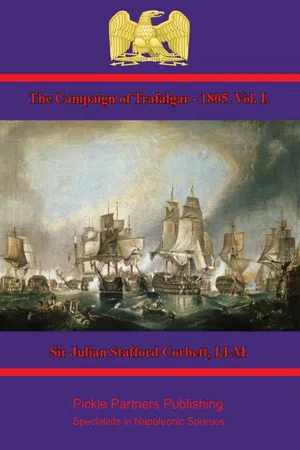
- 230 pages
- English
- ePUB (mobile friendly)
- Available on iOS & Android
eBook - ePub
The Campaign of Trafalgar — 1805. Vol. I.
About this book
Information
Subtopic
British HistoryIndex
HistoryTHE CAMPAIGN OF TRAFALGAR
CHAPTER I
PITT'S WAR POLICY
When, in May 1804, Pitt returned to power it was with a determination to conduct the lingering war on the grand scale of his father and by his father's strenuous methods. Treasured among his papers of the time is an eloquent apostrophe urging him to rise up and take the place that had been held by William the Third, by Marlborough, and by his father: to set himself, as they had done, at the head of Europe against Europe's great oppressor, to stir the faint hearts of the Powers into united effort, and to remove from England the reproach that she had not produced a war minister since the great days of Chatham.
The people, realising how the country's strength had grown with the war, were looking to him to give expression to their rising spirit; to teach them not only how to protect themselves from invasion, but how in the consciousness of their strength to strike down their arch-enemy as they had been wont to do in old days. In this spirit he gathered up the reins, and began at once to lay his widespread plans to give the war a new and more worthy presence.
Ever since we had broken the Peace of Amiens, our attitude, in effect, had been one of defence. Napoleon's unblushing contempt for his diplomatic engagements, and his unconcealed belief that by sheer truculence he could force us out of the European system altogether, had driven Addington's peace-loving Government to declare war{1}. To wage it was another thing, and it quickly proved to be beyond their capacity. From the first they were dominated by the elaborate threat of invasion by which Napoleon seized the initiative. Seeing how weak was the army, it paralysed all hope of offensive action in Europe, and our confident enemy could make merry over a country that went to war to show that it could defend itself.
Such offensive operations as were within their resources had been purely maritime—directed against the sea-borne trade of France and her minor colonial possessions. At the outbreak of hostilities our military strength in the West Indies was considerable, for the garrisons which had been in occupation of the French islands captured in the late war had not yet returned. These were well employed in retaking St. Lucia, which had come from long experience to be regarded as the key of the naval position in the Leeward Islands. So high, indeed, did it stand as a naval position that the question of its retrocession had almost wrecked the peace which ended the Seven Years' War. But, not content with this legitimate opening, the Government, in spite of the bitter lessons of the last war, proceeded to occupy Tobago and the four Dutch settlements of Demerara, Essequibo, Berbice, and Surinam. All these sickly stations required garrisons, and the result was to demobilise a serious proportion of our slender military force, and still further to reduce the possibility of a more active policy at home{2}.
For these adventures Addington and his friends are now blamed without mercy, but candour and a reasonable knowledge of the political conditions should temper the habitual attitude of superiority which their critics are wont to adopt. To begin with, we had in any case no hope of being able to use our army in Europe with effect single-handed, and at that time we were single-handed. And in the second place, the opening moves against the Dutch colonies were, in fact, a direct blow at the object we had in view. The real cause of the war, as is now admitted on both sides, was Napoleon's shameless behaviour to the United Provinces in breach of the Treaty of Lunéville. Before the ink was well dry he had reduced Holland to the condition of a subject-ally of France. His similar behaviour in Northern Italy and Switzerland intensified the resentment his breach of faith aroused; but the virtual annexation of Holland was what made a renewal of the war inevitable. It touched our traditional policy to the quick. The menace to our position in the Narrow Seas was one we had never been willing to endure. Now our reply was a refusal to evacuate Malta as provided by the Treaty of Amiens, and so the war broke out again. It was therefore a perfectly logical opening to strike at the Dutch colonies. It was a blow that could be dealt rapidly, and was well calculated to teach any man but Napoleon the lesson he could never learn. It told him plainly that, if France could find no room for England in the councils of Europe, there would be no room for a French empire beyond the seas.
But in political effect the West Indian conquests proved of no avail, and in the actual war they counted for nothing except in one not unimportant direction. The captured islands were a hotbed of privateering, and privateering was always the chief danger to our sea-borne commerce. Long experience had shown that it could not be dealt with effectually by pelagic operations alone. Addington's policy, therefore, has at least the justification not only of having dealt a direct blow at French commerce, and therefore at her finance, but also of having adopted the most effectual method of protecting our own. And, be it remembered, it was the retention of our financial position that eventually enabled us to beat Napoleon down; it was our sole hope of securing allies: and furthermore our only possible means of offence for the moment was against French sea-borne commerce. It was a form of attack particularly embarrassing to a ruler like Napoleon, whose chief aim in consenting to a peace had been to restore his finances and his fleet. It is therefore perhaps too narrow a judgment to condemn the West Indian operations out of hand merely because they seem to sin against the principle of concentration, and were a form of war which of itself could never decide the issue. Where a maritime empire is concerned caution is required in applying the simple formulae of continental strategists. Oceanic and continental war differ widely in some of their cardinal conditions. It is not enough to apply the maxims of the one crudely to the intricacies of the other, and Addington's detractors, should at least indicate in what direction the troops employed could have been used more profitably than in strengthening the position of the navy and lightening its burden{3}.
Everyone was quick to see that something more drastic must be done in the future, and Pitt rose to power on a wave of opinion that the hour for a change was at hand. The military forces at home had considerably increased. We began the war with a home army of little more than 50,000 regulars; by the summer of 1804 we had 87,000, besides 80,000 militia and 343,000 volunteers, or over half a million men. Pitt's first measures were directed to increasing the regular force still further; but even so, offence against such a power as Napoleon's was impossible single-handed. Only in alliance with the great military states of the continent could his father's methods be used, and simultaneously with the ripening of our striking energy alliances came in view.
It is here—in the negotiations and preliminary action for securing these alliances—that we find the key of the Trafalgar campaign. To treat it as the mere expression of the old policy of defence against invasion, which Pitt had resolved to abandon, is to seek for its meaning in vain. Yet it is on these lines the bulk of criticism runs, with the result that the real teaching has been almost entirely buried in a mass of erroneous strategical deduction. Through all this accumulation we must dig if we would recover the most precious treasure that naval experience has ever fashioned, and the first step towards recovery is to seek a simple understanding of Pitt's policy of military alliances. When Napoleon was trying to browbeat Addington's Government over their refusal to evacuate Malta—trampling on every decency of international comity—he had openly boasted that he had left England without an ally in Europe. She seemed to him helpless. In his almost crazy self-confidence he believed he could prevent the old causes producing the old effects and tread underfoot the fundamental laws which had given England her place in international politics ever since the European system had begun. Ignored by him, these laws began to reassert themselves almost immediately, and even before Pitt came back to power Russia had already made advances. Convinced by Napoleon's action in Holland, Italy, and Switzerland that he had not abandoned for a moment his ambitious dreams of European empire, she was bent on forming a defensive league to thwart his design.
It was where the danger touched her most nearly that England and England alone could give effective help. Napoleon was known to be cherishing a purpose to overrun the Ottoman Empire by way of Albania and Greece, and for this reason Russia had maintained a small squadron and a military outpost in Corfu and the Ionian Islands. We were as deeply concerned in Napoleon's design. For us Turkey was but a step on the path to India, and for this reason also we had clung, in the face of the Treaty of Amiens, to our hold on Malta. There was, moreover, another common interest at stake. It lay in Southern Italy, which Napoleon was openly threatening, and which he seemed bent on making the starting-point of his Near Eastern enterprises. Russia had taken the Kingdom of Naples under her special protection; and by a tradition as old as Cromwell, the denying of the Two Sicilies to France had become as much a dominant note of our maritime policy as the integrity of the Low Countries had been from time immemorial.
Naturally, then, the Russian overtures were well received in London, and just as Pitt came to power Woronzow, the Czar's ambassador, was able to say that a large Russian force from the Black Sea would be sent to the Ionian Islands or to Italy as circumstances might require, and that the Czar hoped his Britannic Majesty would order a corps of troops to be kept at Malta in readiness to act in conjunction with those of Russia{4}.
It is here we pick up the thread that led directly to the decision at Trafalgar. Slender as it proved to be, it is the only sure guide through the labyrinth of the campaign. The splendour and tragedy of the great day of reckoning had long cast this guiding line into obscurity. Yet, so far as human judgment can tell, without the entanglement it weaved about Napoleon the most famous naval battle in history would not have been fought. It was an effort to cut himself free from it that cost Napoleon his fleet; and unless we keep it securely between our fingers we must wander in error through the thronging movements of the year and never reach their real meaning. Let us trace the spinning of it till its strands were securely twined.
The idea that was in the Czar's mind was to form, with British assistance and above all with British subsidies, a great defensive league with Austria, Prussia, and Sweden. Whether all or any of those Powers could be induced to join was doubtful. The formation of the league must at least take much time, during which Napoleon might greatly strengthen his position. But in any event Russia and England could act together at once to bar his advance in the Mediterranean. Under the Treaty of Amiens he had agreed to evacuate the Neapolitan ports of Otranto and Taranto, in the south of Italy. But he had now reoccupied them, and from these points was not only threatening the Levant across the Adriatic, but was in a position to strike a sudden blow through Calabria at Sicily. It was vital to the situation that any such catastrophe should be prevented; and thus the idea of British troops in the Mediterranean became as it were the symbol and test of Pitt's purpose. When he pressed that the league should be offensive and for immediate action, the Czar at once reminded him that with respect to reinforcing our garrisons in the Mediterranean and assembling a corps of troops to act in Italy, Pitt had announced a delay of two or three months, not having as yet sufficient troops available for an expeditionary force. Admiral Sir John B. Warren, who was then our ambassador in Russia, immediately replied that a large part of the garrisons of Malta and Gibraltar could be spared at once, and that the remainder of the British troops would soon follow if the Czar would only propose to enter into a treaty to unite the Powers into an offensive and defensive alliance{5}. Within a month Russia had decided to send an ultimatum to Napoleon demanding the evacuation of Apulia, the arrangement of the affairs of Italy, compensation to the King of Sardinia for what had been taken from him, and the evacuation of North Germany. If there were no satisfactory answer in twenty-four hours his ambassador was to leave Paris{6}. Following on this resolute step Pitt sent out Lord Granville Leveson-Gower to replace Warren in order to negotiate a regular alliance, and the special instructions he carried were first to clear up a misunderstanding that had arisen as to the British view of Russian action in Italy. Pitt wished the Russians at once to seize the passes leading into Calabria from Taranto. The Czar thought he was being urged to drive the French out of the Kingdom of Naples single-handed, and Leveson-Gower was to assure him England knew that was impossible till Austria joined. But if he attempted the lesser operation two thousand troops from Malta were ready to assist at once. The immediate British object was solely to prevent France seizing Sicily by a coup de main through Calabria. For without Sicily as a base of supply the position of our fleet in the Mediterranean would be very difficult to maintain.
The words in which these instructions were conveyed to Leveson-Gower by Lord Harrowby, who was then Pitt's Foreign Secretary, are worth recording and remembering, for in them lies the explanation of much naval strategy, and in particular do they afford the key of Nelson's attitude to the Neapolitan question, and the complex naval problem which it involved. The actual situation at our point of contact with Russia turned upon the command of the Mediterranean, and that depended on Nelson's power of controlling the Toulon fleet-not necessarily of blockading it, but, as he preferred to say, on “holding it in check” till it could be met and destroyed. “It would become doubtful,” wrote Harrowby, in directing Gower to insist on the importance of immediate action, “whether the blockade of Toulon could be maintained as effectually as it has been hitherto [if Sicily were lost]; and in case the French fleet should escape from that port and be able to detach any considerable force to the Adriatic, the Russian Government would do well to consider the danger to which their own squadron in those seas would be exposed, and the opportunity which would be afforded to the French of making a successful attack upon Albania and the Morea.”
These were exactly Nelson's ideas. He was not of course blockading Toulon closely, but endeavouring to watch the Toulon fleet in such a way that if it attempted to get to the eastward and endanger what it was his special province to defend, it would certainly be brought to action. For this purpose Gibraltar and Malta were of little use. As bases they were wrongly placed. What was wanted was one that would enable him to retain continuously the only position that was interior to either line of operation the French might adopt, whether westwards out of the Straits, or eastwards against Naples and the Levant. It was for this reason he always insisted that Sardinia and Sicily were the keys of the strategical situation.
“You will receive,” Harrowby's instructions to Gower went on, “the assurances which were given by me to Count Woronzow, that exertions would be made to increase the disposal force of the garrison of Malta: and you may express a hope that a reinforcement of 5,000 or 6,000 men will have reached it in a few months. These troops will have eventual orders to act in the defence of Sicily, of Calabria, or of Turkey, as circumstances may require... but it seems necessary that their attention should be specially directed to the defence of Sicily.{7}”
The despatch ended accordingly with a renewed suggestion that Russian troops should be sent at once to cooperate with the Calabrians, whom we had been supplying with arms, and to assist them to hold the passes while the British troops from Malta occupied Messina.
The new ambassador also received special instructions to press for the re-establishment of the Sardinian Kingdom in Piedmont as a barrier to France in the intended settlement of Italy. The aggrandisement of the House of Savoy, as a means of preserving the balance of power in the Mediterranean, had become a constant of British policy. The military importance of the Sardinian Kingdom was recognised universally, but in British eyes its naval value was no less; and ever since Nelson had been in command in the Mediterranean he had been pressing the strategical value of Sardinia on the Government. So soon as the new administration was fairly in the saddle he had received orders frankly endorsing his ideas, and on the very day Leveson-Gower's instructions were signed, Nelson was acknowledging the Government's directions to have a special care for Sardinia{8}.
The British proposal, which was based on separate lines of operation, did not commend itself to the Russian Government. They wanted a much larger force and joint operations in Italy itself under one commander: but in view of Napoleon's threat from Boulogne, Leveson-Gower had to say that an increase of the British force in the Mediterranean was as yet impossible{9}. Meanwhile Pitt was devoting himself with all his energy to increasing our disposal force, and was still doing his utmost not only to strengthen the regular army, but to take measures to render the home defence secure in the hands of the territorial forces{10}. Russia, after some demur, admitted the strength of the British arguments, and on the promise of 8000 troops in a month or two, she consented to co-operate at once from Corfu with 20,000, provided the whole force was commanded by a Russian General, and that England furnished the necessary transport. To this arrangement the British Government assented, and before the end of the year Sir James Craig, who had been commanding the Essex defence district, was ordered to prepare the necessary force for Malta.
Concurrently with the arrangement of the military convention, the negotiations for a regular alliance were proceeding, but with constant difficulties, owing to the vacillating attitude of Austria, and the mutual suspicions of all the Powers concerned. Russia could not reconcile herself to England's retention of Malta, and England suspected Russia's real aim to be the partition of the Turkish Empire. Austria was clearly more concerned with recovering the old Hapsburg possessions in North Italy than with the liberation of Europe; and as for Prussia she had obviously no end in view but the filching of Hanover. Even Sweden was only prepared to move in return for an unconscionable British subsidy that...
Table of contents
- Title page
- PREFACE
- CHARTS AND DIAGRAMS
- CHAPTER I
- CHAPTER II
- CHAPTER III
- CHAPTER IV
- CHAPTER V
- CHAPTER VI
- CHAPTER VII
- CHAPTER VIII
- CHAPTER IX
- CHAPTER X
- CHAPTER XI
- CHAPTER XII
- CHAPTER XIII
- CHAPTER XIV
- CHAPTER XV
Trusted by 375,005 students
Access to over 1.5 million titles for a fair monthly price.
Study more efficiently using our study tools.
Frequently asked questions
Yes, you can cancel anytime from the Subscription tab in your account settings on the Perlego website. Your subscription will stay active until the end of your current billing period. Learn how to cancel your subscription
No, books cannot be downloaded as external files, such as PDFs, for use outside of Perlego. However, you can download books within the Perlego app for offline reading on mobile or tablet. Learn how to download books offline
Perlego offers two plans: Essential and Complete
- Essential is ideal for learners and professionals who enjoy exploring a wide range of subjects. Access the Essential Library with 800,000+ trusted titles and best-sellers across business, personal growth, and the humanities. Includes unlimited reading time and Standard Read Aloud voice.
- Complete: Perfect for advanced learners and researchers needing full, unrestricted access. Unlock 1.5M+ books across hundreds of subjects, including academic and specialized titles. The Complete Plan also includes advanced features like Premium Read Aloud and Research Assistant.
We are an online textbook subscription service, where you can get access to an entire online library for less than the price of a single book per month. With over 1.5 million books across 990+ topics, we’ve got you covered! Learn about our mission
Look out for the read-aloud symbol on your next book to see if you can listen to it. The read-aloud tool reads text aloud for you, highlighting the text as it is being read. You can pause it, speed it up and slow it down. Learn more about Read Aloud
Yes! You can use the Perlego app on both iOS and Android devices to read anytime, anywhere — even offline. Perfect for commutes or when you’re on the go.
Please note we cannot support devices running on iOS 13 and Android 7 or earlier. Learn more about using the app
Please note we cannot support devices running on iOS 13 and Android 7 or earlier. Learn more about using the app
Yes, you can access The Campaign of Trafalgar — 1805. Vol. I. by Sir Julian Stafford Corbett, LLM. in PDF and/or ePUB format, as well as other popular books in History & British History. We have over 1.5 million books available in our catalogue for you to explore.