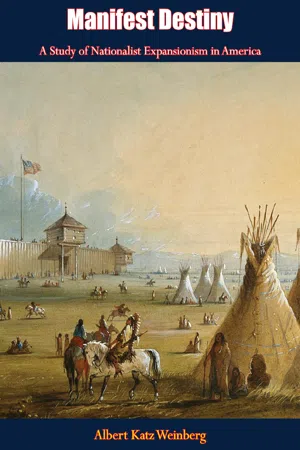
A fertile analysis of the ideology of American expansionism and its relation to national action. The history of the moral justifications that have accompanied the development of the United States is an illuminating study of the evolution of American nationalism.
"[The author] has painstakingly collected and dissected the arguments employed by American leaders to justify such annexations, beginning with Louisiana and Florida, and ending with the acquisitions growing out of the Spanish War. The object of his quest has been an understanding of the motives which have prompted the territorial growth of the United States."—New York Times
"As a source book in the dicta of democracy it is indispensable."—New Republic
"A clear, dispassionate light on recurring crises in American history. The book should be required reading for imperialists everywhere."—Christian Science Monitor
- 502 pages
- English
- ePUB (mobile friendly)
- Available on iOS & Android
eBook - ePub
About this book
Trusted by 375,005 students
Access to over 1.5 million titles for a fair monthly price.
Study more efficiently using our study tools.
Information
Subtopic
American Civil War HistoryIndex
HistoryCHAPTER I—NATURAL RIGHT
The century of the American Revolution witnessed in various lands the growth of nationalism from instinct to idea. The same century saw the first indications of the development of nationalism from idea to fervid prepossession.{15} Before the end of the eighteenth century this development had initiated in nationalism itself a revolution which marked its history with ironical inconsistency. The aim typical of nationalism as fervid prepossession was the very antithesis of the original idea of nationalism.
Nationalism as idea had confined its claims to limits which do not transgress the rights of any alien people. But nationalism as fervid prepossession betrayed this innocuous ideal by adopting an end which, because of the means required for its realization in a world limited in terrestrial space, is seldom compatible with respect for alien rights. This end was territorial expansion, a national aggrandizement which tends to lessen international amity and peace. While the attachment to territorial extensiveness was perhaps “as old as human society,”{16} expansionism derived from nationalism a potent stimulation which enhanced its emotional drive. The very peoples who had drunk most deeply of the new humanitarian nationalism succumbed most readily to the expansionist intoxication which led into the age of imperialism.
One instance of this perversion of an idea was offered by revolutionary Frenchmen, who became “oppressors in their turn” when they veered from Rousseau and the abjuration of conquest to Bonaparte. Another example, no less striking, though less unhappy in its results, was presented by the United States of America. Its appealing declaration of independence was immediately followed by a war not merely for independence but for the extension of power as well. America’s affirmation of equality and the foundation of government on consent was mocked in less than three decades by the extension of its rule over an alien people without their consent.
This strange and yet worldwide transmutation of anti-imperialistic nationalism into nationalist expansionism deserves and has evoked the consideration of those hopeful of making somewhat intelligible the body of human inconsistencies which is called history. Its causation was so complex that it has perhaps not even yet been adequately considered in all its aspects. Moreover, there are some whose explanations betray the same emotional bias which was in large measure responsible for the curiosities of the development of nationalism. Thus Mazzini’s derivation of French imperialism from the desire for glory,{17} and no less Dr. Channing’s interpretation of American expansionism as a restless cupidity,{18} are over-simplifications reflecting vexation at the apparent fall of nationalism from an ethereal plane of humanitarianism. It was not merely self-interest which caused nationalism to become expansionistic. Moral ideology, which made of nationalism a fervid prepossession, also enabled the nationalist to pursue expansion without a sense of heresy to his original ideal. For expansion was so rationalized that it seemed at the outset a right, and soon, long before the famous phrase itself was coined, a manifest destiny. Moral ideology was the partner of self-interest in the intimate alliance of which expansionism was the offspring.
The strangest fact about this incongruous union has to do with the nature of original expansionist philosophy. It was derived from the same method of thought, the same conception of human rights, which was used and popularized by the original nationalist. So protean are ideas that it is a wise father who can know his own intellectual offspring. The expansionism which an anti-imperialistic nationalist would have regarded as some profligate’s monster child was in reality the nationalist’s child—perhaps illegitimate, perhaps unfortunately reared, but still his very own.
The central figure of this tragedy or comedy of errors is the idea of natural right. Broadly defined, the historic concept of natural right is that of a right which “Nature,” regarded as a divinely supported system of “natural law” inclusive of moral truths, bestows prior to or independently of political society. The honorable genealogy of this idea can be traced back at least as far as the Greek conception of those things which are right “by nature,” that is, inherently, and can be recognized by every rational being to be so.{19} Stoicism and Roman law subsequently conceived of “natural rights” as being among the truths inherent in natural law, the rational system of the physical and moral universe; still later, Christianity harmonized these ideas of paganism with its own theology by regarding natural law as the expression of the eternal reason of God. Successive schools of politico-legal thought used the concept of natural right to justify rights of property, civil liberties, and, with the rise of democratic thought, rights of popular sovereignty. Philosophers of the eighteenth century, seeking freedom from all the shackles of past “prejudices,” brought the concept of natural right into the center of political thought by selecting, of all things, this time-worn notion as their instrument of emancipation. And in the eighteenth century natural right did figure as the opening wedge for at least one new political claim—the momentous pretension later to be called nationalism.
The nucleus of nationalism is the thesis that homogeneous populations have the right to form independent political associations. This doctrine was on the one hand a justification of the existing states resting upon popular will; on the other hand, however, it justified separation from existing states on the part of peoples desirous of independence. The revolutionary movements of the eighteenth century were in some measure inspired by, and later in turn inspired, this innovating philosophy of nationalism. It is true that probably the majority of eighteenth-century philosophers were led by their humanitarian cosmopolitanism to disdain local engrossments and provincial exclusiveness. But others, no less devoted to humanity at large, espoused the claims of the peoples who had not achieved independence, and gave to nationalism its first systematic presentations. They included thinkers as diverse as the culturally nationalistic Herder, the democratic Rousseau, the Tory Bolingbroke, and the liberal physiocrats. But virtually all based their doctrine of nationalism on one or both of two principles respecting natural right.{20} The first principle affirmed the natural right of groups to determine upon and organize the desired form of government. The second asserted that nationalities were the most natural agencies for promoting not only the rights of particular groups but also, by virtue of the social contributions of each nationality, the rights of mankind in general.
Such principles arose in part as a challenge to the Machiavellian morality which had long held that the welfare of the state was its highest law, that expansion was necessary to state welfare, and that the dismemberment of states was “a normal resource of diplomacy.”{21} Reacting against the dynastic wars which such notions, were still causing, publicists and jurists of the eighteenth century maintained that “individuals of one nationality should have a high regard for the interests and sentiments of individuals of other nationalities.”{22} This seemed dictated by both phases of the philosophy underlying original nationalism. On the one hand, conquest was condemned as an infraction of every people’s natural right to self-determination. Rousseau declared that conquest had no other basis than the law of the strongest, that is, no moral basis at all.{23} From a similar point of view Holbach, in his La politique naturelle, affirmed “the madness of conquests” to be far from sane politics.{24} The aristocratic Bolingbroke{25} was at one with liberal physiocrats such as Dr. Richard Price{26} and Major John Cartwright{27} in believing that the universal law of reason, the source of natural rights, required a foreign policy of peace and amity with other nations. The Swiss jurists Vattel{28} and Burlamaqui{29} (popular among Americans) forbade aggressive expansion as contrary to the law of nature on which they founded the equal rights of sovereign nations. On the other hand, anti-imperialism was also deduced from the nationalist’s assumption that a diversity of homogeneous states was most favorable for advancing the rights and welfare of humanity. Thus Herder regarded the indiscriminate enlargement of states as “unnatural” because it meant “the wild mixing of all kinds of people,” a destruction of the ethnic homogeneity making possible distinctive cultural contributions.{30} A prejudice against expansion as well as against imperialism was thus the original consequence of the nationalist’s philosophy of natural right.
Such were the European winds of doctrine which blew fresh and strong in the century ascribing perfectibility to men and states. They carried across the wide Atlantic and there first helped to set a new ship of state into motion. These doctrines, however, were destined to move it in an unexpected direction and to produce a curiosity of intellectual history—the adoption of the idea of natural right as the moral rationale of America’s expansionism.
Perhaps it was prophetic of such a development that America’s spirited people had always tended to stress the rights of natural law more forcibly than its duties. The conception of natural right was first used by New England clergymen in behalf of rights of ecclesiastical independency. It descended from their pulpits into the arena of public discussion about 1760 when Americans became concerned with issues of their political rights under Great Britain. As parliamentary assertion of taxing power provoked irritation and then resistance, colonial leaders well-read in the English literature of natural law opposed the actions of Parliament not only with legal considerations but with the argument from the law of nature. Thus James Otis maintained that by “the law of God and nature” Americans were entitled to all rights of their fellow subjects in Great Britain, not excluding consent to taxation.{31} The American interpretation of natural law and natural right is exemplified by the following citation from Alexander Hamilton’s pamphlet of 1775 on America’s “right” to legislative autonomy:
Good and wise men, in all ages,...have supposed, that the Deity, from the relations we stand in to Himself, and to each other, has constituted an eternal and immutable law, which is indispensably obligatory upon all mankind, prior to any human institution whatever.
This is what is called the law of nature, ‘which, being coeval with mankind, and dictated by God himself, is, of course, superior in obligations to any other. It is binding over all the globe, in all countries, and at all times. No human laws are of any validity, if contrary to this; and such of them as are valid, derive all their authority, mediately, or immediately, from this original.’—Blackstone.
Upon this law depend the natural rights of mankind: the Supreme Being gave existence to man, together with the means of preserving and beautifyin...
Table of contents
- Title page
- TABLES OF CONTENTS
- ABOUT THE AUTHOR
- DEDICATION
- PREFACE
- FOREWORD
- INTRODUCTION
- CHAPTER I-NATURAL RIGHT
- CHAPTER II-GEOGRAPHICAL PREDESTINATION
- CHAPTER III-THE DESTINED USE OF THE SOIL
- CHAPTER IV-EXTENSION OF THE AREA OF FREEDOM
- CHAPTER V-THE TRUE TITLE
- CHAPTER VI-THE MISSION OF REGENERATION
- CHAPTER VII-NATURAL GROWTH
- CHAPTER VIII-POLITICAL GRAVITATION
- CHAPTER IX-INEVITABLE DESTINY
- CHAPTER X-THE WHITE MAN’S BURDEN
- CHAPTER XI-PARAMOUNT INTEREST
- CHAPTER XII-POLITICAL AFFINITY
- CHAPTER XIII-SELF-DEFENSE
- CHAPTER XIV-INTERNATIONAL POLICE POWER
- CHAPTER XV-WORLD LEADERSHIP
Frequently asked questions
Yes, you can cancel anytime from the Subscription tab in your account settings on the Perlego website. Your subscription will stay active until the end of your current billing period. Learn how to cancel your subscription
No, books cannot be downloaded as external files, such as PDFs, for use outside of Perlego. However, you can download books within the Perlego app for offline reading on mobile or tablet. Learn how to download books offline
Perlego offers two plans: Essential and Complete
- Essential is ideal for learners and professionals who enjoy exploring a wide range of subjects. Access the Essential Library with 800,000+ trusted titles and best-sellers across business, personal growth, and the humanities. Includes unlimited reading time and Standard Read Aloud voice.
- Complete: Perfect for advanced learners and researchers needing full, unrestricted access. Unlock 1.5M+ books across hundreds of subjects, including academic and specialized titles. The Complete Plan also includes advanced features like Premium Read Aloud and Research Assistant.
We are an online textbook subscription service, where you can get access to an entire online library for less than the price of a single book per month. With over 1.5 million books across 990+ topics, we’ve got you covered! Learn about our mission
Look out for the read-aloud symbol on your next book to see if you can listen to it. The read-aloud tool reads text aloud for you, highlighting the text as it is being read. You can pause it, speed it up and slow it down. Learn more about Read Aloud
Yes! You can use the Perlego app on both iOS and Android devices to read anytime, anywhere — even offline. Perfect for commutes or when you’re on the go.
Please note we cannot support devices running on iOS 13 and Android 7 or earlier. Learn more about using the app
Please note we cannot support devices running on iOS 13 and Android 7 or earlier. Learn more about using the app
Yes, you can access Manifest Destiny by Albert Katz Weinberg in PDF and/or ePUB format, as well as other popular books in History & American Civil War History. We have over 1.5 million books available in our catalogue for you to explore.