Gaming no longer only takes place as a ›closed interactive experience‹ in front of TV screens, but also as broadcast on streaming platforms or as cultural events in exhibition centers and e-sport arenas. The popularization of new technologies, forms of expression, and online services has had a considerable influence on the academic and journalistic discourse about games. This anthology examines which paratexts gaming cultures have produced – i.e., in which forms and formats and through which channels we talk (and write) about games – as well as the way in which paratexts influence the development of games. How is knowledge about games generated and shaped today and how do boundaries between (popular) criticism, journalism, and scholarship have started to blur? In short: How does the paratext change the text?
eBook - ePub
Paratextualizing Games
Investigations on the Paraphernalia and Peripheries of Play
- English
- ePUB (mobile friendly)
- Available on iOS & Android
eBook - ePub
Paratextualizing Games
Investigations on the Paraphernalia and Peripheries of Play
About this book
Information
Topic
Ciencias socialesSubtopic
Películas y vídeosHistories
“And You Didn’t Even Look at It!”
ASSASSIN’S CREED’S (Self-)DISCOVERY TOUR
BENJAMIN BEIL
PROLOGUE: NEW-OLD CHAMBERS
On 3 November 2017, a curious headline appeared on the video game website Kotaku: “This Week’s Giza Pyramid Discovery Was Already Built into ASSASSIN’S CREED ORIGINS.”1 What had happened? A few days earlier, researchers had made public the discovery of two previously unknown rooms near the upper royal burial chamber of the 4,500-year-old Great Pyramid of Giza. The rooms were detected with the help of new scanning technologies. The Great Pyramid of Giza appears as a virtual replica in the action-adventure video game ASSASSIN’S CREED ORIGINS (2017). Players can explore the structure and, in addition to the burial chambers that have been known for some time, actually enter the two antechambers that were still undiscovered at the time of the game’s release on 27 October 2017.
The ASSASSIN’S CREED series is known for its meticulously designed historical settings, for which the developer studio Ubisoft consults historians, archaeologists, and other experts. In the case of ASSASSIN’S CREED ORIGINS, French architect Jean-Pierre Houdin, who has published some controversial theories about the construction of the Egyptian pyramids, was an advisor to the development team. Following Houdin’s hypotheses, Ubisoft had speculatively included the two chambers in the virtual Great Pyramid of Giza.
This anecdote may be a strange coincidence; however, it illustrates the complex interplay between history as an academic discipline, popular historical discourses, and representations of history in entertainment media, i.e., forms of public history. Stephen Totilo addresses this area of tension in his Kotaku article:
“Players who don’t know the history of the Great Pyramid, let alone the controversy over how it was built, might mistake the innards of the structure as poor game design. From a video game standpoint, climbing through the pyramid isn’t all that exciting. It’s far less interesting a feat than climbing through many other areas in the long-running ASSASSIN’S CREED series. But those armed with the knowledge of what’s in the actual pyramid, and who understand what the interpretation presented in the game represents, might find this to be a fantastic opportunity not just for virtual tourism but for an exploration of theoretical history.”2
In this way, the new-old chambers also hint at a certain dilemma of the ASSASSIN’S CREED series, which on the one hand is often praised for its detailed historically reconstructions, but on the other hand, is a frequently mentioned example of a significant dissonance between its historical story world and its gameplay mechanics.
The Ptolemaic Egypt is just one of numerous historical settings of the ASSASSIN’S CREED games: from ancient Greece to Jerusalem and Damascus at the time of the Third Crusade to Renaissance Florence and Rome to Paris during the French Revolution.3 The series’ historical architectures and characters show an impressive visual detail, which increases with each new entry, not least due to the rapid technical evolution of video games. In addition, virtual reconstructions of historical buildings have been part of the archaeological toolkit for quite some time. Thus, it seems only a small step to the virtual worlds of contemporary games. Ubisoft was even recently a cooperation partner of the exhibition From Mosul to Palmyra: A Virtual Journey through World Cultural Heritage,4 in which museum-goers were able to ‘visit’ virtual reality reconstructions of numerous cities and monuments destroyed by war.
However, as (technologically) fascinating as the virtual replicas of ASSASSIN’S CREED’s historical sites may seem at first glance, their combination with gameplay mechanics is often conflicting at second glance. While the historical scenario changes with each new game in the series, the gameplay remains more or less identical. Players fight and sneak their way through the game world, improving the avatar’s skills in the process. This mixture of action-adventure and role-playing elements seems largely detached from the various historical settings. In other words, it hardly makes a difference in terms of gameplay whether the avatar climbs over the roofs of an ancient temple complex or a modern factory building. In both cases, the setting is primarily a “playground,”5 an obstacle course occasionally interrupted by combat.
Such a ludonarrative dissonance6 is by no means unique to the ASSASSIN’S CREED series. It characterizes most video games that make use of historical settings. History becomes an assemblage of sceneries and props that primarily serve to embellish the story world. Thus, these games do not offer “performatory challenges,”7 historical knowledge is not required for the successful completion of the game. History “takes place around and above the players, but their experience of history is fragmented, ontological and particularized.”8
***
As a field of research in both history and media studies, the representation of history in video games has gained considerable attention in the last years, from empirical studies9 to detailed analyses of specific historical periods10 to memory culture11 or phenomenological approaches;12 also the Clash of Realities conference has dedicated itself to the topic in depth.13
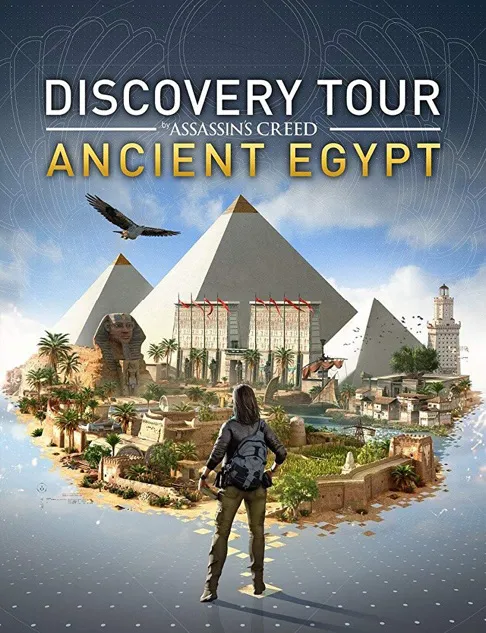
This vivid and wide-ranging debate will not be discussed in detail in the following; it rather serves as a background and starting point for the study of a peculiar paratext: the DISCOVERY TOUR BY ASSASSIN’S CREED: ANCIENT EGYPT (from here on DISCOVERY TOUR). The DISCOVERY TOUR will be explored as a kind of paratextual confrontation of the ASSASSIN’S CREED series with its own pop-cultural status—and its complex relationship to history.
Figure 1: DISCOVERY TOUR BY ASSASSIN’S CREED: ANCIENT EGYPT
Source: Ubisoft/Ubisoft Montreal 2018;
Screenshot by B. Beil
THE DISCOVERY TOUR AS A PARATEXT
The DISCOVERY TOUR was released in February 2018 as an expansion of the main game and has also been available as a standalone version since May 2018.14 In this game mode, there are no enemies and only rudimentary parkour obstacles—and thus no typical gameplay challenges. Players can freely explore virtual Egypt, including the Great Pyramid of Giza, and experience the game world as a huge open-air museu...
Table of contents
- Cover
- Title Page
- Copyright Page
- Table of Contents
- Preface and Acknowledgements
- Paratext | Paraplay
- Histories
- Performances
- Peripheries
- Contributors
Trusted by 375,005 students
Access to over 1.5 million titles for a fair monthly price.
Study more efficiently using our study tools.
Frequently asked questions
Yes, you can cancel anytime from the Subscription tab in your account settings on the Perlego website. Your subscription will stay active until the end of your current billing period. Learn how to cancel your subscription
No, books cannot be downloaded as external files, such as PDFs, for use outside of Perlego. However, you can download books within the Perlego app for offline reading on mobile or tablet. Learn how to download books offline
Perlego offers two plans: Essential and Complete
- Essential is ideal for learners and professionals who enjoy exploring a wide range of subjects. Access the Essential Library with 800,000+ trusted titles and best-sellers across business, personal growth, and the humanities. Includes unlimited reading time and Standard Read Aloud voice.
- Complete: Perfect for advanced learners and researchers needing full, unrestricted access. Unlock 1.5M+ books across hundreds of subjects, including academic and specialized titles. The Complete Plan also includes advanced features like Premium Read Aloud and Research Assistant.
We are an online textbook subscription service, where you can get access to an entire online library for less than the price of a single book per month. With over 1.5 million books across 990+ topics, we’ve got you covered! Learn about our mission
Look out for the read-aloud symbol on your next book to see if you can listen to it. The read-aloud tool reads text aloud for you, highlighting the text as it is being read. You can pause it, speed it up and slow it down. Learn more about Read Aloud
Yes! You can use the Perlego app on both iOS and Android devices to read anytime, anywhere — even offline. Perfect for commutes or when you’re on the go.
Please note we cannot support devices running on iOS 13 and Android 7 or earlier. Learn more about using the app
Please note we cannot support devices running on iOS 13 and Android 7 or earlier. Learn more about using the app
Yes, you can access Paratextualizing Games by Benjamin Beil, Gundolf S. Freyermuth, Hanns Christian Schmidt, Benjamin Beil,Gundolf S. Freyermuth,Hanns Christian Schmidt in PDF and/or ePUB format, as well as other popular books in Ciencias sociales & Películas y vídeos. We have over 1.5 million books available in our catalogue for you to explore.