eBook - ePub
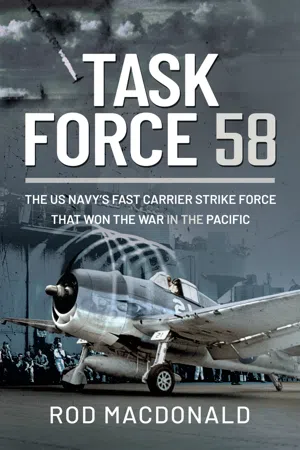
Task Force 58
The US Navy's Fast Carrier Strike Force that Won the War in the Pacific
- 336 pages
- English
- ePUB (mobile friendly)
- Available on iOS & Android
eBook - ePub
About this book
The new breed of American fast aircraft carriers could make thirty-three knots, and each carried almost 100 strike aircraft. Brought together as Task Force 58, also known as the Fast Carrier Task Force, this awesome armada at times comprised more than 100 ships carrying more than 100,000 men afloat. By 1945, more than 1,000-combat aircraft, fighters, dive- and torpedo-bombers could be launched in under an hour. The fast carriers were a revolution in naval warfare – it was a time when naval power moved away from the big guns of the battleship to air power projected at sea. Battleships were eventually subordinated to supporting and protecting the fast carriers, of which, at its peak, Task Force 58 had a total of seventeen. This book covers the birth of naval aviation, the appearance of the first modern carriers in the 1920s, through to the famous surprise six-carrier _Kido Butai_ Japanese raid against Pearl Harbor on 8 December 1941 and then the early US successes of 1942 at the Battles of the Coral Sea and Midway. The fast carriers allowed America, in late 1942 and early 1943, to finally move from bitter defence against the Japanese expansionist onslaught, to mounting her own offensive to retake the Pacific. Task Force 58 swept west and north from the Solomon Islands to the Gilbert and Marshall Islands, neutralising Truk in Micronesia, and Palau in the Caroline islands, before the vital Mariana Islands operations, the Battle of Saipan, the first battle of the Philippine Sea and the Great Marianas Turkey Shoot. The strikes by Task Force 58 took Allied forces across the Pacific, to the controversial Battle of Leyte Gulf and to Iwo Jima and Okinawa. Task Force 58 had opened the door to the Japanese home islands themselves – allowing US bombers to finally get close enough to launch the devastating nuclear bombing raids on Hiroshima and Nagasaki. Task Force 58 participated in virtually all the US Navy's major battles in the Pacific theatre during the last two years of the war. Having spent many years investigating naval shipwrecks across the Pacific, many the result of the devastating effectiveness of Task Force 58, diver and shipwreck author Rod Macdonald has created the most detailed account to date of the fast carrier strike force, the force that brought Japan to its knees and brought the Second World War to its crashing conclusion.
Information
Topic
StoriaSubtopic
Storia del XX secoloChapter 1
Naval Aviation – Genesis
With the first flight of a heavier than air powered aircraft by Wilbur and Orville Wright in 1903, the following years of the early part of the twentieth century were a time of great experimentation and innovation as the possibilities of using aircraft at sea for military purposes were explored. Naval aviation had been born.
As naval aviation developed, a number of important firsts took place in rapid succession. The first powered seaplane appeared in 1910 – the Hydravion designed by the Frenchman Henri Fabre, which took off from water and flew about half a kilometre on 28 March 1910. Seaplanes are powered fixed wing aircraft fitted with wing and/or fuselage floats that allow them to take off from and land on water. The fuselage itself is held up out of the water by the floats, unlike a ‘flying boat’ where the fuselage sits on the water when stationary.
As no flight deck was required for seaplanes, the early seaplane tender vessels could remain relatively small and inconspicuous, simply requiring space for the aircraft themselves and cranes to launch and recover them. The first seaplane tender appeared late in 1911, with the modified 389ft-long, 6,000-ton French torpedo boat tender La Foudre, whose original role in 1896 when she had been built was to carry torpedo boats to the high seas for launch and attack. Work began late in 1911 to convert her to a seaplane tender, with hangars installed on the main deck. Initially her cranes were used to lift seaplanes (or floatplanes) onto the water – and to hoist them aboard on their return. Seaplanes however required large pontoons to enable them to float, and these made them suffer aerodynamically and thus be unsuitable for air combat roles. The trick would be to work out how to fly bespoke combat aircraft directly to and from ships.
The first launch of a fixed wing aircraft from a stationary ship took place on 14 November 1910. A Curtiss Model D (the Curtiss Pusher), piloted by Eugene B. Ely, roared off a temporary inclined wooden platform fitted to the stationary US cruiser USS Birmingham near Hampton Roads, Virginia. Almost incredibly it was still just seven years after the Wright brothers’ first successful flight.
The evolutionary pace of naval aviation was accelerating. The first deck landing, again using a temporary wooden platform, took place just two months later on 18 January 1911, when the same pilot, Eugene B. Ely, landed his Curtiss Pusher on the afterdeck of the 13,680-ton armoured cruiser Pennsylvania, anchored in San Francisco Bay. This landing was also the first use of a tailhook-arrested landing that had been designed and built by circus performer and aviator Hugh Robinson. The new era of the aircraft carrier had now arrived – but with military aviation still in its infancy, even as these tentative steps towards fixed wing aircraft launching and landing on ships progressed, the full potential was not fully apparent. The development of the role of the seaplane still progressed in tandem.
Several navies experimented with using aircraft on different types of ships. The first powered fixed wing launch from a stationary British ship took place on 10 January 1912 – when S.38, piloted by Commander Charles Samson, lifted into the air from a flying off platform fixed to the fore part of the 15,885-ton pre-dreadnought British battleship HMS Africa. This platform ran from her bridge to her bow above her forward 12in main battery gun turret.
Africa then transferred her flying off platform and equipment to the King Edward VII-class pre-dreadnought battleship HMS Hibernia, on which further development of the concept took place resulting in the first recorded flight from a moving ship taking place at the Royal Fleet Review in Weymouth Bay, England in early May 1912. Commander Samson, again flying the modified biplane S.38, launched from the flying off platform on the forepart of Hibernia whilst she was under way at 10.5 knots. In late 1912, at the Grand Naval Review in Yokohama, Japan, a seaplane landed near the imperial flagship carrying the Japanese emperor and other high-ranking officials. A second floatplane and a non-rigid airship flew over the Japanese Fleet.1 The possibilities were obvious to everyone.
The British protected cruiser HMS Hermes was temporarily converted as an experimental seaplane carrier, for two months in April–May 1913, to allow the Royal Navy to evaluate how aircraft could operate with the fleet. Her forward 6in gun was removed, and a tracked launching platform constructed over the fo’c’sle with a canvas hangar installed to shelter her aircraft at the end of the tracks and a derrick on the foremast to lift the seaplane from the water on its return. Hermes is thus often seen as the first true seaplane carrier – in preference to seaplane tender La Foudre, which had a 10m flying off platform added seven months later in November 1913.
As a result of their experimental flights, the Royal Navy came to the view that shipborne aircraft were important for reconnaissance, spotting and other purposes. The aircraft available at the time however were slow and vulnerable and there were no weapons they could carry that could pose a serious threat to a warship – naval aircraft were not yet ship-killers. But even though the possibilities for spotting ahead of the fleet were recognised, their presence, and the flying off platforms, interfered with the firing of the big guns, then of paramount importance in sea warfare. The Royal Navy also had concerns that even if successfully lowered down to the water, seaplanes sometimes could not take off, if water conditions were too rough. In addition, there were practicalities and dangers involved in recovering seaplanes from the water after flight in anything other than calm conditions. These reasonable fears negated the desirability of having aircraft launching from capital ships. Some other way of solving the problem of carrying aircraft at sea would have to be found.
The answer came in 1914 with the first ship designed and built as a seaplane carrier, HMS Ark Royal. She had originally been laid down as a 366ft-long civilian freighter with a beam of 50ft in November 1913 by the Blyth Shipbuilding Company. The Royal Navy purchased the ship in May 1914, whilst she was still under construction, in frames with her keel laid. The hull was launched in September 1914 for fitting out and extensive changes were made to her original civilian design to convert her for her role as a seaplane carrier. Her planned superstructure, smokestack and machinery were moved aft, like a tanker – and the forward section of the ship was outfitted as a working deck, not for flying off aircraft, but for recovering aircraft from the sea and for running up seaplane engines. A large aircraft hold was created that was 150ft long by 45ft wide and 15ft high and which had extensive workshops. Two steam-driven cranes on the sides of the fo’c’sle lifted aircraft through the sliding hatch of the hangar onto the flight deck or lowered them into the water.
Ark Royal was commissioned on 10 December 1914 and carried five floatplanes and two to four wheeled aircraft. The seaplanes were craned into the water alongside the seaplane carrier for take-off and on return, were craned back aboard. Although her wheeled aircraft could launch, they could not land back on the seaplane carrier and had to land ashore. The early aircraft carrier concept of launching wheeled aircraft directly from a flying off deck as opposed to craning seaplanes over the side of the ship to the water to launch had now arrived.
In the Battle of Tsingtao, from 5 September 1914, the Imperial Japanese Navy (IJN) seaplane carrier Wakamiya carried out the world’s first naval launched air raids from Kiaochow Bay during the Siege of Tsingtao. The Wakamiya was fitted with a couple of derricks for hoisting the seemingly fragile Maurice Farman MF.11 seaplanes in and out of the water. Her seaplanes bombarded German communications and command centres, unsuccessfully attacked the German protected cruiser SMS Kaiserin Elisabeth with bombs and damaged a German minelayer in the Tsingtao peninsula.
On 6 August 1914, German Army Zeppelin airships bombed the Belgian city of Liège, and after other night raids on Antwerp and Warsaw, Britain would deploy seaplanes in action for the first time – in an effort to prevent Zeppelin bombing raids on British ports and cities.
German Zeppelins were known to be housed in vast sheds at Cuxhaven, on Germany’s small section of North Sea coastline on the German Bight. From there they could threaten British ports and cities – but the Zeppelin sheds were out of range of British aircraft based in the UK.
On Christmas Day 1914, British seaplanes were carried into action by the three seaplane tenders, Engadine, Riviera and Empress, supported by the cruisers, destroyers and submarines of the Harwich Force commanded by Commodore Reginald Yorke Tyrwhitt. The powerful British naval force moved to within range of the German Zeppelin sheds and then launched three seaplanes from each seaplane tender near Heligoland Island, some 40 nautical miles distant from Cuxhaven. Although two of the seaplanes were unable to start their engines, the remaining seven successfully got airborne and set off to locate and destroy the sheds. Several sites were attacked, although low cloud, fog and AA fire largely thwarted the raid. Nevertheless, the strategic offensive importance of naval aviation was now clear.
Germany experimented with submarine aircraft carriers – by carrying a seaplane on the decks of a submarine close to the British coast, where it could partially submerge and allow the seaplane to float off. In January 1915, U-12 left Zeebruge with a lightweight two-seat FF-29 seaplane carried on its deck in a take-off position – carrying a single bomb.
The British also experimented with the concept of submarines carrying aircraft, with HMS E22 being commissioned on 8 November 1915 and designed to carry two Sopwith Schneider seaplane scouts on her casing. She would submerge and the planes would float off for a water take-off. The planes could not be recovered to the submarine and would return to the east coast of England once their mission was complete.
Naval aviation weapons and deployment techniques were also developing in tandem. On 11 August 1915, the first attack using an air-launched aerial torpedo, from a British Short Admiralty Type 184 seaplane deployed from the seaplane carrier HMS Ben-my-Chree, took place on a Turkish vessel that had already been crippled by the British submarine E14, in the Sea of Marmora.
The Ben-my-Chree was a 390ft-long, 2,651grt packet steamer, launched in 1908 and chartered by the Royal Navy on 1 January 1915. Part of her superstructure abaft her aftmost smokestack was removed and replaced by a large hangar that could house four to six seaplanes – the seaplanes being lifted in and out of the water onto her deck by derricks. A removable 18m-long flying off platform was fitted forward of her superstructure that was equipped with a trolley and rails to allow a seaplane to take off from the foredeck.
The Short Admiralty Type 184 launched by Ben-my-Chree was a two-seat reconnaissance, bombing and torpedo-carrying seaplane with folding wings. It attacked the Turkish vessel, dropping its torpedo from a height of just 15ft at a range of 800yd. It transpired that its target had in fact beached, after the damage by E14.
Five days later, another Short Type 184 was the first aircraft to actually sink a ship using an aerial torpedo, the victim being a Turkish transport vessel a few miles north of the Dardanelles on 17 August 1915.
The first use of a seaplane for reconnaissance in an action at sea took place on 31 May 1916 during the Battle of Jutland, fought between British and German fleets in the North Sea when, at 1445 hours, Admiral Beatty ordered his seaplane tender HMS Engadine, of the 3rd Light Cruiser Squadron in the battlecruiser screen, to launch an aircraft to investigate a sighting of smoke reported by the light cruiser Galatea, which was scouting ahead of the British battlecruiser squadron. Engadine was carrying two Short Type 184 floatplanes fitted with low-power wireless – and two Sopwith Baby floatplanes designed to shoot down Zeppelins.
A Short Type 184 floatplane was launched – and after about 10 minutes of flight, at 1530, its crew of two sighted German naval units – whilst flying at about 1,000ft, due to low clouds. The Type 184 closed to within a mile and a half to see what the ships actually were – before turning to head back to Engadine, reporting the presence of three enemy battlecruisers and ten destroyers turning to the south. As it headed back towards Engadine, the British battlecruiser Lion passed by below steaming into action at flank speed as it led the fifty-two warships of Beatty’s battlecruiser force, six battlecruisers, four battleships and a screen of cruisers and destroyers, into the initial clash with the German battlecruiser squadron. The greatest clash of steel warships the world had ever seen, the Battle of Jutland, had begun.
The frailties of the big gun battlecruiser concept, which sacrificed armour for speed, were subsequently brutally demonstrated as the Battle of Jutland developed, with the catastrophic losses of three British battlecruisers, Indefatigable, Queen Mary and Invincible. Despite these losses, with naval aviation still in its infancy, most naval officers, educated in the late nineteenth century, still held firmly to the traditional belief that the dreadnought was the undisputed super weapon of the maritime battlefield. Every nation that had the industrial might to build them, did so – and put them on display as a lavish statement of national power.
But despite the well-entrenched belief in the supremacy of the big guns of a capital ship, the pace of the development of naval aviation quickened. The first landing on a moving ship, the flying off deck of the modified Courageous-class battlecruiser HMS Furious, took place at Scapa Flow in the Orkney Islands off northern Scotland on 2 August 1917 – when Squadron Commander Edwin Dunning landed a Sopwith Pup biplane in relatively benign conditions. The forward main battery turret of Furious had been removed whilst she was under construction and a flight deck added in its place, such that aircraft had to manoeuvre ...
Table of contents
- Cover
- Title
- Copyright
- Contents
- Explanatory Notes
- Introduction
- Chapter 1 Naval Aviation – Genesis
- Chapter 2 Prelude to War in the Pacific – A Little Bit of Background
- Chapter 3 The Fast Carriers Begin to Appear
- Chapter 4 Let Loose the Dogs of War
- Chapter 5 1942 – The US Navy Goes to War – The Coral Sea and Midway
- Chapter 6 From Defence to Offence – The Guadalcanal Campaign, 7 August 1942–9 February 1943
- Chapter 7 Summer of 1943 – The Allies Begin to Move West Across the Pacific
- Chapter 8 US Fast Carriers and Naval Aircraft
- Chapter 9 Late 1943 – The Isolation of Rabaul – The Central Pacific Drive Begins
- Chapter 10 Task Force 58 is Formed – The Gilbert and Marshall Islands Campaign Continues
- Chapter 11 Central Pacific Drive, 1944 – The Gilbert and Marshall Islands Campaign Continues
- Chapter 12 Preparations for the Mariana and Palau Islands Campaign
- Chapter 13 The Mariana and Palau Islands Campaign – Operation FORAGER, June–November 1944
- Chapter 14 Prelude to the Philippines Campaign
- Chapter 15 The Battles of Peleliu and Angaur – Operation STALEMATE II, September–November 1944 356
- Chapter 16 The Philippine Campaign – Second Battle of the Philippine Sea, Leyte Gulf
- Chapter 17 The Liberation of the Philippines – Corking the Luzon Bottleneck
- Chapter 18 Raiding Tokyo and the Invasions of Iwo Jima and Okinawa, February–April 1945
- Chapter 19 The Final Assault on Japan – Operation DOWNFALL, 1 November 1945–7 (Projected)
- Appendix Dramatis Personae
- Notes
- Select Bibliography
Trusted by 375,005 students
Access to over 1.5 million titles for a fair monthly price.
Study more efficiently using our study tools.
Frequently asked questions
Yes, you can cancel anytime from the Subscription tab in your account settings on the Perlego website. Your subscription will stay active until the end of your current billing period. Learn how to cancel your subscription
No, books cannot be downloaded as external files, such as PDFs, for use outside of Perlego. However, you can download books within the Perlego app for offline reading on mobile or tablet. Learn how to download books offline
Perlego offers two plans: Essential and Complete
- Essential is ideal for learners and professionals who enjoy exploring a wide range of subjects. Access the Essential Library with 800,000+ trusted titles and best-sellers across business, personal growth, and the humanities. Includes unlimited reading time and Standard Read Aloud voice.
- Complete: Perfect for advanced learners and researchers needing full, unrestricted access. Unlock 1.5M+ books across hundreds of subjects, including academic and specialized titles. The Complete Plan also includes advanced features like Premium Read Aloud and Research Assistant.
We are an online textbook subscription service, where you can get access to an entire online library for less than the price of a single book per month. With over 1.5 million books across 990+ topics, we’ve got you covered! Learn about our mission
Look out for the read-aloud symbol on your next book to see if you can listen to it. The read-aloud tool reads text aloud for you, highlighting the text as it is being read. You can pause it, speed it up and slow it down. Learn more about Read Aloud
Yes! You can use the Perlego app on both iOS and Android devices to read anytime, anywhere — even offline. Perfect for commutes or when you’re on the go.
Please note we cannot support devices running on iOS 13 and Android 7 or earlier. Learn more about using the app
Please note we cannot support devices running on iOS 13 and Android 7 or earlier. Learn more about using the app
Yes, you can access Task Force 58 by Rod Macdonald in PDF and/or ePUB format, as well as other popular books in Storia & Storia del XX secolo. We have over 1.5 million books available in our catalogue for you to explore.