This book offers empirical insights on key challenges faced by the travel and tourism industries in the post-COVID-19 era. The desire to make tourism safe is gaining ground, but what does this mean? This book explores the guarantees travelers want in the postpandemic era and how individual territories are predicting and responding to these needs. It explores the role of innovation and digital solutions, assures tourists different ways of using services, both physical and digital. It considers how the commitment of smart tourist cities to technology, sustainability and accessibility is able not only to improve the quality of travelers' tourist experience, but also the quality of life of local inhabitants. This book considers the main solutions that many destinations are already experimenting, around the world to respond to the new safety demands of travelers.
eBook - ePub
Tourism, Safety and COVID-19
Security, Digitization and Tourist Behaviour
- 164 pages
- English
- ePUB (mobile friendly)
- Available on iOS & Android
eBook - ePub
About this book
Information
1Tourism, security and crisis management
DOI: 10.4324/9781003195177-2
Introduction
The tourism sector is regularly subject to economic crisis or downturn as a result of major forces such as natural disasters, terrorist acts, political or social turmoil and epidemics.
Therefore, when we talk about tourism, we refer to a very vulnerable phenomenon that is forced to readjust whenever travelers’ safety can be threatened (Ioannides and Gyimóthy, 2020).
There are many vulnerability factors in the territories that unfortunately cause a looming “tourism crisis” (Faulkner, 2001; EHA, 2002; Handmer, 2003; Miller and Rivera, 2011; Student, Lamers and Amelung, 2020). Sonmez, Backman and Allen (1994) use the expression “tourism crisis” to describe a situation in which a negative event manages to affect tourist flows and, consequently, the progress of all tourism-related activities (Reisinger and Mavondo, 2005). In other words, destinations perceived as dangerous are deeply exposed to the possibility of suffering great economic, social and cultural damages which, starting from the lack of tourist demand, can affect the many actors present in the supply chain. It should not be overlooked that the tourism supply chain involves various components, not only accommodation, transport and excursions, but also catering, crafts, production and sale of local wares and infrastructures that support the development of tourism in a destination (Yavas, 1987; Roehl and Fesenmaier, 1992; Tsaur, Tzeng and Wang, 1997; Smith et al., 2019). In this sense, the tourist offer can be described as a network of organizations involved in a series of different activities that all contribute to the construction of a destination as a “tourist proposal” (Szpilko, 2017).
The decline in tourist demand constitutes a decrease in earnings with consequent loss of job opportunities, slowdown in local development and in the income and profits for the entire community.
Research conducted over the years by numerous academics and professionals in the sector (e.g., Fischhoff, Nightingdale and Iannotta, 2001; Cavlek, 2002; Lepp and Gibson, 2003; Bongkosh and Goutam, 2012; Kwaku, 2012; Uğur and Akbıyık, 2020) has clearly emphasized that when the damage suffered by a destination conditions its image, tourists tend to change their plans. The more a destination is associated with threat or danger, whether real or only perceived, the more likely travelers will consider alternative travel plans. Not surprisingly, Pizam and Mansfeld (1996: 1) argue that “security, tranquility and peace are a necessary prerequisite for prosperous tourism.”
Evidently, the image of a destination and its level of safety play a fundamental role for potential tourists in their choice of holiday destination (e.g., Baloglu and McCleary, 1999; Huang and Min, 2002; Huan, Beaman and Shelby, 2004; Ichinosawa, 2006). The perception of the risk associated with a given destination perhaps exerts a far-reaching impact thanks to the contribution of the media, thereby creating a significant level of unjustified anxiety among potential travelers (e.g., Durocher, 1994; Burnett, 1998; Sonmez and Graefe, 1998; Mansfeld, 1999; Min, 2003; Bhati et al., 2020; Moreno Barreneche, 2020; Russo, 2020).
The objective of this chapter is twofold: on one hand, it aims to show the resilient nature of tourism, that is, its capability to resist crisis. The historical retrospect of tourism reveals the fact that human beings never quit traveling, but readjust their mobility choices after evaluating the potential safety risks of the trip destination in times of historical or social instability.
On the other hand, after a brief historical reconstruction on the main obstacles that tourism has faced starting from the new millennium, the chapter focuses on the relationship between tourism and health.
The final section of this chapter is dedicated to a discussion of crisis management in the industry of tourism as well as the countermeasures against the new threats of COVID-19 in various tourist countries.
1.1 Tourism does not go on vacation
An analysis of historical stages of international tourism on the basis of the data provided by United Nations World Tourism Organization (UNWTO, 2020a) (see Fig. 1.1) reveals that the number of international trips has always been on the rise despite the several crises which have occurred since the new century through to the end of 2019.
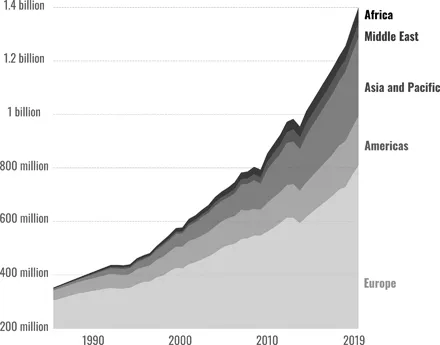
Figure 1.1International tourism arrivals by world region.
Source: Author's elaboration based on UNWTO (2020a) data.
Since the new millennium, in particular, the year of 2000 was marked as a year of prosperity in international tourism as it registered a year-on-year growth of 7 percent. The following year, however, saw great difficulties in the sector: the Israeli–Palestinian conflict was rekindled at the beginning of 2001 and the world stock exchanges suffered from a rapid decline, which was destined to be a far-reaching one, thereby causing an economic downturn globally. The airlines and the entire tourism industry at large, during the summer of the same year, were among the first victims of this downturn, as both experienced reduced demands (UNWTO, 2002).
The 9/11 is considered to be a watershed event in the tourism history due to its unprecedented consequences: on the morning of Tuesday, September 11, 2001, 19 al-Qaeda terrorists hijacked four airliners, two of which were flying between Boston and Los Angeles. These two Boeing 767s, American Airlines Flight 11 and United Airlines Flight 175, crashed into the North and South towers of World Trade Center in Manhattan. The other two airliners, American Airlines Flight 77, a Boeing 757, departed from Washington, D.C. to Los Angeles and then crashed into the Pentagon, and United Flight 73, a Boeing 757, ended itself in Pennsylvania after the passengers managed to defeat the hijackers though they intended to crash the plane in Washington, D.C. The moment when these terrorist attacks were underway, at least 2,500 aircraft were flying over the sky of the United States, all of which were later forced to land within an hour for the sake of security. Worse still, not one aircraft took off in the United States for the consecutive 4 days, which had never happened in the previous 80 years.
The 9/11 terrorist attacks deeply shook the world with a death toll of about 3,000. These victims, however, all lost their lives on a plane, one of our main means of transport. Consequently, safety and normality of travel, which lie at the root of the development of tourism, suffered a severe blow worsened by the economic crisis already underway. Under such circumstances, airlines in the world suffered most from this crisis. As a consequence, the Australian company Ansett and the American company Midway Airlines declared bankruptcy in September 2001, followed the following month by Swissair and, in November, by the Belgian company Sabena (Blake and Sinclair, 2003).
Globally, the UNWTO recorded a slack growth in tourist movements (+ 2.8 percent) from January to August 2001, and a significant drop (−10.9 percent) between September and December. Throughout the year, there was an overall reduction of 1.3 percent in arrivals of international travelers (UNWTO, 2001).
In particular, terrorism generated many problems in the tourism and hospitality industries on American soil, seriously impacting the economies of some states.
The year 2002 began with the war in Afghanistan, followed by the severe crisis that hit an important part of South America. Meanwhile, the stock market continued to decline, and the world economy slackened.
In this period of time, tourism experienced great uncertainty, but it continued to exist, despite people's fear of traveling. According to data provided by UNWTO (2003b), surprisingly, the biggest growth in inbound tourism was recorded in the Middle East, with Egypt and Red Sea destinations at the forefront, followed by the Pacific Coast countries of Asia. These territories gained the spotlight as principal destinations among international travelers to the detriment of the United States, which, by contrast, lost its aura as the top country to visit and became the biggest victim to the fear of terrorist attacks.
The beginning of 2003 also witnessed a war, to be specific, the conflict between the US–UK coalition and...
Table of contents
- Cover Page
- Half-Title Page
- Series Page
- Title Page
- Copyright Page
- Contents
- List of Figures
- Acknowledgments
- Preface
- Introduction: Tourism and COVID-19, among desire to travel, new fears and opportunities
- 1 Tourism, security and crisis management
- 2 Innovation in post-COVID tourism: From big data to artificial intelligence and tourism rebound
- 3 How to choose safe destinations: From “communitycation” to new digital analysis tools
- 4 A system in crisis: Means of transport in search of solutions and new functions to withstand the pandemic
- 5 Being a tourist without moving: Stationary tourism as an alternative strategy for traveling
- Conclusion: A look to the future
- Index
Trusted by 375,005 students
Access to over 1.5 million titles for a fair monthly price.
Study more efficiently using our study tools.
Frequently asked questions
Yes, you can cancel anytime from the Subscription tab in your account settings on the Perlego website. Your subscription will stay active until the end of your current billing period. Learn how to cancel your subscription
No, books cannot be downloaded as external files, such as PDFs, for use outside of Perlego. However, you can download books within the Perlego app for offline reading on mobile or tablet. Learn how to download books offline
Perlego offers two plans: Essential and Complete
- Essential is ideal for learners and professionals who enjoy exploring a wide range of subjects. Access the Essential Library with 800,000+ trusted titles and best-sellers across business, personal growth, and the humanities. Includes unlimited reading time and Standard Read Aloud voice.
- Complete: Perfect for advanced learners and researchers needing full, unrestricted access. Unlock 1.5M+ books across hundreds of subjects, including academic and specialized titles. The Complete Plan also includes advanced features like Premium Read Aloud and Research Assistant.
We are an online textbook subscription service, where you can get access to an entire online library for less than the price of a single book per month. With over 1.5 million books across 990+ topics, we’ve got you covered! Learn about our mission
Look out for the read-aloud symbol on your next book to see if you can listen to it. The read-aloud tool reads text aloud for you, highlighting the text as it is being read. You can pause it, speed it up and slow it down. Learn more about Read Aloud
Yes! You can use the Perlego app on both iOS and Android devices to read anytime, anywhere — even offline. Perfect for commutes or when you’re on the go.
Please note we cannot support devices running on iOS 13 and Android 7 or earlier. Learn more about using the app
Please note we cannot support devices running on iOS 13 and Android 7 or earlier. Learn more about using the app
Yes, you can access Tourism, Safety and COVID-19 by Salvatore Monaco in PDF and/or ePUB format, as well as other popular books in Negocios y empresa & Hostelería, viajes y turismo. We have over 1.5 million books available in our catalogue for you to explore.