- 314 pages
- English
- ePUB (mobile friendly)
- Available on iOS & Android
eBook - ePub
About this book
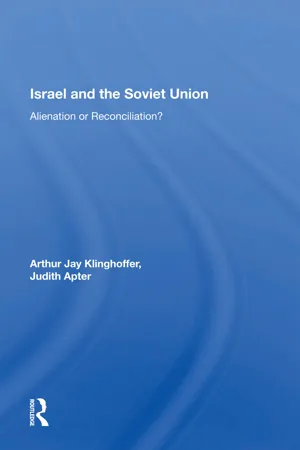
This volume is a survey of Soviet-Israeli relations from the time when the U.S.S.R. supported the establishment of Israel's independence in 1947-48. Although diplomatic relations have been broken since 1967, the author shows how many contacts there have been, from conversations at the foreign minister level to the visits of individuals and delegations.
Information
1 Through the Looking Glass
DOI: 10.4324/9780429037610-1
It was a sunny May day in 1979. Three military officers stepped forward and were awarded ribbons for meritorious service. An Israeli army representative joined in the ceremony. Who was being honored and where was this event taking place? Amazingly, the recipients were Soviet United Nations' observers who served in Syria! The location was Tiberias, Israel, on the shores of the Sea of Galilee. It would seem to be a rather unlikely scenario but, in fact, it was repeated in October 1983.
As one delves into the Soviet-Israeli relationship, things certainly do get curiouser and curiouser. In June 1971, a Soviet journalist and political courier paid a visit to the Western Wall. It is in contested East Jerusalem and is the most sacred Jewish site. In March 1978, there was a demonstration in Moscow against the Palestinians who carried out an attack along Israel's coastal highway! How about the incongruous effort in July 1970 by the mayor of Netanya, Israel. He tried to offer a blessing for Defense Minister Moshe Dayan in a Leningrad synagogue! In September 1976, the body of a Jewish Soviet colonel who died in Minsk a year earlier was sent to Israel for burial on the Mount of Olives. Also unusual is the fact that in 1978, an Israeli kibbutz built a textile plant that uses Soviet equipment. Or ponder the strange case of Igor Beliaev, a commentator on Middle Eastern affairs for Soviet newspapers. In April 1983, he was appointed Deputy Chairman of the Anti-Zionist Committee; in May, he was in Israel to celebrate the anniversary of the defeat of Nazi Germany.
How can we explain this apparently anomalous behavior? Aren't the Soviet Union and Israel sworn enemies who severed diplomatic relations in 1967? Isn't the Soviet Union a patron of the Palestine Liberation Organization (PLO) and arms merchant to the Arabs in their wars against Israel? Only qualified yesses to these questions will suffice, as a simplistic approach to the issues will be of limited analytical value. Few remember that the Soviet Union voted at the United Nations in favor of the partition of Palestine, and was the first state to extend de jure recognition to Israel. The Soviets assisted Israel in its war of independence in 1948 by encouraging arrangements for the transport of arms from Czechoslovakia and oil from Rumania. Diplomatic relations were surely broken in 1967, as they had been once previously in 1953, but extensive contacts have been maintained and active secret diplomacy has been conducted. In fact, Soviet emissaries were even received by Prime Minister Yitzhak Rabin during their covert April 1975 mission.
Soviet-Israeli contacts range from high level diplomacy to mere curiosity items. For example, Israeli beekeepers visited the Soviet Union in August 1971, and an Israeli delegation attended a Moscow conference early in 1983 on interference by birds with air traffic. In order to understand the foundations of this rather odd relationship, we must provide explanations for some striking paradoxes: The Soviet Union, despite its opposition to Zionism, supported the creation of a Jewish state in Palestine. Once relations with Israel soured, the Soviets continued to insist on Israel's right to exist. A Soviet diplomat said to Nahum Goldmann, former president of the World Zionist Organization, that if Israel didn't exist, the Soviet Union would have had to create her.1 While rejecting Zionism, the Soviets insist that all Jewish emigrants get visas for Israel, and many non-Jews also leave the Soviet Union in the same manner. Foreign Minister Andrei Gromyko expressed anger that Soviet Jews were often going to the United States rather than Israel; in October 1981, the chief rabbi of Moscow phoned the chief Ashkenazi rabbi of Israel to say that emigration would be stopped if too many Soviet Jews went to countries other than Israel.2
Why are those Soviets who are most supportive of a political solution to the Arab-Israeli conflict also the strongest proponents of the PLO? How can the provision of advanced weaponry to Arab states act as a military constraint on their behavior? Why does Israel benefit from Soviet influence in the Middle East? Why do the most extreme rightist elements in the Israeli government favor an improvement of relations with the Soviet Union? Why does the rate of Soviet Jewish emigration tend to have virtually no correlation with the state of Soviet-Israeli ties? To begin to unravel these enigmas, we must first deal with the issue of mutual perceptions.
Perceptions
The late King Feisal of Saudi Arabia, an opponent of both communism and Zionism, had a conspiratorial view of history which linked these two ideologies. He correctly pointed out that the Bolshevik movement in Russia included many Jews, some of whom became prominent in the Soviet government. Similarly, the Marxist foundations of nineteenth century Zionism were noted and the Soviet Union indeed supported the establishment of the state of Israel. Weren't there kibbutzim in Israel which were applying Marxist collectivist principles? Feisal argued that Jews established the Soviet Union and then Israel, and he even viewed the emigration of Soviet Jews to Israel as part of a plot to create a communist base in the Middle East.3 Feisal's interpretation evolved into the fantasy that the Soviet Union and Israel were engaged in a joint endeavor to undermine the Islamic Arab world. This belief is surely delusional but it has been derived from the valid principle that communism and Zionism have for long shared a symbiotic relationship.
Both ideologies explosively emerged from East-Central Europe in the late nineteenth century. They were conditioned by the same social circumstances, and they were revolutionary in their approach to change. The major distinction was that the communists emphasized class identity, whereas the Zionists favored national identity. They struggled for the soul of European Jewry, both movements succeeding. The Soviet Union and Israel emerged as their creations but their conflict goes on, centered on the loyalty of Soviet Jewry. Prior to 1948, the Soviets believed that the battle was already over, but they were then amazed at the emotional response of their Jews to the creation of a Jewish state. The upsurge of Jewish nationalism, long latent, revealed significant fissures in the entire edifice of Soviet nationality policies and the Soviet system is now beset with problems on many ethnic fronts. Furthermore, the emigration of Soviet Jews has cut an ideological swath through communist doctrine as many Jews have opted for a Jewish state rather than a workers' state. On the other hand, Zionism itself has been threatened as a majority of the emigrants now choose the United States over the Jewish homeland.
Communism and Zionism wage a particularly fierce struggle because they are estranged relatives reared with similar traditions. Familiarity indeed breeds contempt and this is more easily understandable if we look at the backgrounds of the Israeli political elite. Every Israeli prime minister but one was born in what is now the Soviet Union or Poland. The exception was Yitzhak Rabin, a native Sabra, but his parents both came from Russia. The leading Israeli political personality who never became prime minister, Moshe Dayan, also had two Russian-born parents. The four most prominent Jews in the Israeli communist movement were all born in the Soviet Union or Poland, namely Meir Wilner, Moshe Sneh, Shmuel Mikunis and Esther Wilenska. Israelis feel that they know the Soviet Union, and this raises their adrenalin when it is being discussed. Some Israeli prime ministers are strongly conditioned by negative memories. Menachem Begin will surely not forget his September 1940 arrest by the Soviet secret police in Lithuania and his subsequent terms in prison and Siberian labor camps. He stayed incarcerated only until the following summer, but such an experience must have been psychologically searing. Golda Meir left as a child, but with bitter recollections. She writes about her paternal grandfather, who was drafted into the Russian army when he was twelve and not permitted to follow his religious rituals. After completing his service, he slept on a wooden bench with a stone for a pillow. This was his method of atoning for infidelities of piety.4 Levi Eshkol had a more positive image of his childhood, and this seemed to be reflected in his political attitudes while prime minister.
Israelis are extremely sensitive to the Soviet Union, as is reflected in a public opinion poll of 1200 respondents in late 1981. When asked which threat to Israel was greater, the Arab or Soviet, 42.5% said the Arab, 25.9% the Soviet, 25.5% said they were equal, and 6% had no opinion.5 The fact that more than half the respondents believed the Soviet threat to be greater or equal is rather illuminating as Israel had repeatedly confronted the Arabs in war but had never faced the Soviet Union. Also interesting was the Israeli reaction to a Soviet peace plan proposed in December 1968. It was rejected in January, with Foreign Minister Abba Eban commenting that "Israel regards and will regard with severe suspicion any Soviet plan, by virtue of it being Soviet."6 Rather interesting from the man who three years earlier had sought Soviet participation in the Middle East peace process.
The Soviet attitude toward Israel is no less charged. The Soviet media constantly revile Zionism and prominent Soviet Jews are often included in orchestrated campaigns against an ideology deemed perfidious. Zionism is equated with racism and fascism, and Israel was alleged to have been involved in a plot in 1952-53 to kill Soviet officials through improper medical care. Cyrus Sulzberger has summarized the views expressed to him by Henry Kissinger as follows: "The Russians, however, are not entirely rational on Israel. There is a hysterical edge. They are basically anti-Semitic and hate being licked by Jews. When Kissinger was in Moscow in 1968 he found he could talk to the Russians rationally on all subjects, even including Vietnam—except for Israel."7
A Roaring Mouse?
For the Soviets, Israel's importance greatly transcends its size and influence. It receives media attention far exceeding its newsworthiness and has been the target of a break in diplomatic relations on two occasions, 1953 and 1967. No other country has come close in arousing Soviet passions, as the only other Soviet severance of relations was with Chile in 1973 after the military overthrew Salvador Allende. Why is Israel accorded this special attention? Why are Soviet-Israeli relations much more crucial and explosive than those between the Soviet Union and other small states of similar power? As the first step in arriving at an adequate response, one must turn again to the issue of anti-Semitism.
Russian anti-Semitism predates the 1917 revolution but was developed into an art by Stalin as he struggled against Leon Trotskii, a Jew. Gradually, almost all Jews were removed from positions of authority but they remained useful scapegoats for systemic inadequacies or examples of alien influence attempting to undermine the Russian culture. Jews were accused of "cosmopolitanism" during the late forties, were implicated in a “doctors' plot" against Kremlin leaders in 1952-53, and represented the majority of those executed for "economic crimes" during the early sixties. Jews have been portrayed as dissidents and anti-government activists in both the Soviet Union and East European states. In the latter, Jews were prominent among the defendants in show trials during the early fifties, and an alleged Zionist conspiracy was a common prosecutorial theme.
It is not considered appropriate for Marxists to denounce Jews, so the Soviets attack Judaism and Zionism. In the twenties and thirties, Jews were tarnished with the brush of Trotskyism. By the late forties, Zionism had become the main epithet, a catchword for disloyalty and subversive influence. Israel, in a symbolic sense, became an integral component of Soviet domestic politics and this inevitably was translated into foreign policy realities. In a way, the Soviet Jewish factor led to a negative approach toward Israel; in the United States, the impact of the Jewish factor turned out exactly the opposite.8
Many Soviet political analysts view Israel as part of an international Jewish conspiracy linked to imperialism, banking interests and high finance. Jews are depicted as capitalist businessmen bent on world domination, an amazing reversal of the equally proposterous Feisal theory. Allegations about Jews and Israel serve some vital functional needs of the Soviet system, and are not proffered as idle diatribes. The need for a scapegoat and the allegorization of internal power struggles thus coalesce around the Jew and Zionism. Such a process has been particularly evident in Poland and Czechoslovakia, but it still exists in the Soviet Union despite the almost total absence of Jews from high political positions.9 Of course, Israel is not the real issue but competing factions use Zionism as a code word which helps classify one's political affiliation and identify which groups may include Jews. John Armstrong, a political scientist specializing in Soviet affairs, has astutely observed: "If the USSR and its satellites did not have large Jewish minorities, the prospect of their adopting a more flexible policy toward Israel would be brighter. If, on the other hand, Israel did not exist it is possible that some of the anti-Semitic tendencies within the Soviet block would be moderated."10
The Soviets attach importance to Israel as they see it as a lodestone attracting the sympathies of the world's Jews. Soviet backing of Israel in the late forties was aimed, in part, at securing greater support for the Soviet Union from Western Jews, particularly left-leaning intellectuals and socialists. Later, the Soviet Union made periodic overtures to Israel in order to influence Jewish opinion in the United States. The intent was to secure support for detente, and American extension of economic benefits to the Soviet Union, from Jewish public figures and pro-Israeli members of Congress. The Soviet Union has even moderated its position toward Israel to silence the protests of Jewish communists, particularly those in West European parties.
Soviet permission for Jews to emigrate during the seventies was based on recognition of its impact on world Jewish opinion, but internal suppression of Zionist tendencies produced a countervailing effect. Harsh treatment of those who applied to emigrate, the sad cases of refuseniks who were denied the right to leave, and the arrest for treason of Jewish activist Anatolii Shcharanskii all blackened the Soviet image and served only to raise the level of condemnation. Somewhat illogically, the Soviets were giving with one hand but taking back with the other.
From the Israeli perspective, Israel is seen as the homeland of world Jewry, the bastion of Zionist ideology, and the crucible for preserving the Jewish culture and religion from assimilationist tendencies. The fate of the Jewish people is a major foreign policy concern and Michael Brecher, a prominent analyst of Israeli foreign affairs, has described "a special link" between Israel and Jews in the Diaspora. He averred: "It may indeed be argued that world Jewry is the most important component of the global system for Israel."11 Israel's first foreign minister, Moshe Sharett, even stipulated in June 1949 that states desiring good relations with the Jewish state must support Zionism. He was alluding to the Soviet Union and had Jewish emigration in mind.12 Prime Minister David Ben Gurion declared: "In our policy towards Russia the position of Russian Jews is the main concern." He believed that one-third of them desired to move to Israel.13
Israel strives to protect Jews in states like Iran, Ethiopia, South Africa and Argentina so the welfare of world Jewry acts as a constraint on its foreign policy. This is true to a limited degree in regard to Jerusalem's relations with Moscow, but the main concern there is the right of emigration for the second largest overseas Jewish community. On May 17, 1971, the Knesset went so far as to pass a bill extending Israeli citizenship to Soviet Jews who had been denied the right to emigrate. On July 10, 1978, Yigal Allon reacted to Shcharanskii's treason trial by declaring in the Knesset that Shcharanskii was not disloyal to his homeland, Israel. Israeli relations with the Soviet Union as a superpower are inextricably entwined with the issue of Soviet Jewry, just as relations with the United States are also related to the fact that more Jews live there than anywhere else, including Israel.n
Israel is a major religious center, with Jerusalem sacred to Christians, Moslems and Jews. Its strong spiritual appeal runs counter to the Marxist emphasis on materialism and atheism, and presents other problems for the Soviets as well. The Russian Orthodox Church maintains properties in Israel and continues to sponsor pilgrimages of church officials to Jerusalem. Such activities are carried out with the approval of the Soviet government, but they surely indicate some inherent doctrin...
Table of contents
- Cover Page
- Half Title Page
- Title Page
- Dedication Page
- Table of Contents Page
- Acknowledgments Page
- 1 THROUGH THE LOOKING GLASS
- 2 THE LOOSE KNOT
- 3 ALIENATION OF AFFECTIONS
- 4 OUT IN THE COLD
- 5 COMING TO BLOWS
- 6 UNREWARDED FLIRTATIONS
- 7 THE BREAKING POINT
- 8 SHUNTED ASIDE
- 9 SOME STEPS TOWARD RECONCILIATION
- 10 SEPARATE PATHS
- 11 COOL EMBRACE
- 12 DISTANT PARTNERS
- 13 ALIENATION OR RECONCILIATION?
- Notes
- Index
Trusted by 375,005 students
Access to over 1.5 million titles for a fair monthly price.
Study more efficiently using our study tools.
Frequently asked questions
Yes, you can cancel anytime from the Subscription tab in your account settings on the Perlego website. Your subscription will stay active until the end of your current billing period. Learn how to cancel your subscription
No, books cannot be downloaded as external files, such as PDFs, for use outside of Perlego. However, you can download books within the Perlego app for offline reading on mobile or tablet. Learn how to download books offline
Perlego offers two plans: Essential and Complete
- Essential is ideal for learners and professionals who enjoy exploring a wide range of subjects. Access the Essential Library with 800,000+ trusted titles and best-sellers across business, personal growth, and the humanities. Includes unlimited reading time and Standard Read Aloud voice.
- Complete: Perfect for advanced learners and researchers needing full, unrestricted access. Unlock 1.5M+ books across hundreds of subjects, including academic and specialized titles. The Complete Plan also includes advanced features like Premium Read Aloud and Research Assistant.
We are an online textbook subscription service, where you can get access to an entire online library for less than the price of a single book per month. With over 1.5 million books across 990+ topics, we’ve got you covered! Learn about our mission
Look out for the read-aloud symbol on your next book to see if you can listen to it. The read-aloud tool reads text aloud for you, highlighting the text as it is being read. You can pause it, speed it up and slow it down. Learn more about Read Aloud
Yes! You can use the Perlego app on both iOS and Android devices to read anytime, anywhere — even offline. Perfect for commutes or when you’re on the go.
Please note we cannot support devices running on iOS 13 and Android 7 or earlier. Learn more about using the app
Please note we cannot support devices running on iOS 13 and Android 7 or earlier. Learn more about using the app
Yes, you can access Israel And The Soviet Union by Arthur J Klinghoffer in PDF and/or ePUB format, as well as other popular books in Politics & International Relations & Middle Eastern Politics. We have over 1.5 million books available in our catalogue for you to explore.