- 372 pages
- English
- ePUB (mobile friendly)
- Available on iOS & Android
eBook - ePub
About this book
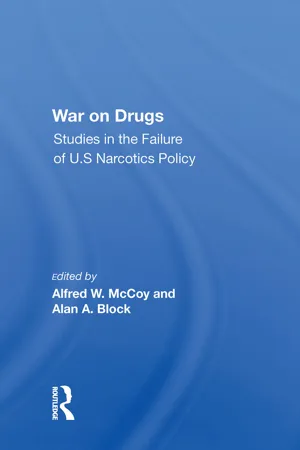
Since George Bush declared his war on drugs in 1989, cocaine addiction in America has increased 15%, and narcotics have emerged as major commodities from the Third World. Focusing on US narcotics policy, Latin America's cocaine traffic and Asia's heroin trade, the essays in this book offer evidence indicating that the war is not working.
Information
1 U.S. Narcotics Policy: An Anatomy of Failure
Alfred W. McCoy & Alan A. Block
DOI: 10.4324/9780429268557-1
Reflecting a deepening public concern about the pandemic of cocaine and heroin, President George Bush declared his "War on Drugs" in September 1989 with a dramatic White House speech that seemed to launch a major foreign policy initiative.1 In its National Drug Control Strategy released simultaneously, the White House was even more explicit: "In the past, programs . . . have been hampered by the lack of importance given by this country to the drug issue as a foreign policy concern. We must develop . . . a broad, meaningful public diplomacy program in a manner that will increase the level of international intolerance for illicit drugs."2 Although soon eclipsed by events in Eastern Europe and the Persian Gulf, the drug war still commands an appropriation of $11 billion in the 1991 budget, making it one of the largest U.S. government programs.3
Initially, of course, the Bush "drug war"–a direct extension of President Reagan's earlier campaign-was really a war on cocaine. Reinforcing the weapons of repression deployed by the Reagan administration, America's cocaine war quickly evolved a three-part strategy: pressing the Andean source countries to eradicate coca leaf cultivation, cutting the flow of drugs northward from the Caribbean and Mexico, demanding draconian law enforcement for domestic users and dealers. Escalating suppression to unprecedented levels, the Bush administration has involved the U.S. military directly in drug law enforcement4 by invading Panama with 24,000 troops,5 floating plans for a battle fleet off the coast of Colombia,6 and dispatching the Green Berets to Peru.7 These events have led many observers to believe that narcotics suppression, particularly against cocaine, may well become the main pretext of U.S. intervention in Latin America for the rest of the decade.
More recently, the Bush administration seems to be enlarging its drug war to include heroin. After a long history of covert operations that contributed indirectly to the rise of heroin production in Asia's opium zone, the United States now seems poised to mount a massive operation against this drug trade. In December 1989, a U.S. prosecutor in Brooklyn indicted Burma's reigning "heroin king," Khun Sa, for conspiracy to import narcotics—a quixotic act that highlights the difficulty of declaring war on an invisible commodity trade.8 While the United States could invade Panama to haul a manacled General Manuel Noriega before a Miami judge, a parallel incursion into the rugged mountains of northern Burma to bring Khun Sa before a Brooklyn jury seems risibly remote. Nonetheless, if domestic heroin abuse continues to expand at the same rapid rate that it did in 1990 and 1991, this effort may well mean surveillance of Asian communities inside the United States or increased intervention in Southeast and Southwest Asia. In this battle the Bush administration clearly expects help from its allies, but many have their own agendas and may prove uncooperative.
Despite White House claims to the contrary, there is mounting evidence that the Bush drug war and its underlying policy of repression have failed. Only months after the President's declaration of war on drugs in September 1989, the White House began using surveys of drug abuse to claim a partial victory. In January 1990, presidential narcotics chief William J. Bennett announced that "the scourge is beginning to end."9 A year later, Dr. Louis W. Sullivan, Secretary of Health and Human Services, announced the results of questionnaires from high school seniors which indicated a drop in crack use from 4 percent in 1986 to only 1.9 percent in late 1990. Dr. Sullivan called the results a "significant milestone underlining considerable progress." Commenting on these findings, Mathea Falco, former Assistant Secretary of State for Narcotics Matters under President Carter, said that "crack and cocaine are finished when it comes to young people in the middle class."10 Citing a similarly structured National Household Survey on Drug Abuse, the White House issued a major report in February 1991 claiming that overall drug abuse had declined 11 percent between 1988 and 1990, driven by a sharp 29 percent fall in "occasional cocaine use" and a dramatic 49 percent drop in adolescent cocaine use, the latter trend described as "far better, and years faster, than originally hoped for."11
Unfortunately, however, surveys that relied upon individuals volunteering information about their own drug abuse were not the most accurate indicator of addiction-arguably a much more serious social problem than casual use. In December 1990, Senator Joseph Biden's Judiciary Committee, using a cluster of objective data, found that cocaine related deaths had increased by 10 percent since 1988 and daily cocaine use by "hard core addicts" was up by 15 percent.12 Indeed, the National Household survey itself estimated that the number of daily cocaine users increased from 292,000 in 1988 to 336,000 in 1990.13 Similarly, the Washington, DC police reported that drug-positive urine samples from arrested juveniles jumped from 10 percent in October 1990 to 26 percent in July 1991. In particular, those suspects using cocaine climbed from 7 percent in March to 17 percent in July.14
Compared with the more complex and intractable problem of daily cocaine abuse, the Bush administration's emphasis on reducing casual use seems misplaced. Although their numbers seem at first glance impressive, casual users consume very little cocaine, place few demands on treatment facilities, and rarely appear before the courts. By contrast, "heavy users" comprise only 6.9 percent of all drug users but consume 63 percent of the U.S. cocaine supply.15
Despite annual appropriation of $2.7 billion to slow the flow of drugs into the United States, there is mounting evidence that this aspect of the drug war is also failing. In 1991, the General Accounting Office reported that U.S. intelligence agencies "agree that the estimated volume of drugs entering the country during 1989 and 1990 did not decline." After spending $13 billion on interdiction over ten years, there was no indication of any sort-price, purity, or consumption—that the U.S. cocaine supply had been reduced. In 1990, the Pentagon detected 6,729 suspicious aircraft flights entering the United States, but the military caught only 49 of the 661 aircraft it had tried to intercept.16 America's operations in the Andes had little apparent effect, and coca leaf production, according to conservative U.S. State Department estimates, rose steadily from 291,100 tons in 1987 to 337,100 in 1991.17 Similarly, after three U.S. bilateral drug wars over the past 20 years, the world's illicit opium production increased four-fold from 990 tons in 1971 to 4,200 tons in 1989.18 In 1990, for example, a sudden surge in heroin smuggling from Southeast Asia reduced New York City's wholesale price from $100,000 to $60,000 per kilo.19
With over 70 percent of federal funding allocated for enforcement, White House narcotics policy simply ignored the reality of the global drug trade with its elusive economic and political dynamics. Since the late 18th century, narcotics have emerged as major commodities with Third World producers and First World consumers linked in an elaborate global exchange. Prohibition of narcotics during the 1920s did not eradicate the trade, but simply drove it into an illicit economy controlled by upland drug lords and urban crime syndicates. When President Nixon launched America's first drug war in Turkey and brought the blunt baton of law enforcement down upon one of these global commodities, heroin, the results were decidedly mixed. Although repression disrupted the trade for several years, over the longer term Nixon's drug war operations, as McCoy's essay explains, stimulated both global opium production and heroin consumption.
Ignoring these lessons, the Reagan and Bush administrations have pursued parallel policies in Latin America with similarly dismal results. In essence, their campaign against cocaine extended a local law enforcement model into the international arena in a way that failed to reduce either coca production or cocaine exports. By the late 1980s, cocaine had grown into a major commodity that was fully, albeit invisibly, integrated into legitimate inter-American economic relations. In Colombia, for example, the production of some 310 tons of cocaine in 1988 employed 300,000 workers and earned 20 percent of the country's foreign exchange worth $1.5 billion-only slightly less than the $1.6 billion from coffee, the country's largest legal export.20 Further south, cocaine, according to Rensselaer Lee's calculations, provides 20 to 30 percent of Peru's foreign exchange and well over 50 percent for Bolivia where a remarkable 5 to 6 percent of total population are directly employed in the illicit industry.21 In the prime coca terrain along the Andes, the surge in U.S. cocaine consumption has fueled an explosive increase in coca leaf cultivation—in Peru from 15,058 tons in 197022 to a crop of 135,000 to 380,000 tons in 1987;23 and in Bolivia from 4,800 metric tons in 196324 to a 1988 harvest calculated at 56,400 to 155,452 tons.25
Rising coca production met economic imperatives on both sides of the Caribbean. The economic benefits of the coca boom were most obvious in Bolivia. As tin mining, the country's main export for over a century, contracted by 30 percent in the early 1980s, unemployment tripled to 20 percent and personal income, already the hemisphere's lowest, declined to desperate levels.26 As annual hyperinflation soared from 297 percent in 1982 to 11,750 percent three years later, the peso was devalued from 25 to the U.S. dollar to 1,000,000–thereby crippling both legitimate exports and the country's capacity to earn foreign exchange to service its heavy debt. Indeed, Bolivia's foreign debt of $4.5 billion was twice size of the country's GNP of $2.0 billion, requiring about 25 to 30 percent of total export earnings for loan servicing.27 While the country's gross national production (GNP) fell by 2.3 percent every year from 1980 to 1986, coca production grew at an average annual rate of 35 percent-providing employment and foreign exchange that averted a virtual economic implosion. In 1986, for example, a quarter of the 20,000 Bolivian miners who lost their jobs sought employment in the coca fields.28 Desperate for export income to feed its peasantry and service its foreign debt, Bolivia became dependent upon coca cultivation for its national survival.
Ironically, U.S. farm lobbies blocked crop substitution programs that could have reduced Bolivia's dependence on coca exports. Despite Bolivia's clear need for new crops to provide employment and foreign exchange, American agricultural interests barred the U.S. Agency for International Development (AID) from promoting legal alternatives to coca cultivation in Bolivia and Peru. According to the General Accounting Office, between 1988 and 1991 Washington lobbyists, working through the U.S. Department of Agriculture, succeeded in blocking any aid for development of citrus and soy crops in the Andes on grounds on that they would increase competition with U.S. producers. "Despite concerns that Bolivian and Peruvian soybeans and citrus crops might compete with U.S. crops," reported the GAO, "Bolivia's and Peru's current production and exports are insignificant." Nonetheless, the USDA, regarding these crops as "politically sensitive," succeeded in cutting the AID budget by $100 million to block promotion of soy and citrus as alternatives to coca in the Andes.29 Although these pressures were but one factor in Bolivia's coca boom, they are still revealing of the powerful institutional and economic forces on both sides of the Caribbean that encourage coca cultivation in the Andes.
Although there is a wid...
Table of contents
- Cover Page
- Half Title Page
- Title Page
- Copyright Page
- Dedication Page
- Contents Page
- Acknowledgments Page
- About the Contributors Page
- 1 U.S. Narcotics Policy: An Anatomy of Failure
- PART ONE: United States Narcotics Policy
- PART TWO: Latin America's Cocaine Traffic
- PART THREE: Asia's Heroin Trade
- About the Book and Editors
Trusted by 375,005 students
Access to over 1.5 million titles for a fair monthly price.
Study more efficiently using our study tools.
Frequently asked questions
Yes, you can cancel anytime from the Subscription tab in your account settings on the Perlego website. Your subscription will stay active until the end of your current billing period. Learn how to cancel your subscription
No, books cannot be downloaded as external files, such as PDFs, for use outside of Perlego. However, you can download books within the Perlego app for offline reading on mobile or tablet. Learn how to download books offline
Perlego offers two plans: Essential and Complete
- Essential is ideal for learners and professionals who enjoy exploring a wide range of subjects. Access the Essential Library with 800,000+ trusted titles and best-sellers across business, personal growth, and the humanities. Includes unlimited reading time and Standard Read Aloud voice.
- Complete: Perfect for advanced learners and researchers needing full, unrestricted access. Unlock 1.5M+ books across hundreds of subjects, including academic and specialized titles. The Complete Plan also includes advanced features like Premium Read Aloud and Research Assistant.
We are an online textbook subscription service, where you can get access to an entire online library for less than the price of a single book per month. With over 1.5 million books across 990+ topics, we’ve got you covered! Learn about our mission
Look out for the read-aloud symbol on your next book to see if you can listen to it. The read-aloud tool reads text aloud for you, highlighting the text as it is being read. You can pause it, speed it up and slow it down. Learn more about Read Aloud
Yes! You can use the Perlego app on both iOS and Android devices to read anytime, anywhere — even offline. Perfect for commutes or when you’re on the go.
Please note we cannot support devices running on iOS 13 and Android 7 or earlier. Learn more about using the app
Please note we cannot support devices running on iOS 13 and Android 7 or earlier. Learn more about using the app
Yes, you can access War On Drugs by Alfred W. Mccoy in PDF and/or ePUB format, as well as other popular books in Social Sciences & Sociology. We have over 1.5 million books available in our catalogue for you to explore.