Manhattan's Public Spaces: Production, Revitalization, Commodification analyzes a series of architectural works and their contribution to New York's public space over the past few decades. By exploring a mix of urban mechanisms, supportive frameworks, legal systems, and planning guidelines for the transformation of the city's collective realm, the text frames Manhattan as a controversial landscape of interests and concerns to authorities, communities, and, very importantly, developers.
The production, revitalization, and commodification of Manhattan's public spaces, as a phenomenon and as a subject of study, also highlights the vicissitudes of the reconciliation of the many different agents, which are part of the process. The challenge of the book does not only lie in the analysis of good design but, more importantly, in how to understand the functional mechanisms for the current trends in the production of space for public use. A complex framework of actors, governance, and market monopolies, which invites the reader to participate in the debate of how these interventions contribute, or not, to an inclusive environment anchored in the existing built fabric.
Manhattan's Public Spaces invites reflection on the revitalization of the city's shared space from all dimensions. Beautifully illustrated in black and white, with over 50 images, this book will be of interest to scholars and students in architecture, planning, and urban design.
Part I ProductionIn the making of openness, incentive mechanisms and corporate capitalism
1 Goodbye, La Guardia
DOI: 10.4324/9781003198543-2
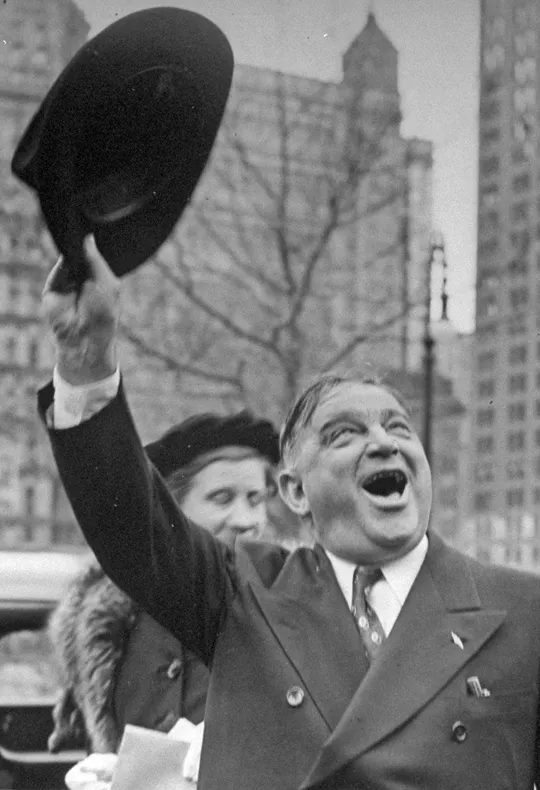
December 31, 1945, was Fiorello La Guardia's last day as Mayor of New York City (Figure 1.1). With him would end one of the most charismatic and prolific terms of office in the recent history of the city. For 12 years, his tenure had led a frenetic construction of new infrastructure, despite inheriting the debts of the Great Depression and a harsh economic repression during World War II. La Guardia carried out the incorporation of a new system of parks and gardens, children's play areas and outdoor swimming pools, transport networks, motorways, bridges and airports. These projects achieved a rapid and necessary modernization of the city, but in return, the quality of the projects was not commensurate with their quantity. Likewise, the enormous scale of these works devastated entire neighborhoods, displacing their populations to public housing blocks on the outskirts of the city.
Figure1.1Former Mayor Fiorello H. La Guardia, on his departure, on December 31, 1945. From the steps of the City Hall, where he has reigned for 12 years, he says goodbye to the workers.
(Allan Grant/The LIFE Images Collection/Getty Images)
This ambitious and, at the same time, controversial urban venture was fundamental not only for New York City but beyond. It was an example for other North American cities and a symbol of political and economic power abroad, an urban proposal backed by President Franklin D. Roosevelt as part of propagandizing the modernization of the country on the eve of an imminent Cold War. During this period, La Guardia's work was not easy. His former Commissioner of Planning and Transportation, Robert Moses, wrote of him: “Being Mayor of New York is an exacting if not a killing job.”1 And in this regard, Moses was not mistaken. An illness took La Guardia's life at only 64 years of age, only a few months after completing his term as Mayor. In September 1947, the death of La Guardia, without a clear successor, marked the end of an era. However, if this change of eras was possible, it was thanks to the successes and errors of La Guardia himself. La Guardia was a peculiar politician for the time. His own history was atypical. Born in New York, the son of European immigrants, from a very young age his life followed a multifarious course. Robert Moses described it this way: “His own birth and background, his early youth as a bandmaster's son on our Western frontier, his experience as an interpreter on the edge of the Balkans, his flying stunts in the south of Europe in World War I, his service in Congress representing a polyglot slum district, UNRRA, the upheavals, the prison camps and furnaces of World War II, the beginnings of the emancipation of colonial people, made him sensitive to such issues, but he was too shrewd, too honest, too basically cool, too calculating, too essentially American really to believe in his own occasional lapses into political claptrap.”2 La Guardia was thus a multi-faceted character, just like the city he led. His sensibility led him to make decisions that were unusual for a politician, since on the one hand, these measures brought advantages to the vast majority, while on the other, they were detrimental to many, including himself. A Mayor close to the people, honest and, above all, pragmatic. A Mayor who was unabashed when it came to admitting that he had never finished reading any book. Perhaps because of this, a man who was able to simplify an opaque, convoluted, and slow local bureaucracy. A Mayor who dodged a multitude of obstacles, capable of simplifying decision-making and mitigating an alarming level of political corruption.
Beginning with La Guardia, the city became modernized in every respect. His legacy promoted an irreversible change toward a collective infrastructure, toward a commitment to the common good. Robert Moses, for example, pursued a decades-long program of slum clearance, replacing entire neighborhoods with superblocks under the banner of urban renewal. Although this agenda is difficult to understand today, it fits neatly into a post-war exulting period. “The war united the disparate factions of this patchwork country, and we Americans are rewarded now, as we float in an ocean of shared assumptions and purpose, driven to produce and perfect. We rise as on a directed tide, each person's hope and joy intermingled with the next, every wave motion conspiring with the others, compounding force. The weaknesses and shame of the past are clear, and we strike as a nation toward a brighter future. America is no longer a flooded meadow but a joyous, virtuous, motivated mass.”3
This motto led La Guardia to envision a strong and united city, which was no longer anchored in the past. La Guardia's vision was no longer immersed in a nostalgic haze whose identifying feature was a silhouette of individualistic, monolithic and setback skyscrapers, the products of archaic local regulations, but a city of technological progress and connecting infrastructures, which completely changed the grain, scale and density of the grid. If the construction of the Manhattan grid was a 19th century enterprise, the mid-twentieth-century tells the story of a different city. A city which apparent unwavering grid starts to be eroded, altered and erased. Although prior to this, the plan of 1811 had suffered some major modifications by exceptions such as Central Park, the technology advances in the new century exacerbated the rigidity of the grid, as towers climbed higher and developers aimed to maximize their land values by building out of the edges of their properties. The municipal regulations in force were still those of 1916, a zoning that imposed outdated regulations on sunlight and ventilation, out of step with the new building technologies. This lack of coordination between theory and practice, together with the maximum exploitation of sites due to the exorbitant price of land, generated buildings that were accommodated to their surroundings based on the setback principle.
However, this setback principle contributed little or nothing to the quality of the open space of the street. From the 1930s through the middle of the century, under La Guardia's administration, large sections of the grid were replaced by tower-in-the-park housing projects. These housing superblocks started to increase the permeability into the orthogonal street system, and although the idea to introduce open space was valuable, its scale and monotony were not accurate. The oversize of these housing blocks proposals did not have the grid's walkable character. At the time that these housing blocks broke the mixed-use characteristic from the buildings of the traditional street wall. It was not until 1947 when the irruption of non-residential projects such as Lever House and later Seagram building brought the effectiveness of this logic into question. Both corporate headquarters avoided the imposition of the old zoning through a self-imposed restriction on the footprint of the tower built on the lot.4 Their designers were conditioned by an obsession with pure geometric forms and avoided unnecessary setbacks by sacrificing part of the exploitation of the private space. Until now, the predominant trend in Manhattan was to reassert the grid, but both of these projects bet for something else. The idea was obvious, they simply erected smaller towers. Both authors no longer considered a useful tool to modulate according to the set of rules of the past but instead to incorporate open space in their lots. Just as La Guardia did, these architects managed to expose an outdated bureaucracy.
The smaller size of the towers’ footprints had the advantage of achieving a more human scale, better lighting, ventilation, permeability and views. A way of designing based on the foundations of the Modern Movement. However, this formula was not new to Manhattan. Speculation and high land prices had quickly buried Rockefeller Center's important heritage. In 1938, Rockefeller, just ten years before Lever House, signaled a change. Instead of occupying the entire site with a massive skyscraper, its architect, Raymond Hood, proposed the division of the site into towers that had smaller footprints but were taller, and it became known as “a city of towers.”5 The magazine Architectural Forum highlighted how overnight New York had forgotten about the Rockefeller Center.6 Developers were willing to build on every square inch of the city by executing buildings typical of the pre-Rockefeller era. It was then that Lever and Seagram came up with a profound reflection on city making. The idea of not raising buildings on the entire plot made it possible to free up an important space for the public realm. This spatial mechanism created and strengthened collective space and had consequently a higher quality and a greater profitability from the resulting private space. In the publication Architectural Record, the architectural firm SOM—Skidmore Owings & Morris—that designed Lever House, pointed to this philosophy as the answer to the problems of the city.7
In the 1950s, an interesting period of inflection was initiated, characterized by looking to the collective from a more sophisticated approach, which resulted in the progressive revitalization of New York's urban space. This step forward was motivated by the post-war unification and instigated by two events. On the one hand, the overwhelming infrastructure promoted by the Moses-La Guardia tandem marked a departure of a different kind: a commitment toward public investment. On the other hand, the incipient advantages of a more interconnected city, with more fluid traffic and with better collective facilities, was an inducement for the establishment of a new typology of corporate headquarters, previously located outside the city. These new buildings, when it came to setting themselves apart, opted for visibility, quality and not quantity, and their spatial generosity set a precedent for a slow but irreversible change in urban policies and in the architectural conception of making a city.
However, it was not the change of the shape of the buildings on the block what was important in the middle of the century, but the pattern, scale and permeability that this architecture was up to create in the blocks itself. This incipient trend highlighted that the city couldn’t be only formed by individual buildings. Instead, the new additions of open space to the grid, beyond its streets, avenues and sidewalks, added to the original grid rather than subtracting from it. At the same time that the introduction of these new headquarters brought a new and not negligible tax revenue for the city to ease public investment. These new projects became effective examples in pointing out the poor consequences of an outdated high-and-wide construction ethos, which exacerbate the city's ground-level congestion, citywide shadows and cavernous street wall corridors as features of a city not desirable to live in. A critical approach, which grew under the influence of the pressing citizens’ demands and influenced a political position that was progressively more sensitive to the constant social, political and economic changes of this period. In New York, after La Guardia, the second half of the twentieth century was ready to begin.
Notes
Robert Moses, “La Guardia, a Salute—and a Memoir,” The New York Times, September 8, 1957.
Ibid.
Timothy Mennel, “Working for the People,” Places Journal, February 2010.
The municipal regulations of 1916 contemplated the possibility of buildings with towers of unlimited height if the tower's footprint occupied less than 25% of the lot.
Carol Willis, “Raymond Hood: City of Towers,” Conference at Whitney Museum of American Art, January 11, 1984.
“Miniature Skyscraper of Blue Glass and Metal Challenges Postwar Craze of Overbuilding City Lots,” Architectural Forum, 1952: 85–86.
“19 Stories Hold to One Fourth of Site to Achieve Light and Air for 280,000 sq ft Without Setback,” Architectural Records, 1952: 52.
2 Lever House and Seagram Plaza
DOI: 10.4324/9781003198543-3
Lever House and Seagram were pioneering projects, and as representatives of commercial corporations, they were located in the heart of Midtown in Manhattan, on Fourth Avenue or the so-called Park Avenue. Lever House at 390, and on the opposite corner, Seagram at 375. The two commercial headquarters, in addition to sharing a location, had the privileged status of a double corner on Park Avenue. This urban condition provided an opportunity for a certain visual awareness that the overcrowded grid did not normally afford. In addition to this, the generous width of the avenue, with spacious sidewalks and vast parterre of vegetation between the two directions of vehicular traffic, propitiated excellent views toward both sites. Park Avenue was one of the boulevards introduced in the 19th century with clear European antecedents. Its traditional public space echoed a traditional residential character to which, however, other mix-uses were progressively integrated. The arrival of these new headquarters on Park Avenue marked a point of transition from a traditional urbanscape to something else.
The 1916 regulations currently in force designated all buildings located north of 50th Street on Park Avenue for residential use. But in 1929, the owners of the buildings on the avenue succeeded in getting the regulators to approve a change from residential to commercial use between 50th and 59th streets, in the area known as Midtown. Despite this change, it was not until the post-World War II building boom that the real transformation of the avenue into a commercial street took place. This was made possible by the fact that rental prices for residences had plummeted after the recession of 1929. In the years following the war, and to avoid another market crash, a rent control system was imposed in which prices became obsolete. To prevent the latter from happening in the prestigious Park Avenue area, two options were considered. Either a building could be sold to the neighbors, who would form a cooperative—these cooperatives were built in the abandoned Park Avenue Upper West Side area. Or instead, the building could be demolished when possible, and others built for other uses. It is at this point that the real evolution of Park Avenue begins. A golden moment for the Modern Movement in architecture, which saw the construction of commercial headquarters during the 1950s: Lever House; Olin Building; 460 Park Avenue; the Colgate-Palmolive b...
Table of contents
Cover Page
Endorsements Page
Half-Title Page
Series Page
Title Page
Copyright Page
Dedication Page
Contents
Preface
Acknowledgments
Introduction: Privacy vs. publicness in an increasingly shared city
PART I Production: In the making of openness, incentive mechanisms and corporate capitalism
PART II Revitalization: Participatory processes and the critical engagement with recreational demands
PART III Commodification: Constituting identities and antagonistic encounters within the neoliberal city
Conclusions
Index
Trusted by 375,005 students
Access to over 1.5 million titles for a fair monthly price.
Study more efficiently using our study tools.
Frequently asked questions
Yes, you can cancel anytime from the Subscription tab in your account settings on the Perlego website. Your subscription will stay active until the end of your current billing period. Learn how to cancel your subscription
No, books cannot be downloaded as external files, such as PDFs, for use outside of Perlego. However, you can download books within the Perlego app for offline reading on mobile or tablet. Learn how to download books offline
Perlego offers two plans: Essential and Complete
Essential is ideal for learners and professionals who enjoy exploring a wide range of subjects. Access the Essential Library with 800,000+ trusted titles and best-sellers across business, personal growth, and the humanities. Includes unlimited reading time and Standard Read Aloud voice.
Complete: Perfect for advanced learners and researchers needing full, unrestricted access. Unlock 1.5M+ books across hundreds of subjects, including academic and specialized titles. The Complete Plan also includes advanced features like Premium Read Aloud and Research Assistant.
Both plans are available with monthly, semester, or annual billing cycles.
We are an online textbook subscription service, where you can get access to an entire online library for less than the price of a single book per month. With over 1.5 million books across 990+ topics, we’ve got you covered! Learn about our mission
Look out for the read-aloud symbol on your next book to see if you can listen to it. The read-aloud tool reads text aloud for you, highlighting the text as it is being read. You can pause it, speed it up and slow it down. Learn more about Read Aloud
Yes! You can use the Perlego app on both iOS and Android devices to read anytime, anywhere — even offline. Perfect for commutes or when you’re on the go. Please note we cannot support devices running on iOS 13 and Android 7 or earlier. Learn more about using the app
Yes, you can access Manhattan's Public Spaces by Ana Morcillo Pallarés in PDF and/or ePUB format, as well as other popular books in Architecture & Urban Planning & Landscaping. We have over 1.5 million books available in our catalogue for you to explore.